Last updated: May 6, 2026
In this article
- Deaf Cats Make Wonderful Adopters
- Why Cats Are Deaf
- Indoor Only — Always
- Visual Communication: The Cue System
- Getting Your Cat’s Attention
- Startle-Proofing
- Indoor Safety Setup
- Other Pets and Household Integration
- Daily Life and Long-Term Outlook
- Enrichment for Deaf Cats
- Common Mistakes to Avoid
- Frequently Asked Questions
Deaf Cats Make Wonderful Adopters
Adopting a deaf cat is much easier than people assume. Cats already rely on visual and scent information more than hearing, and a deaf cat in a stable indoor home behaves almost identically to a hearing cat from across the room. They watch you, they read body language, they read each other through scent and movement, and they bond as deeply as any cat. The setup work is mostly indoor safety, visual communication, and startle-proofing — the same things you’d do for a hearing cat, with a slight emphasis on visual signaling.
Deaf cats are passed over in shelters because adopters worry about life with a cat that “won’t come when called” or “won’t hear danger coming.” Both concerns are real but small with the right setup. This guide walks through everything you need to know in the first month.
Why Cats Are Deaf
Cats are deaf for several reasons. White cats with blue eyes have a high incidence of congenital deafness, often present from kittenhood; this is a well-known genetic association. White cats with one or two non-blue eyes can also be affected, particularly on the side with a blue eye. Senior cats often develop age-related hearing loss as part of normal aging. Chronic ear infections, ototoxic medications, or trauma can also cause deafness.
If your adopted cat is white and the rescue notes deafness, the cause is most likely congenital and the cat has been deaf since birth. They’ve adapted naturally and don’t experience deafness as a loss. If the cat is older with new hearing changes, expect adjustment to be more gradual and watch for other senior conditions — see our senior cat care checklist for the broader picture.
BAER testing can confirm hearing in cats just as in dogs, but most rescues observe the cat’s behavior rather than testing formally. For adoption setup, behavioral observation is sufficient.
Indoor Only — Always
This is the firmest rule in deaf cat adoption: deaf cats stay indoors. They cannot hear cars, predators, aggressive cats, or warning signals from the environment. The risks of outdoor life are higher than for hearing cats, and the consequences are often fatal. No exceptions.
If you want fresh air for your cat, build or buy a catio — an enclosed outdoor space attached to a window or door. A catio gives your cat sun, breeze, bird-watching, and stimulation without the dangers of free-roaming. Window perches with secure screens accomplish a smaller version of the same goal.
Walk-on-leash with a harness is occasionally workable for confident deaf cats but requires a quiet environment without dog encounters or sudden traffic. Most deaf cats prefer the catio option, and most adopters find it more relaxing too.
Visual Communication: The Cue System
Cats don’t sit, stay, and come on command the way dogs do, but they recognize visual signals when they’re consistent and tied to meaningful events. Build a small set of visual cues and use them every day:
- Treat hand: show a treat between thumb and finger, the cat learns to come to that visual
- Wave from the food bowl: a wave from the kitchen at dinner time becomes the “food’s ready” cue
- Open palm down: stop or no, used at the counter or off-limits area
- Pat the lap or sofa: invitation to come up
- Wiggle the wand toy: play time
You don’t need to teach these formally — they emerge naturally from daily routine. The cat watches what your hands do and pairs visual events with their consequences. Within a few weeks the cat reads the household’s visual vocabulary fluently.
Getting Your Cat’s Attention
The trickiest part of deaf cat life is getting their attention when their back is turned. A few options work well:
Floor stomps. A firm stomp on a wood floor sends vibration the cat feels. They turn to look. Use sparingly so it stays meaningful, and pair with a treat for the first few weeks.
Light flicks. A quick flick of a flashlight on the wall or floor catches the cat’s peripheral vision. A flick of the room light works similarly. Many adopters use a small LED on their keychain.
Walking into the cat’s visual field. The simplest option. Approach where the cat can see you rather than from behind, and contact happens calmly.
Vibration through furniture. A gentle thump on the couch the cat is sleeping on wakes them without startle. Better than a hand on the side.
Startle-Proofing
Deaf cats can be startled if approached or touched without warning. The cat doesn’t hear footsteps and doesn’t anticipate contact. A startled cat sometimes swats or bites before the brain catches up. Prevention is simple: don’t surprise a deaf cat from behind.
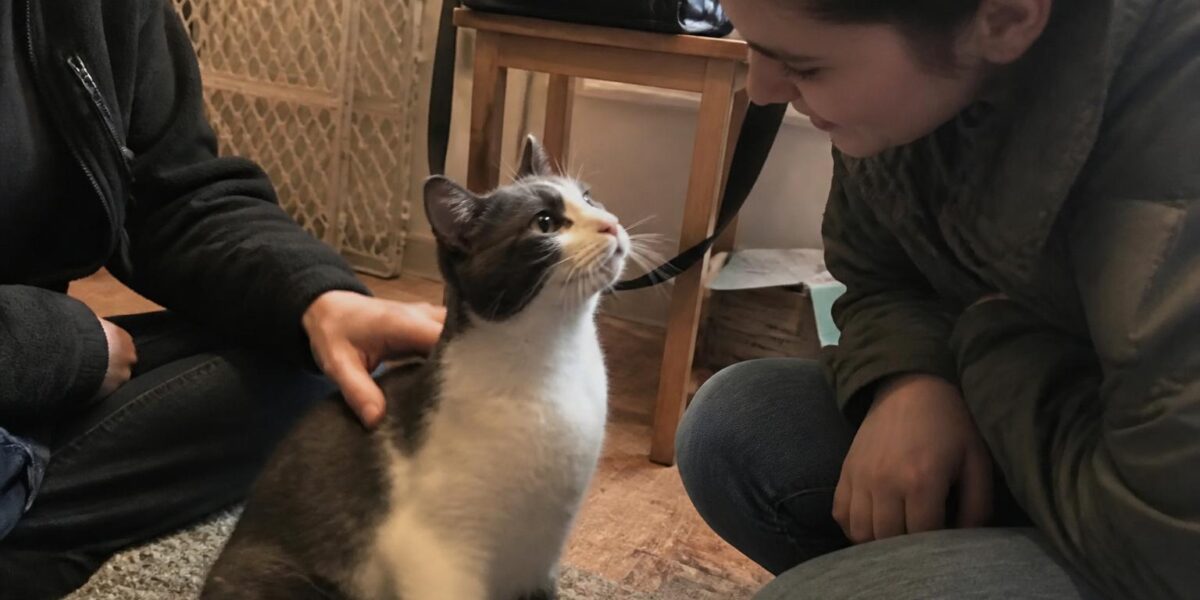
Walk where they can see you. Stomp once on the floor as you approach a sleeping cat. Brush their fur lightly with one finger at the shoulder before you reach for them. Pair every approach with a treat for the first month — the cat learns that contact predicts good things.
Coach kids carefully. Children love to surprise cats with a hug, and a deaf cat handles surprise hugs worse than a hearing one. Teach kids to walk where the cat can see them, kneel down, extend a hand for the cat to sniff, and wait for the cat to choose. Most cats reward this approach with affection. Our fearful cat guide covers more on slow trust-building if your deaf cat is also shy.
Indoor Safety Setup
Deaf cats can’t hear hazards inside the house either. Train yourself to look for the cat before:
- Closing doors (especially the front door, garage door, and refrigerator)
- Starting appliances they might be near (washing machine, dryer, dishwasher)
- Sitting on couches or beds where they may be tucked in blankets
- Using the vacuum (the vibration alerts hearing cats; deaf cats just see a giant approaching object)
A bell on every collar in the household — yours doesn’t need one, obviously, but if you have other pets, bells help your deaf cat track them through visual cue from the collar shake. Some deaf cats wear a small jingle collar themselves so you can locate them when you can’t see them; this is an aesthetic choice and many adopters skip it.
Microchip and a collar with an “I AM DEAF” tag are sensible in case the cat ever escapes. The tag tells anyone who finds the cat why they’re not responding to calls. Browse cats available for adoption for matches if you’re still selecting your cat.
Other Pets and Household Integration
Deaf cats integrate with hearing housemates well. The hearing cat or dog alerts to environmental events and the deaf cat learns to follow visual cues from the housemate’s behavior. Many multi-cat households report that their deaf cat reads the rest of the house through the other cat’s reactions.
Introductions follow standard cat protocol: scent swapping for the first week, brief visual contact through a barrier, supervised meetings, then full integration. Watch the deaf cat’s body language closely during introductions because they can’t hear the resident pet’s growls or hisses. Slow the integration if you see flat ears, tight whiskers, or tucked tail. See our adopting an adult cat guide for the full sequence.
Resident dogs need to be calm. A bouncy puppy who jumps from outside the visual field is harder for a deaf cat than a relaxed adult dog. Bell collars on resident dogs help only if the cat can see the collar — they don’t substitute for visual contact.
Daily Life and Long-Term Outlook
Deaf cats settle into daily routine quickly once the home is set up. They eat at the visual cue of the food bowl, they nap in their favorite spot, they play with feather wands and crinkle balls, they sit on your lap during evening television, and they live for many years in robust health. Most adopters report that within two to three months they’ve stopped thinking of the cat as “the deaf cat” and started thinking of them as just “the cat.”
For senior adopted cats with new hearing loss, watch for coexisting conditions like high blood pressure, kidney changes, or hyperthyroidism — these can come alongside hearing changes and benefit from early management. A baseline vet workup at the first visit catches what’s relevant. Hypertension in cats can also affect vision, so an ophthalmology check is worth requesting if there are any visual concerns.
The biggest message: deaf cats live happy normal lives. The accommodations are minor, the bond is real, and the cats themselves don’t experience deafness as a hardship. They’re cats with one channel offline, and the other channels carry them through life beautifully.
Enrichment for Deaf Cats
Deaf cats need the same enrichment as hearing cats but with a stronger emphasis on visual and tactile stimulation. Feather wands, crinkle balls, and treat puzzles all work well. Skip toys whose appeal is mostly auditory — squeaky mice and electronic noise-making toys offer less to a cat who can’t hear them.
Bird-watching from a window perch is a rich source of enrichment that doesn’t depend on hearing. A secure window perch with a view of a bird feeder gives many cats hours of daily stimulation. A catio expands the option safely. Indoor cat trees with multiple platforms encourage climbing and observation, both of which a deaf cat can do as well as any cat.
Schedule short play sessions twice a day. Five minutes with a wand toy in the morning and five minutes in the evening tires most cats out and reduces the kind of frustrated behavior that comes from boredom. Deaf cats engage with play just as enthusiastically as hearing ones; you just need toys that move visibly rather than make sound.
Common Mistakes to Avoid
The first mistake adopters make is letting the cat outside, even briefly. Deaf cats who slip through a door at the wrong moment can’t hear traffic, predators, or returning calls. The risk is far higher than for hearing cats and the consequences often fatal. Treat every door as a security checkpoint and use a baby gate or vestibule strategy if your home has a high-traffic entry.
The second mistake is approaching the cat from behind without warning. A deaf cat doesn’t hear footsteps and doesn’t anticipate touch. Even a gentle hand on the back becomes a startle. Walk where the cat can see you, stomp lightly on the floor to give vibration warning, or brush their fur with one finger before any larger contact. After a few weeks of consistent practice the cat is unflappable.
The third mistake is assuming a deaf cat needs another cat as a guide. Some appreciate a calm housemate; others prefer to be solo cats. Match by personality observed in the foster home rather than adding a second cat as a service strategy. A second cat who stresses the deaf cat creates more problem than they solve.
Frequently Asked Questions
Can deaf cats live happily indoors?
Yes. Indoors is the only safe option for deaf cats, and most settle into indoor life without difficulty. A catio adds outdoor enrichment safely.
How do I call my deaf cat for dinner?
Visual cues at the food bowl — a wave, opening the cat food container in the cat’s line of sight, or a floor stomp from the kitchen. Most cats catch on within a week.
Will my deaf cat startle and scratch me?
Possibly during week one. Startle-proof by always approaching where the cat can see you, gentle floor stomps before contact, and pairing approach with treats. Most cats become unflappable within the first month.
Should my deaf cat have a hearing companion?
Some deaf cats benefit from a calm hearing housemate; others prefer to be solo cats. Match by personality rather than as an automatic guide-companion strategy.
Are deaf cats more medically fragile?
No. Most are otherwise healthy. Senior adopted cats may have age-related conditions alongside hearing loss; a baseline workup at the first vet visit catches anything relevant.