Last updated: May 6, 2026
In this article
- Adopting a Deaf Dog Is Mostly Adopting a Visual Communicator
- Why a Dog Might Be Deaf
- Hand Signals: The Core Vocabulary
- The Attention Cue: Getting Your Dog to Look
- Startle-Proofing
- Outdoor Safety and the Off-Leash Question
- Other Pets and Household Integration
- Daily Routine and Communication
- Medical Care and Long-Term Outlook
- Common Mistakes to Avoid
- Frequently Asked Questions
Adopting a Deaf Dog Is Mostly Adopting a Visual Communicator
Adopting a deaf dog feels intimidating until you realize the work is mostly translation. Hearing dogs respond to verbal cues; deaf dogs respond to hand signals. Hearing dogs hear you call across the yard; deaf dogs feel a stomp through the ground or see your wave. Every behavior you’d train in a hearing dog has a deaf-dog equivalent that’s just as effective. Many trainers report deaf dogs are easier to train because they watch the handler more closely than hearing dogs do — facial expressions, posture, and hand movement carry weight that hearing dogs sometimes ignore.
Deaf dogs live full normal-length lives, bond hard with their humans, and integrate well into multi-pet households when introductions are done thoughtfully. The core skills are hand signals, a vibration-based attention cue, and startle-proofing for moments when the dog is approached without warning. This guide walks through the setup in order.
Why a Dog Might Be Deaf
Dogs are deaf for a few reasons. Congenital deafness is common in some breeds and color patterns — particularly piebald and merle coat patterns — and is usually present from birth. Age-related hearing loss develops in many senior dogs and is part of normal aging. Some dogs lose hearing from chronic ear infections, ototoxic medications, or injury. The cause sometimes affects what other care the dog needs (an old ear infection might need monitoring), but the day-to-day adoption setup is similar across causes.
If you’re adopting an older dog and the rescue mentions “may have hearing loss,” ask whether it was tested or inferred. A formal BAER hearing test confirms whether the dog has any residual hearing in either ear. Most adopted dogs are simply observed not to respond to sound, which is good enough for setting up the home but doesn’t tell you about partial hearing.
For senior dogs adopted with hearing loss alongside other conditions, our senior dog care checklist covers the broader picture.
Hand Signals: The Core Vocabulary
Pick a small set of hand signals and use them consistently. American Sign Language signs work; made-up signals work just as well as long as the household uses them identically. Here’s a starter set most adopters teach in the first month:
- Sit: open hand, palm up, raise from waist to chest height
- Down: open hand, palm down, lower from chest to waist
- Come: arm extended forward, sweep toward your chest
- Stay: open hand, palm forward, like a stop signal
- Good dog / yes marker: thumbs up or a quick smile-and-nod
- Watch me: two fingers tapping near your eyes
- Outside / potty: point to the door
Train each signal the same way you’d train a verbal cue. Lure the behavior with a treat, mark with the “good dog” signal at the moment it happens, deliver the treat. After ten to twenty repetitions, the signal alone produces the behavior. Add more signals over weeks two through four.
The Attention Cue: Getting Your Dog to Look
The hardest part of deaf dog training isn’t teaching new cues — it’s getting the dog’s attention in the first place when their head is turned. Hearing dogs hear their name; deaf dogs need a different attention signal. There are a few good options:
The check-in stomp. Stomp firmly on a wood or tile floor. The vibration travels through the floor and the dog feels it. Stomp once, wait for the head turn, mark with thumbs-up, treat. After a couple of weeks the stomp becomes a reliable “look at me.” Use it sparingly so it stays meaningful.
The vibrating collar (not a shock collar). A vibration-only training collar delivers a gentle buzz the dog feels around the neck. Train it as a positive attention cue: buzz, the dog looks at you, mark and treat. Many adopters report this becomes the equivalent of calling the dog’s name. Important: this is a vibration collar, never an aversive shock collar. The vibration is an attention cue, not a punishment. Read the product description carefully and avoid any device that includes shock function. If you’re uncertain, ask a fear-free certified trainer.
The flashlight or porch light. A quick flick of a flashlight on the ground in front of the dog or a flick of an outdoor porch light catches their visual attention from across a yard. Useful for nighttime recall or attention from a distance.
Startle-Proofing
A deaf dog can’t hear you approach. Touch from behind without warning startles them, and a startled dog sometimes snaps before the brain catches up to recognize the familiar hand. This is fear, not aggression, and it’s preventable.
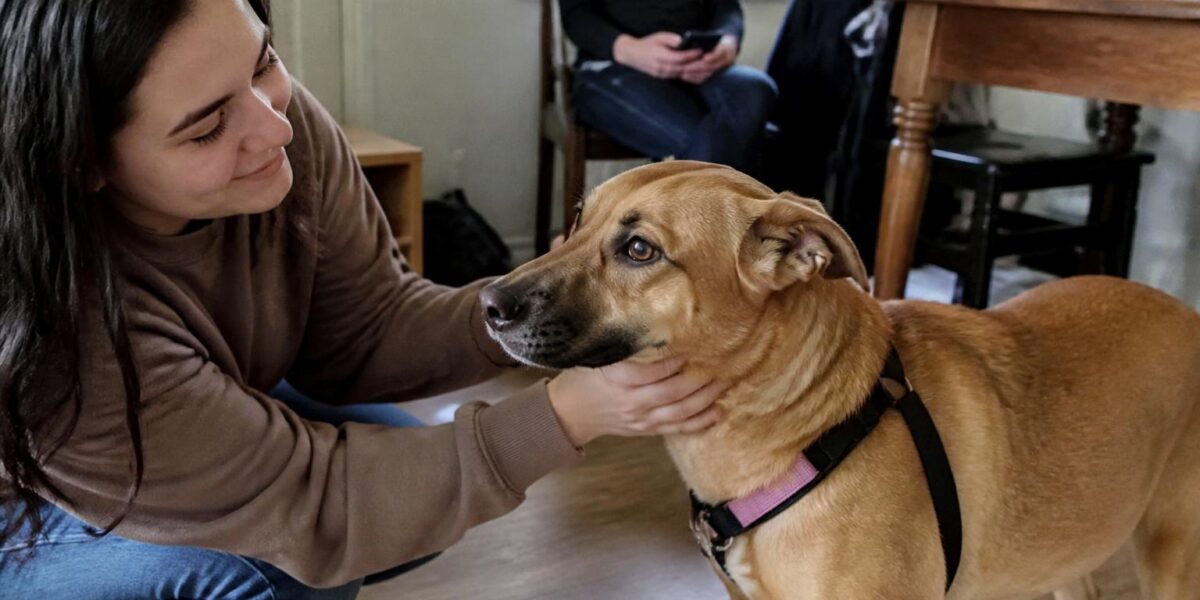
Always make your presence known before you touch. Walk where the dog can see you, stomp once on the floor as you approach, or brush their fur lightly with the back of your hand at the shoulder before you reach for them. Pair every approach with a treat for the first few weeks. The dog learns that touch from behind predicts a treat, not a surprise.
Coach kids and visitors carefully. Children especially want to hug and pet; teach them to wait until the dog looks at them, then approach. Most kids handle the rule well when it’s framed as “this is how you say hi to a deaf dog.” Browse our adoptable dogs for matches that fit your household’s energy and experience.
Outdoor Safety and the Off-Leash Question
Deaf dogs cannot hear you call from across a park. They can’t hear cars approaching from behind. They can’t hear another dog snarling. Off-leash freedom requires more thought than it does for a hearing dog.
Use a long line in unfenced areas. A 30-foot biothane lead attached to a harness gives the dog room to roam while keeping them safely connected. Many adopters never let their deaf dog off-leash in unfenced areas, and that’s a reasonable choice. A securely fenced backyard or a sniffspot rental gives off-leash time without the recall risk.
If your dog wears a vibration collar trained as a recall cue, off-leash recall in a fenced area is reliable. The buzz brings the dog’s attention to you and a hand wave or visible treat reinforces the recall. Build this skill in stages — first in a small fenced yard, then in a larger area, then in a distracting environment. Rushing skips the foundation.
Other Pets and Household Integration
Deaf dogs often integrate with hearing housemates well. The hearing dog or cat alerts to environmental events (doorbell, mail carrier, another animal in the yard) and the deaf dog learns to read their body language and follow their lead. Many adopters describe the hearing dog as the deaf dog’s “ears.”
Initial introductions follow the same protocol as any new dog: neutral ground, parallel walks, then come into the house together. Watch the deaf dog’s body language carefully — they read other dogs through visuals more than hearing dogs do, and a turning head or stiff posture from another dog reads loudly. Most introductions go well when the resident pet is calm and the deaf dog is given time to observe before contact.
Cats benefit from vertical escape routes and a chance to observe the new dog from a height. Bell collars on resident cats give the deaf dog visual cue from collar shake (if the dog can see the cat) but don’t replace visual contact. Our foster adoption guide covers slow integrations for sensitive multi-pet homes.
Daily Routine and Communication
Deaf dogs thrive on visual routine. Feeding times, walk times, and bedtime become predictable visual events — the moment you reach for the food container, the dog knows dinner is coming; the moment you grab the leash, walk time is here. Establish these patterns in the first month and the dog reads your house like a clock.
Use facial expression deliberately. A big smile and exaggerated nod mean “yes, well done.” A neutral or slight head shake means “not that one.” A stiff body and frown mean “stop.” Deaf dogs read facial expression more carefully than hearing dogs and respond accordingly.
Lighting matters. Make sure your dog can see you in every room they spend time in. Add a nightlight in the bedroom so they can see you wake up at night without startle. A small light in the hallway helps if you walk past a sleeping dog in the dark.
Medical Care and Long-Term Outlook
Schedule a baseline vet visit in the first week. Most adopted deaf dogs are otherwise healthy, but a workup catches anything that might be coexisting — particularly chronic ear infections (which need monitoring even in deaf ears) or any vestibular issues that affect balance. For congenital deafness in pigment-related forms, no specific treatment exists; the dog has been deaf since birth and adapts naturally.
For senior adopted dogs with age-related hearing loss, watch for other senior changes — cognitive shifts (see canine cognitive dysfunction), arthritis, vision changes. Hearing loss often comes alongside these and the care plan covers them together rather than separately.
Most deaf dogs live full normal-length lives, train well, bond hard, and don’t experience deafness as a hardship. Adopters consistently report that within two to three months they’ve forgotten their dog is deaf — the visual communication just becomes the household’s normal way of talking to the dog.
Common Mistakes to Avoid
The first mistake adopters make is buying a “training collar” that turns out to include a shock function. Read product descriptions carefully. The right tool is a vibration-only collar used as a positive attention cue. Aversive shock is inappropriate for any training and especially harmful for a deaf dog who relies on visual and tactile communication. If you’re not certain a product is vibration-only, don’t buy it.
The second mistake is inconsistent hand signals across household members. One person uses ASL signs, another uses made-up gestures, a third uses neither. The dog gets confused signals and responds to none reliably. Pick the signals, write them on a sticky note, and use them identically across the household for the first month.
The third mistake is failing to startle-proof. Adopters touch the dog from behind without warning, expect the dog to handle it like a hearing dog, and are surprised by a snap. The fix is simple and reliable: announce every approach with vibration, light contact at the shoulder, or visible presence. Practice for the first month and the startle response fades.
Frequently Asked Questions
Are deaf dogs harder to train?
No. Many trainers find them easier because they watch the handler closely. Visual cues replace verbal ones with the same effectiveness.
Is a vibrating collar the same as a shock collar?
No. A vibration collar delivers a gentle buzz used as a positive attention cue. Shock collars are aversive and inappropriate for any training, especially deaf dogs. Choose products that are vibration-only.
Can I let my deaf dog off-leash?
Only in fenced areas, or with a long line in unfenced ones. A trained vibration recall makes fenced off-leash time reliable; open off-leash carries higher risk than for hearing dogs.
Will my deaf dog bond with me normally?
Yes. Deaf dogs bond as deeply as hearing dogs. Many adopters describe the bond as more focused because the dog watches them more closely.
Should I worry about my deaf dog being startled?
Use the startle-proofing protocol — always announce your approach with vibration, light brushing, or visual presence. Most deaf dogs become unflappable within the first month with consistent practice.