
Two Greys, One Genus: Congo and Timneh
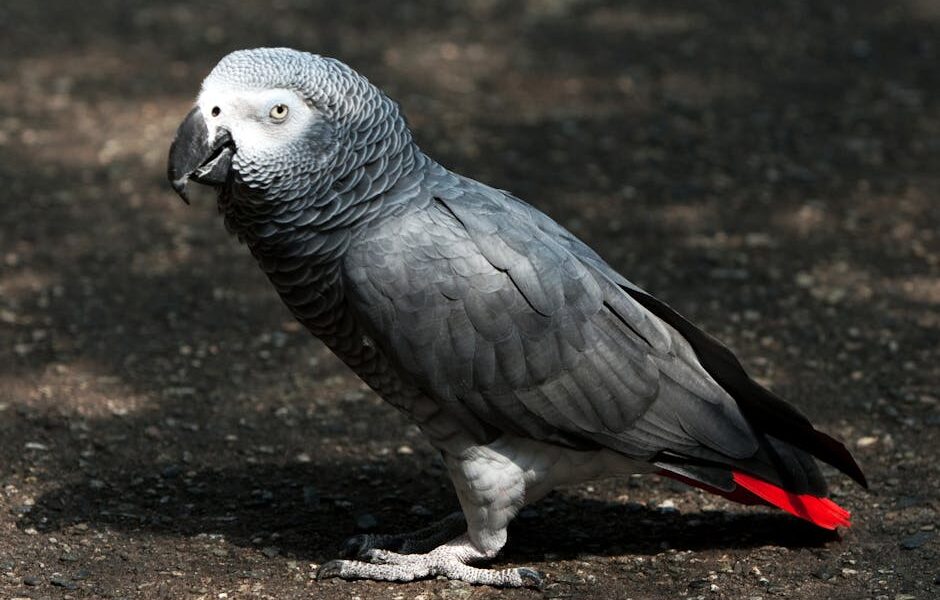
Responsible African grey care begins with knowing which African grey is sitting on your perch. The genus Psittacus contains two recognized species: the Congo African grey (Psittacus erithacus), an iconic gray-bodied parrot with a striking red tail, and the Timneh African grey (Psittacus timneh), a darker, smaller cousin with a maroon tail. Once treated as subspecies, the two were formally split by the International Ornithologists’ Union in 2012 based on plumage, vocalization, and range differences.
In this article
- Two Greys, One Genus: Congo and Timneh
- Congo African Grey: Size, Appearance, and Temperament
- Timneh African Grey: The Quieter Sibling
- Talking, Cognition, and Why Greys Are Different
- Diet, Calcium, and Vitamin A
- Cage, Out-of-Cage Time, and Environment
- Feather Plucking, Bonding, and Behavior Risk
- Adoption, Rescue, and Final Considerations
- Frequently Asked Questions
Both birds share the trait that made African greys famous: extraordinary cognitive ability. The late Alex, studied for three decades by Dr. Irene Pepperberg, demonstrated abstract concepts of category, number, same, and different. Both Congos and Timnehs match those cognitive feats in research and home settings — but they package the intelligence differently, and choosing between them deserves more thought than most adopters give it.
Both are CITES Appendix II species, listed as Endangered (Congo) and Vulnerable (Timneh) on the IUCN Red List, with international trade tightly restricted since 2016. Captive-bred birds dominate the pet trade in the United States and Europe, and a meaningful number of greys now circulate through rescue rather than breeder channels.
Congo African Grey: Size, Appearance, and Temperament
The Congo is the larger of the two, reaching about 13 inches from beak to tail tip and weighing roughly 400 to 550 grams as an adult. The body plumage is a soft scalloped gray, the face is bare white skin that can flush pink with excitement or stress, and the tail is a brilliant scarlet that fades to coral in feather-plucked birds. Eyes lighten from black in chicks to pale yellow in mature adults — a useful aging cue.
Congo temperament is famously sensitive. They bond intensely with one or two preferred people, dislike rough handling, and read household tension better than most owners realize. Loud arguments, new furniture in a familiar room, or even a haircut on the favorite person can trigger weeks of withdrawal or feather-damaging behavior. This is the species behind the stereotype of the “neurotic grey,” but the reality is closer to “exceptionally observant prey animal who responds badly to chaos.”
Lifespan in good husbandry is 50 to 65 years, with documented outliers above that. Estate planning is not optional for a Congo grey — see parrot lifespan estate planning and pet trust formation.
Timneh African Grey: The Quieter Sibling
Timnehs run about 10 to 11 inches and 275 to 375 grams — noticeably smaller than a Congo, closer to a large conure in body weight. Plumage is a deeper charcoal gray with a horn-colored upper mandible and a maroon (rather than scarlet) tail. They look at first glance like a juvenile Congo, but the size, beak color, and tail shade are diagnostic.
Behaviorally, Timnehs have a reputation among avian behaviorists and long-time keepers for being slightly less anxiety-prone, faster to acclimate to new surroundings, and a little more tolerant of household bustle. They are equally intelligent — Pepperberg’s later research extended to Timnehs and found comparable cognitive performance — but tend to express it with less neurotic edge. Speech development often starts a few months earlier than in Congos, although vocabulary tends to land in a similar range.
Lifespan averages 45 to 50 years, modestly shorter than Congos but still long enough that a 30-year-old adopter must think honestly about who inherits the bird.
Talking, Cognition, and Why Greys Are Different
African greys are widely considered the best-talking parrot species, with vocabularies routinely reaching 300 words or more in well-socialized birds. What sets them apart from Amazons and macaws is not raw vocabulary but contextual use: greys often request specific foods by name, refuse commands, label household members, and string short phrases together appropriate to the situation.
The flip side is that a grey who is bored, ignored, or unfocused will mimic microwave beeps, smoke alarms, the dog barking, and any phrase the household repeats with emotion. Owners frequently teach their grey to scream by reacting to mimicked alarms. Behavioral framing for unwanted vocalization is in parrot screaming management protocol, and a fuller per-species discussion of mimicry sits in parrot speech development and mimicry by species.
Cognitive enrichment is non-negotiable. A grey with nothing to forage, shred, or solve will start solving the cage — opening doors, dismantling clips, and eventually plucking. Foraging-style feeders, weekly toy rotation, and protected out-of-cage time are husbandry essentials.
Diet, Calcium, and Vitamin A
African greys are uniquely vulnerable to two diet-driven syndromes. The first is hypocalcemia, a low-blood-calcium condition that presents as seizures, tremors, and weakness, often in Congos between two and ten years old on long-term seed diets. The mechanism appears to involve both calcium intake and Vitamin D3 metabolism, which depends partly on UV exposure. Full workup, supplementation strategy, and prevention are covered in African grey hypocalcemia syndrome and management.
The second is Vitamin A deficiency, which in greys drives chronic sinusitis, oral plaques, and respiratory infections. Seed-based diets are essentially Vitamin A deserts; the fix is a pellet base plus orange and dark-leafy fresh vegetables. See avian vitamin A deficiency: seed diet consequences.
The practical diet for either grey is roughly 60 to 70 percent quality pellet (Harrison’s, Roudybush, TOP’s, Zupreem Natural, Lafeber), 20 to 30 percent fresh vegetables and small amounts of cooked grain or legume, and a small daily portion of nuts and seed as enrichment or training reward. Avoid avocado, chocolate, caffeine, alcohol, onion, garlic, fruit pits, mushroom, raw bean, and excessive salt.
Cage, Out-of-Cage Time, and Environment
The minimum cage for either species is about 36 by 24 by 36 inches with three-quarter-inch bar spacing, but bigger is meaningfully better — a flight cage of 40 by 30 by 40 inches gives a grey real freedom of movement. Place the cage against a wall, at human chest to eye height, in a room with regular family activity but not the kitchen. Per-species sizing details are in parrot cage setup by species.
Greys need three to four hours of out-of-cage time daily in a bird-proofed environment, with windows covered and ceiling fans off. Most thrive with a play stand near the family’s main living area so they can observe without being on you constantly. Background on flight versus clipping decisions is in parrot wing clipping debate.
One under-discussed environmental factor is full-spectrum lighting. Many avian veterinarians recommend a UVB-emitting bird-safe bulb for 6 to 8 hours daily, particularly for greys at risk of hypocalcemia. Place the lamp 12 to 18 inches from the bird, change bulbs on the manufacturer’s schedule (UVB output decays before the bulb stops emitting visible light), and never substitute a tanning or reptile lamp without veterinary input.
Feather Plucking, Bonding, and Behavior Risk
African greys, particularly Congos, sit at the top of the parrot feather-damaging-behavior risk list. Triggers include sudden household change, loss of a flockmate, sleep disruption, low humidity, undiagnosed medical disease, and chronic boredom. A grey that begins plucking needs a workup, not a behaviorist consult alone — medical causes (giardia, heavy-metal exposure, low calcium, low Vitamin A, dermatologic infection) must be ruled out before the case is treated as behavioral. The full sequencing is in parrot feather plucking medical rule-out protocol.
Single-person bonding is a known trait. A grey will often choose one human and tolerate or actively reject the rest. This is workable in a single-person household and stressful in a busy family. Spreading caregiving across two adults from the first weeks of acquisition reduces, but does not eliminate, single-bonding behavior.
Adoption, Rescue, and Final Considerations
African greys are among the most commonly surrendered large parrots in the United States and United Kingdom. The reasons are predictable: lifespan outliving owner plans, noise, biting onset around sexual maturity, plucking, and divorce or illness in the household. Rescue greys are often medically and behaviorally complex but can be deeply rewarding adoptions for prepared owners. Network details are in parrot rescue and sanctuary network overview, and the candid framing of why so many large parrots end up rehomed is in why large parrots end up in rescue.
An African grey is not a starter parrot. Most avian behaviorists steer first-time bird owners toward a budgie, cockatiel, conure, or Pionus before considering a grey. If you are committed, plan for a 40-to-60-year relationship, a five-figure lifetime cost, and a bird who will read your moods better than you do.
Frequently Asked Questions
Which is better, Congo or Timneh?
Neither is better — they suit different households. Timnehs tend to be less anxiety-prone and acclimate faster, which suits first-time grey owners or busier households. Congos are larger, often more visually striking, and bond very deeply but require a calmer environment.
Why do African greys pluck so often?
Greys are intensely observant and sensitive to environmental and household stressors. Plucking can be triggered by sleep disruption, low humidity, dietary deficiency (calcium, Vitamin A), giardia, heavy-metal exposure, or psychological boredom. Plucking always warrants a full medical workup before being labeled behavioral.
How quickly will my grey start talking?
Most Timnehs begin mimicking sounds between 6 and 12 months; Congos often start a few months later. Clear contextual speech usually emerges between 12 and 24 months in well-socialized birds, but quiet greys are common and not abnormal.
Do African greys need a companion bird?
Not necessarily. Greys do not pair-bond strongly with same-species cage mates the way budgies or cockatiels do. A single grey with attentive human flock contact and good enrichment thrives. Forced cohabitation with another grey can backfire and is not generally recommended without expert guidance.
What is the realistic lifetime cost of a grey?
Initial setup (cage, perches, toys, vet exam, bird) typically lands between 2,000 and 3,500 dollars. Ongoing annual costs (food, replacement toys, vet care, insurance) run 800 to 2,000 dollars or more, before any major medical event. Over a 50-year lifespan, lifetime costs in the tens of thousands are realistic — and the bird may outlive you.


