
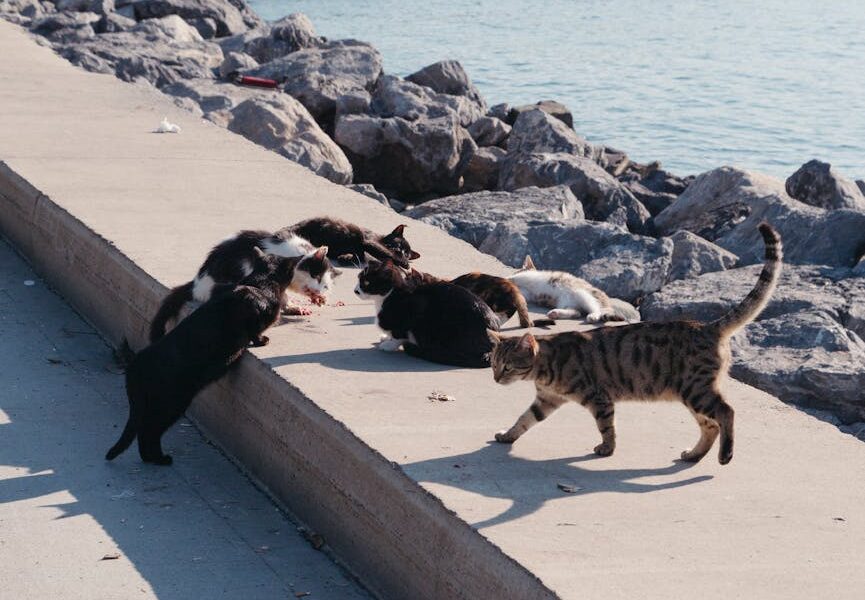
Why These Distinctions Matter for Welfare
Outdoor cats are not one population, and treating them as if they were produces welfare failures in every direction. A lost pet cat needs to be scanned for a microchip and reunited with her family. A truly feral adult cat brought into a shelter for indoor adoption almost always becomes a fearful, miserable cat (or a returned, recycled cat) — and there is a much better outcome available. A community cat ear-tipped by a TNR program is not abandoned; she is part of a managed colony with a caretaker and a known status. Knowing which population an outdoor cat belongs to is the welfare-critical first step in deciding the right intervention. See our Alley Cat Allies and TNR advocacy overview. Alley Cat Allies (alleycat.org), the US national community-cat advocacy organization, is the definitive authority on this framework and is referenced throughout this article.
In this article
- Why These Distinctions Matter for Welfare
- Stray: The Socialized Outdoor Cat
- Feral: The Unsocialized Cat
- Community Cat: The Managed Colony Cat
- TNR: Trap-Neuter-Return Framework
- Why TNR Works: The Vacuum Effect
- Why Trap-and-Relocate Fails
- Why Trap-and-Euthanize Fails
- For Adopters: What to Do When You Find an Outdoor Cat
- Caretaker Welfare: Supporting Community Cat Colonies
- Frequently Asked Questions
Stray: The Socialized Outdoor Cat
A stray cat is a former pet — socialized to humans, often friendly or at least tolerant, and outdoors involuntarily. She may have escaped, been lost, been moved during a household transition, or been abandoned. The welfare-positive intervention is to attempt reunification or rehoming. Practical steps include having the cat scanned for a microchip at any veterinary clinic or shelter (see our cat microchip overview), posting on lost-pet networks (Pawboost, Nextdoor, local Facebook groups), checking with local animal control for missing-pet reports, and posting in the neighborhood where the cat was found. Strays who cannot be reunited with an owner are excellent candidates for adoption, often transitioning smoothly back to indoor life because they were previously socialized.
Feral: The Unsocialized Cat
A feral cat is genetically a domestic cat but has not been socialized to humans during the critical kitten socialization window. Adult ferals respond to human approach with fear, flight, or defensive aggression. They do not want to live in a home environment. Forced indoor adoption of an adult feral cat typically produces a stressed, hidden, sometimes overgrooming or anorectic cat who is suffering — not the welfare-positive outcome the well-meaning rescuer envisioned. The welfare-positive intervention for adult ferals is TNR (trap, neuter, return) plus colony management with a caretaker. See our formerly feral cat rescues overview. Feral kittens trapped before approximately 8-12 weeks of age often socialize beautifully and can become indoor pets; older feral kittens have a closing window and may do better as TNR colony cats.
Community Cat: The Managed Colony Cat
A community cat is a TNR-managed outdoor cat. She is ear-tipped (the universal signal: the tip of the left ear is surgically removed during the neuter procedure under anesthesia, producing a permanent visible mark) and is part of a managed colony. A caretaker provides daily food, monitors for illness, and arranges veterinary care as needed. Community cats may be feral by socialization or simply outdoor-living cats; the defining feature is the managed-colony status and TNR completion. Seeing an ear-tipped cat is important information: it means the cat has been sterilized, vaccinated against rabies and often FVRCP, and has a caretaker network. Removing an ear-tipped cat from her territory is welfare-negative; she has a home and a community, just not in a traditional sense.
TNR: Trap-Neuter-Return Framework
TNR is the welfare-positive management approach for outdoor cat populations. The protocol: humanely trap the cat using a baited live trap, transport to a participating veterinary clinic for spay or neuter under anesthesia, vaccinate against rabies and typically FVRCP, ear-tip during the procedure, recover briefly, and return the cat to her territory. Caretakers then continue food provision and monitoring. Most TNR clinics charge $50-150 per cat for the surgery package, often subsidized by partner organizations. See our cat-only rescues overview for partner-organization context. Alley Cat Allies maintains directories of TNR-aware clinics and provides training for new caretakers. The model is now operationally mature, with hundreds of cities and counties in the US having formal TNR programs.
Why TNR Works: The Vacuum Effect
The welfare-and-population case for TNR rests on what is sometimes called the vacuum effect. Cats are territorial: a colony in a stable territory excludes new cats from settling there. If the colony is removed — trapped and euthanized, for example — the territory becomes available, and new cats migrate in to fill it. Removing the colony does not eliminate the cat population at that site; it merely cycles the population and reduces welfare for the new arrivals (who are not sterilized, vaccinated, or monitored). TNR breaks the reproductive cycle within the existing stable colony. Over years, with sustained effort, the colony shrinks through natural attrition without ever creating a vacuum for new cats to fill. Multi-year studies, including work by Julie Levy and colleagues, document substantial population decline in TNR-managed colonies over time.
Why Trap-and-Relocate Fails
Trap-and-relocate — moving a colony to a new location, often a barn or rural property — sounds humane on its face but has poor outcomes in practice. Cats are strongly territory-bonded. Relocated cats frequently attempt to return to their original territory and die in the attempt (highway, predation, dehydration, starvation). Cats who survive at the new location often disperse or fail to thrive. The relocation produces high mortality among the relocated cats and leaves the original territory open to colonization by new unsterilized cats. Alley Cat Allies and most credentialed welfare organizations recommend relocation only in narrow circumstances where the original territory is genuinely uninhabitable (active demolition, hostile property owner threatening lethal force) and only with extensive acclimation protocols at the new site.
Why Trap-and-Euthanize Fails
Trap-and-euthanize as a population-control strategy fails for two reasons: the vacuum effect (described above) means removed cats are replaced by new unsterilized cats migrating in, and the ethical case against routinely euthanizing healthy cats is opposed by most modern welfare organizations including AVMA, HSUS, ASPCA, and Alley Cat Allies. See our AVMA animal welfare position statements roundup. Decades of trap-and-euthanize programs in US municipalities failed to reduce outdoor cat populations even when implemented aggressively. The model is increasingly recognized as both inhumane and ineffective. Modern municipal animal control increasingly partners with TNR organizations rather than competing with them.
For Adopters: What to Do When You Find an Outdoor Cat
When you encounter an outdoor cat, the welfare-positive sequence is to assess which population she belongs to. Is she ear-tipped? If yes, she is a community cat with a caretaker; observe and leave her unless she is visibly ill or injured. Is she socialized — approaching humans, allowing handling, well-groomed? If yes, she is likely a stray; scan for microchip, post lost-pet, and proceed toward reunion or adoption. Is she fearful, fleeing, but otherwise apparently healthy and adult? She is likely feral; if there is no caretaker, consider contacting a local TNR organization to humanely trap, sterilize, vaccinate, and return her. Kittens under approximately twelve weeks can usually be socialized — see our first 30 days feral cat adoption guide; older kittens and adults are best served by TNR.
Caretaker Welfare: Supporting Community Cat Colonies
Community cat caretakers are an unsung welfare-positive workforce. They provide daily food and water, monitor for illness or injury, arrange veterinary care for sick or injured colony cats, perform TNR for new arrivals, and advocate within their communities for humane management. Becoming a caretaker is welfare-positive and can be coordinated through local TNR organizations or Alley Cat Allies’ caretaker resources. Local colony-cat regulation varies — some municipalities have ordinances supporting managed colonies, others restrict outdoor feeding, others are silent. Caretakers benefit from knowing the local legal status and from working with TNR partner organizations that handle the legal and logistical layer.
Frequently Asked Questions
How do I tell if a cat is feral, community, or stray?
Check for an ear-tip first (community cat with a caretaker). Then assess socialization: an approachable, well-groomed cat is likely a stray former pet; a fearful, flighty adult is likely feral. Kittens under twelve weeks can usually be socialized regardless.
Should I take a feral cat to a shelter?
Generally no. Adult ferals do poorly in shelter environments and indoor adoption rarely produces welfare-positive outcomes. The better path is contacting a local TNR organization or Alley Cat Allies for trap-neuter-return. Feral kittens are different and often adoptable with foster intervention.
What does an ear-tip mean?
An ear-tipped cat (left ear tip surgically removed during anesthesia for spay or neuter) is a TNR-managed community cat. She is sterilized, vaccinated, and has a caretaker. Leave her in her territory unless she is visibly ill or injured.
Why is trap-and-relocate considered welfare-negative?
Relocated cats often attempt to return to their original territory and die in the attempt. Cats are strongly territory-bonded. Alley Cat Allies and most welfare organizations recommend relocation only in narrow circumstances with extensive acclimation protocols.
Where can I find local TNR resources?
Alley Cat Allies (alleycat.org) maintains a national directory of TNR-aware clinics and organizations. Local cat-only rescues and AAFP-credentialed clinics often partner with TNR groups. Municipal animal control increasingly partners with TNR rather than competing with it.


