
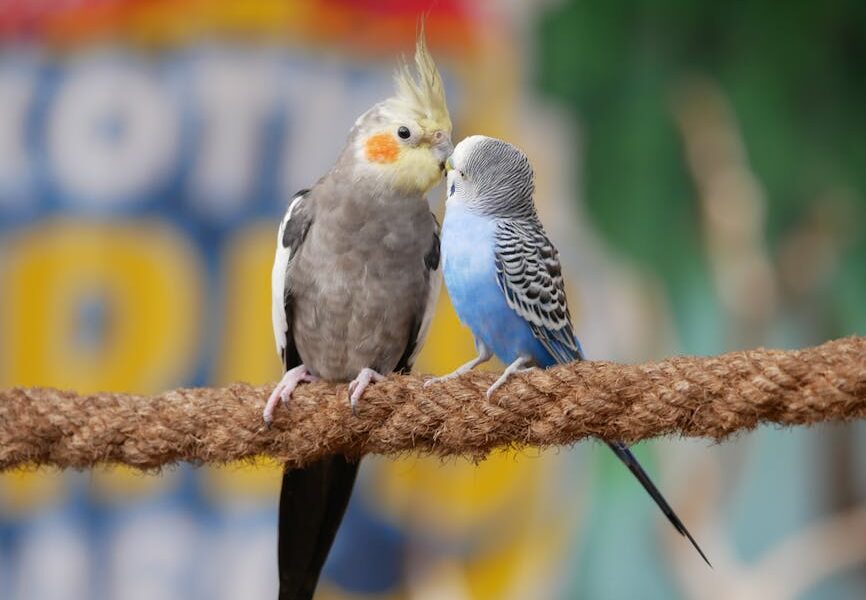
How to Read This First Bird Comparison
A good first bird comparison should focus on the things that actually matter when a bird moves into your home — noise tolerance, cage footprint, lifespan, bite risk, child-friendliness, and what kind of relationship you can realistically expect. Color and “cuteness” are real factors, but they fade in the first month. The four species covered here — budgerigar (budgie), cockatiel, lovebird, and parrotlet — are the most common entry-level pet parrots in the US and Singapore.
In this article
- How to Read This First Bird Comparison
- Noise Level
- Cage Footprint
- Talking Ability
- Lifespan
- Bite Risk
- Child-Friendliness
- Single Bird vs Pair
- Care Difficulty and Mess Factor
- The Three-Question Decision Filter
- Go Deeper on Your Pick
- Vet Care and Adoption Pathways
- Cost of Ownership Reality Check
- What If You Get the Wrong Bird?
- Frequently Asked Questions
None of them is objectively “best.” Each fits a different household. This guide compares them head-to-head across the categories that should drive your choice, and links to the species deep-dives for the bird you ultimately pick.
Note that “first bird” does not mean “low maintenance.” All four species need pellet-based diets, daily out-of-cage time, an annual avian vet exam, and 5 to 25 years of commitment. The umbrella adoption comparison broader than these four is at bird species comparison for adoption.
Noise Level
Sort order from quietest to loudest in routine daily volume: parrotlet ≤ budgie < cockatiel < lovebird.
Parrotlets and budgies are the most apartment-friendly. Parrotlets chirp softly; budgies chatter constantly at conversational volume but rarely scream. Cockatiels are moderate — they whistle and contact-call, and a flock of three or more can fill a room with sound, but a single bird is manageable for any but the thinnest-walled apartments. Lovebirds are the loudest of the four, especially Fischer’s and peach-faced, with piercing contact calls that can be jarring at close range.
If you live in an apartment with shared walls, prioritize parrotlet or budgie. If noise is a complete non-issue, any species works.
Cage Footprint
Minimum recommended cage sizes (per single bird) — bigger is always better, especially with horizontal flight space:
- Budgie: 18 by 18 by 18 inches absolute minimum, 30 by 18 by 18 preferred.
- Cockatiel: 24 by 24 by 24 inches minimum, 30 by 24 by 30 preferred.
- Lovebird: 24 by 18 by 24 inches minimum, 32 by 20 by 24 preferred.
- Parrotlet: 24 by 18 by 24 inches minimum despite their size; flight space matters more than bird size.
The smallest footprint goes to the budgie. The biggest visual cage is the cockatiel because of its larger total volume. Bar spacing should be half an inch or less for all four. The umbrella reference is bird cage sizing and bar spacing by species.
Talking Ability
Sort order from best-talking to least: budgie > cockatiel > parrotlet >> lovebird.
Surprised? Most people are. Male budgies are the most reliable talkers of the four species, with documented vocabularies running into the hundreds of words. Their voices are small and tinny but the volume of speech is impressive. Cockatiel males talk and whistle reliably, with clearer enunciation than budgies but smaller vocabularies. Parrotlets occasionally pick up 10 to 30 words. Lovebirds rarely talk meaningfully.
If talking is your priority, choose a budgie or a cockatiel — and a male, kept singly, with consistent verbal interaction.
Lifespan
Approximate lifespans with proper husbandry:
- Budgie: 7 to 10 years (occasionally 12+).
- Cockatiel: 15 to 25 years.
- Lovebird: 10 to 15 years.
- Parrotlet: 15 to 20 years.
The budgie is by far the shortest commitment, which is meaningful for households new to bird keeping or unsure about long-term plans. The cockatiel is the longest commitment of the four — a 20-year cockatiel is not unusual. Apply that against your own life stage. The umbrella reality-check on parrot lifespan is at bird species lifespan reality check.
Bite Risk
Sort order from least likely to bite hard to most: cockatiel < budgie < lovebird < parrotlet.
Cockatiels are gentle bird-side bird — they may pinch when stressed but rarely break skin. Budgies bite occasionally but their bite force is small. Lovebirds bite hard during hormonal phases and can break skin. Parrotlets have the highest bite force relative to body weight of the four species, and they bite with the confidence of a much larger bird.
For households with very young children or many visitors, the cockatiel is the safest first-bird choice. The bite-management framework that applies to all four is at parrot biting management protocol.
Child-Friendliness
This is mostly a function of bite risk plus how well the bird tolerates the unpredictable movement of small humans. From best to worst with children under 10:
- Cockatiel: best of the four; gentle, slow-moving, and tolerant of soft handling.
- Budgie: good, especially as a paired flock that lives mostly in its cage with occasional shoulder visits.
- Lovebird: only with older, calm children; bites can scare a child.
- Parrotlet: poor; the parrotlet’s one-person bonding and confident bite make them a bad mix with young children.
Single Bird vs Pair
All four species can live happily alone with enough daily human contact, but their tolerance for solitude varies. Budgies and lovebirds are flock species and feel the absence of companions most strongly — a budgie alone in a cage all day is a stressed budgie. Cockatiels tolerate solitude better and bond intensely to humans. Parrotlets are the most independent of the four and frequently make excellent solo pets.
Pairs are the opposite story. Two budgies are easy. Two cockatiels are easy if same-sex or carefully introduced. Two lovebirds need careful pairing and may bond to each other rather than to you. Two parrotlets often fight, sometimes fatally — they are the least pair-tolerant of the four.
Care Difficulty and Mess Factor
All four species need pellet-based diets (60 to 70 percent pellets plus fresh vegetables, with seeds as a limited supplement). Diet conversion from pet-store seed mixes takes 14 to 30+ days — the protocol is at parrot pellet conversion, and the fresh-food rotation framework is at parrot chop fresh food diet.
Mess: cockatiels are dusty (they produce powder down like other cockatoos), which is a meaningful factor in dust-sensitive households. Budgies, lovebirds, and parrotlets produce far less dust. All four shed seed hulls and pellet crumbs onto the cage floor and into surrounding furniture; a cage skirt and a daily five-minute sweep is realistic maintenance.
All four species require complete avoidance of PTFE-coated cookware, scented candles, plug-in air fresheners, aerosol sprays, and cigarette/cannabis/incense smoke. The household hazards umbrella is at bird-safe household: Teflon, candles, fumes.
The Three-Question Decision Filter
If you want a quick decision rule:
- Apartment with thin walls? → Budgie or parrotlet (skip lovebird).
- Children under 10 in the home? → Cockatiel (skip parrotlet).
- Want a talking bird? → Male budgie kept singly, or male cockatiel.
If two of these are true at once — apartment with children — a budgie is the safest universal pick.
Go Deeper on Your Pick
Once you have a leaning, read the species-specific deep dive: budgie parakeet care, cockatiel care and personality, lovebird species comparison, or parrotlet care. Each covers cage, diet, behavior, and species-specific quirks in detail.
Hormones and Sleep: A Universal Challenge
All four species are strongly photoperiod-driven. Long daylight hours (more than 12 hours) signal “breeding season” and trigger hormonal cycling in both sexes. This shows up as cage defense aggression, egg laying in hens, increased biting, regurgitation onto toys or favorite humans, and shredding of paper or fabric into nest-like piles.
The universal protocol across all four species: reduce daylight to 10 to 12 hours during fall and winter, remove nest-like cavities and shredded paper hoards, avoid back-petting and below-the-neck handling, and provide a quiet dark sleep area separate from the busy household if practical. The detailed framework is at parrot hormonal behavior.
Sleep deprivation drives more behavior problems in pet birds than most owners realize. A bird kept in a living room with late-night TV, ambient light, and people moving around may technically have a “covered cage” but rarely gets the 10 to 12 hours of solid quiet sleep its biology requires. The result is irritability, screaming, and feather damaging behavior that owners often blame on temperament rather than husbandry.
Vet Care and Adoption Pathways
All four species need annual avian veterinary wellness exams. Find a vet before you need one — the directory guide is at finding an avian-certified veterinarian. New-bird exams in the first 30 days catch the most common pet-store-origin issues — giardia, megabacteria (avian gastric yeast), mites, and respiratory infections — when they are still treatable.
Adoption from a rescue is generally a better starting point than buying from a pet store. Rescues typically have adult tame birds of all four species available for small fees, surrendered with honest history and often already eating pellets. The umbrella context on rescue parrot intake and rehabilitation is at adopting a rescued parrot.
Cost of Ownership Reality Check
“Small bird” does not mean “cheap bird.” Realistic first-year costs for any of these four species include the cage and stand ($150-400), initial vet exam and basic diagnostics ($150-300), pellets and fresh food ($25-50/month), toy rotation ($20-40/month, more for active chewers), and any unexpected medical visit ($150-600 per incident). Annual cost after the first year typically runs $700 to $1,500 depending on species, vet costs in your area, and how often the bird needs medical attention.
Over a 15 to 25 year cockatiel lifespan, that adds up to $15,000 to $35,000+ in cumulative costs. Budgies are slightly cheaper because of shorter lifespans, but the per-year math is similar. None of these species is a “set it and forget it” pet, and none of them is realistically cheaper than a small dog over the long run.
What If You Get the Wrong Bird?
It happens. Many first-bird owners discover after six months that the species they chose does not fit their household — the parrotlet they hand-tamed is biting the children, the lovebird they thought would be friendly is shrieking eight hours a day, the budgie they bought singly is depressed and self-mutilating. Rehoming a bird is not a moral failure; it is the right move when the fit is genuinely wrong.
Reputable bird rescues will help with surrenders. They prefer surrenders to euthanasia or release-to-the-wild outcomes, and they often have waiting lists of approved adopters. If you find yourself with the wrong bird, contact your nearest bird rescue first; pet store “buyback” programs rarely place birds well.
Frequently Asked Questions
Which of these is the easiest first bird?
For most households, the budgie. Short-to-moderate lifespan, small cage footprint, low bite risk, decent talking potential, and easy to find in rescues.
Which lives the longest?
The cockatiel, at 15 to 25 years. That length of commitment should be weighed seriously by anyone undergoing life changes.
Are any of these “low maintenance”?
None. All four need daily attention, pellet-based diets, annual vet care, and bird-safe households. The lowest day-to-day demand is the parrotlet because of its independence, but its bite intensity offsets that for many households.
What if I’m allergic to dust?
Avoid the cockatiel. Budgies, lovebirds, and parrotlets produce much less powder down.
Can I get a bird from a rescue instead of a pet store?
Strongly recommended. Rescues frequently have adult tame budgies, cockatiels, and occasionally lovebirds available for a small adoption fee — and they typically come already on pellets, vet-checked, and surrendered with honest history. Background at adopting a rescued parrot.


