
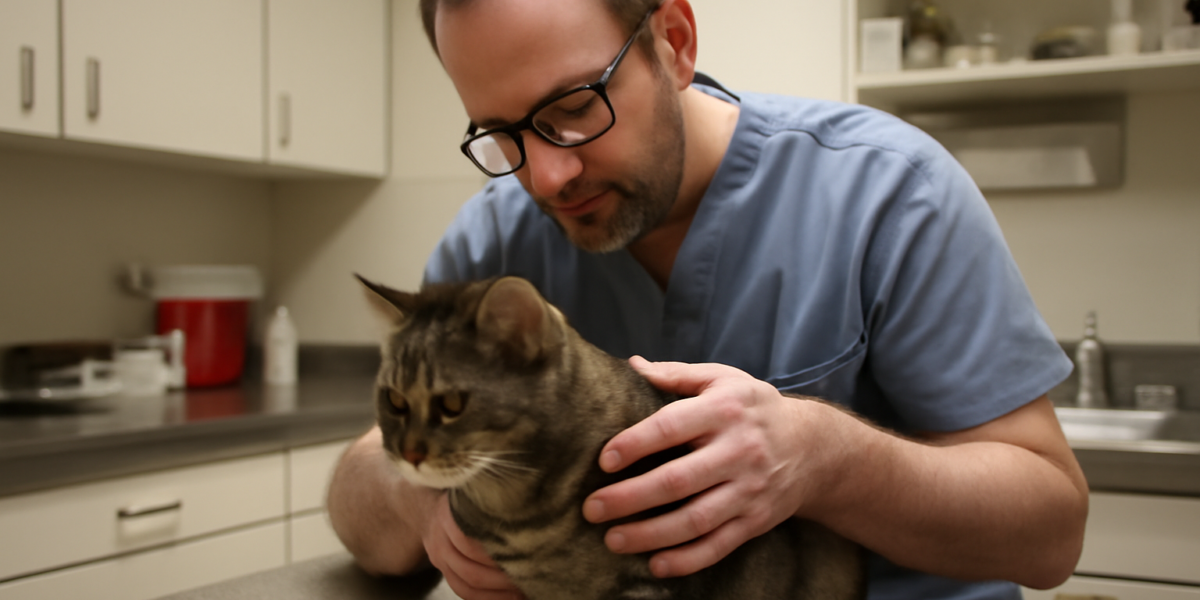
What Neuter Recovery for Cats Looks Like
Neuter recovery for cats is the fastest of the four standard spay/neuter procedures. The surgery is short — often under fifteen minutes — and the two small scrotal incisions usually heal without sutures, left open to drain naturally. Most cats are eating, drinking, and acting close to normal within twenty-four to forty-eight hours.
In this article
- What Neuter Recovery for Cats Looks Like
- Pickup Day and the First Evening
- The Cone Question
- Litter Box Adjustments
- Activity Restriction
- Pain Management for Cats
- Days 1 to 2: Quick Initial Recovery
- Days 3 to 7: Healing and Restriction
- Behavior Changes Over Weeks
- Warning Signs That Need a Vet Call
- Multi-Cat Households
- Frequently Asked Questions
That speed is no excuse to skip post-op care. The cone (or a workable alternative), litter swap, restricted activity for the first week, and incision monitoring all matter. The behavior changes that come from removing testosterone — reduced spraying, fighting, roaming — happen on a longer timeline of weeks rather than days.
This guide walks through the realistic neuter recovery cats need, what to expect at each stage, and the warning signs that warrant a vet call.
Pickup Day and the First Evening
Bring your cat home in a carrier — never loose in the car, especially the first hours when balance is still off from anesthesia. Most clinics release neutered cats the same day as surgery, often by mid- to late-afternoon.
What to expect that first evening:
- Wobbliness and dilated pupils as anesthesia clears
- Quietness, hiding, or unusual vocalization
- Reduced appetite — offer a small wet meal but do not force food
- The two small scrotal incisions visible, possibly with a small amount of pinkish drainage
- The scrotum looking somewhat swollen or empty
Set up a quiet recovery space — a bathroom, spare bedroom, or large pen. Provide a litter box, water, soft bedding, and a small wet meal. Keep other pets and children away for at least the first night so the cat can rest undisturbed.
The Cone Question
Many vets send cats home without a cone for routine neuter, since the incisions are small and many cats do not bother them. Others insist on the cone for the full recovery window. Follow your vet’s specific guidance, but watch your cat carefully.
If the cat is licking the incision area excessively, a cone or alternative becomes necessary:
- Soft fabric cone: often better tolerated than rigid plastic
- Inflatable collar (donut): comfortable, but flexible cats can sometimes still reach
- Surgical recovery suit / onesie: a full-body fabric suit (some brands include rear coverage)
- Boomerang neck collar: a flexible padded collar that limits flexibility
Watch for the first day or two whether the cat is leaving the area alone. If yes, you may be able to skip the cone with vet approval. If no, intervene before licking causes a problem.
Litter Box Adjustments
Standard clay clumping litter sticks to fresh incisions and can introduce bacteria. Switch to a temporary litter for the first five to seven days post-op:
- Shredded plain newspaper
- Unscented paper-pellet litter (Yesterday’s News, Fresh News)
- Pine pellets without strong oil additives
- Plain unscented paper towels in a pinch
Avoid scented litters and crystal litters during recovery — chemical irritation near the incision is a real concern. Return to your normal litter once the incisions are fully closed and dry, typically around day five to seven.
Place the litter box close to the cat’s resting area. Some cats are reluctant to walk far the first day; proximity matters.
Activity Restriction
Cat neuter recovery is shorter than the other spay/neuter procedures, but jumping and rough play during the first week can still cause complications. Confine the cat to a small space for the first three to five days, then expand gradually.
What to block during recovery:
- Cat trees and high perches
- Counters, refrigerator tops
- Stairs (especially open or steep ones)
- Outdoor access — keep all cats indoors during recovery, including indoor-outdoor cats
A bathroom or spare bedroom works well. The cat is recovering quickly, but a high jump or rough chase can still cause bleeding or open one of the small incisions. Use baby gates or close doors as needed.
Pain Management for Cats
Cats hide pain well. Most clinics give a long-acting injectable pain medication during surgery that lasts twenty-four to seventy-two hours. Some send oral medication home; others rely solely on the injection because oral dosing is hard with cats.
Common cat-safe options your vet may use:
- Buprenorphine — see our buprenorphine for cats guide
- Onsior (robenacoxib) — a feline-labeled NSAID for short-term post-op use, more in our Onsior for cats guide
- Gabapentin — used for sedation and nerve pain, see our gabapentin for cats guide
Never give human pain medications. Acetaminophen (Tylenol) is highly toxic to cats. Ibuprofen, naproxen, and aspirin are also dangerous at common doses. Use only what the vet prescribed.
Signs of pain in cats include: hiding more than expected, hunched posture, loss of appetite past day one, repeatedly looking at or licking the incision area, growling or hissing when picked up, dilated pupils, and rapid breathing. Call the vet rather than waiting it out.
Days 1 to 2: Quick Initial Recovery
The first forty-eight hours show the bulk of behavioral recovery. Expect:
- Sleeping more than usual the first day
- Eating returning to normal by day two
- Slightly reduced activity for two to three days
- Mild scrotal swelling or bruising
- The incisions clean and slightly pink
Most cats are walking normally and showing interest in food and water by the morning after surgery. If your cat seems unable to walk normally, refuses food past twenty-four hours, or seems to be in significant pain, call the vet.
Days 3 to 7: Healing and Restriction
By day three, most cats feel essentially normal. The challenge is keeping them restricted while their incisions finish closing.
What to monitor:
- Incisions look closed and dry by day three to four
- Scrotal swelling shrinking, not growing
- No discharge, no bleeding
- Cat eating, drinking, and using the litter box normally
- Activity returning to baseline (which makes the restriction harder)
Replace physical activity with mental engagement: food puzzles, slow feeders, lickable treats, gentle wand-toy play at floor level (no jumping). Most cats settle into a slower routine when their environment is structured for it.
Returning to Normal at the End of Week One
By the end of the first week, most cats are physically healed enough to expand their territory. The incisions are closed and dry, swelling is minimal, and energy is back to baseline.
Gradual reintroduction:
- Day 5-7: open the recovery room door, allow access to the larger home
- Day 7-10: full return to normal indoor activity
- Day 10-14: indoor-outdoor cats can resume outdoor access if the vet has cleared the incisions
Switch back to your normal litter once the incisions are fully closed.
Behavior Changes Over Weeks
The big “why we neuter” behavior changes — reduced spraying, fighting, roaming — take four to eight weeks to fully resolve as testosterone clears the body. Behavior that has become a habit may persist longer or need additional management.
What you may see fade over weeks:
- Urine spraying (especially if neutered before the habit was deeply established)
- Inter-male aggression and fighting
- Roaming and escape attempts in indoor-outdoor cats
- Mounting behavior
- Strong tomcat odor in urine
What does not change: core personality, hunting drive, vocalization tendencies, fear or anxiety patterns. These traits are who the cat is, with or without testosterone.
Spayed and neutered cats are slightly more prone to weight gain because metabolism drops. Adjust food portions over the months following surgery and weigh the cat regularly. For decision-making on timing, see our when to spay or neuter kittens guide.
Warning Signs That Need a Vet Call
Most cat neuter recoveries are uneventful. Call the vet for:
- Bleeding from either incision (more than a tiny spot)
- Scrotal swelling that grows after day three
- Hot, hard, or painful scrotum
- Foul-smelling discharge
- Persistent licking or chewing despite preventive measures
- Not eating beyond 24 hours post-op
- Vomiting more than once after the first day
- Lethargy beyond 24 hours
- Hiding to the point of not using the litter box
- Difficulty breathing, pale gums, weakness
Cats hide illness. Do not wait to “see if it gets better” — small problems can escalate quickly in cats.
Multi-Cat Households
If you have other cats at home, keep the recovering cat separated for at least three to five days. Even friendly housemates can stress a recovering cat or trigger a chase.
Slowly reintroduce after day three or four:
- Crack the door for short visual contact
- Allow brief supervised time together once the recovering cat seems calm
- Watch for any rough play or chasing — interrupt immediately
- Resume full integration once incisions are closed and the cat is back to baseline energy
Browse adoptable cats on our adopt a cat hub if you are considering a future companion for your newly neutered cat.
Frequently Asked Questions
How long does neuter recovery take in cats?
Most cats are physically recovered in five to seven days, with full activity restored by day seven to ten. Behavior changes from testosterone clearing take four to eight weeks to fully resolve.
Does my cat really need a cone after neuter?
Sometimes. Many vets send cats home without a cone because the incisions are small and many cats leave them alone. If your cat licks the area excessively, a cone, recovery suit, or alternative becomes necessary. Watch closely the first day or two.
Why are there no stitches on the incisions?
Standard cat neuter uses two small scrotal incisions that are left to heal open. They drain naturally, close within a few days, and rarely need sutures. This is normal and intentional.
When will my cat stop spraying after being neutered?
Spraying typically reduces within four to eight weeks as testosterone clears. Cats neutered before the spraying habit was established usually stop quickly. Cats with long-established spraying habits may continue some marking and benefit from additional behavioral and environmental work.
Can my indoor-outdoor cat go back outside right away?
No. Keep all cats indoors for at least seven to ten days post-neuter. Outdoor activity strains healing tissue, exposes incisions to dirt, and risks fights with other cats while the recovering cat is more vulnerable.
What if I notice my cat licking the incision a lot?
Add a cone or recovery suit immediately. Persistent licking can break down the small incisions and introduce bacteria. Call the vet if you see redness, swelling, or discharge.


