
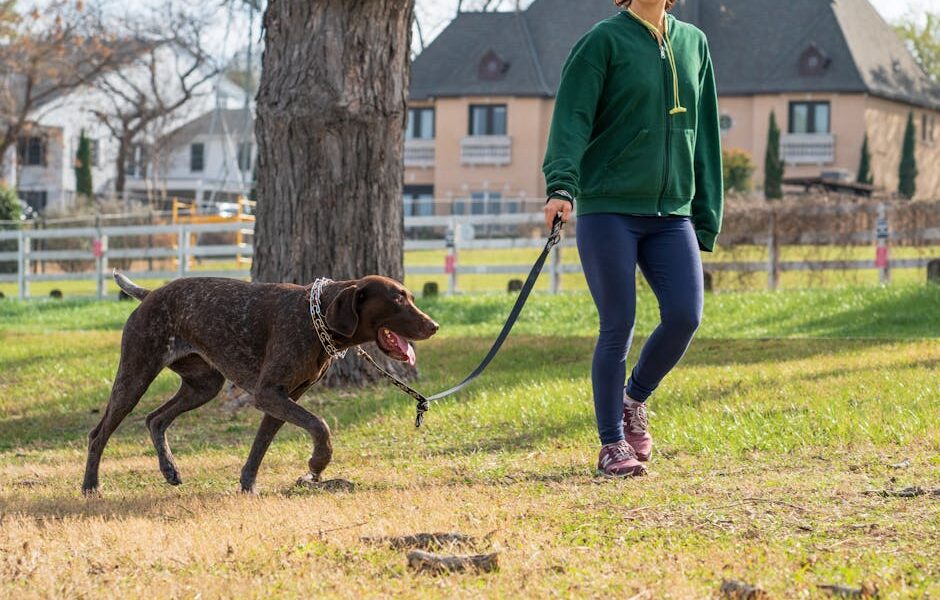
Why Management Comes First
Most reactivity work fails or stalls not because the dog can’t learn, but because the dog is exposed to over-threshold triggers between training sessions. Every over-threshold incident — a sudden encounter at six feet with a triggering dog around a blind corner — is an unrehearsed rehearsal of the reactive behaviour. The training session that follows is paddling upstream against the previous day’s adrenaline-soaked sensitisation. Management is the discipline of routing the dog through the world in a way that prevents those unrehearsed rehearsals.
In this article
- Why Management Comes First
- Building a Route Map of Your Neighbourhood
- Time-of-Day Strategy
- Urban → Suburban → Rural Choice
- Sight-Line and Visual Barrier Management
- Pat Miller-Style Emergency U-Turn
- Parked-Car and Off-Path Decompression Breaks
- Equipment Choices That Support Management
- Communicating With Others on the Path
- Tracking Walks and Iterating
- Where Walk Management Sits in the Plan
- Pre-Workup and Professional Support
- LIMA Placement
- Frequently Asked Questions
Pat Miller — founder of Peaceable Paws, author of The Power of Positive Dog Training, and one of the founding voices of the force-free dog training movement — frames management as the senior partner of any reactivity rehab plan. “Manage the environment so the dog can succeed” is the operating principle. Training fills the gaps; management prevents the catastrophes. Sarah Stremming’s Cognitive Canine podcast and Clicker Solutions community materials echo this framing.
This article is a practical playbook for the management side. Cross-link leash reactivity protocol for the training side.
Building a Route Map of Your Neighbourhood
The first practical step is to walk your neighbourhood without your dog and build a mental — or actual — map of trigger density. Mark known dog-walking households, off-leash hotspots, blind corners, narrow paths with no escape route, parks, schools, construction zones, and the times of day each becomes active. Mark the safer routes — wide paths with multiple exit points, low-density streets, parks with sight lines, paths bordered by hedges or fences that visually block triggers.
For most reactive-dog handlers, the result is a small set of go-to routes — three or four reliable walks of varying length — that can be deployed in the dog’s first weeks of training. Variety in the route map keeps the walk experience enriching; standardisation in the route map keeps the trigger exposure manageable. Both matter. HDB apartment routines have framing for owners whose route options are space-constrained.
Time-of-Day Strategy
The single highest-leverage management move is shifting the walk time. Most dog-dense triggers cluster around fixed times — morning commute walks (6 to 9 a.m.), evening commute walks (5 to 8 p.m.), and weekend mid-mornings. Reactive-dog handlers who walk at 5 a.m. and 10 p.m. encounter a fraction of the triggers of those who walk at conventional times. The dogs that are out at those hours are usually owned by people who are themselves managing for similar reasons.
In hot or humid climates, the early-morning and late-night windows are also the practical exercise window for any dog. Cross-link walking dogs in heat for climate-side framing. The reactive-dog management benefit overlaps neatly with the thermoregulation benefit.
Urban → Suburban → Rural Choice
Some reactive dogs walk better in city environments where the noise and visual clutter mask individual triggers; others walk better in quiet rural environments where triggers are rare. The right choice depends on your dog’s specific triggers. A dog reactive to other dogs may do better on a quiet rural path with few dogs around; a dog reactive to skateboards and cyclists may do better in a green-belt area away from urban infrastructure.
Handlers often discover the right environment by trial: try the dog in three different settings, observe arousal baseline and trigger response, and choose. Driving the dog ten or fifteen minutes to a better walking environment is a reasonable trade-off; many handlers do it daily.
Sight-Line and Visual Barrier Management
Many reactivity-triggered events happen because the dog sees the trigger far before the handler does or far before the handler is ready. Managing sight lines — staying on streets with hedge cover, walking on the side of a path with a wall or fence to one side, choosing routes that block the dog’s peripheral vision toward known trigger zones — buys you reaction time.
The handler can also use their own body as a visual block. When a trigger appears at a known angle, stepping between the dog and the trigger gives the dog a chance to lose visual contact and re-engage with the handler. Combined with a quick reorientation cue, this is the foundation of in-walk emergency management.
Pat Miller-Style Emergency U-Turn
The emergency U-turn is the workhorse exit-strategy behaviour. It is a cued, clean, fast 180-degree turn — handler and dog moving together back the way they came — used when a trigger appears at a distance the handler cannot manage. Pat Miller and most credentialed force-free trainers teach it as a structured behaviour with its own cue (“Let’s go!” or “This way!”), reinforced richly in clean environments first, then deployed in real-world emergency moments.
The mechanics: the handler chooses a cue, says it cheerfully, immediately pivots and walks the other way, and the dog earns high-value reinforcement for following. Practiced for two to three weeks in clean environments before any trigger deployment, the U-turn becomes a near-reflex that the dog runs with the handler rather than against. The U-turn does not solve reactivity but it gives the handler an honest exit option when a trigger appears too close to manage.
Parked-Car and Off-Path Decompression Breaks
Reactivity walks are mentally taxing for both handler and dog. Building decompression breaks into the route map — a parked car the dog can sit beside, a low-traffic green space, a quiet corner of a park — gives the dog moments to recover arousal during the walk rather than after it. A dog walked for fifteen minutes with one five-minute decompression break in the middle often ends the walk in a better state than a dog walked for twenty minutes straight.
The decompression break is unstructured: the dog sniffs, the dog watches the world, the dog does not get cued to do anything. It is rest, not training. Cross-link decompression for rescue dogs for the broader framing on why this matters.
Equipment Choices That Support Management
A reactive-dog walk kit usually includes: a Y-front harness with both front and back clip, a four- to six-foot leash on the back clip, optional second leash on the front clip for additional control, a treat pouch with high-value reinforcement, a clicker or marker word, and a conditioned muzzle for trigger-rich routes.
The leash length matters: shorter than four feet limits the dog’s ability to sniff and self-regulate; longer than six feet limits the handler’s ability to manage close-quarters trigger encounters. A four-to-six-foot fixed leash is the standard. Retractable leashes are not appropriate for reactive-dog work — the variable line length makes trigger management essentially impossible.
Communicating With Others on the Path
Yellow “I need space” leash sleeves, ribbons, and bandanas exist for this purpose. They are not universally recognised but they help with the subset of other walkers who are paying attention. Asking other handlers to wait or pass widely — “Could you give us a moment, my dog needs space” — gets compliance more often than not. A muzzled dog visually communicates the same message at a glance.
For households with members who don’t share the same management discipline (a partner who walks the dog without applying the management rules), the dog’s progress slows or reverses. Family alignment matters as much as the route plan.
Tracking Walks and Iterating
Many handlers keep a simple walk log: route, time of day, weather, triggers encountered, dog’s arousal level by tens, any incidents. Three to four weeks of logs reveal patterns — Tuesday evening walks are predictable disasters, Saturday morning walks at the new park work consistently — that drive the next iteration of the route map. The log itself is also useful at a behaviour-consultant or veterinary-behaviourist appointment.
Where Walk Management Sits in the Plan
Walk management is the management side of the broader reactivity plan. It pairs with training (Pattern Games, Engage-Disengage, LAT, BAT — see related articles), with cooperative-care work, and where appropriate with a medication overlay supervised by a DACVB veterinary behaviourist. The management side reduces unrehearsed rehearsals so the training side has space to actually work. The two are partners, not alternatives.
Pre-Workup and Professional Support
Reactive dogs benefit from a medical workup before structured behavioural work. Primary vet first, DACVB referral when the reactivity is anxiety- or aggression-driven. For trainer selection, look for CCPDT, IAABC, KPA, or PPG-credentialed trainers experienced with reactive-dog walk management; many will do a walk-with-you session that produces a tailored route map for your specific neighbourhood.
LIMA Placement
Walk management sits at LIMA Tier 2 (antecedent management — controlling the environment so the dog can succeed). It is the cleanest, most force-free intervention in the reactivity toolkit. No leash pops, no e-collars, no aversives — just thoughtful route choice, time-of-day strategy, and exit planning.
Frequently Asked Questions
How long do I have to manage walks like this?
Until the dog’s reactivity has reduced enough that surprise triggers don’t tip the dog over threshold. For mild reactivity, that may be three to six months of intensive management plus training. For severe reactivity, management remains part of the plan permanently, with the training work gradually reducing the dog’s threshold sensitivity over years.
My only walk window is 7 a.m. — can I still do this?
Yes, but you’ll need tighter route management. Choose the lowest-density walking direction at that time, prefer paths with good sight lines, and consider driving fifteen minutes to a quieter starting point. Some handlers also use treadmill or yard-based exercise on weekdays and reserve outdoor walks for off-peak weekend hours.
Should I avoid walks entirely until my dog is rehabilitated?
No. Some daily outdoor decompression time is part of mental health for almost every dog. The goal is to walk in a managed way that doesn’t sensitise the dog, not to stop walking. Replace stressful walks with managed ones rather than dropping walks altogether.
What if I encounter a trigger I can’t avoid?
Deploy the U-turn cue, add distance, or step into the nearest visual block (parked car, hedge, doorway) to interrupt the dog’s line of sight. If the dog goes over threshold despite all of this, end the walk early and head home; do not continue working through repeated over-threshold events.
Are off-leash parks ever appropriate?
Public off-leash parks rarely suit reactive dogs. Private fenced rentals (Sniffspot-style) or off-peak fenced municipal parks can work for decompression. See our off-leash recall for reactive dogs piece for the broader framing.


