
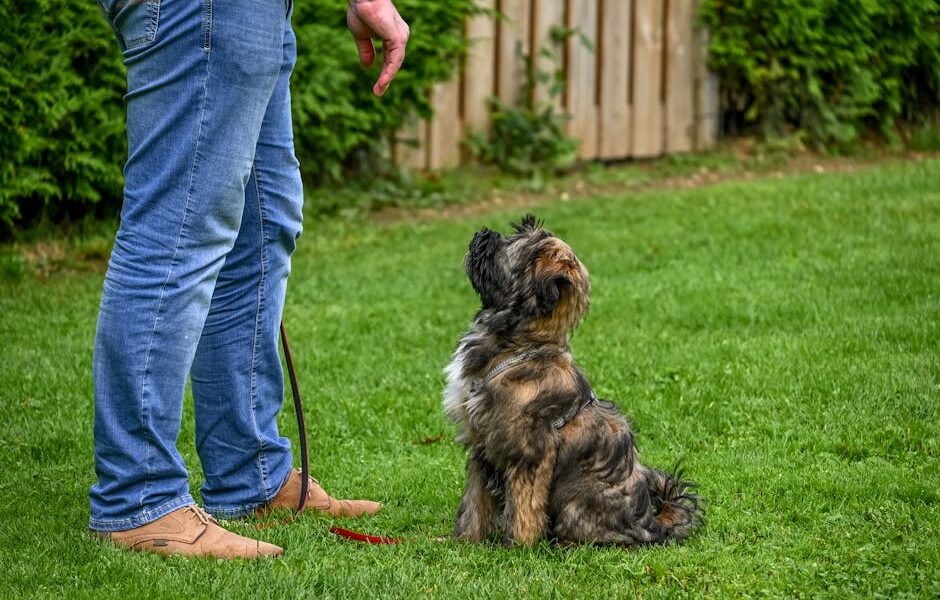
What Stimulus Control Actually Means
Stimulus control is one of the most precise and most demanding concepts in applied animal learning, and it is also one of the most underused in everyday pet training. A behavior is said to be under stimulus control when two conditions are met: the cue reliably produces the behavior, and the behavior occurs only when the cue is given. Most pet dogs operate well below full stimulus control. They sit when asked, but they also sit when they want a treat, when they greet a person, when they hear the food bowl being filled. That is not stimulus control — that is a dog who has learned that sitting often pays. Competition obedience, on the other hand, demands precise stimulus control because the dog must perform the cued behavior on cue and not at any other time.
In this article
- What Stimulus Control Actually Means
- The Four Tests of Stimulus Control
- Cue Transfer — From Lure to Hand Signal to Verbal Cue
- The Sequence in Detail
- Why the Cue Has to Be Clean
- Environmental Cues and Default Behaviors
- Stimulus Control and Generalization
- Cue Transfer for Deaf Dogs
- The Operant-Classical Crossover
- Common Stimulus Control Failures
- Frequently Asked Questions
The framework comes from the operant tradition that Karen Pryor and Bob Bailey both shaped. Bailey, who trained thousands of animals for commercial and military work, was particularly emphatic that stimulus control is a measurable, achievable state and that most trainers underestimate how clean it needs to be. Pryor’s writing made the same case for pet trainers — clean stimulus control is the difference between a dog who “knows” a cue and a dog whose behavior is actually reliable.
The Four Tests of Stimulus Control
Trainers in the operant tradition often test stimulus control with four questions. First, does the dog perform the behavior when the cue is given? Second, does the dog refrain from performing the behavior when the cue is not given? Third, does the dog perform a different behavior when a different cue is given? Fourth, does the dog refrain from performing the behavior when a different cue is given? A behavior under full stimulus control passes all four tests. Most pet behaviors pass the first test and fail one or more of the others.
This matters in practical training because most reliability problems are stimulus-control problems. The dog who sits when the doorbell rings instead of sitting when “sit” is said has not generalized stimulus control to the relevant cue. The dog who knows ten cues but performs whichever one was last reinforced has not differentiated the cues cleanly. Cleaning up stimulus control is often what separates a dog who is “trained” from a dog whose training is functionally useful in the real world.
Cue Transfer — From Lure to Hand Signal to Verbal Cue
Most pet behaviors begin life as lured behaviors. A treat held above the dog’s head produces a sit; a treat lowered to the floor produces a down. Luring is fast and forgiving, but a lured behavior is under control of the lure, not under control of any cue the handler has chosen. Cue transfer is the process of moving the behavior from the lure to a hand signal, and then from the hand signal to a verbal cue, until the behavior is on the verbal cue alone.
The mechanics are simple but require discipline. Once the dog is fluently responding to the lure, fade the lure into a hand signal — the same motion as the lure, but without a treat in the hand. Reinforce after the behavior, not before. After many repetitions, the dog will respond to the hand signal alone. Then layer the verbal cue: say the cue, pause briefly, give the hand signal. Repeat many times. The dog learns to anticipate the hand signal from the verbal cue and begins to respond to the verbal cue alone. Fade the hand signal. The behavior is now on the verbal cue.
The Sequence in Detail
Stage one is lure. The dog follows a treat into the position. Reinforce when the position is reached. Do this for five to ten repetitions across multiple short sessions. Stage two is empty-handed lure. Make the same motion without a treat. The dog should follow the motion into the position; reinforce after with a treat from the other hand. This converts the lure into a hand signal. Stage three is hand signal alone, from a small distance, with the treat hidden until after the behavior. Stage four introduces the verbal cue before the hand signal. The verbal cue predicts the hand signal, and the dog begins to respond to the verbal cue alone. Stage five fades the hand signal entirely.
The pace of progression depends on the dog and the behavior. Simple behaviors like sit and down move through the sequence in days; complex behaviors take longer. Our clicker training for dogs guide covers the foundational mechanics and the timing precision the cue transfer requires. Behaviors built through shaping rather than luring — covered in our errorless learning and shaping article — skip stage one entirely and begin with hand-signal or environmental-cue work, which often produces cleaner stimulus control from the outset.
Why the Cue Has to Be Clean
A cue that is not clean produces inconsistent behavior. If “sit” sometimes means “sit,” sometimes means “sit and wait for me to release you,” and sometimes means “do whatever you want until I notice,” the dog has no way to know what the cue actually requires. The fix is for the handler to decide what the cue means and to be consistent — every “sit” produces the same behavior, with the same release conditions, every time.
Cleanliness also matters for the differentiation between cues. A dog who has been taught “down” with a hand sweep toward the floor and “stay” with a flat palm in the air will differentiate cleanly between the two. A dog whose hand signals have drifted over time and overlap with each other will get confused. Periodic refresher sessions, where each cue is given in clear isolation and the dog is reinforced for correct responses, maintain the differentiation. Our stay protocol covers the criterion-raising for cue-clean stays.
Environmental Cues and Default Behaviors
Some of the most useful pet behaviors are under environmental cue control rather than verbal cue control. The dog who automatically sits at the curb when the leash tightens is responding to the curb itself as the cue. The dog who automatically lies on the mat when the doorbell rings is responding to the doorbell. These environmental cues are powerful because they do not require the handler to remember to give a verbal cue in the moment — the environment cues the behavior. Default behaviors built this way often outperform cued behaviors in real-world reliability.
Building an environmental cue follows the same logic as building a verbal cue. The desired behavior is paired repeatedly with the environmental antecedent until the antecedent itself begins to elicit the behavior. The dog at the curb is reinforced many times for sitting at the curb until sitting at the curb becomes the default. The doorbell-mat protocol pairs doorbell with mat-down many times until the doorbell itself cues the mat-down.
Stimulus Control and Generalization
A cue that works in the kitchen but does not work at the park is not generalized. Stimulus control has been established in the kitchen environment but not in the park environment. The fix is to re-build the cue in each new environment — the same teaching sequence as the original, compressed because the dog already knows the behavior, but still requiring deliberate repetition in the new context. Pat Miller and Susan Friedman both write about this directly: dogs (and cats) are poor generalizers. The cue learned in one context does not automatically transfer to another. Our generalization and proofing article covers the stepwise approach.
The advanced obedience and competition contexts demand stimulus control across novel environments. The CGC test specifically evaluates cues under mild distraction, and the more advanced CGCA and CGCU tests escalate distraction substantially. Our CGC test breakdown article describes how stimulus control is evaluated under formal testing conditions.
Cue Transfer for Deaf Dogs
Deaf dogs cannot transfer to verbal cues, but they can transfer fluently to hand signals and to vibration or touch cues. The teaching sequence is the same, with the verbal-cue layer simply omitted. Many deaf dogs are extraordinarily reliable on hand signals precisely because the handler has had to be more deliberate about the cue-cleanliness. Our deaf dog hand signal article covers the adaptations.
The Operant-Classical Crossover
Cues in operant training (the “sit” cue) become reinforcing in their own right because they predict the opportunity to earn reinforcement. This is a classical-conditioning effect layered on top of the operant behavior — the cue takes on positive associations because of its reinforcement history. A dog who hears “sit” and responds with eagerness rather than reluctance is a dog whose cue has been classically conditioned to predict good outcomes.
Common Stimulus Control Failures
The most common failure is the dog who responds to the cue when the food is visible and not when it is not. This is a lure-faded-too-late problem: the dog is still responding to the food, not to the cue. The fix is to revisit the cue-transfer sequence, fading the food from the cue more rigorously. The second common failure is the dog who responds to the cue indoors but not outdoors. This is a generalization problem, addressed by re-training in each new environment.
A third common failure is the dog who responds to the cue when calm but not when aroused. This is a state-dependent learning problem. The cue has been trained at low arousal and is not yet under stimulus control at high arousal. The fix is to systematically train the cue at progressively higher arousal levels, starting low and building, with the dog reinforced for responding correctly at each level.
Frequently Asked Questions
How long does it take to get a behavior under full stimulus control? Months, for most behaviors, with consistent practice. Most pet behaviors never fully reach the four-test definition of stimulus control — and that is fine for everyday life. Stimulus control is a spectrum, and most pet households need the practical version (cue produces behavior reliably) rather than the competition-grade version (cue produces behavior exclusively and exclusively that behavior).
What if my dog responds to the hand signal but not the verbal cue? The verbal cue has not yet taken precedence over the hand signal. Practice the verbal cue first, pause briefly, then give the hand signal. Over many repetitions, the verbal cue will begin to elicit the behavior before the hand signal arrives, and the hand signal can be faded.
Can I have two cues for the same behavior? Yes, and it is sometimes useful. Many dogs have a verbal cue and a hand signal for the same behavior — both reliably produce the behavior. What you do not want is the same cue producing different behaviors in different contexts, because that is the situation where stimulus control breaks down.
Why does my dog ignore the cue when other dogs are around? Stimulus control has not been established at that arousal level. The cue works in low-distraction contexts and breaks down at high distraction. Re-train the cue in progressively higher-distraction settings, starting with one mild distractor at distance and building gradually. This is the proofing stage covered in our generalization and proofing article.
How does stimulus control relate to shaping and errorless learning? Shaping builds the behavior. Errorless learning keeps the dog succeeding through the criterion-raising. Stimulus control is the next stage — once the behavior is reliably offered, the trainer attaches a cue and works through the cue-transfer sequence. The three procedures are sequential steps in building a complete trained behavior, and trick titles and competition obedience apply the full sequence end to end.


