
Last updated: April 27, 2026
In this article
- What Territorial Aggression Is
- Common Triggers and Locations
- Why It Gets Worse Over Time
- Medical Workup First
- Management Before Modification
- Counter-Conditioning Visitors
- Yard and Fence-Line Work
- What Not to Do
- Visitor Greeting Protocols
- Calming Aids and Medication
- When to Get Professional Help
- Frequently Asked Questions
What Territorial Aggression Is
Territorial aggression in dogs is a defensive response triggered by perceived intrusion into a space the dog considers theirs. The most common locations are the home, the yard, the front door, the car, and the area immediately around the owner. Behaviors include barking, lunging, charging, and sometimes bites if the perceived intruder enters the protected space.
It is often confused with general aggression, but territorial aggression is context-specific. The same dog who lunges at the mail carrier through the front window may be friendly with strangers on a neutral walk. The space is the trigger, not the person or dog inside it.
Most cases are driven by some combination of fear, frustration, learned reinforcement, and breed predisposition. Treatment focuses on changing the underlying emotion and removing the rehearsal opportunities that have made the behavior automatic.
Common Triggers and Locations
Several territorial flashpoints come up repeatedly:
- The front door — knocks, doorbells, deliveries, and arriving guests
- The yard fence — passing dogs, walkers, kids on bikes, the mail carrier
- The car — strangers approaching parked or stopped vehicles, gas station attendants, drive-through workers
- Front-facing windows — anything that moves on the street
- The owner’s lap or immediate space — when other people or dogs approach
- The crate, bed, or specific resting spot — though this often crosses into resource guarding territory
Each location has its own management plan. The common thread is that the dog has rehearsed the behavior many times in that specific spot, building a strong, automatic response.
Why It Gets Worse Over Time
The classic example is the front door. A dog hears a knock, barks, and the person eventually leaves. From the dog’s perspective, the barking worked. The next knock produces faster, louder barking. Add years of mail carriers and delivery drivers who reliably leave after the dog barks, and you have a perfectly trained territorial display.
Yard fences work similarly. The dog barks at every passerby, every passerby keeps walking. The dog reaches a hundred or thousand “wins” per year. The behavior becomes automatic, frustration-driven, and intense, even though the dog never actually wanted contact with the person.
Car aggression follows the same logic. Each passing car, pedestrian, or attendant who approaches and then leaves reinforces the display. Inside a car, the dog also has no escape, which adds frustration on top of the territorial component.
Medical Workup First
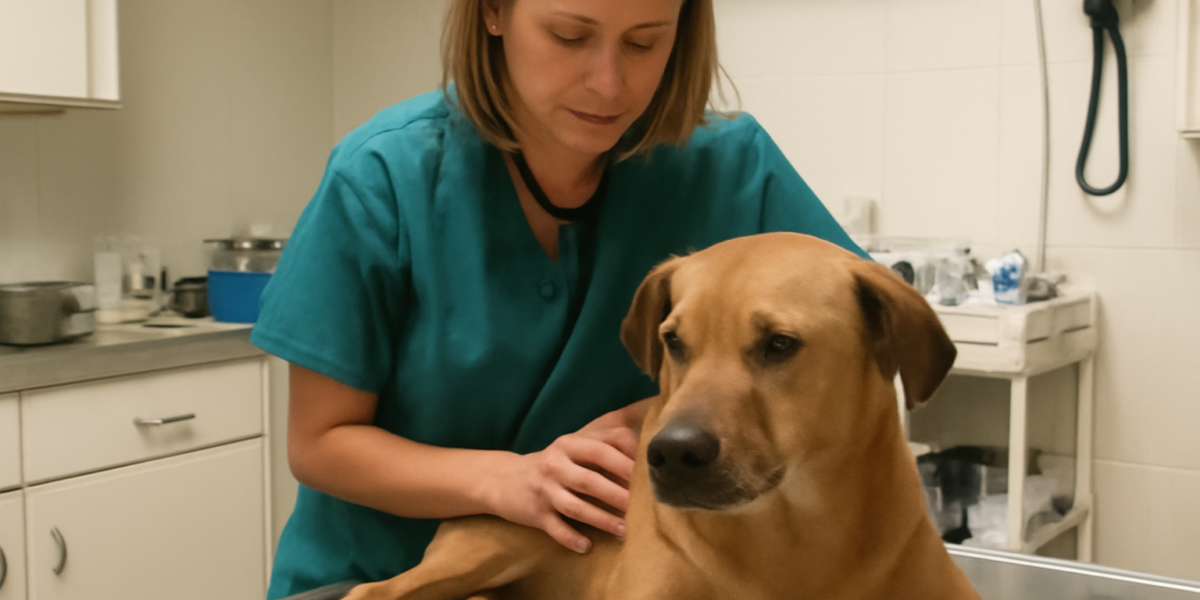
For sudden onset of territorial aggression in an adult dog, schedule a veterinary exam. Pain, dental disease, ear infections, orthopedic problems, sensory loss, hyperthyroidism, and cognitive dysfunction can all show up as new territoriality. Senior dogs whose hearing or vision is fading often become more startled by sudden visitors and may guard the home more.
The exam should include a thorough physical, bloodwork including thyroid, and depending on findings, additional diagnostics. Treating the underlying medical issue often substantially reduces the behavior.
Even when no medical cause is found, the workup is reassuring and rules out a class of contributors that no behavior modification will fix.
Management Before Modification
Every territorial display rehearsed makes the next one more automatic. The first job is to set up the environment so practice opportunities stop.
For the front door:
- Put the dog in a separate room or behind a baby gate before guests arrive
- Use a long-lasting chew or food puzzle to occupy the dog through the arrival
- Place opaque film on glass doors and sidelights so the dog cannot see arrivals
- Mute the doorbell or replace it with a softer chime
- Use a sign asking delivery drivers to leave packages without knocking
For the yard:
- Block fence-line visibility with privacy slats, lattice, or plantings
- Supervise outdoor time rather than leaving the dog alone in the yard
- Limit yard access during peak walker, school, or delivery hours
- Build positive associations with the yard through scatter feeding rather than letting it become a barking arena
For the car:
- Use window film or shades to reduce visibility
- Crate or harness the dog rather than letting them rove
- Avoid drive-throughs with the dog present
- Park where the dog cannot see direct approach
Counter-Conditioning Visitors
The structured behavior modification piece for door-related territorial aggression is changing what the trigger predicts. Instead of “knock means barking that makes the threat leave,” we want “knock means a great food experience and then a calm guest greeting.”
A practical sequence: a friend agrees to act as a controlled visitor. They knock once. You immediately deliver a stream of high-value food (chicken, cheese) to the dog while the visitor stands quietly outside. After thirty seconds, the visitor leaves. Repeat at intervals over multiple sessions, eventually opening the door, eventually having the visitor enter and ignore the dog.
Pair the work with a station behavior. Train the dog to go to a specific mat or bed when the doorbell rings, reinforced with high-value food. The dog learns that the doorbell is a cue to go to a calm spot, not to charge the door.
For dogs who cannot stay calm enough during the practice, work on the doorbell sound alone in the absence of an actual visitor first. Build calm responses to recordings of doorbells before adding the human element.
Yard and Fence-Line Work
Fence-line aggression is often the toughest territorial pattern to resolve because the dog has had so many free reinforcement opportunities. Management is the foundation: block visibility with privacy slats or plantings, supervise rather than free-range, and limit access during peak trigger hours.
For active training, work on engagement and recall in the yard. Reinforce the dog for checking in, for orienting to you when they hear something on the other side of the fence, and for moving away from the fence on cue. A confident recall away from the fence is one of the most useful skills you can build.
If the yard is small or the fence is highly transparent, consider whether off-leash yard time is workable at all. Some dogs are better managed with on-leash potty trips and supervised play in a fully blocked area until the behavior is meaningfully reduced.
What Not to Do
Punishment-based methods are not appropriate for territorial aggression and are flagged by AVSAB, IAABC, and ACVB as contraindicated. Prong collars, electronic collars, choke chains, alpha rolls, and bark collars suppress the visible behavior without changing the underlying emotion. They often add fear of the trigger, which makes the territorial response more intense rather than less.
Other things to avoid include:
- Yelling or scolding when the dog barks at the door — it adds to the chaos
- Encouraging the dog to “alert” and then trying to redirect — the alert itself is the rehearsal
- Letting the dog “guard” the home as a deliberate strategy — this rarely scales safely
- Allowing children to be the primary handler when the dog is in territorial mode
- Strangers reaching to “win the dog over” — this often produces a bite
Visitor Greeting Protocols
For the dog to be safely loose with a visitor in the home, you need a clear protocol. A practical one: dog is gated in a separate space when the visitor arrives. The visitor settles in the living room, no fuss. Once the visitor is calm and the dog’s initial arousal has passed, the dog comes out on a leash. The visitor ignores the dog completely.
If the dog wants to investigate, they can. If they choose to stay back, that is fine. The dog gets reinforced for calm behavior near the visitor. The visitor does not stare, lean over, reach out, or attempt to “make friends.” Many territorial dogs do best when guests never attempt direct interaction at all.
Some dogs warm up over multiple visits with the same person; others stay vigilant indefinitely. Both outcomes are workable. Safety is the only non-negotiable.
Calming Aids and Medication
Some territorially aggressive dogs benefit from products that lower baseline arousal so behavior modification can land. Lower stress means a higher threshold for the territorial response.
Options to discuss with your veterinarian include pheromone products like Adaptil for dogs, alpha-casozepine supplements such as Zylkene for dogs, multi-ingredient formulas like Composure for dogs, and CBD oil for dogs. Body wraps such as the anxiety vest for dogs help some dogs.
For dogs with significant generalized anxiety, daily SSRIs like fluoxetine for dogs or situational support like trazodone for dogs may be appropriate under veterinary direction.
When to Get Professional Help
Most territorial aggression without bite history is manageable with a positive-reinforcement trainer experienced in reactivity. Look for credentials such as CPDT-KA, KPA-CTP, CBCC-KA, or IAABC certification, and confirm they use no aversive tools.
For territorial aggression with bite history, escalating intensity, or aggression that has produced a serious incident, work with a board-certified veterinary behaviorist (DACVB) or a certified IAABC behavior consultant alongside your veterinarian. Find a DACVB through the American College of Veterinary Behaviorists directory.
For broader context, see our guide to dog aggression causes, our reactive dog overview, and the dog anxiety signs and treatment hub. Browse our adopt a dog hub or read more behavior content in the dog care blog.
Realistic Outcomes
Most territorial aggression cases improve substantially with consistent management and structured behavior modification over weeks to months. Some dogs become reliably calm at the door, fence, or car. Others become safely managed with continued protocols. A small subset need lifelong management, particularly with strangers approaching the home.
Track wins like a calmer recovery, a successful guest visit, a quieter response to the doorbell, or a less reactive yard session. The trajectory matters more than any single setback day.
Frequently Asked Questions
Is territorial aggression the same as protectiveness?
Functionally similar in many cases. Some “protective” behavior is genuine handler defense; much of it is generalized territoriality and learned reinforcement. The treatment is the same regardless of the label.
Will my dog stop guarding the door if I get a bigger dog?
Probably not, and adding a second dog often produces a barking duo rather than reducing the behavior. Solve the existing dog’s behavior first.
Should I let my dog “alert bark” and then quiet them?
The alert itself is the rehearsal that strengthens the pattern. Most cases improve faster when you prevent the barking with management and build calm alternatives instead of trying to “manage” the bark in real time.
Can I train the mail carrier away?
Not directly. You can manage the dog away from the window during delivery times, build counter-conditioning to delivery sounds, and ask carriers to leave without knocking. The dog’s belief that their barking made the carrier leave is hard to undo, so prevention works better than correction.
Why is my dog territorial in the car but friendly on walks?
The car is a small, contained space the dog cannot leave, which adds frustration to whatever territorial component is present. Manage with crating, harnessing, and visibility reduction. Avoid contexts like drive-throughs that reliably trigger the behavior.
Should I get an electric fence to stop fence-line aggression?
No. Electric fences add pain to encounters with passing triggers, which often escalates fear and aggression. They also do not stop the dog from charging an unfamiliar person who enters the yard. Use physical barriers and supervised yard time instead.


