
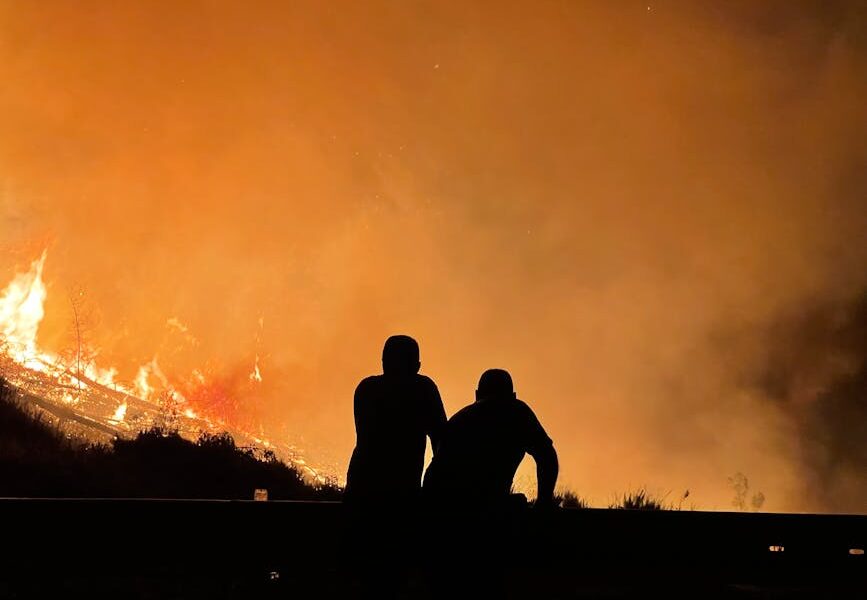
Three Alert Levels: Red Flag, Evacuation Warning, Evacuation Order
Wildfire evacuation pets protocol starts long before flames are visible — it starts the morning a Red Flag Warning is issued. A Red Flag Warning from the National Weather Service means critical fire weather is forecast within 24 hours: low humidity, high winds, dry fuels. No fire yet, but conditions are stacked for one to explode. This is the day you confirm your go-bag is packed, top off prescriptions, verify carrier and crate readiness, and review your evacuation route with your buddy contact.
In this article
- Three Alert Levels: Red Flag, Evacuation Warning, Evacuation Order
- Tracking Tools: Cal Fire, InciWeb, Watch Duty, and PulsePoint
- Defensible Space Prep With Pets at Home
- Air Quality Protection: AQI, HEPA Filters, and Why N95 Masks Are Useless on Pets
- Smoke Inhalation Symptoms and When to Race to the ER Vet
- Transport Heat: The Hidden Wildfire Casualty
- Re-Entry and the Post-Fire Hazard Window
- Frequently Asked Questions
An Evacuation Warning (sometimes called “Get Set” under the Ready-Set-Go framework Cal Fire uses) means a fire is active in your region and you should be prepared to leave at any moment. This is the moment to pre-stage: pets are leashed and carriers are by the door, vehicle is fueled and pointed nose-out in the driveway, go-bag is in the trunk, and one adult in the household is always within arm’s reach of a phone with notifications on. Children and elderly family members should already be transported to a safe relative or designated shelter.
An Evacuation Order (or “Go”) means leave now — minutes matter. Pets are loaded, doors are locked, and you drive your pre-planned route. The single biggest predictor of pet loss in wildfire is owners who waited for the Order before starting to pack. By the time the Order comes, smoke can be blinding, roads can be jammed, and embers can be falling miles ahead of the visible flame front. Treat the Warning as your real deadline, not the Order.
Tracking Tools: Cal Fire, InciWeb, Watch Duty, and PulsePoint
Reliable wildfire intelligence is the difference between a calm evacuation and a panicked one. Cal Fire publishes incident reports for California fires at fire.ca.gov; InciWeb (inciweb.wildfire.gov) is the federal interagency dashboard for fires nationwide and includes evacuation maps, structure-threat data, and containment percentages. Watch Duty is a nonprofit mobile app that aggregates radio scanner traffic, official statements, and verified citizen reports — many California rescuers consider it the fastest source for hour-by-hour fire-line movement.
Set push notifications for the specific incidents nearest your home and any incidents along your primary and secondary evacuation routes. Wind shifts can redirect a fire across your escape road within an hour. If your primary route enters or crosses a Warning zone, switch to your backup route before traffic congeals. Your county emergency management office’s Twitter/X account or Nixle alerts often publish the formal Order before national news catches up.
Pair digital tracking with low-tech backups: a hand-crank or battery-powered AM/FM radio tuned to your local emergency broadcast frequency, and a printed map with your route marked. Cell towers fail, batteries die, and apps freeze when servers are overloaded by a region-wide evacuation event. Defense in depth keeps you informed when one channel collapses.
Defensible Space Prep With Pets at Home
Defensible space — the 100-foot buffer around your home you clear of dry brush and combustible debris — is recommended fire-season practice in every wildland-urban interface region. The pet-relevant nuance is that some of the prep work creates short-term hazards for animals: chainsaws and brush chippers terrify dogs and cats, herbicide and rodent-control products applied during prep are toxic, and cleared brush piles attract snakes and rodents until hauled away.
Confine pets indoors while heavy clearing work is in progress, in a quiet interior room away from the equipment noise. Store any cleared brush piles at least 30 feet from pet exercise areas until removal, and inspect for snakes before letting dogs near them. If you apply rodenticide as part of the cleanup, choose first-generation anticoagulant baits and place them in tamper-resistant stations dogs cannot pry open — secondary poisoning is a known wildfire-prep risk. For accidental ingestion, call ASPCA Animal Poison Control Center at 888-426-4435 or Pet Poison Helpline at 855-764-7661 immediately (both charge a consultation fee, roughly $95 and $85 respectively).
The pet-specific defensible-space upgrade is making sure your evacuation route from inside the house is clear. Carriers should be reachable without crossing flammable storage, leashes should hang on hooks beside the door you will leave through, and any cat-hiding nooks (under beds, behind dressers, inside hollow furniture) should be partially blocked so frightened cats cannot wedge into spots you cannot reach. A cat who hides under the deck when sirens start is a cat you will leave behind.
Air Quality Protection: AQI, HEPA Filters, and Why N95 Masks Are Useless on Pets
Smoke from a fire 50 miles away can push your local Air Quality Index (AQI) past 200 for days. Pets are more vulnerable to smoke than humans for two reasons: they breathe faster (a small dog breathes 20-40 times per minute at rest, double a human’s rate), and they cannot rationalize about avoiding outdoor air. At AQI 101-150 (Unhealthy for Sensitive Groups), limit outdoor time for senior pets, brachycephalic breeds, and pets with known respiratory or cardiac disease. At AQI 151+ (Unhealthy for everyone), keep all pets indoors except for the shortest necessary potty breaks.
N95 and KN95 masks do not work on pets. The fit, anatomy, and respiratory rate of a dog or cat make human masks worse than useless — pets often suffocate themselves trying to remove them, and a poorly sealed mask gives a false sense of protection. The correct strategy is filtering the air your pet breathes indoors. Run a HEPA air purifier sized for the room your pet spends most of their day in. Close windows, seal obvious gaps with damp towels, and run HVAC with a MERV-13 filter if your system can handle it. Avoid burning candles, incense, or wood fires indoors during a smoke event — you are stacking pollution on pollution.
Cats are especially sensitive to smoke because their nasal turbinates concentrate inhaled particulates and because they often hide and breathe shallowly when stressed, which can mask early respiratory symptoms. Watch litter habits and water intake daily; both drop in a cat developing smoke-related illness.
Smoke Inhalation Symptoms and When to Race to the ER Vet
Smoke inhalation in pets ranges from mild eye and airway irritation to fatal acute respiratory distress. Mild signs include watery eye discharge, occasional coughing, mild lethargy, decreased appetite, and reluctance to play. Moderate signs add persistent coughing, wheezing, increased respiratory rate at rest (over 40 breaths per minute in a resting dog or 30 in a resting cat), and gum color that has shifted from pink to pale, gray, or muddy. Severe signs — open-mouth breathing in a cat, extended-neck “air hunger” posture, blue-tinged gums or tongue, collapse — are immediate ER vet emergencies.
For mild signs, move the pet to your cleanest indoor air space, offer fresh water, monitor for 6-12 hours, and call your regular vet for next-day evaluation. For moderate signs, call your regular vet or a 24-hour ER vet the same day; oxygen supplementation and nebulized bronchodilators may be needed. For severe signs, go directly to the nearest 24-hour ER vet — preferably an ACVECC-credentialed practice. Carbon monoxide poisoning can co-occur with smoke inhalation and is invisible without blood gas testing.
Carry your pet’s pet emergency binder so the ER vet has vaccination history, current medications, and microchip information without delay. Smoke-event ER vet visits are higher-volume than normal; having paperwork ready accelerates triage.
Transport Heat: The Hidden Wildfire Casualty
Evacuation traffic during a wildfire often crawls at 5 mph for hours, in daytime heat, with windows closed because of smoke. A vehicle interior on a 90°F day with smoke-closed windows can reach 110°F+ within 30 minutes — a fatal hyperthermia setup for any pet, especially brachycephalic dogs and senior cats. Plan for this. Keep AC running and cycle to recirculating mode to reduce smoke intake while cooling. Carry frozen water bottles wrapped in dish towels for pets to lie against. Offer water every 30 minutes; small frequent sips beat one large bowl.
If you suspect hyperthermia developing in transit — heavy panting that doesn’t slow when AC is on, drooling, glazed eyes, vomiting — pull off the road safely, cool with a wet towel on the belly and paws (not ice; ice causes vasoconstriction that traps heat), and head to the nearest open vet even if it is off your evacuation route. Heatstroke is fatal within hours if uncorrected. The extreme heat emergency protocol applies in full to evacuation vehicles, and the heatstroke emergency treatment framework covers field cooling steps.
Crate placement inside the vehicle matters: in shade if any seat is in shade, away from the sun-facing window, and never in a closed trunk. Cargo-area crates in SUVs are acceptable only if AC reaches them; many SUVs don’t. A small portable battery-powered fan clipped to the crate door is a cheap insurance policy.
Re-Entry and the Post-Fire Hazard Window
When evacuation orders lift and you return home, the danger to pets has changed shape but not disappeared. Hot spots can reignite. Ash contains fine silica and heavy metals that pets ingest by grooming. Burned vegetation no longer holds rodents, snakes, and wildlife in their normal ranges; displaced animals now share your yard. Power lines may be down. Water service may be on a boil-water notice.
Keep pets leashed and supervised for at least 72 hours after re-entry. Wipe paws and bellies with a damp cloth after every outdoor trip until rain or street-cleaning has removed surface ash. Provide bottled or boiled water until your municipal supply is cleared. Inspect fences for fire damage before letting pets off-leash in the yard. If you find injured wildlife, do not handle it — call your state wildlife rehabilitator network.
For households with multiple species, review the multi-pet household evacuation logistics framework before the next event and consider the pet disaster mutual aid and buddy system for redundancy if you are not home when an Order is issued. Wildfires are the disaster type that most often outpaces solo households.
Frequently Asked Questions
How early should I leave during a wildfire evacuation warning?
Treat the Warning as your real deadline. Leave at the Warning, not the Order. Roads jam quickly, smoke reduces visibility, and embers can ignite spot fires miles ahead of the main flame front. If you have any senior pets, exotic species, or multiple animals to load, add a 30-minute buffer.
Can I leave my pet at home if I am evacuating to a non-pet-friendly shelter?
No. Pets left behind during a wildfire evacuation rarely survive. The PETS Act 2006 requires state and local emergency plans to address household pets, and most counties now have co-located pet-friendly shelters or work with rescue partners. Call your county’s emergency management office before fire season to identify the pet-friendly options.
What AQI level requires veterinary attention for a pet?
AQI itself doesn’t trigger a vet visit — symptoms do. But sustained AQI over 150 with any clinical signs (coughing, eye discharge, lethargy, decreased appetite) warrants a same-day call to your regular vet. AQI over 300 (Hazardous) is an indoor-only situation for all pets, healthy or not.
Are HEPA filters actually effective for pet smoke protection?
Yes, properly sized HEPA purifiers remove the fine PM2.5 particulates that drive most wildfire respiratory illness. Choose a unit rated for your room’s square footage, run it 24/7 during smoke events, and replace filters per the manufacturer schedule — smoke saturates filters fast.
How do I find a vet during a regional wildfire evacuation?
State VMA directories (e.g., CVMA for California) maintain disaster-response vet lists. The ASPCA Animal Poison Control Center at 888-426-4435 and Pet Poison Helpline at 855-764-7661 can help triage urgent questions when local vets are overwhelmed.


