
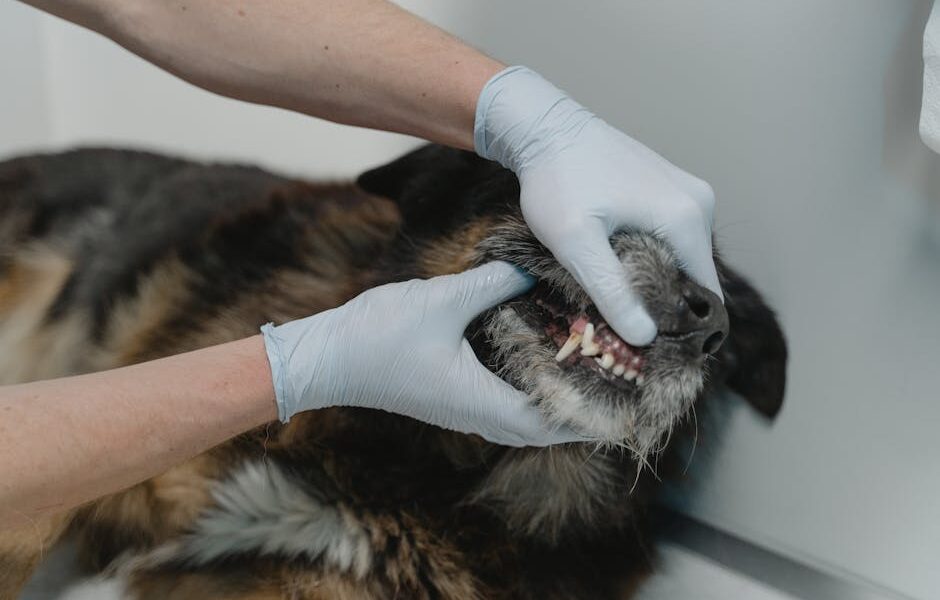
The Three Major Veterinary Bodies All Say No
If you have searched for “anesthesia-free dog dental” you have probably seen marketing language about “gentle hand scaling,” “no risk to your pet,” and “natural alternative.” It is worth knowing that the three major veterinary organizations that set the standard of care in North America have each published formal positions opposing non-professional dental scaling (NPDS), also called anesthetic-free dental cleaning, also called hand-scaling-only or HCO.
In this article
- The Three Major Veterinary Bodies All Say No
- What a Real Professional Cleaning Actually Does
- Why Anesthesia-Free Cleaning Cannot Do the Job
- The Welfare Problem with Restraint
- The Anesthesia Risk Argument, Honestly
- What About “Veterinary-Supervised” Anesthesia-Free Cleaning?
- What to Tell Your Dog’s Care Team Instead
- The Periodontal Probe and the Radiograph Are the Point
- What “Successful” Anesthesia-Free Cleaning Hides
- Bottom Line
- Frequently Asked Questions
The American Veterinary Dental College (AVDC) calls anesthesia-free dental scaling “inappropriate” and “below the standard of care.” The American Animal Hospital Association (AAHA) Dental Care Guidelines require general anesthesia for any professional dental cleaning. The American Veterinary Medical Association (AVMA) endorses these positions and states that anesthesia-free dental scaling does not address periodontal disease, the primary reason dogs need cleanings in the first place.
This is not a case of veterinarians protecting a revenue stream. It is a case of every credentialed professional body looking at the procedure and concluding it fails the basic test of “does this treat the disease?” The next sections explain why.
What a Real Professional Cleaning Actually Does
A professional dental cleaning under anesthesia (sometimes called COHAT — Comprehensive Oral Health Assessment and Treatment) involves several steps that simply cannot happen in an awake dog:
- Full-mouth dental radiographs to find subgingival disease, root abscesses, retained roots, resorption lesions, and bone loss
- Periodontal probing of every tooth at 4-6 sites to measure pocket depth and attachment loss
- Ultrasonic scaling above and below the gumline (subgingival scaling is where periodontal disease actually lives)
- Subgingival curettage of infected granulation tissue
- Polishing of the smoothed enamel to slow plaque re-adherence
- Treatment of identified lesions: extractions, restorations, antibiotic locals, or referral
This is what the modern dental cleaning anesthesia protocol looks like and why your dog needs intubation, IV catheter, fluids, and continuous monitoring. The anesthesia is the enabler of the medicine, not an inconvenient overhead.
Why Anesthesia-Free Cleaning Cannot Do the Job
The fundamental problem is that periodontal disease lives below the gumline. The visible tartar on the tooth crown is cosmetic — unsightly, sure, but not what makes your dog sick. What hurts your dog is the subgingival plaque biofilm, the inflamed periodontal ligament, the bone resorption around the root, and the bacterial bacteremia seeding the rest of the body.
An awake dog will not tolerate periodontal probing of a painful 6-millimeter pocket. An awake dog will not stay still while a sharp curette runs along a root surface 4 millimeters below the gum. An awake dog will not allow intraoral radiograph sensors to be placed and held against each tooth. So the operator skips all of this. The dog leaves with a clean-looking crown, the owner is reassured, and the periodontal disease continues to destroy attachment and bone underneath.
This is the central deception of anesthesia-free dental: it makes the visible problem disappear while letting the actual disease progress. Owners come back six months later with a dog whose periodontal disease has advanced to PD3 or PD4 because every “cleaning” missed every diagnostic step. See our PD0 to PD4 staging framework for what real assessment looks like.
The Welfare Problem with Restraint
Even if you accepted that a cosmetic-only crown clean was useful, there is a second issue: how do you keep an awake dog still for 30-60 minutes of sharp instrument work? The honest answer is forcible physical restraint, often with multiple operators and sometimes with leverage from the floor or against a wall. Some practitioners use partial sedation that is below the level of safe airway protection.
This is a welfare concern. Dogs find restraint stressful. Sharp instruments in the mouth of a restrained dog increase the risk of iatrogenic injury — lacerations of the tongue or cheek, broken tooth fragments aspirated, panic responses that traumatize the patient and the operator. The AVDC has documented multiple cases of jaw fracture, ocular injury, and tooth fracture occurring during anesthesia-free procedures.
If your dog associates dental care with being pinned down and afraid, every future veterinary visit becomes harder. The puppy cooperative care protocol exists specifically to teach voluntary cooperation with handling — the opposite of forced restraint.
The Anesthesia Risk Argument, Honestly
The strongest argument for anesthesia-free cleaning is that anesthesia itself carries risk. This is true. It is also dramatically overstated. A 2008 multi-center study of small animal anesthesia death rates put the overall risk at about 0.17% for healthy dogs and 1.33% for sick dogs (ASA 3+). With modern protocols — pre-anesthesia bloodwork, IV catheter, fluids, intubation, continuous monitoring (BP, ECG, capnography, pulse-ox, temp), trained anesthesia staff — the risk in a healthy adult dog at a well-equipped clinic is very low.
The risk is higher in seniors and patients with comorbid disease, which is exactly the population that needs careful pre-anesthesia screening. Our senior pet pre-anesthesia workup and anesthesia risk monitoring guides cover the modern senior-specific protocol.
What the “anesthesia is too risky” argument leaves out is that untreated periodontal disease has its own mortality and morbidity: bacteremia, endocarditis, jaw fracture from bone loss in small breeds, chronic pain, weight loss, and reduced lifespan. Choosing untreated disease to avoid a one-in-several-hundred anesthesia risk is not a safer choice. It is a more visible trade-off, which is a different thing.
What About “Veterinary-Supervised” Anesthesia-Free Cleaning?
Some practices market anesthesia-free dental as “veterinary-supervised” because a veterinarian is on the premises or signed off on the procedure. This is regulatory window-dressing. A veterinarian’s presence does not change the fact that an awake dog cannot have subgingival scaling, dental radiographs, or comprehensive oral assessment. The procedure is still below the standard of care defined by AVDC, AAHA, and AVMA.
The AVDC position statement specifically addresses this: it is the procedure (awake hand scaling without radiographs, probing, or subgingival work) that fails the standard, not the supervisory arrangement. Veterinary supervision does not turn a cosmetic clean into a therapeutic one.
What to Tell Your Dog’s Care Team Instead
If cost is the barrier, talk frankly. Many practices offer staged dental plans — radiographs and assessment at one visit, treatment at a follow-up — so the bill spreads across two anesthetic episodes. Some have payment plans. Pet insurance with a wellness rider or comprehensive coverage may help, though most plans exclude pre-existing periodontal disease — see our dental insurance realities piece.
If anesthesia anxiety is the barrier, ask your veterinarian to walk you through the specific protocol: pre-op bloodwork, induction drugs used, monitoring equipment, recovery protocol. A clinic that cannot describe these confidently is a different question than the question of anesthesia in principle.
For maintenance between professional cleanings, follow the AVDC home brushing protocol, use VOHC-accepted products (VOHC chews review, water additives review), and keep an eye on the gum line. Cats have the parallel problem — read our companion piece on anesthetic-free cat dental claims debunked if you also share a household with a feline.
The Periodontal Probe and the Radiograph Are the Point
It is worth dwelling on what specifically gets missed in an anesthesia-free cleaning. The two diagnostic tools that drive dental decision-making — the periodontal probe and the intraoral radiograph — are both impossible in an awake dog.
The periodontal probe is a millimeter-graduated dental instrument that the operator walks around each tooth at 4-6 sites, recording pocket depth and gingival attachment. This is the measurement that distinguishes PD1 (gingivitis, fully reversible) from PD2 (early periodontitis, irreversible attachment loss). Without probing, the operator is staging by appearance, which correlates poorly with actual disease severity.
The intraoral dental radiograph reveals subgingival pathology — bone loss patterns, root abscesses, retained roots from prior extractions, resorptive lesions, fractures below the gum, oronasal fistulas, and bone tumors. Anywhere from 30% to 60% of significant dental pathology in dogs is invisible above the gumline. Skipping radiographs is skipping more than half the diagnostic information.
An anesthesia-free cleaning that does neither probing nor radiography is not a dental evaluation. It is a crown cosmetic with marketing.
What “Successful” Anesthesia-Free Cleaning Hides
The single most common outcome of repeated anesthesia-free cleanings is undiagnosed progression of periodontal disease. The owner sees a clean-looking mouth twice a year and concludes the dog is doing well. The dog’s actual periodontal stage advances quietly: PD1 to PD2 in year one, PD2 to PD3 by year three, PD3 to PD4 by year five. By the time a different clinician finally puts the dog under anesthesia for a real assessment, multiple teeth are unsalvageable and the bill for surgical extractions is several times what the maintenance cleanings would have cost.
This is the hidden financial argument too. Anesthesia-free cleanings appear cheaper per visit but cost dramatically more in total because they enable progression of the very disease they claim to address. By contrast, dogs maintained with annual real cleanings under anesthesia plus daily home brushing rarely need expensive late-stage interventions.
If your motivation for considering anesthesia-free is cost, the math actually points the other way. The cheapest dental care over a dog’s lifetime is the kind that catches disease at PD1 and arrests it there.
Bottom Line
Anesthesia-free dog dental cleaning is a cosmetic procedure marketed as a therapeutic one. It cannot reach the disease, cannot diagnose the disease, and cannot treat the disease. The three major veterinary organizations agree. If your dog needs dental care, schedule a real cleaning with anesthesia, pre-op workup, full-mouth radiographs, and a veterinarian or DAVDC specialist running the procedure.
Frequently Asked Questions
My groomer offers dental cleaning. Is that safe?
If it is anesthesia-free hand scaling, no — for all the reasons above. Groomers are not licensed to perform veterinary procedures including dental work. Schedule a real cleaning with your veterinarian.
What about “dental cleaning” treats and chews — same thing?
No. Daily home brushing and VOHC-accepted chews are legitimate home-care adjuncts. They are not substitutes for professional cleaning, but they are not the same as anesthesia-free scaling either.
Is anesthesia really that safe for older dogs?
With a proper senior pre-anesthesia workup (CBC, chemistry, urinalysis, BP, possibly cardiac evaluation) and modern monitoring, anesthesia in healthy seniors is far safer than untreated periodontal disease.
Will my insurance pay for a real cleaning?
Depends on the plan. Wellness riders often cover routine cleaning up to a cap. Comprehensive plans may cover periodontal therapy if the disease arose after enrollment. Pre-existing disease is usually excluded.
What if my dog “always behaves” and would tolerate hand scaling?
The behavioral compliance of your individual dog does not change the fact that no awake dog can have subgingival scaling, periodontal probing, or dental radiographs. The procedure fails the standard regardless of patient temperament.


