
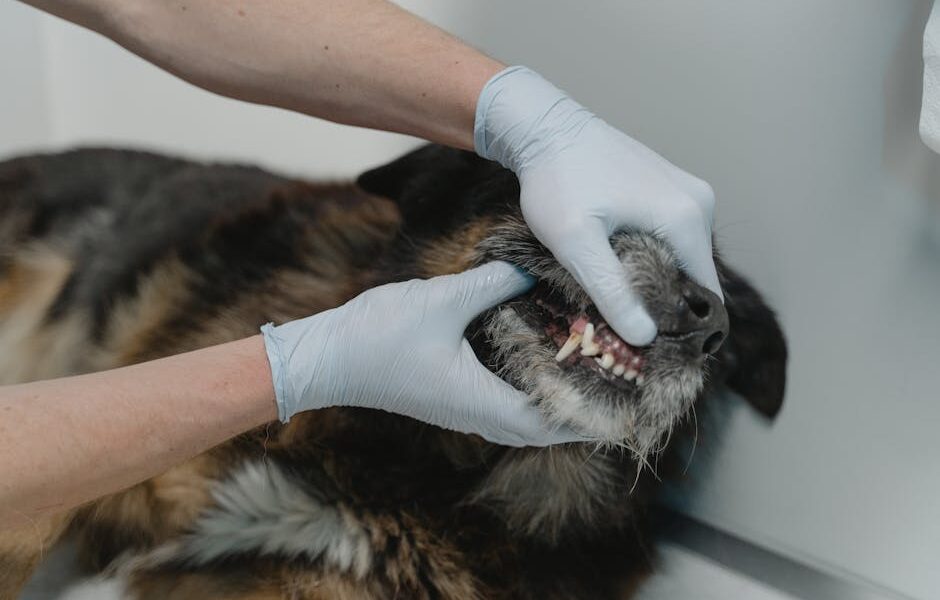
Why Daily Brushing Is the One Intervention That Actually Works
Of the hundred things marketed for dog dental care — chews, water additives, sprays, gels, “dental” kibbles, raw meaty bones — only one has consistent published evidence of reducing plaque and gingivitis as effectively as the human equivalent: daily mechanical brushing with a soft-bristle brush and an enzymatic toothpaste designed for dogs. The American Veterinary Dental College (AVDC) recognizes home brushing as the gold-standard home-care intervention. Everything else is an adjunct.
In this article
- Why Daily Brushing Is the One Intervention That Actually Works
- Toothpaste Rules: Enzymatic, Dog-Specific, No Xylitol
- Brush Options: Soft-Bristle vs Finger Brush
- The 14-Day Desensitization Ramp
- What to Brush and What to Skip
- Frequency: Daily Is the Target, 3x Weekly Is the Floor
- Common Problems and How to Fix Them
- Brushing Does Not Replace Professional Cleaning
- Brushing Special Populations
- Adjuncts That Help (and Ones That Do Not)
- Frequently Asked Questions
The right dog home dental brushing protocol takes 30 seconds per side. It uses pet-safe enzymatic toothpaste — never human toothpaste, which contains fluoride and frequently xylitol (see xylitol toxicity in dogs for why even trace amounts can kill). And it builds on a foundation of cooperative-care training so your dog volunteers his face into the procedure rather than tolerating restraint.
This guide walks through the AVDC-accepted technique, the toothpaste rules, the brush options, the 14-day desensitization ramp, and how to integrate brushing with the rest of a real dental care plan including annual professional cleanings under anesthesia.
Toothpaste Rules: Enzymatic, Dog-Specific, No Xylitol
Pet toothpaste does two jobs. First, it provides a flavored, palatable medium that makes brushing tolerable for your dog (chicken, beef, peanut butter flavors are common). Second, the better products contain enzymatic systems — glucose oxidase, lactoperoxidase, and lactoferrin — that produce hypothiocyanite in the saliva and have measurable antimicrobial effect.
Hard rules:
- Never use human toothpaste. Fluoride is intended to be spit out — dogs swallow everything. Xylitol, found in many “natural” and sugar-free human toothpastes, is acutely lethal to dogs at very low doses.
- Look for the VOHC seal on the toothpaste tube if you want third-party validation. The list is small but real; check vohc.org for the current accepted products.
- Avoid baking soda preparations for dogs. The sodium load is unnecessary and the abrasive can damage enamel over time.
- A pea-sized amount per brushing session is plenty.
If your dog hates the first flavor you try, switch. There are five or six major flavor options across the main brands. The right toothpaste is the one your dog accepts willingly.
Brush Options: Soft-Bristle vs Finger Brush
For most dogs, a soft-bristle pediatric or dog-specific toothbrush is the best tool. The bristle stiffness lets you angle into the gum margin where plaque actually accumulates, and the small head reaches the back molars. A 45-degree angle to the long axis of the tooth, sweeping from gumline toward the crown, is the AVDC-accepted technique.
Finger brushes (rubber cones with nubs that fit over your fingertip) are useful in the desensitization phase for small dogs or for owners who feel safer with their finger in the mouth. They are inferior to bristle brushes for actual plaque removal because they cannot get under the gumline, but they are a good bridge while your dog learns to accept the procedure.
For tiny dogs (Yorkies, Chihuahuas, toy breeds), use the smallest brush head you can find, often labeled as a puppy brush or pediatric toothbrush.
The 14-Day Desensitization Ramp
Trying to brush all 42 of your adult dog’s teeth on day one is the fastest route to a dog who runs when he sees the brush. Build the behavior gradually. The full puppy cooperative-care protocol covers this in depth for puppies, but the same ladder works for adult dogs.
Day 1-3: With your dog sitting calmly, lift the lip on one side for 2 seconds and feed a high-value treat. Repeat 5-8 times. No brush yet.
Day 4-6: Put a tiny smear of enzymatic toothpaste on your fingertip. Lift the lip, run your finger across the canine and a few adjacent teeth. Treat. Repeat 5-8 times.
Day 7-9: Introduce the brush. Lift the lip, touch the brush to one tooth without movement. Treat. Repeat with a different tooth each rep.
Day 10-12: Lift the lip, brush 2-3 teeth on the upper outside (buccal) surface with toothpaste, 5-10 seconds total. Treat generously.
Day 13-14: Build up to brushing the entire outside surface of upper and lower teeth on one side, then the other, 30 seconds per side, total 1 minute of brushing.
If your dog protests at any step, back up two steps and rebuild slowly. The behavior must be voluntary or it does not stick.
What to Brush and What to Skip
Focus on the outside (buccal/labial) surfaces of the teeth. This is where 80%+ of visible plaque and tartar accumulates because the cheek and lip cannot self-clean those surfaces. The tongue keeps the inside (lingual/palatal) surfaces relatively cleaner through mechanical sweeping during eating and drinking.
Hit the canine teeth, premolars, and molars hardest — these are the largest crowns with the most plaque-trapping anatomy. Incisors (the small front teeth) are easier to maintain and often need less attention. The maxillary fourth premolar (carnassial tooth) on the upper jaw is the largest tooth and a frequent site of caries and slab fractures; do not skip it.
Do not try to pry the mouth open. Brush with the mouth closed by lifting the lip and angling the brush along the gum line. Forcing the mouth open is uncomfortable and breaks the cooperation you have built.
Frequency: Daily Is the Target, 3x Weekly Is the Floor
Plaque biofilm matures into mineralized tartar in roughly 48-72 hours. This is the biological reason daily brushing is the goal — anything less and you are letting some teeth complete the plaque-to-tartar transition between sessions, after which the bristle no longer removes it (mineralized tartar requires ultrasonic scaling under anesthesia).
Studies have shown brushing fewer than 3 times per week is not significantly better than no brushing at all for periodontal disease control. So 3x weekly is the realistic floor; daily is the actual goal. Pick a routine time — after dinner is common — and tie it to a behavior the dog already does daily (treat after walk, pre-bedtime cuddle) so the habit compounds.
Common Problems and How to Fix Them
Problem: dog clamps mouth shut. Fix: back up to the desensitization step where the dog accepted a lifted lip. Rebuild slowly. Use higher-value treats.
Problem: dog bites the brush. Fix: this usually means the brush is too far inside the mouth or you are moving too quickly. Slow down, brush only the front teeth, build up to molars.
Problem: gums bleed when brushed. Fix: a small amount of pinpoint bleeding at the gum margin is common in dogs with pre-existing gingivitis. Continue brushing gently — the bleeding typically resolves within 7-14 days as the gingivitis improves. If bleeding is significant or persistent, see your veterinarian for a comprehensive oral exam.
Problem: dog has loose tooth or oral pain. Fix: stop brushing that area and book a veterinary dental exam. You should not be brushing through visible disease that warrants staged periodontal therapy.
Brushing Does Not Replace Professional Cleaning
This is the part of the home-care conversation that gets skipped. Home brushing is necessary but not sufficient. Even daily perfect brushing leaves subgingival plaque untouched, and that subgingival biofilm is what drives periodontal disease progression. Every dog still needs annual professional cleanings under anesthesia with full-mouth radiographs.
The combination — daily brushing + annual COHAT — is what moves a dog from PD2 stage progression to PD0/PD1 maintenance over a lifetime. Brushing alone is not enough. Cleaning alone is not enough. Both together is the gold standard.
If you are reading this because someone offered an anesthesia-free alternative to professional cleaning, please read that companion piece. Daily brushing does not substitute for professional cleaning, and neither does awake hand-scaling.
Brushing Special Populations
Some dogs need a modified approach.
Brachycephalic breeds (Pugs, French Bulldogs, English Bulldogs, Shih Tzus) often have crowded, rotated, or impacted teeth that are harder to reach. Use a smaller brush head, accept that you cannot reach every tooth perfectly, and prioritize the teeth that are most accessible. These breeds tend to develop periodontal disease earlier, so the marginal benefit of even imperfect brushing is high.
Senior dogs with existing periodontal disease may have sore gums that make brushing genuinely uncomfortable. Address the periodontal disease first with a professional cleaning, then start brushing on the cleaned, healing mouth. See senior pet pre-anesthesia workup for the workup before that cleaning.
Rescue dogs with handling history may be face-sensitive in ways an average puppy is not. Build the cooperative-care behavior even more slowly — sometimes weeks rather than 14 days. Backup adjuncts (VOHC chews, water additives) are reasonable bridges while you patiently build acceptance.
Dogs with broken or fractured teeth need veterinary evaluation before brushing — see broken tooth in dogs for the diagnostic and treatment workup. Brushing on a fractured tooth with pulp exposure causes pain and worsens the dog’s tolerance for future brushing.
Adjuncts That Help (and Ones That Do Not)
Useful adjuncts to daily brushing include VOHC-accepted dental chews, VOHC-accepted water additives, and a low-carbohydrate diet that reduces fermentable substrate for oral bacteria.
Things marketed as “dental” that do not move the needle: bones (high fracture and resorption risk), antlers (extremely hard, slab-fracture risk), ice cubes (enamel cracking), dental “powders” sprinkled on food (no controlled evidence), and homemade coconut-oil pulling (a human trend with no canine evidence).
Frequently Asked Questions
How long should each brushing session take?
30 seconds per side is plenty once your dog is fully trained. Total brushing time is about 1 minute per day. Longer is fine; shorter (under 15 seconds total) is too quick for adequate plaque removal.
What if my dog only lets me brush the front teeth?
Front teeth are better than nothing, but the molars and premolars are where most periodontal disease starts. Use the cooperative-care ladder to gradually build acceptance for the back of the mouth.
Is finger-rubbing toothpaste on the gums useful?
The enzymatic activity has some benefit on its own, but mechanical disruption of plaque is the main mechanism. Finger application is better than nothing during the desensitization phase but should transition to brush use as soon as the dog tolerates it.
Can I brush a dog with already-bad teeth?
Brushing on top of established periodontitis is uncomfortable and incomplete. Schedule a professional cleaning first to address the disease that is already there, then start home brushing on the cleaned, healthy mouth.
My cat needs brushing too — same protocol?
Similar principles, different tolerance. See our cat home dental brushing protocol for the feline-specific version.


