
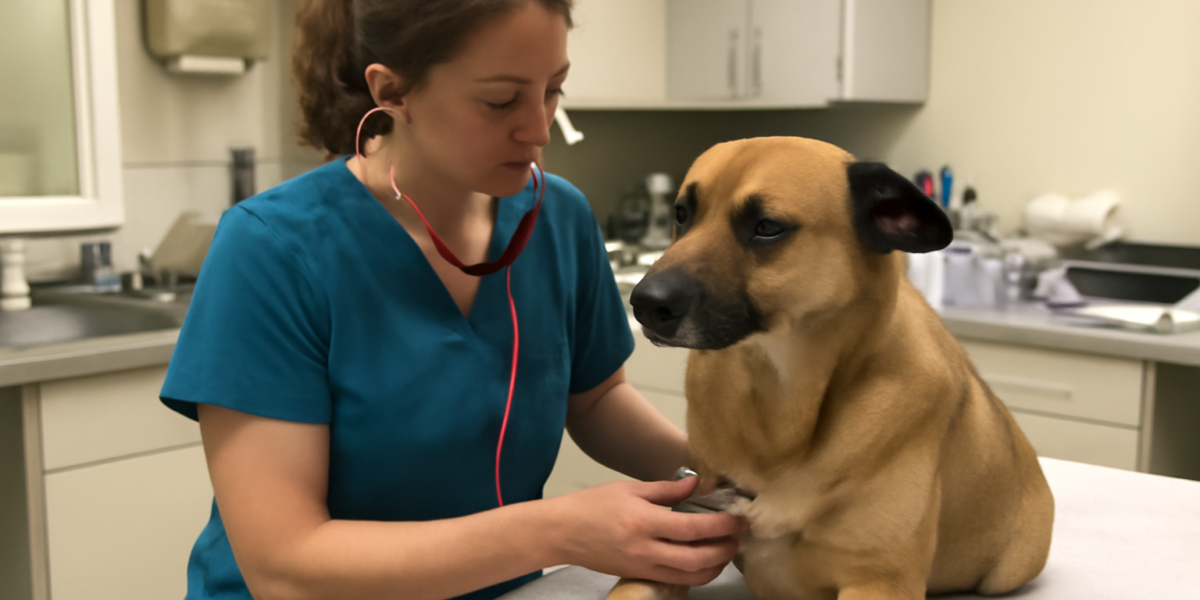
What Are Calming Signals in Dogs?
Calming signals in dogs are the subtle, polite gestures dogs use to lower tension — in themselves, in another dog, or in a human. The term and the original observed list come from Norwegian dog trainer Turid Rugaas, whose book On Talking Terms with Dogs: Calming Signals documented around thirty consistent behaviors dogs use to defuse social pressure.
In this article
- What Are Calming Signals in Dogs?
- The Original Signal List
- Yawning, Lip Licking, and Looking Away
- Sniffing the Ground
- Walking in a Curve and Splitting
- Sitting Down, Lying Down, and Slow Movement
- Play Bow
- Freezing — When Calming Signals Have Failed
- How to Use Calming Signals in Daily Life
- What Calming Signals Are Not
- Pairing Calming Signals With Enrichment
- Frequently Asked Questions
Rugaas’s central insight was that dogs are constantly trying to keep the peace. They yawn, lip-lick, look away, sit down, sniff the ground, and walk in arcs to communicate “I mean no harm” and “let’s keep this calm.” When humans miss these signals — or worse, punish them — dogs lose access to their primary peace-making vocabulary. That is when “out of nowhere” growls and snaps appear.
Learning the calming signal vocabulary is a force-free skill. It reframes “weird” or “guilty” behaviors as functional communication and gives you a way to respond that respects your dog.
The Original Signal List
Rugaas’s observed signals include yawning, lip licking, head turning, looking away, softening of the eyes, turning the body away, sniffing the ground, walking in a curve, slowing down, freezing, sitting down, lying down, play bow, splitting (moving between two tense dogs), and approaching in an arc rather than straight on. Different dogs favor different signals, and individuals build their own dialects.
None of these behaviors are unique to stress. Dogs also yawn when tired, lip-lick after eating, and sniff for the joy of sniffing. The skill lies in reading the behavior in context: a yawn at 9 p.m. on the couch is sleepy; a yawn at the vet while a stranger leans in is a calming signal.
Yawning, Lip Licking, and Looking Away
Yawning out of context is one of the most common calming signals. Dogs yawn to dial down their own arousal and to ask the human or other dog to dial down too. You will see it during nail trims, at the vet, during corrections, when a stranger leans over the dog, and during training when criteria are too high. If your dog yawns repeatedly during a training session, lower the difficulty. If your dog yawns when a child runs over, intervene calmly and add distance. We dig into this signal further in our piece on dog yawning meaning.
Lip licking aimed at no food — a quick tongue flick across the nose — is another classic calming signal. Like yawning, it is contextual: lip licking after eating chicken is unrelated, while lip licking when a stranger reaches for the head, or when the camera comes out, is a quiet “please slow down.” The “kiss-to-dismiss” pattern in many family photos is exactly this: a child leans in for a hug, the dog turns the head and licks. The internet calls it cute. Behaviorists call it a stress signal that owners should respect by giving the dog space.
Looking away and head turns work the same way. Dogs do not enjoy direct, sustained eye contact from strangers, and they diffuse it by turning the head, breaking gaze, or fully turning the body away. This is not rudeness or “ignoring” — it is the dog actively de-escalating. When you meet a strange dog, mirror the polite version of this: stand sideways, soften your eyes, and let the dog approach you. Most shy dogs will offer to engage faster when you stop pressuring them with frontal posture.
Sniffing the Ground
A sudden, intense sniff at the grass when nothing is there is often a calming signal. Dogs use sniffing to give themselves a moment to regulate, and to signal “I’m just minding my business” to a tense dog or person nearby.
Reactive dogs frequently sniff the ground when they spot another dog at distance. Let them. The sniff is them coping, and interrupting it makes the situation worse. This is a core principle in protocols like Behavior Adjustment Training, which we touch on in our guide to leash reactivity in dogs.
Walking in a Curve and Splitting
Confident, well-socialized dogs greet each other in arcs, not head-on. Two dogs approaching nose-to-nose in a straight line is a high-pressure greeting that often goes badly. The arc is a calming signal that says “I’m not coming at you.”
“Splitting” is when one dog physically inserts itself between two tense individuals to break up the building tension. Dogs split between two arguing dogs, between two arguing humans, and even between an owner and a frustrating object. It is a remarkable peacekeeping behavior.
Sitting Down, Lying Down, and Slow Movement
A dog who suddenly sits or lies down in front of an approaching dog is offering a calming signal — making themselves smaller and less threatening. Slow, exaggerated movements serve the same purpose. A dog who slows to a creep when approaching another dog is being polite, not disobedient.
If your dog freezes mid-walk when another dog appears, it may be a calming attempt that has tipped into overwhelm. Add distance and let your dog reset before moving on.
Play Bow
The play bow — front end down, rear end up, soft face — is the friendliest, most universally recognized canine signal. It says “everything I do next is play, even if it looks intense.” Dogs use it to invite play and to repair social mistakes mid-play.
Watch for play bows during interaction. Real play includes frequent bows, role reversals, and self-handicapping by the larger or more skilled dog. Play that lacks these elements has tipped into pestering.
Freezing — When Calming Signals Have Failed
Freezing is technically on the calming-signal list, but it is also the signal that often appears when earlier signals have been ignored. A dog who freezes — body still, breath held, hard eyes — is at the top of the stress ladder. The next rung is often a snap or bite.
If you see a freeze, do not push the interaction. Do not lean closer, do not reach in, do not try to reassure with petting. Calmly add distance, drop the camera, and give the dog room. Children leaning over frozen dogs is one of the most common bite contexts. We discuss this further in our pieces on whale eye in dogs and fear aggression in dogs.
How to Use Calming Signals in Daily Life
You can use calming signals back to your dog. Yawning gently in front of an anxious dog, blinking softly, turning sideways instead of facing them head-on, slowing your movements, and avoiding direct stares all read as polite to a dog. Many shy or fearful dogs warm up faster to humans who use these signals.
You can also use calming signals as a behavioral thermometer. If your dog is showing two or three calming signals in five minutes, the situation is too much. Lower the difficulty, add distance, or end the session. This is true at the vet, during training, on a leash walk, and in any new environment.
What Calming Signals Are Not
Calming signals are not “guilt.” A dog who lip-licks and looks away when you scold them is not confessing — they are appeasing your tense body. Modern behavior science discarded the guilty interpretation as anthropomorphic; it is the dog asking you to lower the pressure, not admitting wrongdoing.
Calming signals are also not submission to “alpha” status. The dominance framework has been retired by the behavior science community for decades. Dogs use these signals to maintain peace, not to acknowledge a hierarchy. Force-free training rests on this distinction. Punishing a calming signal — yelling at a yawn, jerking the leash for a sniff — teaches the dog that polite communication does not work. That is when bites with no warning start to appear.
Pairing Calming Signals With Enrichment
A dog whose daily life provides decompression, sniffing, choice, and rest will show fewer high-stress calming signals than a dog whose life is constant pressure. Slow sniffy walks, food puzzles, snuffle mats, and licki mats all lower the baseline. Our guide to mental enrichment for dogs covers practical ways to build that foundation.
For dogs with serious anxiety — noise phobia, vet anxiety, separation distress — calming signals will appear constantly until the underlying fear is addressed. See our companion guides on noise phobia in dogs and vet visit anxiety in dogs for behavioral plans.
One way to track progress is to count calming signals during a typical fifteen-minute walk or training session each week. Write down the number. Over weeks, the count should drop as the dog feels safer in the contexts you are training. If it does not drop — or if it rises — that is signal that the plan needs adjustment, the criteria are too high, or there is a medical contributor worth investigating. This is a free, repeatable measure that gives you a data-based read on whether your protocol is working.
Frequently Asked Questions
Who first described calming signals in dogs?
Norwegian trainer Turid Rugaas first described and named calming signals after years of observing dogs interacting with each other and with humans. Her book On Talking Terms with Dogs: Calming Signals remains the foundational text on the topic.
Is a yawning dog always stressed?
No. Dogs also yawn when tired, when waking up, or sometimes for no obvious reason. Out-of-context yawning — at the vet, during a hug, when a stranger reaches in — is the version that signals stress.
Should I respond to my dog’s calming signals?
Yes. Treat them as honest information. Add distance, lower the difficulty, end the session, or simply pause. Responding to early signals prevents escalation and builds trust over time.
Can I use calming signals back to my dog?
Absolutely. Soft eyes, slow blinks, turning your body sideways, slow movements, and gentle yawns all read as polite to dogs. They are particularly useful with shy, fearful, or newly adopted dogs.
Are calming signals the same as submission?
No. Calming signals are peace-keeping behaviors, not signs of social rank. The dominance/submission framework has been retired by modern behavior science. Calming signals are about defusing tension, not acknowledging hierarchy.
What if my dog skips calming signals and goes straight to growling?
Often this means earlier signals have been punished or repeatedly ignored, so the dog has learned the polite versions do not work. A force-free trainer or veterinary behaviorist can help rebuild the dog’s communication ladder safely.


