
Last updated: April 27, 2026
In this article
- What Fear Aggression Looks Like
- Recognizing the Signs
- Common Causes
- Medical Workup First
- Management Before Modification
- Counter-Conditioning the Trigger
- Building Confidence Independently
- What Not to Do
- Stranger and Visitor Protocols
- Calming Aids and Medication
- When to Bring in a Behaviorist
- Frequently Asked Questions
What Fear Aggression Looks Like
Fear aggression in dogs is exactly what it sounds like: aggressive behavior driven by underlying fear. Instead of using flight to handle a scary stimulus, the dog uses fight, often because retreat is not possible or the dog has learned that a big display works. The most common trigger categories are unfamiliar people, unfamiliar dogs, handling, vet visits, and specific objects or sounds.
Owners are often surprised by these dogs because they look “confident” when they bark and lunge. They are not. The aggression is a protective strategy built on top of an anxious foundation. Understanding that distinction is the most important reframing in the whole conversation, because the treatment is built around reducing fear, not asserting authority.
Most fear-aggressive dogs would prefer the trigger simply went away. The display is meant to create distance. When the trigger leaves, the dog learns the display worked, and the pattern strengthens.
Recognizing the Signs
Body language tells you what is going on long before the dog escalates. Early warnings include lip licking, yawning, looking away, slowing down, holding the tail low, lowering the head, and a closed mouth. As stress climbs, you may see whale eye, weight shifted backward, raised hackles concentrated at the shoulders, panting that does not match the temperature, and a stiff body.
The aggressive display itself can include barking, growling, snarling with teeth showing, snapping, lunging, and bites. A fearful dog often paired with conflicted body language, like leaning back while lunging forward, is a textbook presentation. Some dogs offer no warning at all, usually because earlier warnings were punished out of them, which is a much more dangerous pattern.
Watch for the recovery period too. A truly confident dog returns to baseline quickly. A fearful dog stays aroused, jumpy, and reactive for minutes to hours after an incident. That long tail of arousal is a classic signature.
Common Causes
Fear aggression usually traces back to one or more of the following:
- Genetic predisposition toward shyness or sensitivity
- Insufficient socialization during the 3 to 14 week sensitive period
- A specific traumatic experience the dog has not recovered from
- Chronic punishment or harsh handling, especially in puppyhood
- Pain or medical conditions that lower threshold
- Sensory loss in older dogs that makes encounters more startling
- Cognitive dysfunction in seniors
Many shelter and rescue dogs come with unknown histories, and you may never know exactly what produced the fear. The good news is that the treatment is the same regardless of the cause. The bad news is that some dogs have such heavy genetic and developmental loading that they will need lifelong management.
Medical Workup First
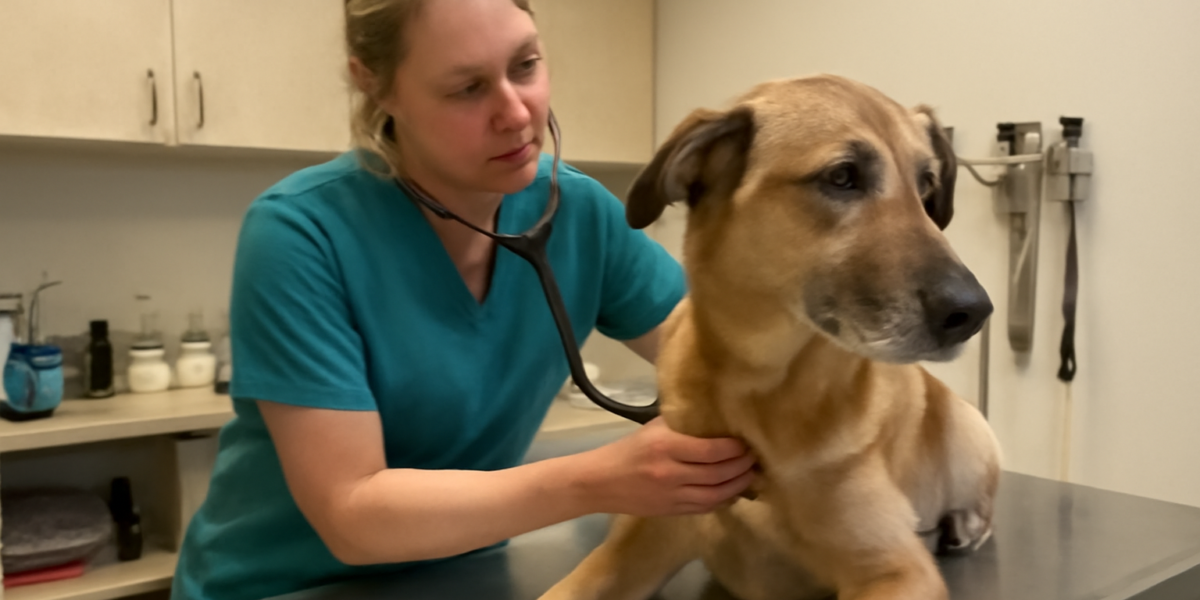
Any sudden change in behavior in an adult dog warrants a veterinary exam before behavior modification begins. Pain is a documented trigger for what looks like fear aggression, particularly handling sensitivity. Dental disease, ear problems, anal gland issues, orthopedic pain, and gastrointestinal disease all show up as a shorter fuse.
The exam should include a thorough physical, bloodwork including thyroid, and depending on findings, urinalysis, imaging, or specialist referral. For senior dogs, screen specifically for cognitive dysfunction and sensory loss. Treating the underlying medical issue often reduces the behavior dramatically without any other intervention.
Even when medical contributors are present, behavior modification is usually still needed because the dog has learned associations that need to be unlearned. The two interventions work together.
Management Before Modification
Every fearful display rehearsed makes the next one more likely. The first job is environmental setup that prevents practice. For a dog who fears strangers, that means baby gates and a safe room when guests visit, advance notice for service workers, and front-door management that keeps the dog away from the entry.
For a dog who fears other dogs, that means walks at off-peak hours, low-traffic routes, parking lots and quiet trails, crossing the street early, and never approaching unfamiliar dogs. For a dog who fears handling, that means going slow, using counter-conditioning at home for husbandry tasks, and making vet visits low-pressure.
Useful equipment includes a basket muzzle (positively conditioned), a sturdy front-clip harness, a six-foot fixed leash, and physical barriers like crates, ex-pens, and gates. Children should never be the primary handler for a fearful dog because they cannot read warnings reliably.
Counter-Conditioning the Trigger
The evidence-based core of treatment is desensitization paired with counter-conditioning, often shortened to DS/CC. The dog encounters a low-intensity version of the trigger and is fed something excellent at the moment of noticing. Over many repetitions, the trigger comes to predict good things and the underlying emotion changes.
Practical execution requires careful threshold management. The trigger has to be far enough away or low enough intensity that the dog can eat and remain calm. If the dog will not take food, you are too close. The food itself matters: real chicken, cheese, hot dog, or freeze-dried liver, not kibble. Timing matters too: the food appears the instant the dog notices the trigger, not after a reaction.
Several structured frameworks support this work. Pattern Games and Look at That from Leslie McDevitt’s Control Unleashed framework give the dog predictable routines. Behavior Adjustment Training, developed by Grisha Stewart in BAT 2.0, lets the dog gather information and choose disengagement. Karen Overall’s Relaxation Protocol builds duration calm in mildly distracting environments.
Building Confidence Independently
Counter-conditioning addresses specific triggers. Confidence-building work raises the dog’s overall resilience, which is what lets them handle novelty in general. The two together work better than either alone.
Confidence-building activities include nose work, food puzzles, sniff walks on a long line in a quiet field, trick training that emphasizes choice, agility-style obstacles in a low-pressure setting, and free shaping with a clicker. These activities reward the dog for engaging with the environment on their own terms and give them a sense of agency.
Provide plenty of decompression time. A fearful dog who is constantly being pushed into new experiences accumulates stress faster than they can process it. Build in quiet days, predictable routines, and uninterrupted rest in a safe space.
What Not to Do
Punishment-based methods are particularly damaging for fear-aggressive dogs and are explicitly contraindicated by AVSAB, IAABC, and ACVB. Prong collars, choke chains, electronic collars, alpha rolls, scruffing, leash pops, and yelling all add fear to a dog who is already operating from a fear baseline. They often suppress warning signals (growls, snarls) without changing the underlying emotion, producing a dog who bites without warning.
Other approaches to avoid include flooding (forcing exposure to scary stimuli), forced socialization at dog parks, encouraging strangers to “win the dog over” with treats (which can produce a conflicted dog who bites the hand reaching out), and any “dominance” framework that frames the dog’s behavior as a status problem.
If a trainer recommends any of the above, find another trainer. The science on this has been settled for years.
Stranger and Visitor Protocols
For dogs who fear strangers, the goal is not making the dog love every visitor. The goal is calm tolerance. Most practical visitor protocols put the dog in a separate room with a long-lasting chew when guests arrive, then bring the dog out on leash once the visitor is settled. The visitor is instructed to ignore the dog completely.
If the dog wants to investigate, they can. If they choose to stay back, they can. The dog gets paired food rewards for calmly being in the room. Visitors should not stare, lean over, reach out, or attempt to “make friends.” Many fear-aggressive dogs do best when guests never attempt direct interaction at all.
Some dogs warm up over multiple visits with the same person; others stay vigilant indefinitely. Both outcomes are acceptable. The only non-negotiable is safety.
Calming Aids and Medication
Pharmacologic and supplement support is appropriate for many fear-aggression cases. Lowering baseline anxiety often makes behavior modification work meaningfully more effective.
Options to discuss with your veterinarian include pheromone products like Adaptil for dogs, alpha-casozepine supplements such as Zylkene for dogs, multi-ingredient calming formulas like Composure for dogs, and CBD oil for dogs. Body wraps such as the anxiety vest for dogs help some individuals.
For dogs with significant fear, daily SSRIs like fluoxetine for dogs and situational support like trazodone for dogs are commonly prescribed. Medication choice should be made by a veterinarian, ideally with veterinary behaviorist input. Pair every medication with active behavior modification.
When to Bring in a Behaviorist
Standard positive-reinforcement trainers can handle reactivity without bite history. For fear aggression involving bites, escalating intensity, or significant unpredictability, you need a board-certified veterinary behaviorist (DACVB) or a certified IAABC behavior consultant working with your vet.
Find a DACVB through the American College of Veterinary Behaviorists directory and a certified consultant through the IAABC directory. Telehealth consults make this accessible even outside major metropolitan areas. For broader context, see our guide to dog aggression causes, our reactive dog overview, and our hub for dog anxiety signs and treatment.
Browse adoptable pets on our adopt a dog hub or read more behavior content in the dog care blog.
Long-Term Outlook
Many fear-aggressive dogs improve substantially with consistent work. Some become genuinely social again. Many become reliably neutral around former triggers, which is a complete win even if they never seek interaction. A small subset reach a ceiling that requires lifelong management, and that is also a successful outcome when it keeps everyone safe.
Setbacks are normal. A startling encounter, illness, hormonal shifts, or simply a stressful week can drop progress backward. Track wins like a calmer recovery, a longer working distance, a new trigger handled, or a quieter household. The trajectory matters more than any single bad day.
Frequently Asked Questions
Can fear aggression be cured?
Improved substantially in most cases, fully resolved in some. Many dogs reach safe, calm neutrality with consistent training and sometimes medication. A subset need lifelong management, which is still a successful outcome when it keeps the dog and family safe.
Why does my dog only act aggressive on leash?
The leash removes the dog’s flight option, which forces an anxious dog into fight-or-freeze. Owner tension travels down the leash too. Off-leash, the same dog often handles the same trigger by simply moving away.
Should I socialize a fear-aggressive dog at the dog park?
No. Dog parks are inappropriate for any dog with fear or aggression. They are also not effective at “fixing” under-socialized dogs and frequently make the problem worse.
What if my dog bites a family member?
Treat it as serious. Separate immediately, schedule a veterinary exam to rule out pain, and contact a board-certified veterinary behaviorist. Do not punish. Do not try to “show the dog who is boss.” The bite was communication that the dog felt cornered, and the priority is preventing the next one.
Can children live safely with a fear-aggressive dog?
Sometimes, with strict management and adult supervision at all times. Children should not be primary handlers, should not approach the dog when resting or eating, and should be taught to leave the dog alone. Cases involving bite history toward a child usually need behaviorist involvement.
Will medication change my dog’s personality?
Properly chosen medication does not sedate or alter personality at therapeutic doses. It reduces baseline anxiety enough that the dog can engage with training and the world. Most owners describe it as “the same dog, just less stressed.”


