
Last updated: March 26, 2026
In this article
- Why Indoor Cat Enrichment Matters
- Food Puzzles and Foraging
- Vertical Climbing Spaces
- Window Watching Stations
- Interactive Toys and Play Sessions
- Solo Play Toys
- Cardboard Boxes and Paper Bags
- Hiding Spots and Safe Retreats
- Rotating Toys Weekly
- Scent Enrichment: Silvervine, Valerian, and Beyond
- Training as Enrichment
- Cat TV and Videos
- Outdoor Enclosures and Catios
- Companion Cat Considerations
- Frequently Asked Questions
Indoor Cat Enrichment: 25 Ideas to Keep Your Cat Happy and Stimulated
An indoor cat can live 15 years or more — significantly longer than the average outdoor cat, whose lifespan is often cut short by traffic, predators, disease, and territorial conflicts. Keeping a cat indoors is one of the most protective decisions an owner can make. But safety alone is not enough. A cat confined to four walls without adequate indoor cat enrichment will develop the same behavioral and psychological problems that affect any intelligent animal deprived of stimulation: obesity, anxiety, destructive scratching, compulsive grooming, litter box avoidance, and aggression. The solution is not to let the cat outside. The solution is to bring the outside in — to design an indoor environment so rich in sensory input, physical challenge, and mental engagement that the cat never feels the absence of the world beyond the window. These 25 enrichment ideas will help you do exactly that.
Why Indoor Cat Enrichment Matters
In the wild, a cat’s day is structured around survival: hunting, stalking, climbing, territorial patrol, scent marking, and navigating complex three-dimensional environments. A house cat retains every one of those instincts but has almost no opportunity to express them in a standard home. The food arrives in a bowl. The territory never changes. There is nothing to hunt, nowhere to climb, and nothing to investigate. The result is a cat that sleeps 18 hours a day not because it is content but because there is nothing else to do.
Indoor cat enrichment addresses this gap by providing structured outlets for natural behaviors. A well-enriched cat is more active, maintains a healthier weight, exhibits fewer stress-related behaviors, and forms a stronger bond with its owner. Enrichment does not need to be expensive or complicated. It simply requires understanding what cats need — predatory play, vertical territory, novelty, sensory stimulation, and choice — and then systematically providing those things. If you are considering adding a cat to your home, visit our adoptable cats page and start planning your enrichment setup before your new companion arrives.
Food Puzzles and Foraging
In nature, a cat may make 10 to 20 hunting attempts per day, succeeding in only a fraction of them. Each attempt involves stalking, pouncing, problem-solving, and physical effort. Placing food in a bowl eliminates all of that complexity and replaces it with nothing. Food puzzles restore the cognitive challenge of obtaining a meal and are one of the single most impactful forms of indoor cat enrichment available.
Start simple. Scatter dry kibble across a muffin tin or place it inside a crumpled paper towel tube with the ends folded shut. As your cat gains confidence, graduate to commercially made puzzle feeders with adjustable difficulty settings. Slow feeder mats, treat-dispensing balls, and snuffle mats all work well. You can also hide small portions of food around the house to simulate foraging — behind furniture, on cat shelves, or inside paper bags. The goal is not to frustrate the cat but to engage its brain before every meal. Most cats take to food puzzles within a few days, and once they do, eating from a plain bowl feels dull by comparison.
Vertical Climbing Spaces
Cats think in three dimensions. Floor space matters far less to a cat than vertical territory — the ability to climb, perch, survey, and retreat upward. A cat that cannot climb is a cat missing a fundamental dimension of its environment. Cat trees are the most common solution and work well when chosen thoughtfully. Look for tall, stable structures with multiple platforms at different heights. Wall-mounted cat shelves offer even more flexibility, allowing you to create climbing paths along walls and up to ceiling height without consuming floor space.
The best vertical setups connect to other enrichment features: a shelf path that leads to a window perch, a cat tree positioned near a bird feeder window, or a series of wall steps that end at a cozy hiding spot near the ceiling. Sisal-wrapped posts incorporated into climbing structures serve a dual purpose, giving the cat a sanctioned scratching surface integrated into its vertical world. If you have multiple cats, vertical space becomes even more critical — it allows cats to establish spatial hierarchy without direct confrontation, reducing tension and resource guarding. Different cat breeds have different climbing drives, so consider your cat’s natural tendencies when designing vertical spaces.
Window Watching Stations
A window is a television set for cats, and the programming never gets old. Birds, squirrels, passing dogs, rustling leaves, shifting light patterns, rain — all of it provides passive but genuine mental stimulation. Setting up a dedicated window watching station is one of the easiest and most effective indoor cat enrichment strategies you can implement. A sturdy window perch, a cat tree positioned beside a window, or even a simple shelf at sill height gives your cat comfortable access to the view.
Amplify the effect by placing a bird feeder or birdbath outside the window. The movement of birds at close range will hold a cat’s attention for hours. If you live in an apartment without a garden view, even street-level activity provides stimulation. Some owners install window-mounted suction cup perches that allow the cat to sit directly in the window frame. Make sure any window your cat accesses has a secure screen — cats in hunting mode can and will launch themselves at glass if something particularly exciting appears on the other side.
Interactive Toys and Play Sessions
Interactive play is the single most important enrichment activity you can share with your cat, and no automated toy can fully replace it. A wand toy — a stick with a feather, ribbon, or small toy dangling from a string — simulates prey movement in a way that activates the full predatory sequence: stare, stalk, crouch, pounce, grab, and bite. Two 15-minute play sessions per day, one in the morning and one in the evening, can transform a sedentary, overweight cat into an alert, athletic one.
The key to effective interactive play is technique. Move the toy away from the cat, not toward it — prey runs from predators, not at them. Let the toy hide behind furniture and reappear. Vary the speed: slow, twitchy movements interspersed with sudden bursts of flight. Allow the cat to catch the toy periodically so it experiences the satisfaction of a successful hunt. End each session by slowing the toy’s movement and then offering a small meal or treat, which completes the natural hunt-catch-eat-groom cycle. This is not optional for indoor cats. It is a biological requirement.
Solo Play Toys
While interactive play with a human is irreplaceable, cats also need toys they can engage with independently, particularly during the hours when their owners are away or asleep. The best solo play toys are those that move unpredictably or reward interaction. Spring-loaded toys that wobble when batted, motorized mice that change direction on contact, and ball-track circuits all work well for self-directed play. Crinkle balls and lightweight plastic springs are inexpensive favorites that many cats will bat around for extended periods.
Catnip-stuffed kicker toys satisfy the grab-and-bunny-kick instinct that is central to feline predatory behavior. Some cats enjoy batting lightweight balls into bathtubs or down hallways, creating their own fetch-style games. The important principle is variety — no single toy will hold a cat’s interest forever. Provide a rotating selection and observe which types your cat gravitates toward. Some cats prefer toys they can chase. Others prefer toys they can wrestle. Matching the toy to the cat’s play style dramatically increases engagement.
Cardboard Boxes and Paper Bags
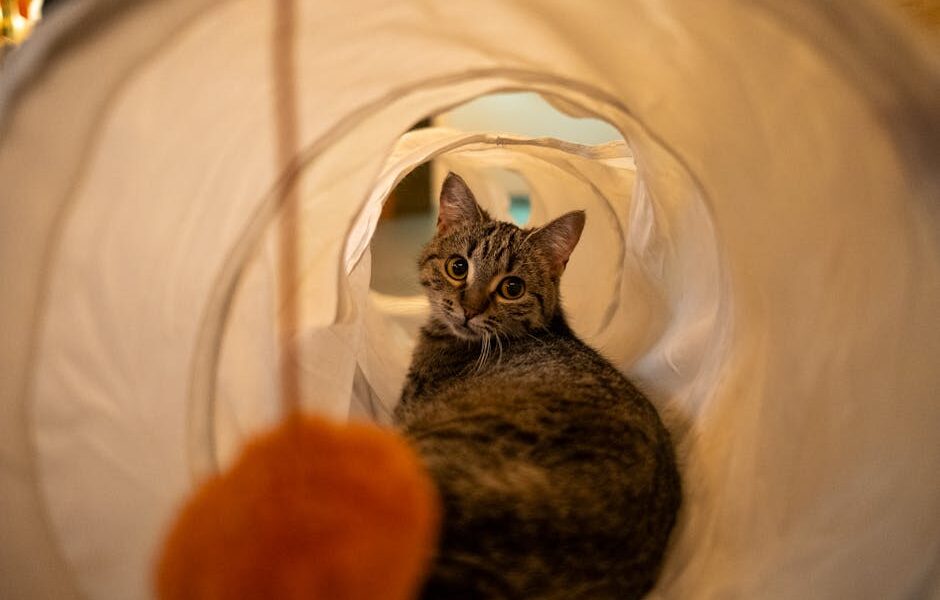
Before you spend money on elaborate enrichment products, remember that the most universally beloved cat toy in existence is free: the cardboard box. There is genuine science behind this preference. Enclosed spaces reduce stress by limiting the angles from which a threat can approach, giving the cat a sense of security and control. Boxes also retain heat, which cats find comforting. A simple cardboard box placed on the floor will attract most cats within minutes.
Paper bags — with the handles removed to prevent entanglement — offer a similar appeal with the added bonus of crinkling sounds that stimulate auditory curiosity. You can cut holes in boxes to create tunnels or stack them to build multi-level structures. Some owners create elaborate cardboard forts by connecting several boxes with cut-out doorways. These homemade structures cost nothing, provide genuine enrichment, and can be recycled and replaced regularly to maintain novelty. Avoid plastic bags entirely, as they pose a suffocation risk.
Hiding Spots and Safe Retreats
A cat that cannot hide is a cat that cannot fully relax. Hiding is not a sign of fear or antisocial behavior in cats — it is a normal, healthy coping mechanism and a fundamental part of feline behavioral repertoire. Every indoor cat should have access to multiple hiding spots distributed throughout the home. These can be as simple as a blanket draped over a chair, a covered cat bed, a shelf in a closet left slightly open, or a cat cave placed in a quiet corner.
Hiding spots are especially important in multi-cat households, where a less dominant cat may need a retreat when social tension arises. They are also critical for newly adopted cats adjusting to an unfamiliar environment. When you bring a new cat home from a shelter — and you can browse cats available for adoption here — provide at least two or three hiding options in the room where the cat will spend its first few days. As the cat gains confidence, it will emerge and explore on its own timeline. Never force a hiding cat out. The ability to hide is what gives the cat the security to eventually stop hiding.
Rotating Toys Weekly
Cats are novelty seekers. A toy that was endlessly fascinating on Monday can become invisible by Friday — not because the toy has changed but because the cat’s brain has categorized it as a known, predictable element of the environment and stopped allocating attention to it. This is called habituation, and it is the reason many owners believe their cat is not interested in toys when in reality the cat is simply bored with the specific toys available.
The solution is rotation. Keep a collection of 15 to 20 toys and divide them into three or four groups. Put one group out for the cat and store the rest in a sealed container with catnip or silvervine to absorb the scent. Every five to seven days, swap the current group for a fresh one. When a toy reappears after a week or two of absence, the cat treats it as a new object — sniffing it, batting it, and engaging with it as though encountering it for the first time. This simple system costs nothing beyond the initial toy investment and dramatically extends the enrichment value of every toy you own.
Scent Enrichment: Silvervine, Valerian, and Beyond
Cats experience the world primarily through scent. Their olfactory system is roughly 14 times more powerful than a human’s, and scent plays a central role in territory assessment, social communication, and emotional regulation. Scent enrichment is an underutilized but highly effective form of indoor cat enrichment that stimulates the brain without requiring any physical activity — making it particularly valuable for senior cats or cats with mobility limitations.
Catnip is the most familiar option, but it only affects about 60 to 70 percent of cats due to a genetic sensitivity factor. Silvervine, a plant native to the mountainous regions of East Asia, triggers a response in a broader percentage of cats and often produces a more intense reaction. Valerian root is another alternative that many cats find irresistible. You can offer these dried herbs sprinkled on scratching posts, rubbed into toys, or placed inside fabric pouches. Some owners grow cat grass indoors — wheat grass or oat grass — which provides both scent stimulation and a safe chewing outlet. Introducing a new scent to the environment once or twice a week adds a layer of novelty that keeps the cat mentally engaged.
Training as Enrichment
The myth that cats cannot be trained is exactly that — a myth. Cats are highly trainable when the method respects their nature. Clicker training, which uses a small device that produces a consistent clicking sound to mark desired behavior followed by an immediate food reward, works exceptionally well with cats. Most cats can learn to sit, come when called, high-five, spin, and even navigate a simple agility course within a few weeks of short daily sessions.
Training provides enrichment on multiple levels. It engages the cat’s problem-solving abilities, strengthens the human-cat bond, and gives the cat a sense of agency — the ability to control outcomes through its own behavior. Keep sessions short, between three and five minutes, and always end on a success. Never use punishment or negative reinforcement, which will cause the cat to disengage entirely. The treats used during training should be small, high-value, and deducted from the cat’s daily caloric intake to avoid weight gain. Training is especially beneficial for high-energy breeds that need more mental stimulation than the average house cat. You can explore different breeds and their activity levels in our cat breeds directory.
Cat TV and Videos
It may sound whimsical, but cat-specific video content is a legitimate enrichment tool backed by animal behavior research. Videos designed for cats typically feature close-up footage of birds, fish, squirrels, and insects moving across the screen, often accompanied by natural sounds like chirping and rustling. Many cats will watch these videos with intense focus, tracking movement with their eyes and occasionally pawing at the screen.
Cat TV is not a replacement for active play or physical enrichment, but it serves as a useful supplement — particularly during times when you cannot interact with your cat directly. Play the videos on a tablet propped securely on a surface or on a television at your cat’s eye level. Some cats lose interest after a few minutes, while others will watch for an hour or more. Observe your cat’s response and adjust accordingly. If your cat becomes frustrated by its inability to catch the on-screen prey, limit screen time and redirect to a physical toy. Used thoughtfully, cat TV adds another dimension to a comprehensive enrichment plan.
Outdoor Enclosures and Catios
A catio — a screened outdoor enclosure designed specifically for cats — represents the best of both worlds: access to outdoor sensory experiences without exposure to outdoor risks. Catios range from small window-box designs that extend from a single window to large freestanding structures that fill an entire patio or backyard section. Inside a catio, a cat can feel the breeze, smell outdoor air, watch birds and insects at close range, bask in filtered sunlight, and experience the changing weather — all while remaining safely enclosed.
Building a basic catio can be as simple as framing a wooden structure and attaching wire mesh or hardware cloth on all sides, including the top. Many commercially available catio kits require only basic tools and an afternoon of assembly. Position the catio to connect to the house through a window or cat door so your cat can enter and exit freely. Add platforms at different heights, a scratching post, and a shaded resting area. If a full catio is not feasible, even a secured window box or a screened-in balcony provides meaningful outdoor exposure. For apartment dwellers, a harness and leash can offer supervised outdoor time as an alternative, though this requires patient training and a cat with the right temperament.
Companion Cat Considerations
One of the most significant enrichment decisions an owner can make is whether to add a second cat. For many indoor cats, a compatible feline companion provides a level of social interaction, play, and mutual grooming that no toy or human can fully replicate. Two cats will chase each other, wrestle, groom each other’s hard-to-reach spots, and share sleeping spaces in ways that clearly indicate contentment and social fulfillment.
However, adding a second cat is not a universal solution and can backfire badly if done without careful thought. Not all cats want or tolerate a companion. Cats that have lived alone for years, cats with territorial aggression, and cats with anxiety disorders may become significantly more stressed by the introduction of another cat. Age, temperament, and energy level should be closely matched — a rambunctious kitten paired with a sedentary senior is a recipe for conflict. Introductions must be gradual, ideally over two to four weeks, using scent swapping and controlled visual access before any direct contact. If you are considering a companion cat, browse our available cats and speak with the rescue team about personality matching. A well-matched pair of indoor cats will enrich each other’s lives in ways that nothing else can.
Frequently Asked Questions
How many hours of enrichment does an indoor cat need per day?
Most veterinary behaviorists recommend a minimum of 30 to 60 minutes of active engagement per day, split across two or more sessions. This includes interactive play with wand toys, training sessions, and puzzle feeding. Passive enrichment — window watching, exploring new scents, solo play with rotating toys — should be available throughout the day. The exact amount depends on the cat’s age, breed, and energy level, but erring on the side of more stimulation rather than less is always safer for indoor cats.
My cat ignores every toy I buy. What am I doing wrong?
The most common reason cats ignore toys is presentation rather than the toy itself. A toy lying motionless on the floor is not prey — it is furniture. Wand toys need to be moved in realistic prey patterns: away from the cat, behind obstacles, with unpredictable speed changes. For solo toys, try rotating them weekly so they feel novel. Also consider that your cat may prefer a specific prey type — some cats favor bird-like feather toys while others respond to ground-running mouse-style toys. Experiment with different textures, sizes, and movement styles before concluding that your cat does not like toys.
Is catnip safe for cats to use regularly?
Yes. Catnip is completely non-toxic and non-addictive. The active compound, nepetalactone, triggers a temporary euphoric response in genetically sensitive cats that lasts about 10 minutes, followed by a refractory period of roughly 30 minutes during which the cat will not respond again. Offering catnip two to three times per week is a reasonable frequency. If your cat does not respond to catnip, try silvervine or valerian root as alternatives — both are equally safe and affect a broader range of cats.
Can I leave my indoor cat alone all day while I work?
Adult cats can generally tolerate eight to ten hours alone, provided the environment is properly enriched. Before leaving, set up food puzzles, ensure window perches are accessible, leave a few rotating toys out, and consider running a cat TV playlist on a tablet. An automated toy that activates on a timer can also provide midday stimulation. If your cat shows signs of distress during extended alone time — excessive vocalization, destructive behavior, or litter box avoidance — a companion cat or a midday visit from a pet sitter may be necessary.
What is the best indoor cat enrichment for senior cats?
Senior cats benefit most from low-impact enrichment that engages the mind without demanding athletic performance. Scent enrichment with silvervine or valerian, gentle interactive play with slower wand toy movements, heated cat beds near windows, food puzzles set to easy difficulty, and short clicker training sessions are all excellent choices. Ensure that climbing structures have ramps or low-entry platforms so arthritic cats can still access vertical space. Senior cats may play less intensely, but they still need daily mental stimulation to maintain cognitive health.


