
Last updated: March 26, 2026
In this article
- Tail Up: Happy and Confident
- Tail Down: Scared or Submissive
- Puffed Tail: Frightened or Threatened
- Slow Swish: Focused and Hunting
- Fast Whip: Irritated or Agitated
- Tail Wrapped Around You: Affection and Trust
- Question Mark Tail: Playful and Friendly
- Tucked Tail: Nervous or Anxious
- Twitching Tip: Mild Interest or Slight Irritation
- Tail Between Legs: Fear and Submission
- How to Read Your Cat’s Tail in Context
- Frequently Asked Questions
- Final Thoughts
Cat Tail Language: What Your Cat’s Tail Is Telling You
Cats are famously subtle communicators. Unlike dogs, who broadcast their emotions with full-body wiggles and enthusiastic barking, cats rely on quieter signals to express how they feel. Of all the body language cues your cat uses, the tail is one of the most expressive and easiest to read once you know what to look for.
Understanding cat tail language can transform your relationship with your feline companion. When you learn to decode the position, movement, and shape of your cat’s tail, you gain real-time insight into their emotional state, whether they are happy, scared, focused, irritated, or looking for affection. This guide breaks down the most common cat tail positions and what each one means.
Tail Up: Happy and Confident
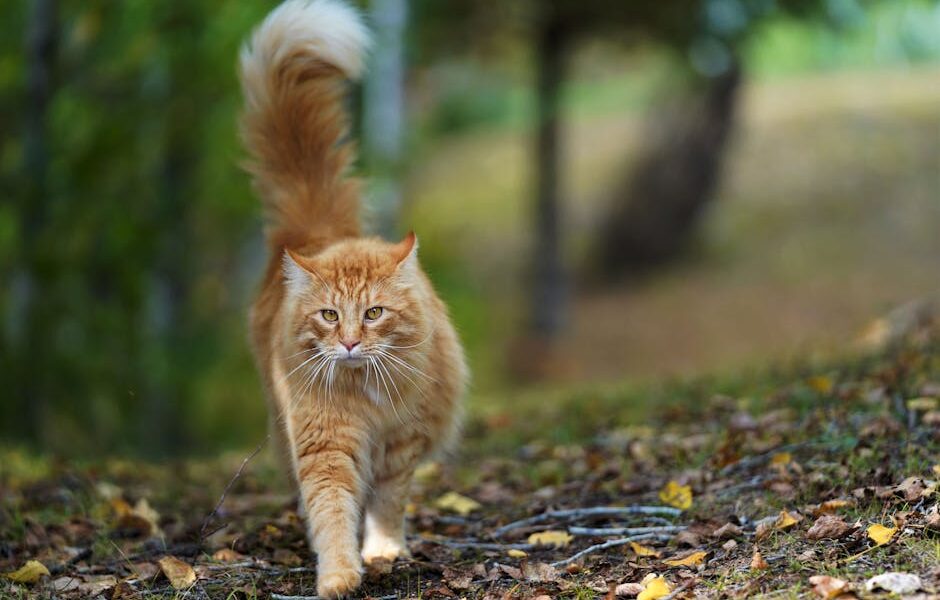
A tail held straight up in the air is one of the most positive signals in cat tail language. This upright position means your cat is feeling happy, confident, and comfortable in their environment. Cats typically display the tail-up posture when greeting someone they like, walking through a space they feel safe in, or approaching their food bowl at mealtime.
Kittens learn the tail-up signal from their mothers at a very young age. Mother cats use an upright tail to let their kittens know it is safe to approach, and kittens respond with their own tails raised high. This early social behavior carries into adulthood, making it one of the most reliable indicators of a content and confident cat. If your cat’s tail is almost always held high around the house, you are doing something right as a cat owner.
Tail Down: Scared or Submissive
When a cat holds their tail low, pointing downward toward the ground, it usually signals fear, anxiety, or submission. A cat with a low tail may be encountering an unfamiliar person, hearing a loud noise, or navigating a new space. The low position is a way of making themselves appear smaller, which is an instinctive response to potential danger.
It is important to note that some cat breeds naturally carry their tails lower than others. Persians and certain Scottish Folds may hold their tails at a lower angle even when perfectly relaxed. Context matters. Look at overall body language, including ear position, pupil dilation, and body posture, to get the full picture. If your cat frequently holds their tail low, consider whether something in their environment might be causing ongoing stress.
Puffed Tail: Frightened or Threatened
A puffed-up tail, sometimes called a bottle-brush tail, is one of the most dramatic signals in cat tail language. When a cat’s tail fur stands on end, making it appear two or three times its normal size, the cat is experiencing intense fear or feels seriously threatened. This involuntary response makes the cat look bigger and more intimidating, and it is often accompanied by an arched back, flattened ears, and hissing.
When your cat displays a puffed tail, give them space. Do not try to pick them up or comfort them with physical contact, as a frightened cat may scratch or bite out of reflex. Remove the source of the threat if possible, speak in a calm low voice, and let them retreat to a safe spot on their own terms. Most cats calm down within a few minutes once the perceived danger passes.
Slow Swish: Focused and Hunting
A slow, deliberate side-to-side swishing motion is a sign that your cat is deeply focused on something. This tail movement is most commonly seen during hunting behavior, whether your cat is stalking a bird through the window, zeroing in on a toy, or watching an insect crawl across the floor. The slow swish is controlled, rhythmic, and purposeful, with the cat’s body low and still and their eyes fixed on the target.
This is completely normal behavior rooted in your cat’s predatory instincts. If you see this tail movement during play, it means your cat is fully engaged. Interactive toys that mimic prey movement, such as wand toys with feathers, are excellent for triggering this focused hunting behavior and providing the mental stimulation your cat needs.
Fast Whip: Irritated or Agitated
A fast, forceful whipping or thrashing of the tail is a clear warning sign. Unlike the slow focused swish, a rapid tail whip means your cat is irritated, overstimulated, or agitated and is telling you to back off. This often appears during petting sessions that have gone on too long. Many cats have a threshold for physical contact, and the fast tail whip is their way of saying they have had enough before resorting to a bite or swat.
Other triggers include being confined in a space they want to leave, being near an animal they dislike, or watching prey they cannot reach. When you see a fast tail whip, stop the interaction and give your cat space. They will come back on their own terms when ready. Respecting this signal builds trust over time.
Tail Wrapped Around You: Affection and Trust
When your cat wraps their tail around your arm, leg, or hand, it is one of the most affectionate gestures in their communication repertoire. This behavior is the feline version of a hug, signaling deep trust, comfort, and a desire for connection. Cats also wrap their tails around other cats they are bonded with, making it a sign of strong social attachment.
Not all cats display this behavior, so if yours does, take it as a high compliment. Respond with gentle interaction like a slow blink or a soft chin scratch to reinforce the bond. If you are thinking about adopting a cat, moments like these are what make the experience so rewarding.
Question Mark Tail: Playful and Friendly
A tail curved at the top into a question mark or hook shape is one of the most cheerful signals in cat tail language. This playful posture means your cat is in a good mood and open to interaction, play, or exploration. You will often see it when your cat approaches you for attention or investigates something interesting.
The question mark tail is especially common in kittens and young cats but appears in adult cats of all ages when they are feeling lighthearted. When you see this tail position, it is an open invitation. Grab a toy, offer a treat, or simply spend a few minutes giving your cat the attention they are asking for.
Tucked Tail: Nervous or Anxious
A tail tucked tightly against the body or curled underneath signals nervousness, anxiety, or deep insecurity. This is a step beyond the low tail position and indicates a higher level of emotional distress. You may see this during veterinary visits, when meeting intimidating strangers, or when a dominant animal in the household is nearby.
If your cat regularly displays a tucked tail at home, something in their environment is causing chronic stress. Common culprits include conflict with another pet, lack of safe hiding spaces, or insufficient resources in multi-cat homes. Provide multiple hiding spots, ensure each cat has their own resources, and consult your veterinarian if the behavior persists.
Twitching Tip: Mild Interest or Slight Irritation
A tail that is mostly still with just the tip twitching or flicking is one of the more nuanced signals in cat tail language. If your cat is watching birds from a windowsill and the tip twitches, they are mildly interested but not in full predatory mode. However, if the tail tip starts twitching while you are petting them, it may be an early warning that they are approaching their stimulation threshold.
The twitching tip is a subtle signal that rewards attentive owners. By noticing this small movement and adjusting your behavior accordingly, you demonstrate that you understand and respect your cat’s boundaries, which leads to a more trusting relationship over time.
Tail Between Legs: Fear and Submission
A tail pressed flat between the hind legs is a strong indicator of fear and submission. A cat displaying this posture feels genuinely threatened and is signaling that they are not a threat. This position is often seen in cats in unfamiliar or overwhelming environments, such as shelters, new homes, or veterinary clinics.
If you have recently adopted a cat and notice this posture, patience is the most important thing you can offer. Give them a quiet room with food, water, a litter box, and hiding spots. Let them come to you rather than forcing interaction. Understanding this tail position is especially valuable for anyone considering adopting a rescue cat, because the fear is real but temporary in the right hands.
How to Read Your Cat’s Tail in Context
The most accurate reading of cat tail language comes from looking at the whole picture. A cat’s tail works together with ear position, eye shape, vocalizations, and body posture to tell a complete story. An upright tail with forward-facing ears means confidence, while an upright tail with puffed fur could indicate aggression.
Spend time observing your cat during different activities and moods. Over time, you will develop an intuitive understanding of your specific cat’s communication style. The more fluent you become in cat tail language, the better equipped you are to meet your cat’s needs and deepen the trust between you.
Frequently Asked Questions
Why does my cat wag their tail when I talk to them?
A gentle tail wag while you are talking usually means your cat is acknowledging your voice and paying attention. It is a sign of engagement and mild interest. If the wag becomes faster or more forceful, it may indicate overstimulation, so watch the intensity and adjust accordingly.
Do all cat breeds use the same tail language?
The core tail signals are consistent across all domestic cats. However, some breeds are more expressive than others, and breeds like the Manx or Japanese Bobtail have shorter tails that make some positions harder to read. Explore our cat breeds directory to learn about breed-specific traits.
Is a cat wagging their tail the same as a dog wagging their tail?
No. A dog wagging their tail usually expresses excitement and happiness. A cat moving their tail rapidly is more likely expressing irritation or overstimulation. Slow tail movements in cats indicate focus or mild interest, while fast movements are typically a warning sign.
What does it mean when my cat wraps their tail around their own body?
A cat wrapping their tail around their body while sitting or lying down is usually a sign of contentment and relaxation. However, if they wrap it tightly while displaying other stress signs like flattened ears or wide eyes, they may be anxious and self-soothing.
Can I train my cat to be more expressive with their tail?
You cannot train a cat to change their tail language, as these signals are instinctive. However, you can create an environment that encourages positive signals. A cat who feels safe, stimulated, and loved will naturally display more confident tail positions like the upright tail and question mark curl.
Why does my cat puff up their tail when they see me?
This is likely a startled reaction rather than aggression. Cats can puff up momentarily when surprised, even by someone they love. If it happens regularly, you may be approaching too quickly or quietly, startling them before they realize it is you.
Final Thoughts
Your cat’s tail is a constantly broadcasting antenna of emotion and intention. From the joyful upright tail of a happy greeting to the puffed-up bottle brush of a frightened cat, every position and movement carries meaning your cat expects you to understand.
Learning to read cat tail language requires attention and practice, but the payoff is enormous. Whether you already share your home with a cat or are considering adopting your first feline companion, understanding tail language is one of the best investments you can make in that relationship. Your cat is always talking to you. All you have to do is watch.


