
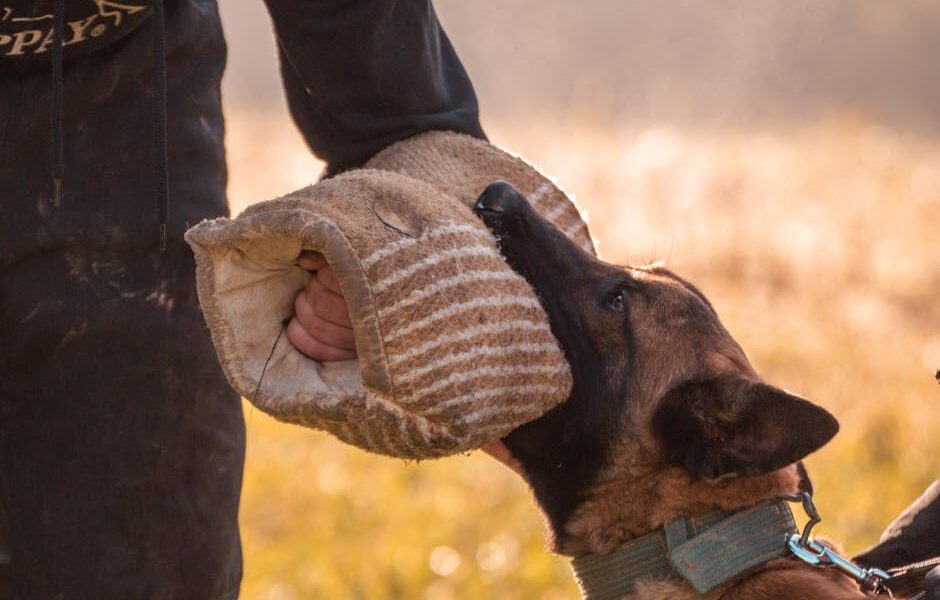
What Dog Petting-Induced Aggression Is
Dog petting-induced aggression is a category of conflict behavior in which a dog who is being touched, held, restrained, or groomed escalates from tolerance to growl, snap, or bite. The dog is not “suddenly aggressive” — they have nearly always been giving handling-tolerance signals long before the bite, and those signals were missed, ignored, or punished.
In this article
- What Dog Petting-Induced Aggression Is
- The Handling Threshold Concept
- Pre-Bite Signals: The Tolerance Ladder
- The 3-Second Consent Test
- Where Dogs Generally Prefer to Be Touched
- Building Handling Tolerance: A Cooperative Care Approach
- Differentiating Petting-Induced Aggression from Other Causes
- When to Use a Muzzle
- When Medication Helps
- When to Escalate to a Professional
- Frequently Asked Questions
The classic case: a dog is on the couch being petted, appears to be enjoying it, and then suddenly turns and snaps at the petter. The handler reports “no warning.” Slow-motion video almost always reveals two to three lower-rung warning signals (tongue flick, whale eye, weight shift, freeze, lip lift, head turn away) in the seconds before the snap. The dog was telling you it had reached its handling threshold.
This article walks through the handling threshold concept, the pre-bite signals to learn, the 3-second consent test, structured tolerance-building, and when to escalate to professional support. It complements our broader reading dog body language guide and the dog aggression causes overview.
The Handling Threshold Concept
Every dog has a handling threshold — a duration, intensity, and location of touch beyond which they become uncomfortable. Some dogs have a high threshold and tolerate hours of full-body petting. Some dogs have a low threshold and become uncomfortable after thirty seconds of head-stroking. Most dogs are somewhere in between, with location-specific tolerances (a dog may love chest scratches and dislike top-of-head petting).
The handling threshold is not “the dog needs more socialization” — it is an individual characteristic that varies by breed history, individual temperament, past handling experiences, current pain, and arousal level. A dog with mild orthopedic pain has a lower threshold for hip-area petting than the same dog without pain. A dog who has just exercised may tolerate touch better than one woken from sleep.
Respecting the handling threshold is not coddling. It is the foundation of a long-term relationship in which the dog trusts that handling will not exceed what it can tolerate. Dogs whose thresholds are respected gradually become more tolerant over time. Dogs whose thresholds are repeatedly violated become more reactive over time.
Pre-Bite Signals: The Tolerance Ladder
The signals that a dog is approaching its handling threshold sit on a graded ladder. Learn the ladder, and you will rarely be bitten by a familiar dog.
Bottom rung — subtle distancing. The dog turns its head slightly away. Looks past you rather than at you. Shifts weight backward. Pulls one paw away. Stops leaning into the petting and becomes a passive recipient.
Second rung — appeasement. Tongue flick. Lip lick. A brief slow blink. The commissure pulls back into a long C. A small yawn. These are calming signals — the dog is asking for the touch to ease.
Third rung — clear discomfort. Whale eye (white sclera showing). Head turned away, body angled away. Freeze — sudden stillness with held breath. A subtle lip lift, often quickly retracted.
Fourth rung — overt warning. Growl. Snarl. Snap (an air-bite that does not make contact). The dog has formally warned you. Stop touching, slowly release pressure, allow the dog to disengage. Never punish — punishing this rung teaches the dog to skip directly to a bite.
Fifth rung — bite. Contact with teeth, with or without injury.
For more on the ladder framework, see our dog body language guide. The signals are subtle and easily missed if you are not specifically watching for them.
The 3-Second Consent Test
The 3-second consent test (sometimes called the petting consent test) is a structured tool for assessing whether a dog wants to continue an interaction. It is simple, fast, and effective for both familiar dogs and dogs you have just met.
Pet the dog gently for three seconds on a low-risk area (chest, side of neck, shoulder). Stop. Wait. Watch the dog’s response. If the dog leans in, nudges you, paws at you, or moves closer, they are consenting to continue. If the dog moves away, looks elsewhere, freezes, or shows any of the lower-rung warning signals, they are declining. Respect the decline.
Use the test repeatedly throughout an interaction. A dog who consented at second 10 may decline at second 30 because they have reached their threshold for that session. Allowing the dog to opt out gradually builds tolerance — because the dog learns that handling is predictable, finite, and respectful.
Teach children the consent test as well, with adult supervision. Children are statistically the most common bite victims in family dog cases, often because they do not recognize when a dog is asking to be left alone.
Where Dogs Generally Prefer to Be Touched
Most dogs prefer touch in low-risk areas they cannot easily groom themselves and that do not feel restraining. Generally well-tolerated locations include the chest, the side of the neck, the shoulder, the side of the body, and the base of the tail.
Generally less well-tolerated areas include the top of the head (looms over the dog’s face), the muzzle, the ears (especially inside), the paws (especially the rear), the hindquarters, and the belly (despite popular belief — many dogs roll over as appeasement rather than as a request for belly rubs).
Individual dogs vary. Some dogs love ear massage and tolerate belly rubs warmly. Others find these aversive. Use the consent test to find out for the individual dog you are working with rather than assuming.
Building Handling Tolerance: A Cooperative Care Approach
Cooperative care training builds genuine handling tolerance through consent-based protocols. The dog learns that handling is predictable, finite, paid (with food reinforcement), and reversible (they can opt out by moving). Within weeks, even handling-sensitive dogs typically gain meaningful tolerance.
The foundation behaviors are the chin rest (the dog rests its chin on your hand or a target, and any time the chin lifts, you stop touching) and the stationing behavior (the dog stands on a mat or platform and remains there as a signal of consent). When the dog leaves the station or lifts the chin, the procedure stops. This puts the dog in genuine control.
Pair these foundations with high-value food reinforcement and very gradual handling progressions. For example, brushing might start with a single brushstroke on the shoulder followed by a treat, building to longer sessions over weeks. See our pillar on cooperative care for reactive dog vet visits for the structured protocols that translate directly to home handling.
Differentiating Petting-Induced Aggression from Other Causes
Several aggression categories present as “bit me while I was petting them.” Distinguishing them changes the treatment plan.
Pain-related aggression. The dog tolerated petting before, but now snaps when touched in a specific area. Always rule out musculoskeletal, dental, ear, or abdominal pain before treating as purely behavioral. Senior dogs with new petting aggression deserve a workup including the senior pet pain assessment.
Resource-guarding aggression. The dog is on a bed, holding a toy, or near food and snaps when approached or touched. This is location- or item-specific. See our resource guarding protocol and the broader resource guarding in dogs overview.
Fear-based aggression. The dog is generally fearful of touch from unfamiliar people. Approaching strangers trigger snap responses. Different protocol — see fear aggression in dogs.
Petting-induced aggression proper. The dog tolerates touch for a finite period from a familiar handler and then escalates. The treatment is consent-based handling tolerance training as outlined above.
When to Use a Muzzle
For dogs who have bitten during handling, especially during essential procedures like nail trims, ear cleaning, vet exams, or grooming, a properly conditioned basket muzzle is essential safety equipment. It protects everyone, lowers handler stress (which lowers dog arousal), and allows the cooperative care protocol to proceed safely.
See our pillar on muzzle positive conditioning for reactive dogs for the two-to-four-week conditioning protocol. The wrong approach is to put a muzzle on a struggling dog right before the procedure — that pairs the muzzle with stress. The right approach is to build positive muzzle associations weeks before the procedure ever happens.
When Medication Helps
For dogs with very low handling thresholds, especially for essential medical care, anxiolytic medication can change what is possible. Daily SSRI medication like sertraline or paroxetine lowers the baseline arousal so the behavior modification can take hold. For event-specific high arousal (vet visits, grooming appointments), trazodone or gabapentin two to three hours before the appointment can take a dog from “impossible to handle” to “manageable with cooperative care.”
Medication is not a shortcut around behavior work. It is a tool that makes behavior work effective. All decisions about behavior medication should involve your veterinarian, ideally one with behavior training.
When to Escalate to a Professional
Refer to a certified behavior professional when there is bite history with injury, when bites are becoming more frequent or severe, when the household includes children, or when basic cooperative care protocols are not gaining traction within four to six weeks. Look for IAABC CDBC, CAAB, or DACVB credentials. Avoid dominance-based trainers and tools — these worsen petting-induced aggression by adding stress to an already conflicted dog.
Frequently Asked Questions
My dog used to love being petted but now snaps — what happened?
The first rule-out is medical, especially pain. Schedule a vet exam including orthopedic, dental, and abdominal palpation. If medical workup is clear, look for changes in arousal (new stressor in the household, less exercise, less sleep) and apply the consent-based handling protocol.
Is it true that dogs that roll over want belly rubs?
Often not. Many dogs roll over as an appeasement gesture — they are showing the soft underside to defuse a perceived threat. Use the 3-second consent test: rub briefly, stop, watch. If the dog leans in or asks for more, they are consenting. If they move away or freeze, they were appeasing.
Should I punish my dog for snapping?
No. The snap is a warning that prevented a bite. Punishing it teaches the dog to skip the warning. Stop touching, give the dog space, and address the underlying threshold issue with structured cooperative care.
How long does building handling tolerance take?
For most dogs, meaningful improvement appears within four to six weeks of consistent daily cooperative care sessions. Severely conflicted dogs may take three to six months. Speed depends on the dog, not the calendar.
Can children participate in handling tolerance training?
Adults should run the protocol first to build a solid foundation. Children can participate with close adult supervision and explicit consent-test training. For dogs with any bite history, children should not handle the dog alone until the protocol is well-established and a behavior professional has signed off.


