
Last updated: April 27, 2026
In this article
- What Generalized Anxiety Means in Dogs
- Signs You Are Looking at Generalized Anxiety
- Get a Veterinary Workup First
- The Treatment Framework
- Why Punishment Makes Anxiety Worse
- The Adoption-Context Reality
- Daily Life with an Anxious Dog
- Stress Stacking and the Trigger Bucket
- When to Consult a Veterinary Behaviorist
- Frequently Asked Questions
What Generalized Anxiety Means in Dogs
Generalized anxiety in dogs refers to a sustained, baseline elevation in worry that is not tied to a specific trigger. A dog with thunderstorm phobia is fine until the storm starts; a dog with separation anxiety is fine while you are home. A dog with generalized anxiety is anxious most of the time — pacing, vigilant, unable to settle, struggling to sleep deeply, easily startled, and slow to recover from minor stressors.
This presentation is well recognized in veterinary behavior medicine, though it is more commonly referred to as “panic disorder” or “general anxiety disorder” in clinical contexts. It overlaps with — but is distinct from — fear-based reactivity, separation anxiety, and noise phobia. A dog can have generalized anxiety alone, or generalized anxiety plus a specific anxiety like noise phobia stacked on top.
The good news is that generalized anxiety in dogs responds well to a multi-modal approach: management to reduce stressors, behavior modification to build coping skills, and often pharmacological support to lower the baseline. Without treatment, chronic anxiety affects sleep, immune function, gut health, and longevity. With treatment, most dogs improve substantially.
Signs You Are Looking at Generalized Anxiety
The pattern that distinguishes generalized anxiety from situational anxiety is its constancy. Common signs include:
- Difficulty settling — even in a quiet familiar environment, the dog cannot lie down and relax for sustained periods
- Pacing, especially in the evening or before bed
- Hyper-vigilance — startling at small sounds, scanning the environment, alerting to neighbors moving in adjacent units
- Lip licks, yawns, panting in cool, quiet rooms
- Decreased appetite or eating only when no one is nearby
- Reduced play behavior
- Difficulty being alone in any room, even with people in the house
- Sleep disturbance — light, fragmented sleep; waking at small sounds
- Excessive licking, scratching, or other displacement behaviors
- Stress-related GI issues — soft stool, intermittent vomiting, food sensitivity
An adopted dog showing several of these signs in the first three to six weeks may simply be in decompression. Anxiety symptoms that persist past the three-month mark, or that intensify rather than improve with stable routine, warrant a closer look.
Get a Veterinary Workup First
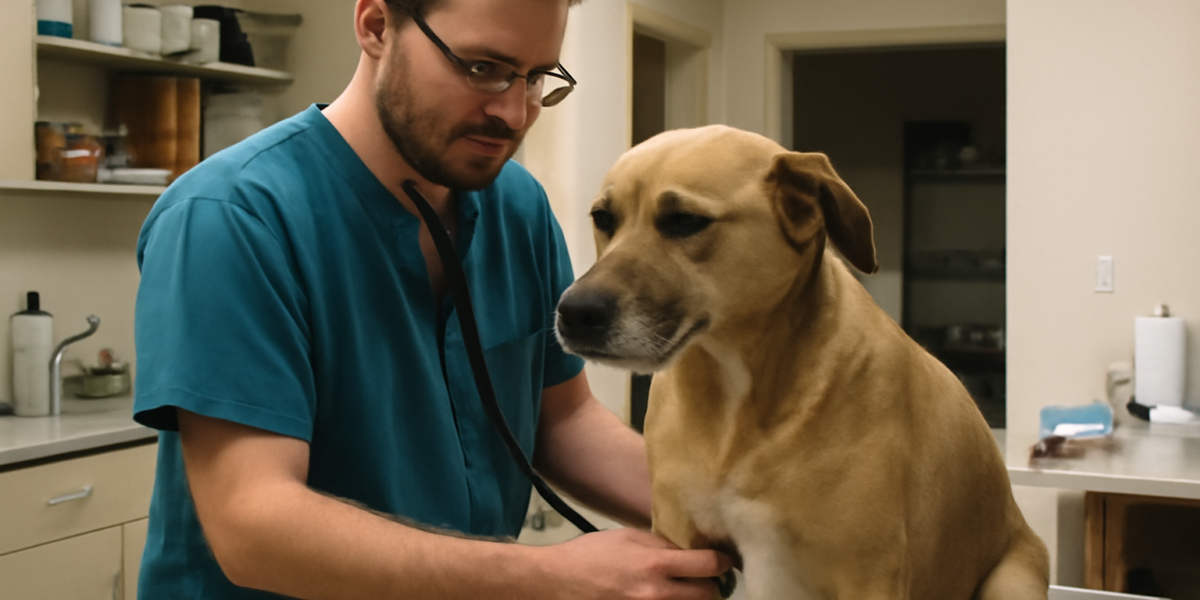
Many medical conditions mimic anxiety. Pain in particular is wildly under-recognized as a contributor — orthopedic pain, dental pain, GI discomfort, ear infections, urinary tract issues, and skin disease all change behavior. Endocrine conditions like Cushing’s disease and hypothyroidism can produce restlessness, anxiety, or behavioral changes. Cognitive dysfunction in older dogs presents almost identically to anxiety.
A reasonable workup before assuming a behavior diagnosis includes a full physical, complete blood count, chemistry panel, T4, urinalysis, and a thorough orthopedic exam. For older dogs or dogs with sudden onset, additional imaging or specialty evaluation may be warranted.
If your dog’s anxiety started suddenly after years of being calm, the index of suspicion for medical cause goes up. Sudden behavior changes in adult dogs are medical until proven otherwise.
The Treatment Framework
Treatment of generalized anxiety in dogs has three layers, used in combination. None of them works as well alone.
Layer 1: Reduce the load. Audit your dog’s life and remove unnecessary stressors. That might mean changing walking routes to quieter streets, reducing exposure to triggering visitors, providing a covered safe space, using white noise or calming music, switching to enrichment-based feeding, and maintaining a consistent daily routine. Predictability is calming.
Pheromone support is appropriate at this layer. Adaptil for dogs diffusers run continuously in the rooms your dog spends most time in. Compression wraps (anxiety vests) help some dogs, especially during predictable arousal times.
Layer 2: Behavior modification. Teach the dog skills that help them cope. A reliable settle cue. A go-to-place behavior with positive associations. Cooperative care training so handling and grooming are not stressors. Counter-conditioning to specific recurring triggers (the doorbell, the mail carrier, your departure routine).
Enrichment matters. Anxious dogs benefit from work that engages the brain — snuffle mats, puzzle feeders, scent games, short training sessions multiple times daily, decompression walks in low-stimulation environments where the dog can sniff and explore on a long line.
Layer 3: Medication. For dogs whose anxiety is moderate to severe, daily SSRI or TCA medication is often the breakthrough. Fluoxetine for dogs and Reconcile for dogs (the FDA-approved branded fluoxetine for canine separation anxiety) are first-line. Clomipramine is another option. These medications take four to six weeks to reach steady-state effect, so patience is required.
Adjunct situational medications such as trazodone for dogs, alprazolam for dogs, or Sileo for dogs can help during predictable spikes (storms, vet visits, fireworks). Non-prescription options like Zylkene for dogs or Composure for dogs add gentle support.
Why Punishment Makes Anxiety Worse
An anxious dog whose handler uses corrections — leash pops, verbal harshness, prong or e-collars, alpha rolls — gets worse, not better. The science here is unambiguous. Aversive training methods elevate cortisol, increase reactivity, and damage the human-animal bond. They suppress visible behaviors short term while increasing the underlying anxiety long term, often producing a more dangerous dog who has stopped warning before escalating.
Modern force-free training is not “permissive” — it sets clear expectations using positive reinforcement and management. For an anxious dog, this approach is not just more humane; it is more effective. The dog learns that the world is predictable and safe, which is the foundation of recovery.
The Adoption-Context Reality
If your anxious dog is recently adopted, set your expectations using the 3-3-3 framework. Three days to begin decompressing. Three weeks to start showing a clearer baseline. Three months to fully settle into the new home. Many “anxiety” symptoms in week one resolve completely by month three with no intervention beyond patience and routine.
For adopted dogs whose anxiety persists past three months, you are likely looking at a true behavior issue rather than transitional stress, and the treatment framework above applies. This is also a fair time to reach out to a veterinary behaviorist, especially if you have unknowns about the dog’s history or if multiple anxiety presentations are stacked together.
Daily Life with an Anxious Dog
Practical rhythms that help anxious dogs:
- A consistent daily schedule — meals, walks, sleep, and activity at predictable times
- Two or three sniffari walks per week in quiet environments — long line, no agenda, the dog leads
- Short positive training sessions daily — five minutes of trick training, settle work, or scent games builds confidence
- A designated safe space the dog can retreat to when overwhelmed; never disturb the dog there
- Polite household rules for kids and visitors — no chasing, hugging, or surprising the dog
- Adequate sleep — anxious dogs need more sleep than calm dogs and often do not get enough; protect rest time
- Avoid over-scheduling — daycare, dog parks, training classes, and busy outings can be cumulatively too much
The goal is a stable, predictable, low-arousal life with built-in coping work. Over time, the dog’s nervous system rewires toward a calmer baseline. Many adopters report that the dog they meet at month six bears little resemblance to the one they brought home — the personality that emerges from a calm, supportive routine is often markedly different from the anxious presentation of the early weeks.
Track stress events and recovery time as informal data. A dog who used to take three days to recover from a vet visit but now bounces back the next morning is showing real progress, even if you cannot point to a single dramatic change. These accumulated micro-improvements are how chronic anxiety lifts.
Stress Stacking and the Trigger Bucket
A useful concept for owners of chronically anxious dogs is “trigger stacking” — the idea that each stressor adds to a metaphorical bucket that empties slowly over time. A single trigger may be tolerable; multiple triggers in close succession overflow the bucket and produce a reactive episode that looks disproportionate to the immediate cause. Many “out of nowhere” reactions are actually the cumulative result of three or four smaller stressors that day or week.
The practical response is to give the bucket time to empty. After a stressful day, build in genuine rest — quiet time, low demands, no training sessions, no visitors. Anxious dogs often need 24 to 72 hours to fully recover from a significant stressor; pushing through compromises the next day’s coping.
When to Consult a Veterinary Behaviorist
For severe cases, for dogs with multiple stacked anxieties, for cases not responding to first-line medication after eight to twelve weeks, or for any dog with bite history, a referral to a board-certified veterinary behaviorist (DACVB) is appropriate. These specialists can pursue more nuanced medication strategies (combining drugs, switching classes, addressing co-morbid presentations) and design individualized behavior plans. Many work via telehealth now, expanding access.
Certified consultants through the IAABC, KPA-CTPs, and Fear Free Certified professionals can also be valuable members of the care team, particularly for hands-on training implementation.
Frequently Asked Questions
How long until I see improvement on medication?
SSRIs like fluoxetine typically show some effect at four weeks and reach steady-state by six to eight weeks. Many vets recommend a three-month trial before judging effectiveness. Situational medications like trazodone work within an hour or two but address only the acute episode.
Will my dog need medication forever?
Some dogs need long-term daily medication. Others can be tapered after six to twelve months of stability, especially if behavior modification has substantially shifted their baseline. Tapering should always be done slowly and with veterinary guidance.
Is generalized anxiety in dogs genetic?
Genetic predisposition is real — certain breeds and certain lines within breeds show higher anxiety rates. But early experience, socialization, and ongoing environmental factors all interact with genetics. A genetically predisposed dog can do very well with appropriate support.
Are CBD products effective for canine anxiety?
The evidence is preliminary. Some studies suggest mild benefit; others show no effect. Quality control of products on the market is uneven. If you want to try CBD, discuss with your vet, choose a product with third-party testing, and use it as a layer in a broader plan rather than a standalone solution.
Can I use exercise alone to manage my dog’s anxiety?
Exercise helps but rarely solves it, and over-exercising an anxious dog can paradoxically increase arousal. Mental enrichment, sniffing, and decompression walks often help more than high-intensity activity for chronically anxious dogs.
What if my dog seems anxious only when I’m at work?
That is more likely separation anxiety than generalized anxiety. The treatment overlap is significant, but separation cases benefit from a specialized protocol and a certified separation anxiety trainer (CSAT) can be very effective.


