Last updated: May 6, 2026
In this article
Snowshoe Cat: Blue-Eyed Breed Complete Guide
The Snowshoe is a strikingly beautiful cat breed that combines the elegant pointed coloring of the Siamese with distinctive white markings, most notably the white paws that give the breed its name. With their brilliant blue eyes, inverted white facial “V” marking, and charming, outgoing personality, Snowshoe cats have developed a devoted following among cat enthusiasts who appreciate a breed that is as personable as it is photogenic.
Despite their eye-catching appearance, Snowshoes remain relatively uncommon. The specific combination of markings required by the breed standard is notoriously difficult to produce consistently, making perfectly marked Snowshoes something of a rarity even among dedicated breeders. This scarcity only adds to the breed’s appeal for those who discover them. This guide explores everything about the Snowshoe, from their American origins to their specific care needs and the personality traits that make them such memorable companions.
History and Origins of the Snowshoe
The Snowshoe breed was created in the 1960s by Dorothy Hinds-Daugherty, a Siamese breeder in Philadelphia, Pennsylvania. When three kittens in one of her Siamese litters were born with distinctive white feet, Hinds-Daugherty saw potential in the unusual marking pattern and began working to develop a new breed that combined Siamese coloring with white points on the paws and face.
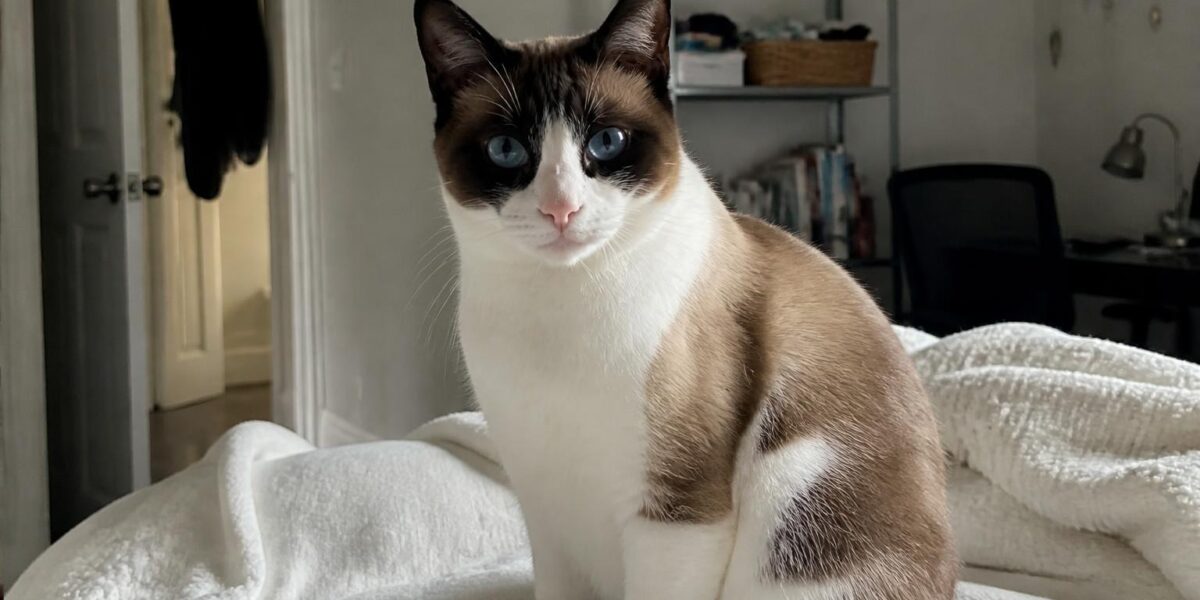
She crossed her white-footed Siamese with American Shorthairs to establish the body type and white spotting pattern she envisioned. The resulting cats had the pointed coloring of the Siamese — darker extremities on a lighter body — combined with white mittens on the front paws, white boots on the back paws, and often an inverted white “V” marking on the face.
The early development of the breed was challenging, and Hinds-Daugherty eventually stepped back from the project. Vikki Olander of Norfolk, Virginia, took over development in the early 1970s and worked tirelessly to gain recognition for the breed. She wrote the first breed standard and campaigned for acceptance by cat registries.
The International Cat Association granted the Snowshoe experimental status in 1982 and championship status in 1994. The Cat Fanciers’ Federation and the American Cat Fanciers’ Association also recognize the breed. However, the Cat Fanciers’ Association does not currently accept the Snowshoe for championship competition, which has limited the breed’s visibility in some show circles.
The difficulty in breeding Snowshoes with the precise markings called for in the breed standard has kept the breed relatively rare. The white spotting gene is unpredictable, and each litter may produce kittens with too much white, too little white, or poorly placed markings. This randomness means that even experienced breeders cannot guarantee the marking pattern of their kittens, making show-quality Snowshoes particularly challenging to produce.
Appearance and Physical Characteristics
The Snowshoe is a medium-sized, well-muscled cat that combines features of both its Siamese and American Shorthair ancestry. Males typically weigh nine to twelve pounds, while females range from seven to ten pounds. The body type falls between the extreme slenderness of the modern Siamese and the stockier build of the American Shorthair, creating a balanced, athletic silhouette.
The head is a broad modified wedge with high cheekbones and a medium-length nose. The ears are medium to medium-large, broad at the base with slightly rounded tips, and set to continue the lines of the modified wedge. The most captivating feature is the eyes, which are walnut-shaped and always a vivid blue. The deeper and more brilliant the blue, the more desirable the eye color is considered.
The coat pattern combines pointed coloring with white markings in a specific configuration. The body should show clear contrast between the lighter body color and the darker point color on the ears, face mask, legs, and tail. Accepted point colors include seal, blue, chocolate, and lilac, with seal and blue being the most common.
The white markings that define the breed include white mittens on the front paws that extend to or just past the ankle, and white boots on the rear paws extending up to the hock. The preferred facial marking is an inverted white “V” extending from the forehead down over the nose. Additional white on the chest and belly is common and acceptable. The challenge for breeders is that the white spotting gene does not follow predictable patterns, making consistent production of correctly marked kittens extremely difficult.
The coat is short to medium in length, smooth, and close-lying with a slight sheen. It is denser than the Siamese coat but not as plush as the American Shorthair. Like all pointed cats, Snowshoe kittens are born white and develop their point color gradually over the first few weeks of life, with full color development sometimes taking up to two years.
Temperament and Personality
Snowshoe cats inherit the best personality traits of both their parent breeds. They have the sociability and intelligence of the Siamese combined with the mellowness and adaptability of the American Shorthair. The result is a cat that is engaging and interactive without being overwhelming or excessively demanding.
Snowshoes are deeply attached to their human families. They want to be involved in household activities and will follow their favorite people from room to room, often providing a running commentary in their moderately vocal manner. They are talkative cats, but their voice is softer and less piercing than the typical Siamese, making their vocalizations more conversational than demanding.
Intelligence is a standout trait in this breed. Snowshoes are quick learners who can be taught tricks, respond to their names, and even learn to open doors and cabinets. They enjoy puzzle toys and interactive games that challenge their minds. Many Snowshoe owners report that their cats watch them perform tasks and then attempt to replicate the actions, demonstrating impressive observational learning.
One quirky trait shared by many Snowshoes is a fascination with water. Unlike most cats, many Snowshoes are drawn to running water and may play in sinks, bathtubs, or water bowls. Some will even join their owners at the edge of the bathtub or swim in shallow water. This water affinity is thought to be inherited from the Siamese side of their ancestry. For a broader exploration of feline water behavior, our article on why cats hate water provides interesting context on how Snowshoes differ from most breeds.
Snowshoes generally get along well with other cats, dogs, and older children. Their social nature means they actually benefit from having companions, particularly in households where humans are away during the day. A bored, lonely Snowshoe may develop behavioral issues such as excessive vocalization or destructive behavior. They do best in active households where they receive plenty of attention and stimulation.
Care and Nutrition Requirements
Snowshoe cats thrive on a high-quality, protein-rich diet that supports their active metabolism and maintains their muscular build. Named animal proteins should be the primary ingredient in their food, and a combination of wet and dry food provides both nutritional balance and variety. The moisture content in wet food is particularly beneficial for urinary tract health.
Portion control is important, as Snowshoes can gain weight if overfed. Their athletic build should be maintained through measured meals served twice daily rather than free-feeding. Monitor your cat’s body condition regularly and adjust portions as needed based on activity level, age, and your veterinarian’s recommendations.
Mental stimulation is essential for this intelligent breed. Provide a rotation of interactive toys, puzzle feeders, and climbing structures to keep your Snowshoe engaged. They enjoy fetch-style games, laser pointers used responsibly, and toys that mimic prey movement. Daily interactive play sessions of fifteen to twenty minutes help satisfy their need for mental and physical activity.
Snowshoes are best kept as indoor cats. Their friendly, trusting nature and attractive appearance make them vulnerable to outdoor dangers and theft. Providing a rich indoor environment with cat trees, window perches for bird watching, and access to various rooms satisfies their need for exploration. If you want to offer outdoor experiences, a secure catio or leash training provides safe alternatives. For advice on setting up a cat-friendly home, our guide on preparing your home for a new kitten covers essential considerations.
Grooming Needs
The Snowshoe’s short, smooth coat is one of the easiest to maintain among all cat breeds. Weekly brushing with a soft bristle brush or rubber grooming tool removes loose hair and distributes natural skin oils, keeping the coat sleek and shiny. The coat does not mat or tangle, and shedding is moderate compared to many other breeds.
Bathing is rarely necessary. The Snowshoe’s coat stays clean with normal self-grooming, and their short fur does not trap oils or debris as long-haired coats do. However, given the breed’s frequent affinity for water, some Snowshoes may tolerate or even enjoy occasional baths better than most cats.
Dental care should be a priority in the grooming routine. Brush your Snowshoe’s teeth several times per week with a cat-specific toothpaste to prevent plaque buildup and gum disease. Regular professional dental cleanings as recommended by your veterinarian complement home care.
Nails should be trimmed every two to three weeks. Snowshoes are generally cooperative with nail trimming if the routine is established early. Ears should be checked weekly for wax buildup or signs of infection and cleaned as needed with a veterinarian-recommended ear cleaner. The blue eyes do not require any special care, but any unusual discharge or squinting should be evaluated by a veterinarian.
Health Considerations
Snowshoe cats are generally healthy with a lifespan of fourteen to twenty years. Their mixed heritage from Siamese and American Shorthair stock provides a reasonable degree of genetic diversity, though they can inherit health predispositions from either parent breed.
From the Siamese side, some Snowshoes may be predisposed to certain conditions including dental disease, which is common in Siamese and Siamese-derived breeds. Regular dental care helps manage this risk. Some individuals may also carry a predisposition to amyloidosis, a condition where abnormal protein deposits accumulate in organs, though this is relatively uncommon.
Crossed eyes and kinked tails, once common in Siamese cats, occasionally appear in Snowshoes. These are cosmetic issues rather than health concerns and have been largely bred out of modern bloodlines, though they still appear occasionally. Neither condition affects the cat’s quality of life.
As with all pointed cats, Snowshoes can be sensitive to temperature-related coat color changes. The pointed pattern is caused by a temperature-sensitive enzyme, and exposure to extreme cold can cause the body coat to darken. This is a cosmetic consideration rather than a health concern but is worth noting for owners who show their cats.
Standard preventive care including regular veterinary checkups, core vaccinations, parasite prevention, and dental care forms the foundation of health maintenance. Annual wellness examinations allow for early detection of any developing issues, and age-appropriate screening tests become increasingly important as the cat ages.
Is the Snowshoe Cat Right for You?
The Snowshoe is an excellent choice for active households that can provide the social interaction and mental stimulation this breed needs. Their combination of striking beauty, intelligence, and engaging personality makes them exceptionally rewarding companions. They do best in homes where someone is present for a significant portion of the day or where they have feline companions to keep them company during owner absences.
Snowshoes are less suitable for people who want a quiet, independent cat. Their vocal nature, need for interaction, and high intelligence mean they require more engagement than many lower-energy breeds. People who work long hours and live alone may find a Snowshoe’s social demands challenging unless they provide a compatible feline companion.
Finding a Snowshoe can be challenging due to the breed’s relative rarity. The difficulty in producing correctly marked kittens means there are fewer breeders than for most popular breeds, and waiting lists are common. Pet-quality Snowshoes, which may have imperfect markings but are otherwise wonderful companions, are typically easier to find and less expensive than show-quality cats. Expect to pay between eight hundred and two thousand dollars from a reputable breeder. The foster-to-adopt process is another option worth exploring.
For those who appreciate a beautiful, intelligent, and deeply social cat, the Snowshoe offers a companionship experience that combines the best of its Siamese and American Shorthair heritage into something uniquely its own.
Frequently Asked Questions
Are Snowshoe cats related to Siamese cats?
Yes, the Snowshoe was created by crossing Siamese cats with American Shorthairs. The breed inherits its pointed coloring and blue eyes from the Siamese, while the white paw markings come from the white spotting gene introduced through the American Shorthair crosses. Despite their Siamese heritage, Snowshoes have a more moderate body type and a mellower personality than modern Siamese cats, though they retain the intelligence and sociability that the Siamese is known for.
Why are Snowshoe cats so rare?
Snowshoe cats are rare primarily because of the difficulty in producing kittens with the correct marking pattern. The white spotting gene that creates the breed’s signature white paws and facial “V” is unpredictable, and each kitten in a litter may have different amounts and placements of white. Breeders cannot reliably predict or control the markings, meaning that many kittens do not meet the show standard. This makes consistent breeding extremely challenging and keeps the number of available kittens low.
Do Snowshoe cats like water?
Many Snowshoe cats do show an unusual fascination with water, which is considered a breed characteristic. They may play in sinks, investigate running faucets, splash in water bowls, or even wade in shallow water. Not every individual displays this trait, but it is common enough to be a recognized feature of the breed. This water affinity is thought to be inherited from their Siamese ancestry, as some Siamese lines also show interest in water.
How vocal are Snowshoe cats?
Snowshoe cats are moderately vocal, inheriting their talkative nature from their Siamese heritage. However, their voice is typically softer and less piercing than the modern Siamese, described by many owners as conversational rather than demanding. They will talk to their owners, comment on activities, and vocalize when they want attention or food. People who enjoy interacting verbally with their cats often find the Snowshoe’s chattiness endearing, while those who prefer a silent cat should consider a quieter breed.
How long do Snowshoe cats live?
Snowshoe cats have an impressive lifespan of fourteen to twenty years when properly cared for. Some individuals may live even longer with excellent nutrition, regular veterinary care, and a safe indoor environment. Key factors that support longevity include maintaining a healthy weight, providing regular dental care, keeping vaccinations and parasite prevention current, and ensuring the cat receives adequate mental stimulation and social interaction throughout its life. Their hybrid vigor from mixed Siamese and American Shorthair ancestry contributes to their overall health and longevity.
Looking to adopt a Snowshoe Cat?
Browse Snowshoe Cat cats and mixes available for adoption from shelters and rescues near you.
Find Snowshoe Cat Cats for Adoption