Last updated: May 6, 2026
In this article
- Training a Blind Dog Is Mostly Listening Training
- Start with a Verbal Marker
- Name Recognition and Eye Contact (Sound Contact)
- Sit, Down, and Touch Cues
- Recall: The Safety Cue
- Safety Cues: “Wait,” “Watch,” “Step”
- Touch Signals as a Supplement
- Training Sessions: Short and Frequent
- Working with a Trainer or Specialist
- Treats, Timing, and Reward Value
- Common Training Mistakes to Avoid
- Frequently Asked Questions
Training a Blind Dog Is Mostly Listening Training
Training cues blind dog systems start from a different premise than sighted-dog training. A sighted dog learns by watching your hand signal and pairing it with a verbal cue. A blind dog learns by listening for the verbal cue and pairing it with a touch, a treat, or a known consequence. The exchange runs through ears and nose instead of eyes, but the underlying mechanics — clear marker, immediate reward, consistent repetition — are exactly the same. Most newly adopted blind dogs learn cues as fast as sighted dogs, sometimes faster, because they’re already paying close attention to your voice.
This guide covers the foundational cues most adopters need in the first month: name recognition, recall, sit, stay, the safety cues for navigation, and a couple of useful add-ons. Use positive reinforcement only. Aversive methods are inappropriate for any dog and especially harmful for a blind dog who relies on trust.
Start with a Verbal Marker
A verbal marker is a short sound that tells the dog “yes, that exact thing you just did, a treat is coming.” Most trainers use “yes” or a clicker. For blind dogs, a verbal “yes” tends to work better than a clicker because clickers come from your hand, which can be hard to localize when the dog can’t see it.
Charge the marker before you train any cue. Say “yes,” then immediately deliver a small treat. Do this fifteen to twenty times in a row. Take a break, come back, do another round. After a couple of sessions, the dog hears “yes” and looks expectantly for food. Now your marker carries information.
Use the marker the instant the dog does something correctly, even if you’re slow with the treat afterwards. The marker bridges the gap. A late marker confuses the dog about what behavior earned the reward.
Name Recognition and Eye Contact (Sound Contact)
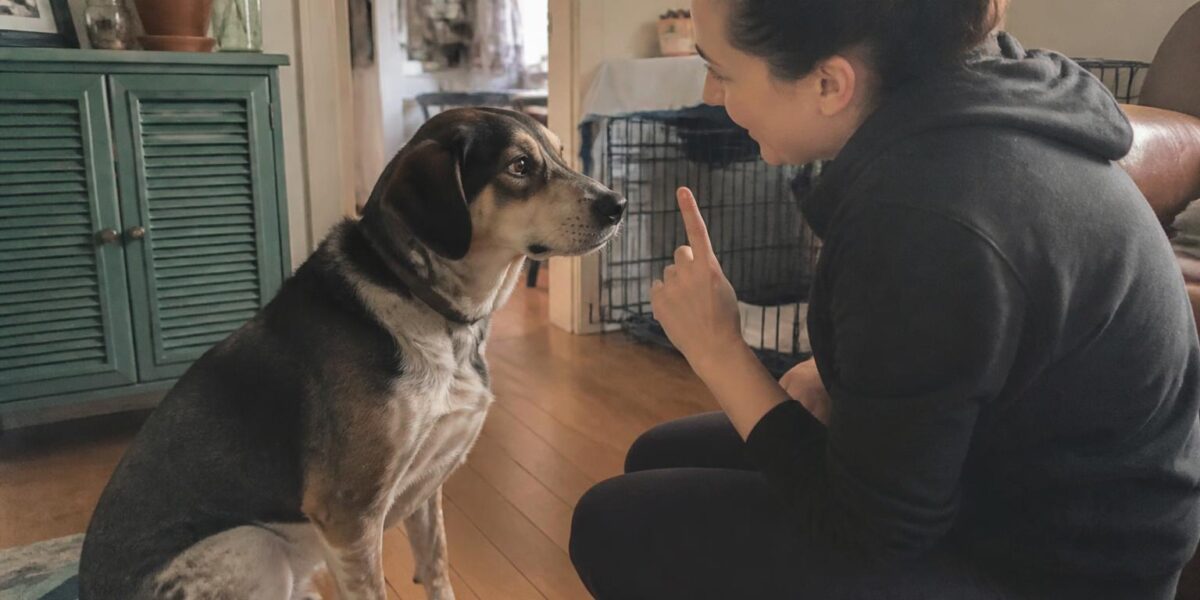
Sighted dogs learn to make eye contact with you on their name. Blind dogs can’t, but they can turn their head toward your voice — and that head-turn becomes the equivalent of eye contact for the rest of training.
Sit a few feet from your dog with treats. Say their name once in a happy tone. The moment they turn their head toward you, mark with “yes” and deliver a treat. Repeat ten times. Move to a different spot in the room and repeat. Next session, say the name from another room. The dog should orient toward your voice every time.
Don’t say the name twice. Don’t repeat it as “Buddy, Buddy, Buddy.” If the dog doesn’t respond the first time, walk closer, get their attention with a sound (clap quietly, kiss noise), and try again. Over time the name becomes a sharp cue, not background noise.
Sit, Down, and Touch Cues
Sit is taught with food luring as for any dog, but with the verbal cue paired right at the moment the dog’s bottom hits the floor. Hold a treat at the dog’s nose, slowly raise it back over their head. Their nose tracks up, their bottom drops. Mark with “yes,” treat. Add the verbal cue “sit” once they’re doing the motion reliably.
Down works the same way. From sit, lure with the treat down to the floor and slightly forward. As the dog’s chest hits the floor, mark and treat. Add the verbal “down” cue after a few successful repetitions.
“Touch” is one of the most useful cues for blind dogs. Hold a flat hand near the dog’s nose. Most dogs sniff it. Mark and treat the sniff. Repeat from different angles and distances. Once the cue is reliable, you can use “touch” to position your dog for grooming, vet visits, or to redirect them away from something. Many adopters teach their dog to touch a target stick or a section of wall, which becomes a useful directional cue.
Recall: The Safety Cue
Recall — coming when called — matters more for blind dogs than for any other dog. A blind dog off-leash relies on hearing your voice and trusting it absolutely. Build recall as a high-value behavior from week one and never poison it.
Choose a unique recall word. “Come” is fine; “here” works; some adopters use a word that’s never been said in the household before, so the dog has no prior associations. Sit close to the dog, say the recall word, and feed a high-value treat — small piece of chicken, freeze-dried liver. Do twenty repetitions over a few days at zero distance.
Add distance gradually. Move ten feet away in the same room, say the recall word once, mark when the dog moves toward you, treat when they reach you. Move to a different room. Then add distractions. Most blind dogs build a strong recall in two to four weeks of daily practice. Never call your dog for something unpleasant — bath time, nail trims, leaving the dog park. Use a different cue for those moments.
Safety Cues: “Wait,” “Watch,” “Step”
The safety cues — “wait,” “watch,” “step up,” “step down” — overlap with the navigation cues from your home setup but deserve dedicated training. Practice “wait” at every doorway and curb. Say it, take a half-step in front of the dog with light leash pressure, and reward when they pause. After a week, the dog stops automatically at doorways without pressure.
“Watch” gets practiced in the moment — when the dog is approaching a wall or piece of furniture. Say “watch” at half speed, then redirect with “this way” and a leg tap. The dog slows, listens for the next cue, and follows it. After a few weeks “watch” becomes a built-in pause that gives you a moment to redirect.
“Step up” and “step down” get reps every single time you go through a door, on or off a curb, up or down a stair. Say it, give the dog a beat to feel forward, then move. Treats for the first two weeks. After that the cues run on muscle memory. See our home navigation cues guide for the layered home version.
Touch Signals as a Supplement
Touch signals work alongside verbal cues, especially when you’re close to the dog or the environment is noisy. A light tap on the chest can mean “back up.” A hand on the shoulder before a hug or pickup signals “here comes contact.” A two-finger tap on the side of the leg can mean “this way.”
Pair each touch signal with a verbal cue at first, then fade the verbal when the touch alone is reliable. The dog learns a layered system: verbal at distance, touch up close, both together when needed. This is especially valuable in busy environments — vet’s office, sidewalk crowd — where verbal cues might get lost in noise.
Don’t tap a blind dog from behind without warning. Always say their name first, give a beat, then make contact. Touch from behind without warning becomes a startle, which over time can erode trust if it happens repeatedly.
Training Sessions: Short and Frequent
Three to five minutes, three to five times a day, beats one twenty-minute session. Blind dogs concentrate hard during training because they’re listening intently, and they tire mentally faster than sighted dogs in formal training. Short sessions keep them engaged and reward-motivated.
End every session on a success. If the dog is struggling with a cue, drop back to an easier version, get a clear win, mark and treat enthusiastically, and stop. The dog leaves the session feeling capable and looks forward to the next one.
Vary location. A dog who knows “sit” in the living room may not generalize it to the yard, the sidewalk, or the vet’s lobby. Practice each cue in three or four different environments before assuming it’s solid. Browse our adoptable dogs if you’re still selecting your match and want to compare special-needs profiles.
Working with a Trainer or Specialist
If you hit a wall — a cue that won’t stick after weeks of practice, a startle response that’s getting worse, a recall that breaks in real-world environments — bring in a fear-free certified trainer with experience in blind dog work. A short consultation often catches a small handler-side issue (timing of marker, treat value, body position) that’s easy to fix.
For dogs with progressive vision loss, build the training while they still have some vision. The cues become reflexive while sighted, and they carry through the transition smoothly. Our PRA adoption guide covers this in more detail.
Don’t forget medical workups. Sometimes a “training problem” is actually a hearing or pain issue layering on top of vision loss. A baseline vet visit and any indicated specialist referrals (ophthalmology, neurology) rule those out.
Treats, Timing, and Reward Value
Reward timing matters more in blind dog training than most adopters realize. The marker — your “yes” — should land within a half-second of the behavior you want. The treat should follow within a couple of seconds of the marker. If you’re slow on either end, the dog learns the wrong association.
Treat value also matters. Use small, soft, high-value treats during training sessions: tiny pieces of chicken, freeze-dried liver, cheese cubes, or commercial soft training treats. Save the kibble for general meals. The training treat should make the dog’s eyes light up — or whatever the blind-dog equivalent is. A treat the dog merely tolerates won’t drive learning at the same rate as one they love.
Keep treats prepped and accessible. A treat pouch on your belt during training sessions saves you from fumbling with a bag and missing the timing window. Many adopters keep a small jar in each room of the house so spontaneous training moments are always rewarded promptly.
Common Training Mistakes to Avoid
The biggest mistake new adopters make in blind dog training is inconsistency in cue words across the household. Partner says “step up,” you say “up,” kid says “watch out” — the dog hears three signals for the same situation and responds to none reliably. Pick the cues, write them on a sticky note, and stay disciplined for the first month.
The second mistake is rushing through the marker-charging step. Adopters skip “yes” plus treat reps and jump straight into training new behaviors, then wonder why the dog seems lukewarm about training. The marker is the foundation. Twenty paired reps a session for a few sessions before training anything else makes the rest of training run smoothly.
The third mistake is poisoning the recall cue by using it for things the dog dislikes. Calling the dog for a bath, nail trim, or to leave the dog park teaches them that “come” sometimes leads to unpleasant outcomes. Use a different cue (or just walk over and clip the leash) for those moments. Save the recall cue for moments that earn a treat or a happy reunion.
Frequently Asked Questions
Are blind dogs harder to train than sighted dogs?
No. Most train as well as sighted dogs and often listen more carefully. The cues are verbal and tactile rather than visual, but the learning process is identical.
Can I use a clicker with a blind dog?
You can, but a verbal “yes” is often easier because the dog can locate your voice better than a clicker held in your hand.
How do I teach hand signals to a fully blind dog?
You don’t need to. Use verbal cues and touch signals instead. Reserve hand signals for dogs with partial vision who can still see them.
What if my blind dog doesn’t respond to recall outside?
Practice on a long line in a quiet area. Most blind dogs build solid outdoor recall in two to four weeks of consistent daily practice.
Should I use a vibrating collar?
Only as an attention cue (not as punishment), and only after the dog is already trained to associate the buzz with a positive cue. Vibrating collars are more useful for deaf dogs than blind dogs.