
Last updated: May 16, 2026
In this article
- What Atrial Fibrillation Is
- Breeds Most Affected
- Symptoms Owners Notice
- How AF Is Diagnosed
- Why Rate Control Matters
- Rate-Control Drug Categories
- Working With a Cardiologist
- Living With AF at Home
- Prognosis and the Underlying Disease
- Cost and Insurance Considerations
- When to Call the Vet Versus the ER
- Frequently Asked Questions
What Atrial Fibrillation Is
Atrial fibrillation in dogs is an arrhythmia where the upper chambers of the heart, called the atria, lose their organized electrical rhythm and quiver chaotically instead of contracting. The lower chambers, the ventricles, end up firing fast and irregularly because they receive a flood of disorganized impulses from above. The result is a heart rate that is both too high and irregularly irregular, often well over 200 beats per minute in a dog who should be resting at 80-120.
It is a common arrhythmia in medium-to-large and giant-breed dogs, and it almost always lives alongside other heart disease. The two most common settings are advanced dilated cardiomyopathy and advanced mitral valve disease. Occasionally a giant-breed dog develops “lone AF” without any obvious underlying disease, but that is the exception rather than the rule.
If your vet has just told you your dog is in atrial fibrillation, the workup is going to look in two directions at once: confirm the rhythm and find what caused it. Both threads matter. Treating the rhythm without addressing the underlying cardiomyopathy or valve disease leaves the bigger picture untouched.
Breeds Most Affected
Atrial fibrillation has a strong size bias. Affected breeds include:
- Doberman Pinschers — strongly predisposed to DCM, in which AF is common
- Irish Wolfhounds — predisposed to lone AF as well as DCM
- Great Danes
- Newfoundlands
- Boxers — especially with arrhythmogenic right ventricular cardiomyopathy
- Cocker Spaniels — late-stage DCM context
- Cavalier King Charles Spaniels — late-stage mitral valve disease
The pattern across all of these is large left atrium plus underlying heart muscle or valve disease. The atria stretch as the disease progresses, and the stretched atrial muscle becomes electrically unstable. AF is often the moment a chronic disease announces it has reached an advanced stage.
Lone atrial fibrillation in giant breeds — without any structural heart disease — does occur. Irish Wolfhounds and Great Danes are over-represented. Even in lone AF, your cardiologist will repeat echocardiograms over time because some “lone” cases later reveal underlying cardiomyopathy.
Symptoms Owners Notice
The clinical picture depends on the heart rate during AF and the underlying disease. Some dogs are nearly asymptomatic when their ventricular rate is well-controlled. Others arrive at the emergency vet in overt heart failure.
Common signs include:
- Exercise intolerance — slowing down on walks, refusing stairs, lying down mid-walk
- Persistent cough, especially at night or in the early morning
- Labored or fast breathing at rest
- Belly breathing
- Episodes of weakness, stumbling, or fainting
- Distended abdomen from right-sided fluid accumulation
- Decreased appetite and weight loss
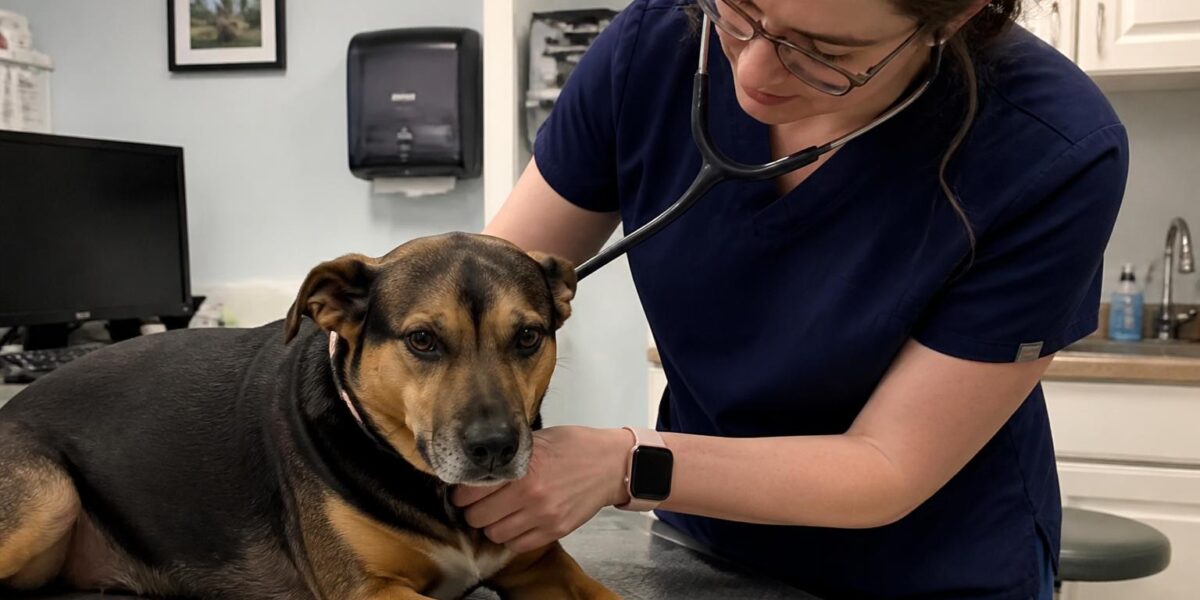
The hallmark physical exam finding is a heart rate that sounds chaotic on the stethoscope, with pulses that are weaker than expected and out of sync with the heart sounds. Your vet may use the term “pulse deficit” — meaning some heartbeats do not generate enough pressure to produce a felt pulse. That is classic for poorly controlled AF.
How AF Is Diagnosed
The definitive diagnostic test is an electrocardiogram. AF on ECG is unmistakable: no organized P waves, irregularly irregular R-R intervals, and a fast ventricular rate. A 30-second strip is usually enough for a confident diagnosis, though longer recordings are sometimes needed to confirm sustained AF versus paroxysmal episodes.
Your vet will then move to the second question — what caused this. Expect:
- Chest radiographs to assess heart size and look for pulmonary edema
- Echocardiogram (cardiac ultrasound) to assess underlying cardiomyopathy or valve disease, atrial size, and ventricular function
- Bloodwork including a thyroid panel — hyperthyroidism is a rare canine cause but checked routinely, and electrolytes and kidney function affect treatment choices
- NT-proBNP if heart failure status is unclear
- Holter monitor — a 24-hour ECG worn at home — to measure your dog’s average ventricular rate over a full day
The Holter monitor is particularly important once treatment starts, because rate-control drugs are titrated to bring the average daily heart rate into target range. Spot ECG measurements in the clinic do not give you the whole picture. Most cardiology services will send you home with a fitted Holter for 24 hours and review the data the following day.
Why Rate Control Matters
Sustained ventricular rates over 200 beats per minute exhaust the heart muscle, drop cardiac output, and accelerate progression of heart failure. The goal of treatment in canine AF is rate control: bringing the ventricular rate down into a more sustainable range, typically a Holter average around 100-125 beats per minute, depending on the case.
Rhythm control — converting back to normal sinus rhythm — is rarely pursued in dogs the way it is in humans. The atria are usually too remodeled, the underlying disease too advanced, and the recurrence rate too high to make it worthwhile. Cardioversion (electrical shock back to normal rhythm) is reserved for very specific cases of acute lone AF in dogs without significant underlying disease.
Rate control gives the heart room to fill between beats, restores some cardiac output, and often improves quality of life dramatically within days of getting the ventricular rate down. It does not cure the underlying disease, but it buys back time and comfort.
Rate-Control Drug Categories
The drugs used most often for rate control in canine AF are:
- Diltiazem-class calcium channel blockers — typically first-line, often used long-term
- Digoxin — added to diltiazem in some cases for synergistic rate control, with serum levels closely monitored
- Beta-blockers — used selectively, often in dogs without significant systolic dysfunction
Specific dose, frequency, and duration are vet-determined by weight, kidney and liver function, electrolytes, and Holter response. Dogs in active heart failure may need IV rate control during hospitalization before transitioning to oral therapy. The combination of diltiazem and digoxin is more effective than either alone in many cases, but digoxin has a narrow therapeutic window and serum-level monitoring is mandatory.
Concurrent therapies for the underlying disease — pimobendan, ACE inhibitors, spironolactone, and diuretics — are usually continued or initiated alongside rate control. The full congestive heart failure in dogs guide outlines the broader cardiac drug categories your vet will be coordinating.
Working With a Cardiologist
Most AF cases earn a referral to a board-certified veterinary cardiologist (ACVIM-Cardiology). The reasons:
- Echocardiography requires advanced training to assess underlying disease severity accurately
- Holter monitoring and rate-control titration are specialty-level workflows
- Combination drug therapy needs careful coordination, especially when digoxin is added
- Underlying DCM and severe MVD have evolving treatment guidelines that cardiologists track closely
Your primary vet usually catches the murmur or the chaotic rhythm, runs the initial ECG and radiographs, and starts emergency stabilization if the dog is in failure. From there, a cardiology referral lets the specialist handle the echo, set the rate-control plan, and oversee Holter rechecks. The two teams co-manage the case over the long run.
If a board-certified cardiologist is not geographically accessible, ask your vet about telecardiology — many cardiology services now offer remote echo and Holter review, which can support your primary vet in managing the case locally.
Living With AF at Home
A dog in stable rate-controlled AF can live well at home for an extended period. Your job is to give the medications consistently, watch for changes, and keep recheck appointments. The single most useful home metric is resting respiratory rate.
Track and log:
- Resting respiratory rate while sleeping — under 30 is normal, persistently above 40 is a red flag
- Exercise tolerance compared to last week and last month
- Appetite and body weight
- Cough frequency
- Any episodes of weakness or fainting
- Abdominal size — measure waist circumference monthly and note changes
Bring your log and any pulse counts you have taken (apex beat through the chest wall) to every recheck. Your cardiologist may also ask you to repeat a Holter every six to twelve months, or sooner if the picture changes.
Prognosis and the Underlying Disease
AF prognosis depends mostly on the underlying disease. AF in advanced DCM or advanced MVD signals an advanced stage, and the long-term outlook reflects the underlying cardiomyopathy or valve disease rather than the rhythm itself. Lone AF in a giant-breed dog without structural heart disease has a better outlook, sometimes with stable years on rate-control therapy.
Your cardiologist will frame prognosis qualitatively — “guarded but treatable,” “good rate-control response with stable months ahead,” “advanced underlying disease, focus on quality of life” — rather than commit to specific survival times. The variation between individual dogs is too wide for a single number to be helpful.
Quality of life remains the central question through it all. Many dogs feel noticeably better within a week or two of getting the ventricular rate controlled, and that improvement is often the first piece of good news after a difficult diagnosis. The ASPCA Pet Loss Hotline at 877-474-3310 is a free resource if you find yourself thinking about end-of-life decisions.
Cost and Insurance Considerations
Cardiology workups, Holter monitoring, advanced echocardiography, and combination drug therapy all add up. The total varies by region, severity, and underlying disease, but plan for an upfront workup in the four-figure range and ongoing monthly medication costs. Heart failure hospitalizations, when they occur, push into thousands-of-dollars territory quickly.
If your dog is at-risk-breed and you do not yet have insurance, look at the pet insurance decision for dogs guide and enroll before any heart disease shows up. Pre-existing condition exclusions are the single biggest pitfall in cardiac coverage. The veterinary specialist cost breakdown sets expectations for what cardiology referrals look like financially.
Adopters considering a senior dog with a stable AF diagnosis can absolutely give them a wonderful retirement home. Ask the rescue for the most recent cardiology report, ideally including a Holter average heart rate, and budget for at least one cardiology recheck in the first three to six months.
When to Call the Vet Versus the ER
Call your primary vet for: gradual exercise intolerance, occasional cough, mild but persistent rise in resting respiratory rate, or upcoming Holter recheck. Mild changes during a stable phase are normal and best handled in business hours.
Go to the emergency vet for: open-mouth breathing, persistent labored breathing, sudden collapse, vomiting plus lethargy in a dog on cardiac medications, sudden abdominal distension, or pale or blue gums. Worsening heart failure and uncontrolled rapid rates can both decompensate fast.
Keep your dog’s medication list — drug name, strength, dose, and last administration time — printed on your fridge. If you end up at an unfamiliar emergency hospital, that single sheet of paper saves your team valuable time during stabilization. Save your cardiologist’s after-hours instructions in your phone.
Frequently Asked Questions
Is atrial fibrillation always serious in dogs?
Atrial fibrillation in dogs almost always indicates significant underlying heart disease, even when symptoms are mild. Lone AF without structural disease occurs in some giant breeds but is the exception. Either way, the rhythm warrants a full cardiology workup, including echocardiogram and Holter, and ongoing rate-control therapy. Take it seriously and pursue specialist evaluation when offered.
Can canine AF be converted back to normal rhythm?
Cardioversion is rarely pursued in dogs because the atria are usually too remodeled and the recurrence rate is high. The standard approach is rate control rather than rhythm control, using diltiazem-class drugs sometimes combined with digoxin. Rhythm conversion is reserved for select cases of acute lone AF in dogs without significant underlying heart disease.
How is heart rate target chosen?
Cardiologists target a 24-hour Holter average, typically around 100-125 beats per minute depending on the case. Spot in-clinic heart rates can be misleading because of stress and excitement. Holter monitoring at home gives the realistic average, which guides drug titration over weeks to months.
What breeds get atrial fibrillation most often?
Doberman Pinschers, Irish Wolfhounds, Great Danes, Newfoundlands, Boxers, Cocker Spaniels, and Cavalier King Charles Spaniels are over-represented because of their predisposition to underlying cardiomyopathy or valve disease. Giant breeds also see lone AF without underlying disease. Any large or giant-breed dog with new exercise intolerance or chaotic heart sounds deserves an ECG.
Can my dog still go for walks with AF?
Once rate control is established, most dogs return to a comfortable level of activity, though high-intensity exercise is usually discouraged. Your cardiologist will set a specific activity plan based on your dog’s underlying disease and Holter response. Watch resting respiratory rate at home as your simplest gauge of how the heart is coping.


