Last updated: May 6, 2026
In this article
Bombay Cat Breed Profile: The Miniature Black Panther
Have you ever dreamed of sharing your home with a sleek, jet-black panther — minus the wild temperament and the need for a zoo permit? The Bombay cat breed offers exactly that fantasy in a compact, affectionate, and thoroughly domestic package. With its gleaming black coat, striking copper-gold eyes, and muscular yet graceful build, the Bombay looks like a miniature panther that has been custom-designed for apartment living and lap sitting.
But the Bombay is much more than its stunning appearance. This breed is known for its warm, people-loving personality, its intelligence, and its gentle nature. Often overlooked in favor of more well-known breeds, the Bombay is a hidden gem in the cat world — and those who discover it rarely look back. In this comprehensive breed profile, we will cover the Bombay’s history, appearance, temperament, health, grooming needs, and the ideal home for this captivating breed.
History and Origin of the Bombay Cat
The Bombay cat breed was created in the 1950s by an American breeder named Nikki Horner of Louisville, Kentucky. Horner had a specific vision: she wanted to create a domestic cat that resembled a miniature black panther, inspired by the Indian black leopard. She set about achieving this goal by crossing sable Burmese cats with black American Shorthairs.
The breeding program required years of patience and careful selection. Horner began her crosses in 1953, but it took until the mid-1960s before she consistently produced cats that met her vision — jet-black cats with the Burmese body type, muscular build, and those distinctive copper-penny eyes. The resulting breed was named the “Bombay” after the exotic Indian city (now Mumbai), paying homage to the black leopards of India that inspired the breed’s creation.
The Cat Fanciers’ Association accepted the Bombay for registration in 1970 and granted it championship status in 1976. The International Cat Association (TICA) also recognizes the breed. Interestingly, Britain developed its own version of the Bombay by crossing Burmese cats with black British Shorthairs, resulting in a cat that is classified under the Asian breed group in the UK rather than as a separate Bombay breed.
Despite its striking appearance and wonderful personality, the Bombay remains a relatively rare breed. Breeders are fewer in number compared to more popular breeds, and litters tend to be small. This rarity only adds to the Bombay’s appeal for those who discover it. For a fascinating exploration of the cultural significance of black cats, check out our article on black cat myths.
Appearance and Physical Characteristics
The Bombay is a medium-sized cat with a muscular, surprisingly heavy build that catches people off guard. Like its Burmese parent, the Bombay is often described as a “brick wrapped in silk” — compact and solid with a weight that exceeds visual expectations. Males typically weigh 8 to 11 pounds, while females range from 6 to 9 pounds.
The body is semi-cobby, meaning it is moderately stocky with a broad chest and solid musculature. The legs are proportional to the body and end in round paws. The tail is medium length, straight, and tapers slightly toward the tip. Every aspect of the Bombay’s build suggests controlled power and athletic capability.
The head is rounded with a full face and a moderate, well-defined stop (the indentation between the forehead and the nose). The muzzle is broad and short, and the chin is firm and rounded. The ears are medium-sized, set wide apart, and tilt slightly forward, giving the face an alert, engaged expression.
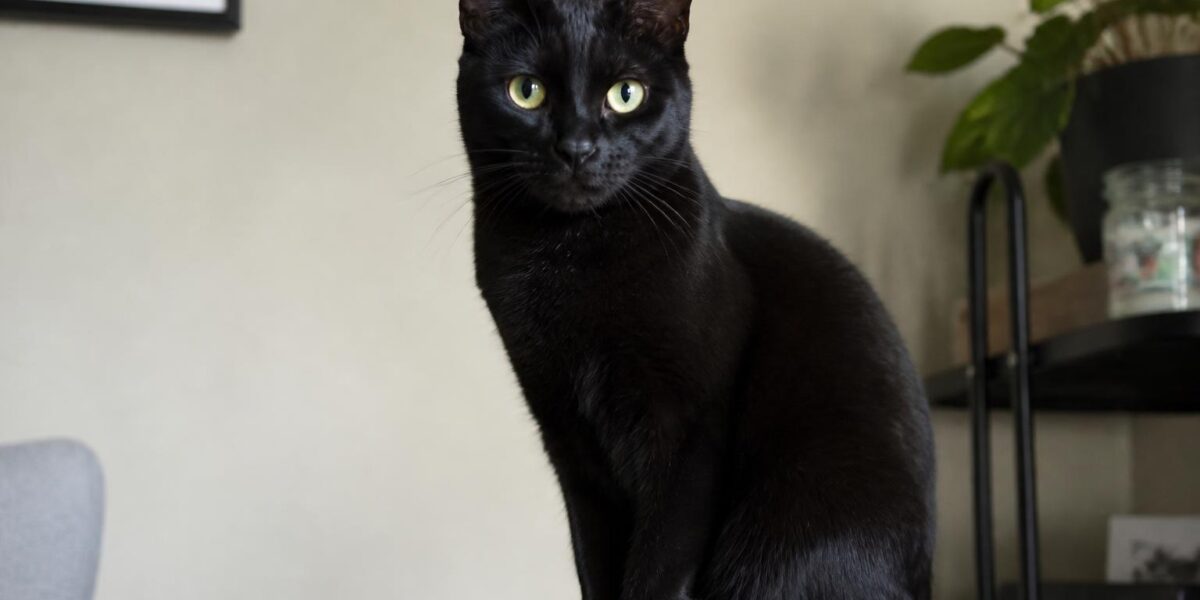
The eyes are perhaps the Bombay’s most mesmerizing feature after its coat. They are large, round, and set wide apart, ranging in color from deep gold to rich copper. The most prized eye color is a deep, brilliant copper-penny shade that stands out dramatically against the black coat. The combination of jet-black fur and glowing copper eyes is the Bombay’s signature look and the quality that most immediately evokes the image of a black panther.
The coat itself is the breed’s crowning glory. It is short, very close-lying, and has a satin-like texture with an extraordinarily high gloss. When a Bombay moves, its coat shimmers like patent leather. The color must be jet black to the roots — there should be no brown or gray tones, no white hairs, and no ghost tabby markings. Even the nose leather and paw pads are black, completing the monochromatic panther aesthetic.
Temperament and Personality
The Bombay cat breed combines the best personality traits of both its parent breeds, resulting in a cat that is affectionate, social, intelligent, and adaptable. From the Burmese, the Bombay inherits a deep love of human companionship and a desire to be close to its people at all times. From the American Shorthair, it gets a slightly more moderate energy level and an easygoing adaptability that makes it comfortable in a variety of living situations.
Bombays are true lap cats. They adore physical closeness and will seek out your lap, your chest, or any other warm spot on your person whenever the opportunity arises. Many Bombay owners report that their cats love to sleep under the covers, curled against their owner’s body. This breed takes the concept of “cuddle buddy” to a whole new level and consistently earns a spot among the best lap cat breeds.
Intelligence is a strong suit of the Bombay. These cats are quick learners who enjoy interactive toys, puzzle feeders, and trick training. They can learn to fetch, walk on a leash, and respond to verbal commands. Their Burmese heritage gives them a playful, almost dog-like quality that endears them to people who appreciate an engaged, responsive pet.
The Bombay is moderately vocal. It communicates with a pleasant, soft voice that is less insistent than the Siamese or Burmese but more expressive than the average Domestic Shorthair. They will let you know when they want attention, food, or play, but they do so with gentle persuasion rather than demanding yowls.
Socially, the Bombay tends to get along well with other cats, dogs, and children. They are confident without being aggressive and adaptable without being passive. Many Bombays will establish themselves as the household’s social director, greeting visitors and keeping tabs on all household activities. However, they do tend to have a favorite person and will reserve their deepest affection for that individual.
Health Issues and Lifespan
The Bombay has a lifespan of 12 to 16 years, with many individuals living healthy lives well into their mid-teens. As a breed developed from the Burmese and American Shorthair, the Bombay can inherit health predispositions from both parent breeds. Awareness of these potential issues is important for proactive health management.
Hypertrophic cardiomyopathy (HCM), the most common heart disease in cats, has been reported in Bombays. Regular cardiac screenings are recommended, particularly for breeding cats. Early detection through echocardiography allows for management that can significantly extend an affected cat’s quality of life.
Craniofacial defects, sometimes called “Burmese head fault,” have been documented in some Bombay lines. This is a serious congenital condition associated with the Burmese genetics. Responsible breeders screen for this condition and make ethical breeding decisions to minimize its occurrence.
Respiratory issues related to the breed’s moderately shortened muzzle can occasionally be a concern, though the Bombay’s facial structure is less extreme than truly brachycephalic breeds. Excessive tearing may occur in some individuals but is typically manageable with regular facial cleaning.
Obesity is a practical health concern for the Bombay, as these cats enjoy their food and can easily gain excess weight if portions are not monitored. Keeping your Bombay at a healthy weight through measured meals and regular exercise is one of the most important things you can do for its long-term health. Monitoring your cat’s body condition with a cat weight chart can help you stay on track.
Dental disease, urinary tract issues, and common feline conditions can also affect the Bombay. Regular veterinary checkups, a balanced diet, dental care, and an active lifestyle form the foundation of preventive health care for this breed.
Grooming and Care
Grooming the Bombay is a pleasure rather than a chore. The short, close-lying coat is exceptionally low maintenance. A weekly brushing with a rubber grooming mitt or a soft-bristled brush is all that is needed to remove loose hair and enhance the coat’s natural, patent-leather sheen. Many Bombay owners find that simply running their hands over the cat’s coat regularly is enough to keep it looking magnificent.
Bathing is rarely necessary, as the Bombay is an excellent self-groomer. If a bath is needed, the short coat dries quickly and returns to its glossy state with minimal effort. During seasonal shedding periods, an extra brushing session per week can help manage loose fur.
Nail trimming should be done every two to three weeks. Check the ears weekly for any signs of wax buildup or redness, and clean them gently with a veterinarian-approved solution as needed. Dental care is important for all cats, so incorporate regular tooth brushing or dental treats into your Bombay’s routine.
Because Bombays are intelligent and social, environmental enrichment is an important aspect of their care. Provide climbing trees, window perches, puzzle feeders, and a variety of interactive toys. Dedicate time each day for interactive play sessions — these not only keep your Bombay physically fit but also strengthen the bond between you and your cat. Rotate toys regularly to keep things fresh and interesting.
Bombays are indoor cats by nature and temperament. Their dark coat can make them difficult to see outdoors at night, and their trusting, friendly disposition makes them vulnerable in outdoor environments. Keeping your Bombay safely indoors is the best way to protect it from traffic, predators, and other hazards.
Who Is the Bombay Cat Best For?
The Bombay cat breed is wonderfully adaptable, making it suitable for a wide variety of households. Its affectionate nature and moderate energy level create a balanced companion that is neither too demanding nor too distant. However, some living situations are particularly well-suited to this breed.
Individuals and couples who want a deeply bonded, affectionate companion will find the Bombay to be an ideal match. These cats form strong attachments and provide the kind of devoted, responsive companionship that enriches daily life. If you work from home, a Bombay will be your constant, contented shadow.
Families with children are also a great fit. Bombays are patient, playful, and sturdy enough to enjoy gentle play with kids. Their social confidence means they are not easily startled or stressed by the activity and noise that comes with a family household.
Multi-pet households can work well for Bombays, as they generally get along with other cats and cat-friendly dogs. They may assume a leadership role among household pets, but they do so with confidence rather than aggression.
Seniors and retirees will appreciate the Bombay’s calm affection and lap-warming tendencies. These cats are not hyperactive and are perfectly happy to spend a quiet afternoon purring on your lap, making them excellent companions for a relaxed lifestyle.
If you are drawn to the beauty and mystique of a black panther but want a loving, gentle, and manageable feline companion, the Bombay cat breed is an extraordinary choice that combines breathtaking looks with a heart of gold.
Frequently Asked Questions About the Bombay Cat Breed
Are Bombay cats rare?
Yes, the Bombay is a relatively rare breed. There are fewer Bombay breeders compared to more popular breeds, and litters tend to be small. If you are set on acquiring a Bombay, you may need to join a waiting list with a reputable breeder. Alternatively, check with breed-specific rescue organizations, as Bombay and Bombay-mix cats occasionally become available for adoption.
Do Bombay cats get along with dogs?
Yes, Bombays generally get along well with cat-friendly dogs. Their confident, social nature helps them adapt to canine housemates, and they often form close bonds with family dogs. As with any pet introduction, take things slowly and supervise initial interactions to ensure a positive relationship develops.
Are Bombay cats the same as regular black cats?
No, while many domestic shorthair cats can be black, the Bombay is a specific pedigreed breed with defined standards for body type, coat quality, and eye color. A true Bombay has a jet-black coat that is black to the roots, a satin-like gloss, copper to gold eyes, and a distinctive muscular build. A random-bred black cat may be beautiful but does not have the specific genetic makeup and breed characteristics of a Bombay.
How much exercise does a Bombay cat need?
Bombays have a moderate activity level. They enjoy daily play sessions and benefit from interactive toys and climbing structures, but they are not hyperactive cats. Two to three 15-minute play sessions per day, combined with access to toys and enrichment throughout the day, are usually sufficient to keep a Bombay physically fit and mentally stimulated.
Looking to adopt a Bombay Cat Breed Profile?
Browse Bombay Cat Breed Profile cats and mixes available for adoption from shelters and rescues near you.
Find Bombay Cat Breed Profile Cats for Adoption