
Last updated: April 8, 2026
In this article
- Why Enrichment Matters for Indoor Cats
- Best Interactive Toys for Cats
- Wand Toys and Laser Pointers
- Puzzle Feeders and Food-Dispensing Toys
- Vertical Space: Cat Trees and Shelves
- Window Perches and Bird Watching
- Catnip and Silvervine
- DIY Enrichment Ideas
- Rotating Toys to Keep Things Fresh
- Social Play and Bonding
- Frequently Asked Questions
Cat Enrichment: Toys, Games & Activities to Keep Cats Happy
Cats are natural-born hunters, climbers, and explorers. In the wild, a cat spends the majority of its waking hours stalking prey, patrolling territory, and solving the daily puzzle of survival. When we bring cats indoors — which is absolutely the right decision for their safety and longevity — we remove most of those natural outlets. What remains is a smart, athletic animal living in an environment that offers very little to do. Without intentional cat enrichment, boredom sets in, and boredom in cats does not look like a lazy afternoon on the couch. It looks like destructive scratching, excessive grooming, weight gain, aggression, litter box problems, and a general decline in well-being.
The good news is that providing meaningful enrichment does not require an enormous budget or a complete home renovation. It requires understanding what your cat actually needs — variety, challenge, movement, and the chance to use the instincts they were born with. This guide walks through the most effective cat enrichment strategies, from the toys that genuinely engage cats to the environmental changes that transform an indoor space into one worth exploring. If you are considering bringing a new feline companion into your home, visit our adoption page to meet cats who would thrive in an enriched environment.
Why Enrichment Matters for Indoor Cats
Indoor cats live significantly longer than outdoor cats — an average of 12 to 18 years compared to 2 to 5 years for cats that roam freely. But a longer life is not automatically a better life. Without adequate cat enrichment, indoor cats are at elevated risk for obesity, diabetes, urinary tract issues, anxiety, depression, and behavioral problems that strain the bond between cat and owner. A bored cat is not simply an inconvenience; a bored cat is a cat whose physical and mental health is quietly deteriorating.
Enrichment addresses the gap between what a cat’s brain and body were designed to do and what an indoor environment typically offers. A well-enriched cat shows fewer behavioral problems, maintains a healthier weight, sleeps more soundly, and interacts more positively with its human family. It is not an optional luxury — it is a fundamental component of responsible cat care. Every indoor cat, regardless of age or temperament, benefits from a thoughtful enrichment plan.
The key principle behind effective cat enrichment is mimicking the challenges and rewards a cat would encounter in a natural environment. That means opportunities to hunt (even simulated hunting), climb, observe, problem-solve, and make choices. Enrichment should engage as many senses as possible — sight, sound, smell, taste, and touch — and it should change regularly, because predictability is the enemy of a stimulated mind.
Best Interactive Toys for Cats
Not all cat toys are created equal. The plastic mouse gathering dust under the couch is not enrichment — it is furniture. The best interactive toys for cats are the ones that move unpredictably, reward engagement, and tap into hunting instincts. When shopping for cat enrichment toys, look for items that roll, wobble, chirp, or respond to a cat’s touch in some way. Motion-activated toys that dart across the floor or wiggle when bumped are far more engaging than static objects.
Electronic interactive toys have improved dramatically in recent years. Robotic mice that change direction, flopping fish that move when touched, and automated ball circuits that keep rolling give cats something to stalk when their humans are busy. These should not replace interactive play with you — nothing truly replaces the bond built during shared play — but they are valuable supplements for the hours when you are at work or otherwise unavailable.
Crinkle balls, springs, and lightweight balls that skitter unpredictably across hard floors are simple, inexpensive, and surprisingly effective. Many cats prefer the toys that cost the least, because what matters to a cat is not the price tag but the movement. A crumpled piece of paper tossed across the kitchen floor can provide more genuine cat enrichment than a twenty-dollar toy that sits motionless in a basket.
Wand Toys and Laser Pointers
If there is one category of cat enrichment that consistently outperforms everything else, it is wand toys. A simple wand — a stick with a string and a feather, bird, or insect-like attachment at the end — allows you to simulate the erratic movement of real prey. You control the speed, direction, and behavior of the “prey,” and your cat responds with every instinct it has: stalking, crouching, pouncing, grabbing, and delivering the final bite. This is not just exercise. It is a complete predatory sequence that satisfies a deep neurological need.
The most effective wand toy technique is to move the toy away from the cat, not toward it. Prey does not run at a predator. Let the feather dart behind furniture, pause, twitch, and sprint. Let your cat “catch” it periodically — a hunt that never ends in a catch is frustrating, not enriching. After a successful catch, let the toy go still for a moment before resuming. End every session with a catch followed by a small treat or meal to complete the hunt-catch-eat cycle that nature intended.
Laser pointers are popular but come with an important caveat. Cats can become frustrated chasing a dot they can never physically catch. If you use a laser Pointer, always end the session by directing the dot onto a physical toy or treat that the cat can grab, bite, and “kill.” This provides the tactile closure that the laser alone cannot offer. Used responsibly, lasers are excellent for getting sedentary cats moving, but they should always be paired with a tangible reward at the end.
Puzzle Feeders and Food-Dispensing Toys
In nature, cats spend a significant portion of their day working for food — hunting, stalking, and catching multiple small meals. The standard pet food bowl eliminates this challenge entirely. Puzzle feeders restore it. These devices require a cat to push, paw, nudge, or manipulate an object to release kibble or treats, turning mealtime into a problem-solving exercise that provides genuine cat enrichment.
Start with simple puzzle feeders — a treat ball with large openings, a muffin tin with kibble hidden under tennis balls, or a shallow dish with obstacles inside. As your cat masters each level, increase the difficulty. More complex puzzle feeders feature sliding compartments, adjustable openings, and multi-step challenges that keep even experienced problem-solvers engaged. Some cats take to puzzle feeders immediately; others need gradual introduction with easy wins to build confidence and interest.
Scatter feeding is another low-cost approach. Instead of placing all food in one bowl, scatter kibble across a mat, along a windowsill, or inside a few different locations around the house. This encourages movement, foraging behavior, and the use of the cat’s powerful sense of smell. For multi-cat households, puzzle feeders and scatter feeding also help reduce mealtime competition and resource guarding, since food is distributed rather than concentrated in one location.
Vertical Space: Cat Trees and Shelves
Cats think in three dimensions. Floor space alone is not enough. Vertical space — cat trees, wall-mounted shelves, and elevated perches — dramatically expands the usable territory in your home from a cat’s perspective. A six-foot cat tree in a small apartment can provide more meaningful cat enrichment than an extra room of empty floor space, because it offers climbing, scratching, hiding, and high-vantage observation all in one structure.
When choosing a cat tree, prioritize stability above all else. A wobbly tree is a tree that gets used once. Look for a wide, heavy base and a design that does not sway when a full-grown cat launches itself at the upper platforms. Multiple levels of varying heights give cats options — the top platform for confident observation, a mid-level hammock for relaxed napping, and a ground-level cave for retreating when the world feels overwhelming.
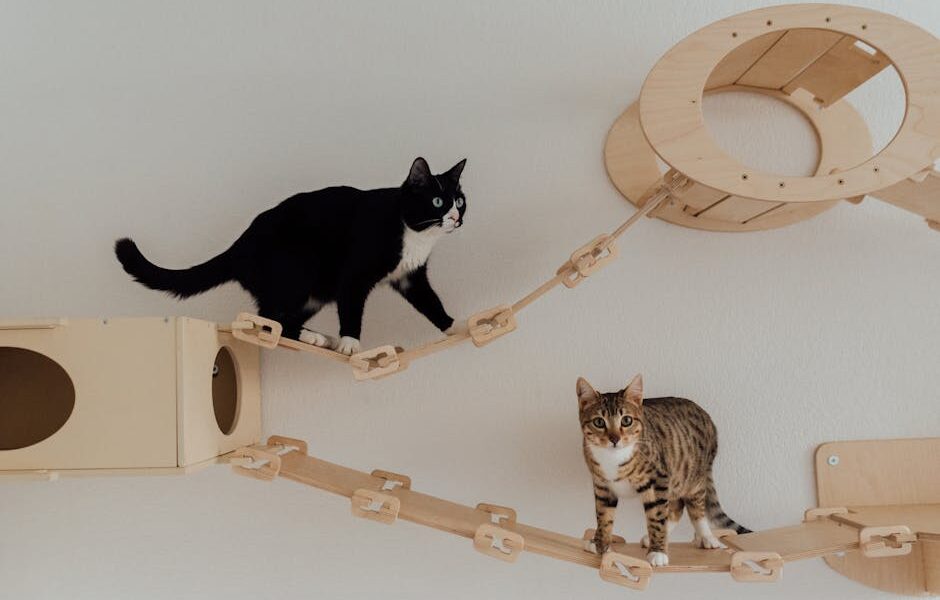
Wall-mounted cat shelves take vertical enrichment even further. A series of sturdy shelves installed at ascending heights along a wall creates a climbing highway that cats find irresistible. These are particularly valuable in smaller homes where floor space is limited. Position the highest shelf near a window for the ultimate payoff — a high perch with a view. For households with multiple cats, vertical space is especially important because it creates additional territory and escape routes, reducing conflict and stress. Explore our cat breeds directory to learn which breeds have the strongest climbing instincts and need the most vertical territory.
Window Perches and Bird Watching
A window perch is one of the simplest and most effective forms of cat enrichment available. Cats are visual hunters, and watching the outside world — birds, squirrels, passing pedestrians, blowing leaves — provides hours of passive but genuine mental stimulation. A securely mounted window perch that catches morning sunlight becomes a cat’s favorite spot in the house almost immediately.
To enhance the experience, place a bird feeder outside the window where your cat’s perch is located. The constant movement of birds visiting the feeder creates what some owners call “cat television,” and it is no exaggeration. Cats will watch bird feeders with intense focus for extended periods, chattering and chirping at the birds, fully absorbed. This is not idle staring — it is active mental engagement that exercises the hunting circuits in a cat’s brain without any risk to wildlife.
If you do not have a window that accommodates a perch, a sturdy piece of furniture positioned next to a window works just as well. The goal is to give your cat a comfortable, stable spot where they can observe the outside world at their leisure. Even a view of a busy street provides stimulation. Cats notice movement that humans overlook, and they find it endlessly interesting.
Catnip and Silvervine
Catnip is the most well-known feline stimulant, but it only affects roughly 50 to 70 percent of cats — the response is genetic, and kittens under six months rarely react at all. For cats that do respond, catnip triggers a burst of euphoric energy — rolling, rubbing, running, and playful aggression — that lasts about ten minutes before the cat becomes temporarily immune for roughly 30 minutes to two hours. Used occasionally, catnip is excellent cat enrichment that breaks up routine and sparks spontaneous play.
Silvervine is the less well-known but often more effective alternative. Derived from a plant native to the mountainous regions of East Asia, silvervine affects a broader range of cats than catnip does — including many cats that show no response to catnip at all. The behavioral response is similar: energetic play, rolling, rubbing, and heightened engagement with toys. Silvervine is available as a powder, as dried sticks the cat can chew and rub against, and infused into toys.
Both catnip and silvervine are non-addictive and safe for regular use. Sprinkle catnip on a scratching post to renew interest in it, stuff a sock with dried catnip for an instant toy, or rub silvervine powder on a cat tree platform that has been ignored. These plant-based stimulants are a simple, affordable way to add a burst of novelty to your cat enrichment rotation.
DIY Enrichment Ideas
Some of the best cat enrichment costs nothing at all. A cardboard box with a few holes cut in the sides becomes a hunting blind, a hiding spot, and a play fort. Stack two boxes together with connecting holes for a multi-level adventure. Cats find cardboard inherently satisfying — they like the texture for scratching, the enclosed space for hiding, and the novelty of a new object to investigate.
Paper bags — with handles removed for safety — are another instant enrichment item. Most cats will walk into, hide inside, and pounce out of a paper bag with zero encouragement. Toss a crinkle ball inside the bag to add sound stimulation. Crumple sheets of tissue paper into loose balls for lightweight toys that skitter across the floor. Thread a pipe cleaner through a wine cork for a simple, textured toy that tumbles unpredictably when batted.
Ice cube enrichment is a warm-weather favorite. Freeze a few treats or a small amount of tuna water inside an ice cube tray, then place the cubes on a plate and let your cat figure out how to access the reward as it melts. Toilet paper rolls stuffed with treats and folded closed at the ends make simple foraging puzzles. A muffin tin with small toys hiding under a few of the wells gives cats a reason to use their paws and brains together. DIY cat enrichment is limited only by your creativity, and the impermanence of these homemade toys is a feature, not a flaw — new things appear, old things disappear, and the environment stays interesting.
Rotating Toys to Keep Things Fresh
Even the best toy in the world becomes invisible if it is available every day. Cats are novelty seekers, and a toy that was thrilling on Monday is often ignored by Friday. The single most effective cat enrichment strategy that most owners overlook is rotation. Instead of leaving every toy out at once, keep the majority stored in a sealed container and rotate a few into the environment every two to three days.
A toy that has been hidden for a week comes back smelling slightly different and feeling new again. Cats investigate it with renewed interest, and you get maximum engagement from a finite collection of toys without constantly buying new ones. This approach also helps you identify which toys genuinely engage your cat and which were impulse purchases that never landed. If a toy gets ignored even after a long absence, it is time to retire it and try something different.
Apply the rotation principle beyond toys. Move cat furniture to different locations periodically. Rearrange the shelves. Put a new blanket on the cat tree. Place a box in the hallway where there was not one yesterday. Small environmental changes keep a cat’s curiosity engaged and prevent the monotony that leads to under-stimulation. Predictability is comfortable for anxious cats in the short term, but over months and years, an unchanging environment slowly drains a cat’s mental vitality.
Social Play and Bonding
No toy, no puzzle feeder, and no amount of vertical space replaces the enrichment that comes from meaningful social interaction. Cats are not the solitary, aloof animals that popular culture portrays. Most cats form deep bonds with their humans and benefit enormously from dedicated one-on-one play time. Fifteen to twenty minutes of active, engaged play with your cat each day — ideally split into two sessions — provides more cat enrichment than any product you can buy.
During social play, put your phone down. Cats read human attention and body language with remarkable sensitivity, and a distracted play partner is not a real play partner. Use a wand toy, drag a string across the floor, toss a ball down the hallway, or initiate a gentle game of hide-and-seek around a corner. Follow your cat’s energy level — short, intense bursts followed by rest periods match the natural rhythm of feline play.
For multi-cat households, social enrichment also includes managing the relationships between cats. Provide enough resources — food stations, litter boxes, resting spots, and vertical escape routes — so that every cat can access what it needs without competition. Play sessions with each cat individually help prevent jealousy and ensure that quieter cats get the attention they deserve. If you are thinking about adding a second cat to your household for companionship, our adoption team can help match personalities for the best possible outcome.
Frequently Asked Questions
How much playtime does an indoor cat need each day?
Most veterinary behaviorists recommend a minimum of 15 to 30 minutes of active, interactive play per day for adult cats, ideally divided into two or three shorter sessions. Kittens and young adults often need more — 30 to 60 minutes is not unusual for cats under two years old. Senior cats still benefit from daily play, though sessions may be shorter and less intense. The key is consistency. A short play session every day provides far more cat enrichment than an hour-long session once a week followed by days of nothing.
My cat ignores every toy I buy. What am I doing wrong?
Most cats that “ignore toys” are actually responding to the wrong type of play presentation, not rejecting play itself. First, try different prey types — some cats prefer feathered bird toys, others respond to furry mice, and many are most excited by fast-moving insect-like toys. Second, remember that cats are ambush predators. They need the toy to move away from them, pause, and create an opportunity to stalk. A toy waved directly in a cat’s face is not prey — it is an annoyance. Third, apply the rotation strategy. Remove all toys for a full week, then reintroduce one at a time. Scarcity creates interest where abundance created indifference.
Is it okay to use a laser pointer as the only form of play?
No. Laser pointers should always be used as one component of a broader cat enrichment plan, never as the sole source of play. Because a cat can never physically catch the laser dot, exclusive laser play can lead to frustration, obsessive light-chasing behavior, and anxiety. Always end a laser session by landing the dot on a physical toy or treat that the cat can grab and “kill.” Follow the laser session with a wand toy or a tossed ball to provide the tactile satisfaction of a real catch. Used responsibly alongside other play methods, lasers are a helpful tool — used in isolation, they can cause more harm than good.
What enrichment is best for senior cats?
Senior cats benefit from enrichment that accommodates reduced mobility while still engaging their minds. Low-profile cat trees with ramps instead of tall jumps, puzzle feeders set to easy difficulty, gentle wand toy sessions at floor level, and cozy window perches that are easy to access are all excellent options. Scent enrichment — silvervine, catnip, or even a small amount of dried valerian root — provides mental stimulation without requiring physical effort. Warm, soft resting spots near windows give older cats the comfort and visual engagement they prefer. Even in their senior years, cats are curious and alert, and a thoughtful enrichment plan keeps their quality of life high.
Can too much enrichment overwhelm a cat?
Yes, particularly for anxious or newly adopted cats. The goal of cat enrichment is stimulation, not overstimulation. Introduce new toys, furniture, and activities gradually, and watch your cat’s response. Signs of overstimulation include flattened ears, a rapidly twitching tail, dilated pupils, hiding, and aggressive swatting. If your cat seems stressed by a new addition, remove it and try again later in a less intense form. A confident, well-adjusted cat may thrive with constant novelty, while a shy or anxious cat may need changes introduced slowly over weeks. Let your cat’s behavior guide the pace.


