
Last updated: April 6, 2026
In this article
Cat Sleeping Positions: What They Mean About Your Cat
Cats sleep an average of 12 to 16 hours a day, and the positions they choose during all that rest say far more about them than you might think. From the classic loaf to the fully exposed belly-up stretch, every sleeping posture reveals something about your cat’s comfort level, mood, body temperature, and even their health. Understanding cat sleeping positions helps you read your feline companion more accurately and notice subtle changes that could signal a trip to the vet. Whether your cat is a dedicated side sleeper or an acrobatic contortionist, this guide breaks down the most common positions and what they really mean.
The Loaf Position
The loaf — sometimes called the “bread loaf” or “cat loaf” — is one of the most universally recognised cat sleeping positions. Your cat sits upright with all four paws tucked neatly beneath the body, tail wrapped close, creating a compact, rectangular shape that looks remarkably like a loaf of bread. The eyes may be fully closed or half-lidded in a relaxed squint.
A cat in the loaf position is comfortable but not fully at ease. By tucking the paws underneath, your cat keeps them warm while staying in a posture that allows for a quick getaway if needed. This is a light-sleep position rather than a deep-sleep one. You will often see cats loafing in common areas where they feel safe enough to rest but alert enough to monitor their surroundings. If your cat frequently loafs near you, take it as a sign that they enjoy your company and feel relaxed in your presence — just not relaxed enough to fully let their guard down.
Belly Up
When a cat rolls onto their back and sleeps with their belly fully exposed, paws flopped to the sides, it is one of the strongest displays of trust a cat can offer. The belly is a cat’s most vulnerable area — it protects vital organs that in the wild would be a predator’s primary target. A cat that sleeps belly up in your home is telling you, without any ambiguity, that they feel completely safe.
This position also serves a practical thermoregulation purpose. Exposing the belly helps a cat release excess body heat, so you may notice your cat sleeping belly up more often during warmer months or in rooms with direct sunlight. Kittens and younger cats tend to sleep belly up more frequently than older cats, partly because they are more naturally trusting and partly because they run warmer. If your rescue cat has started sleeping belly up after weeks or months of more guarded positions, it is a meaningful milestone in their adjustment to your home. If you are thinking about welcoming a rescue cat into your family, visit our adoption page to see cats currently looking for homes.
Side Sleeper
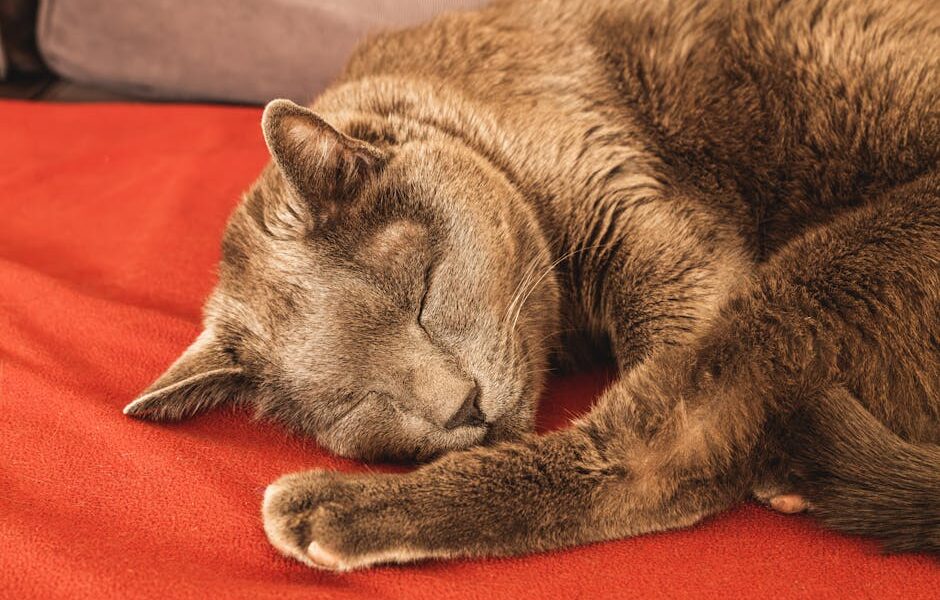
The side sleeping position is another strong indicator of a relaxed, content cat. Your cat lies on one side with legs extended — sometimes stretched out fully, sometimes loosely bent. The belly is partially exposed, and the neck and head rest naturally on the ground or on a soft surface. This is a deep-sleep position. Cats in this posture cycle into REM sleep more readily, and you may notice twitching paws, flickering whiskers, or small movements that suggest dreaming.
Side sleeping indicates that your cat trusts the environment enough to enter a state of sleep from which they cannot spring up instantly. It is common in cats who have lived in a stable household for some time. If you have multiple cats and notice them side sleeping near each other, that is a reliable sign that they are comfortable sharing space — genuine relaxation near another cat is not something they fake.
Curled Up in a Ball
The classic curled-up position — nose tucked to tail, paws drawn in, body forming a tight circle — is probably the most ancient and instinctive of all cat sleeping postures. In the wild, this position accomplishes two critical things: it conserves body heat by minimising the surface area exposed to the air, and it protects the vulnerable belly and vital organs from potential threats.
Domestic cats curl up for the same reasons, though the threat element is less about predators and more about comfort. A cat sleeping curled up may simply be cold, which is why this position appears more in winter or air-conditioned rooms. It is also a default for cats who are new to an environment or feeling anxious. If a cat that normally sleeps stretched out suddenly switches to consistently curling up, pay attention to whether something has changed or whether they may be unwell.
Sleeping in a Box
Any cat owner knows the scene: you buy an expensive cat bed, and your cat sleeps in the cardboard box it arrived in. Cats are drawn to enclosed spaces because the walls of a box provide contact on multiple sides of the body, which triggers a deep sense of security. Research from Utrecht University found that shelter cats given hiding boxes showed significantly lower stress levels and adapted to new environments faster than cats without them.
A cat sleeping in a box, basket, sink, or any snug enclosure is seeking the comfort of pressure and containment. The walls also retain body heat, creating a warm microclimate cats find irresistible. You can encourage this by providing enclosed beds or leaving clean boxes in quiet corners. Different breeds have different tendencies when it comes to enclosed spaces versus open perching — explore breed-specific patterns in our cat breeds directory.
Sleeping on Your Chest
When your cat climbs onto your chest and settles in for a nap, they are choosing you as their safe place. This position combines warmth, the rhythmic vibration of your heartbeat, and the security of physical closeness with the person they trust most. Cats who sleep on their owner’s chest tend to be strongly bonded and may have a more social, people-oriented personality than average.
There is also a scent-marking element. By sleeping on your chest, your cat mingles their scent with yours, reinforcing the bond and claiming you as part of their territory. This behaviour is most common in cats who were well-socialised as kittens or who have developed a deep attachment to a single person. It is endearing, though it can become disruptive if your cat insists on chest sleeping at three in the morning — a boundary you may need to set gently over time.
The Face Plant
The face plant — also called the “head press” during sleep — is when a cat sleeps with their face pressed directly into a surface, whether that is a cushion, a blanket, your arm, or the floor. The rest of the body may be in any position, but the defining feature is the face buried downward. It looks deeply uncomfortable to human eyes, but cats find it perfectly natural.
This position serves a practical purpose: blocking out light. Cats are crepuscular — most active at dawn and dusk — and their eyes are extremely light-sensitive. Pressing the face into a surface creates darkness for deeper sleep during bright hours. Some cats also find the facial pressure soothing, similar to a weighted blanket for humans. The face plant is nothing to worry about, though persistent head pressing while awake — pushing the head against a wall for extended periods — is a different behaviour and can indicate a neurological issue requiring veterinary attention.
Paws Over Face
A cat sleeping with one or both paws draped over their face is one of the most photographed sleeping positions for good reason — it is undeniably charming. Like the face plant, the primary function of this position is light blocking. Cats who are sleeping during bright hours may use their paws as a makeshift sleep mask, shielding their sensitive eyes from ambient light without needing to bury their entire face.
This position also emerges when a cat starts grooming and drifts off mid-wash — the paw was already near the face and simply stays there as sleep takes over. The paws-over-face posture indicates comfortable, natural sleep. A cat who felt threatened would not obstruct their own vision during rest.
Perched High
Cats who choose to sleep on top of bookshelves, refrigerators, cat trees, or high shelves are expressing one of the deepest feline instincts: the drive to seek elevated ground. In the wild, height provides two advantages — a clear vantage point to spot threats or prey, and distance from ground-level dangers. Domestic cats retain this instinct even when there are no threats in sight.
A cat sleeping high up feels in control. They can survey the room below and rest knowing nothing can approach without being seen. This is especially common in multi-cat households, where the highest spot often belongs to the most confident cat. If your cat seeks elevated positions, tall cat trees or wall-mounted shelves will support their preference. Some breeds are more inclined toward high perching — the Abyssinian and Bengal, for example, rarely sleep at ground level if a higher option exists.
The Contortionist
Every cat owner has at least one photo of their cat sleeping in a position that seems to defy anatomy — limbs twisted in opposite directions, the head at a seemingly impossible angle relative to the body, the spine curved in ways that would send a human straight to the chiropractor. These “how is that comfortable?” positions are surprisingly normal for cats.
Cats have 230 bones and an exceptionally flexible spine with elastic cushioning between vertebrae. Their free-floating clavicles give the front limbs a wider range of motion. Positions that look painful to us can be perfectly comfortable for a cat. Contortionist sleeping is most common in kittens and young adults, though cats of all ages do it. It is a sign of deep relaxation — a cat twisted into a pretzel shape is not planning on jumping up soon. As long as your cat moves normally when awake with no signs of stiffness, there is nothing concerning about bizarre sleeping contortions.
What Position Changes Mean for Health
While individual sleeping positions are mostly about comfort and personality, changes in sleeping patterns or positions can be an early indicator of health issues that deserve attention. Cats are masters at hiding discomfort, and subtle shifts in how or where they sleep may be the first sign that something is wrong.
A cat that normally sleeps stretched out or belly up but begins consistently sleeping in a tight, curled-up ball may be experiencing pain, particularly abdominal pain. Curling up protects the stomach and can be a self-soothing response to internal discomfort. Similarly, a cat that suddenly avoids elevated sleeping spots they previously favoured may be dealing with joint pain, arthritis, or mobility issues that make jumping painful — this is especially common in senior cats over the age of ten.
Changes in sleep quantity matter as much as posture changes. A cat sleeping significantly more than usual may be dealing with illness, depression, or hormonal imbalances. A cat that becomes restless and cannot settle may be in pain or experiencing anxiety. Frequent location changes — moving from spot to spot without settling — can also indicate discomfort.
Watch for these warning signs alongside position changes: loss of appetite, changes in litter box habits, increased vocalisation, reluctance to be touched, hiding in unusual places, and altered grooming behaviour. Any combination of these signs with a shift in sleeping patterns warrants a veterinary visit. Early detection of arthritis, kidney disease, dental pain, and digestive issues often starts with an observant owner noticing that their cat sleeps differently. Keeping a mental note of your cat’s normal habits creates a baseline that makes changes easier to spot. For breed-specific sleep behaviours and health predispositions, browse our cat breeds directory.
How many hours a day do cats sleep?
Most adult cats sleep between 12 and 16 hours per day, though some cats — particularly seniors, kittens, and certain breeds — may sleep up to 20 hours. Sleep needs vary by age, activity level, and individual temperament. Indoor cats tend to sleep more than outdoor cats because they expend less energy during the day.
Why does my cat sleep on me?
Cats sleep on their owners for warmth, security, and bonding. Your body heat, heartbeat rhythm, and familiar scent make you an ideal sleeping spot for a cat that trusts you. It is a significant sign of attachment and indicates that your cat considers you a safe and comforting presence.
Is it normal for my cat to change sleeping positions throughout the day?
Yes, this is completely normal. Cats cycle through light and deep sleep stages and often shift positions, locations, or postures as they move between sleep phases. They may also change positions in response to temperature changes, household noise levels, or simply because they feel like relocating. Concern is only warranted when the changes are sudden, dramatic, and accompanied by other behavioural or physical symptoms.
What does it mean if my cat sleeps with their eyes open?
Cats sometimes sleep with their eyes partially open, particularly during light sleep stages. You may see the third eyelid — a translucent membrane — partially covering the eye. This is normal and allows the cat to remain somewhat aware of their surroundings while resting. If both eyes are fully open and unblinking for extended periods, or if the third eyelid is consistently visible when your cat is awake, consult your vet.
Should I wake my cat up if they are twitching in their sleep?
No. Twitching paws, whisker movements, and small vocalisations during sleep are signs of REM sleep, the stage during which cats dream. This is normal and healthy. Waking a cat from deep sleep can startle them and may result in a scratch or bite. Let them sleep through it.
When should I worry about my cat’s sleeping habits?
Consult your veterinarian if your cat suddenly sleeps significantly more or less than usual, cannot seem to get comfortable, shows pain when lying down or getting up, hides in unusual locations to sleep, or if sleeping changes are accompanied by loss of appetite, lethargy when awake, changes in litter box use, or altered grooming behaviour. Sudden shifts from one consistent sleeping pattern to another can be an early signal of underlying health issues.
Ready to give a cat a safe, comfortable place to call home? Browse adoptable cats on our adoption page and take the first step toward finding your new companion.


