Last updated: May 4, 2026
In this article
- What an F2 Savannah Cat Actually Is
- Size, Build, and Appearance
- Legal Status and What It Means in Practice
- Cost — Acquisition and Ongoing
- Behavior and Personality
- Daily Care, Diet, and Routine
- Health Considerations
- Enrichment and Living Environment
- Life Stages: Kitten Through Senior
- Comparison: F2 Versus Other Savannah Generations
- Adoption, Rescue, and Whether an F2 Is Right for You
- Frequently Asked Questions
What an F2 Savannah Cat Actually Is
An F2 Savannah cat is the second filial generation from the original African Serval × domestic cat foundation cross. The cat’s grandfather (or, more rarely, grandmother) is a full Serval, and the parent generation between them is an F1 Savannah female. F2s carry roughly 25% to 35% Serval genetics depending on which domestic male the F1 female was bred to, though percentages vary significantly across lines.
F2 Savannahs sit between F1 and F3 in size, intensity, behavior, and legal complexity. They are still substantial cats — typically 20 to 25 pounds for males, 15 to 20 for females — and they retain many of the strong physical and behavioral traits of the wild parent line. They are not, however, as intense or as legally restricted as F1s in most jurisdictions.
If you are weighing F2 versus other Savannah generations, this profile will give you the realistic picture. F2s are genuinely magnificent companion animals for the right home, but they remain demanding and not appropriate for casual cat owners.
Size, Build, and Appearance
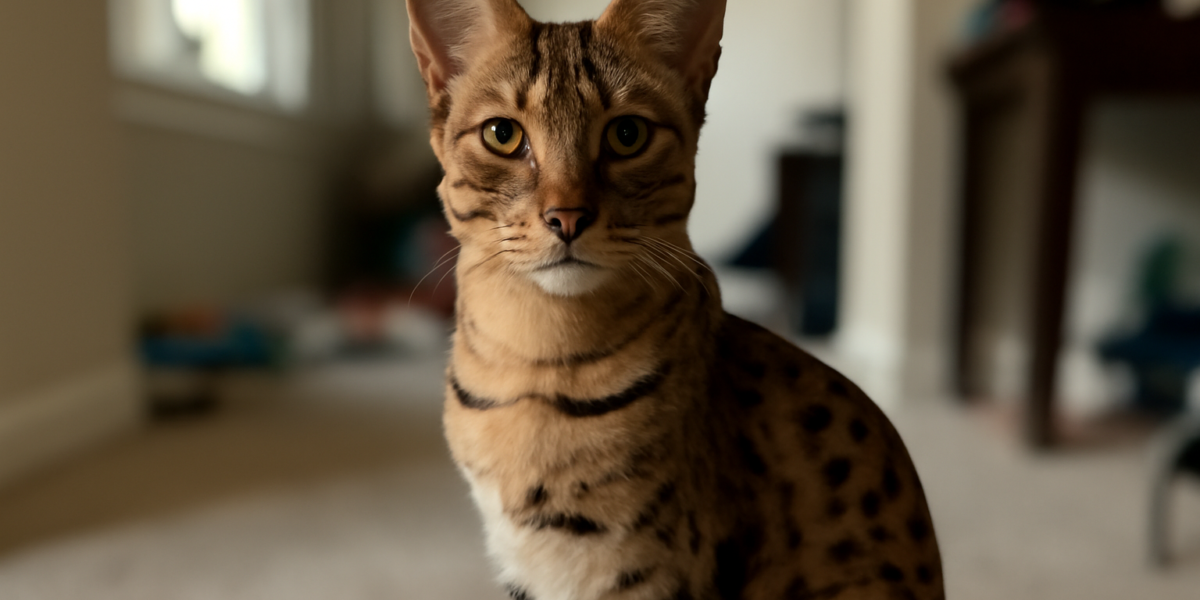
Adult F2 Savannah males commonly weigh 20 to 25 pounds, with some reaching 28+ pounds. Females are smaller, typically 15 to 20 pounds. The body remains tall, lean, and powerful, with long legs, a long neck, and the trademark large, wide-set ears that give Savannahs their unmistakable silhouette. The coat in standard color is golden or tawny with crisp black spots running in horizontal flow patterns.
Compared to F1s, F2s often have slightly less extreme leg length and ear size — the wild parent’s most pronounced features begin to soften across generations. This dilution is gradual, not abrupt; many F2s look nearly indistinguishable from F1s to a casual observer, while breeders and judges can identify generation-specific traits readily.
F2s jump nearly as well as F1s — vertical leaps of seven to eight feet are routine — and they are powerful runners and climbers. Plan your home environment with that capability in mind.
Legal Status and What It Means in Practice
F2 Savannahs face legal restrictions in many US states and municipalities, though typically less severe than F1s. Some jurisdictions that ban F1s permit F2s with permits; others ban both generations equally. Internationally, regulations vary widely.
The practical implication is the same as for F1s: verify legality at the state, county, and city level before purchasing. Get answers in writing. Regulations can change between when you start your search and when a kitten is ready to come home, so stay current. Our hybrid cat legality by state overview is a starting point.
If your jurisdiction permits F2 ownership, expect that owning one means staying registered as a hybrid-cat owner with relevant authorities, possibly carrying liability insurance, and being prepared to relocate if you move to a less permissive area.
Cost — Acquisition and Ongoing
F2 Savannah kitten prices commonly range from $5,000 to $12,000 in legal jurisdictions, with significant variation by line, breeder, and individual cat quality. F2 females (which can produce F3 kittens) are sometimes priced higher than F2 males. Verify with current breeders — these figures shift year to year.
Ongoing costs are substantial but generally less than F1s:
- Specialized vet care, ideally with exotic-cat experience
- Permit and registration fees where applicable
- High-quality diet, often partial raw or fresh-prepared
- Substantial enrichment infrastructure
- Insurance complications — most standard pet carriers exclude hybrids
For the insurance angle specifically, see our hybrid cat pet insurance challenges guide.
Behavior and Personality
F2 Savannahs are intelligent, active, vocal, and intensely bonded to their primary humans. They form deep attachments and often shadow their favorite person around the house. Many learn to walk on harness, fetch toys, and respond to verbal cues. Some learn to open doors, drawers, and faucets, and a few learn to operate light switches.
Behaviorally, F2s carry more wild-parent intensity than F4s or F5s. They tend to be more reserved with strangers, more particular about handling, and more demanding of mental stimulation. With patient, structured raising they can be wonderful companions; with neglect or insufficient enrichment they become destructive or anxious.
F2 males are often (but not always) sterile because of residual chromosomal differences from the Serval parent line. Most F2 fertility issues resolve by F3 or F4 in standard pedigree lines.
Daily Care, Diet, and Routine
F2 Savannahs need a structured daily routine. Plan for two to three sessions of intensive interactive play (wand toys, fetch, climbing chase), at least one structured training or puzzle-feeder session, and continuous access to vertical climbing space, scratching surfaces, and stimulating toys. A bored F2 finds its own entertainment, and you usually do not enjoy what they choose.
Grooming is straightforward — Savannah coats are short, dense, and need only weekly brushing with a soft slicker or grooming mitt. Trim claws every two to three weeks, brush teeth several times weekly with feline toothpaste, and check ears monthly.
Most F2s enjoy water. A safe fountain, a draining bathtub, or supervised access to outdoor water features can be excellent enrichment. For more on indoor exercise structures that work in homes of various sizes, our indoor cat exercise guide covers practical setups.
F2 Savannahs do best on high-protein, species-appropriate diets. Many breeders and owners feed partial or full raw, with whole-prey items several times weekly. High-quality wet food and minimal kibble are reasonable alternatives. Avoid kibble-only feeding long-term — F2s are not metabolically built for it.
Caloric needs are higher than for domestic cats because the cat is larger and more active. Use body condition scoring rather than bag-default portions. Our hybrid cat raw diet feeding overview covers food safety, balance, supplementation, and the realistic learning curve for raw feeding.
Health Considerations
Responsible F2 Savannah breeders cardiac-screen parent cats annually for hypertrophic cardiomyopathy (HCM), which is the most significant breed concern across all Savannah generations. The hypertrophic cardiomyopathy in cats overview explains the condition, screening cadence, and warning signs.
Vaccination protocols and anesthesia approaches differ from domestic-cat norms. Establish a relationship with an exotic-cat-experienced veterinarian before bringing an F2 home, not after a problem develops. Our hybrid cat vet special considerations overview covers anesthesia, vaccines, and drug-metabolism issues for hybrid generations.
Other concerns to monitor: early kidney function changes, dental disease (Savannahs benefit from active dental care), and joint health in larger individuals. Annual wellness exams from kitten-hood are non-negotiable.
Enrichment and Living Environment
F2 Savannahs are too large and too active for small apartments without supplementary enrichment. Minimum recommended infrastructure includes:
- A secure outdoor catio of substantial size with vertical climbing
- Indoor climbing structures reaching at least seven to eight feet vertical
- Multiple scratching posts and surfaces
- Puzzle feeders rotated regularly to prevent boredom
- Daily structured interactive play (minimum 60-90 minutes total)
- Access to safe water enrichment
For broader hybrid enrichment expectations, see our hybrid cat enrichment requirements overview. F2-specific reality leans toward the more demanding end of that spectrum.
Life Stages: Kitten Through Senior
Kittenhood (0-12 months)
F2 kittens grow quickly and need intensive socialization to become well-adjusted adults. Establish carrier and harness training early. Feed several small meals daily and transition gradually to adult diet structure by twelve months. First vet visits should happen with an exotic-cat-experienced practitioner.
Adolescent and adult (1-10 years)
Daily structured play, climbing access, and consistent enrichment routines. Annual cardiac screening, weight monitoring, and dental care from middle adulthood onward. Spay or neuter per your vet and breeder contract.
Senior (10+ years)
Many F2 Savannahs remain athletic into their teens. Increase wellness exam frequency, monitor for kidney disease, arthritis, and cardiac changes. The senior cat care checklist covers screening recommendations.
Comparison: F2 Versus Other Savannah Generations
F2s sit between the very intense F1 generation and the more domesticated F3+ generations. Compared to F1s, F2s are slightly smaller, slightly less legally restricted, somewhat more domestic in temperament, and significantly less expensive. Compared to F3s, F2s are noticeably larger, more wild-parent-intense in behavior, and more demanding of enrichment.
If you are weighing F2 versus F3, the F3 Savannah cat breed profile is the natural next read. If you want to skip generations entirely and pursue a show-eligible Savannah, the F4 Savannah cat SBT profile is the first TICA championship-eligible generation. The full Savannah cat breed profile gives the unified breed view.
Adoption, Rescue, and Whether an F2 Is Right for You
F2 Savannahs occasionally appear in rescue, usually because their first owners underestimated the breed’s energy or because of legal complications when owners moved across state lines. Rescue F2s often need patient rehabilitation but can become deeply rewarding companions for experienced exotic-cat owners. See our adopting a rescue Savannah cat guide for realistic expectations.
If buying from a breeder, work only with established Savannah specialists who hold appropriate USDA licensing where applicable, screen prospective buyers, provide health guarantees, and stay in touch for the cat’s lifetime. Walk away from any breeder marketing F2s as “easy” or “first-cat-friendly” — neither claim is accurate.
An F2 Savannah works for experienced cat owners with appropriate space, an exotic-cat-friendly vet relationship, verified legal status, a robust budget, and the schedule to provide several hours of structured engagement daily. They are not appropriate for first-time cat owners, households with very small children or small pets, frequent travelers, or anyone drawn to the breed solely for its appearance.
If your circumstances do not match that profile, lower generations like F4 or F5 fit normal homes far better. Consult your vet, your state’s wildlife department, and a hybrid-cat-experienced behaviorist before pursuing. The honest answer is sometimes “not now” or “not this generation” — and that answer protects both you and the cat.
Frequently Asked Questions
How big does an F2 Savannah get?
Males commonly 20-25 pounds, females 15-20 pounds. Some F2 males exceed 28 pounds, but extremes are not the breed norm.
Is an F2 Savannah legal where I live?
Possibly — but possibly not. Legality varies by state, county, and city. Verify locally before pursuing, and confirm in writing.
How much does an F2 Savannah cost?
Commonly $5,000-$12,000 for a well-bred kitten in legal jurisdictions. Verify with current breeders; figures shift year to year.
Are F2 Savannah males fertile?
Often not. F2 male sterility is common because of residual chromosomal differences. Females are typically fertile and produce F3 kittens.
Are F2 Savannahs good with children?
Generally not recommended for households with small children. Older, calm children with extensive cat experience can work in some cases, but the size and intensity of the breed creates real risk in chaotic environments.
Looking to adopt a F2 Savannah Cat Breed Profile?
Browse F2 Savannah Cat Breed Profile cats and mixes available for adoption from shelters and rescues near you.
Find F2 Savannah Cat Breed Profile Cats for Adoption