Last updated: May 6, 2026
In this article
Savannah Cat Breed Profile: The Complete Guide to the Serval Hybrid
The Savannah cat breed is one of the most extraordinary domestic cats in existence. Tall, lean, and strikingly beautiful, the Savannah combines the dramatic appearance of the African Serval with the companionship and adaptability of a domestic cat. With its bold spotted coat, towering height, and legendary jumping ability, the Savannah turns every room into a stage and every day into an adventure.
But the Savannah is not a cat for everyone. This breed demands experienced, dedicated owners who understand its unique needs, are prepared for its extraordinary energy levels, and have researched the legal requirements in their area. If you are considering adding a Savannah to your family, this comprehensive guide covers everything from the breed’s hybrid origins to its temperament, care requirements, health profile, and the important question of whether this remarkable cat is the right fit for your lifestyle.
History and Origins
The Savannah cat’s story begins in 1986, when a domestic cat owned by Judee Frank crossed with a male African Serval, a tall, spotted wild cat native to the grasslands of sub-Saharan Africa. The resulting kitten, named Savannah, became the foundation for the breed that bears her name. Patrick Kelley, who acquired one of Savannah’s offspring, later partnered with breeder Joyce Sroufe to develop the breed standard and work toward registry recognition.
The African Serval is a remarkable wild cat in its own right. Standing up to 24 inches at the shoulder and weighing 20 to 40 pounds, the Serval is one of Africa’s most successful hunters, catching prey on approximately 50 percent of its attempts, a rate far higher than most wild cats. Its long legs, large ears, and spotted coat are all adaptations for hunting in tall grasslands, and many of these traits are visible in its domestic Savannah descendants.
The International Cat Association began accepting Savannahs for registration in 2001 and granted full championship status in 2012. The Cat Fanciers’ Association does not recognize the breed. TICA classifies Savannahs by filial generation: F1 cats have a Serval parent, F2 cats have a Serval grandparent, and so on. Later generations (F4 and beyond) are classified as “SBT” (Stud Book Tradition) and are considered fully domestic for show and registration purposes.
The breeding of Savannahs is a complex and specialized endeavor. The significant size difference between the Serval and the domestic cat makes F1 breeding particularly challenging, and F1 and F2 males are almost always sterile. This difficulty, combined with legal restrictions and the limited number of qualified breeders, contributes to the breed’s rarity and high cost.
Appearance and Physical Characteristics
The Savannah’s appearance is dominated by its height and its wild-looking spotted coat. This is one of the tallest domestic cat breeds, with F1 and F2 cats sometimes standing 16 to 17 inches or more at the shoulder. Later-generation Savannahs are typically smaller but still taller and more leggy than the average domestic cat. Weight varies significantly by generation, with F1 males potentially reaching 20 to 25 pounds and later-generation cats weighing 12 to 16 pounds.
The body is long, lean, and athletic, with long legs that create the distinctive tall, graceful silhouette. The hind legs are slightly longer than the front legs, giving the Savannah a slightly sloped appearance when standing. The chest is deep, the neck is long, and the overall build suggests speed and agility rather than bulk.
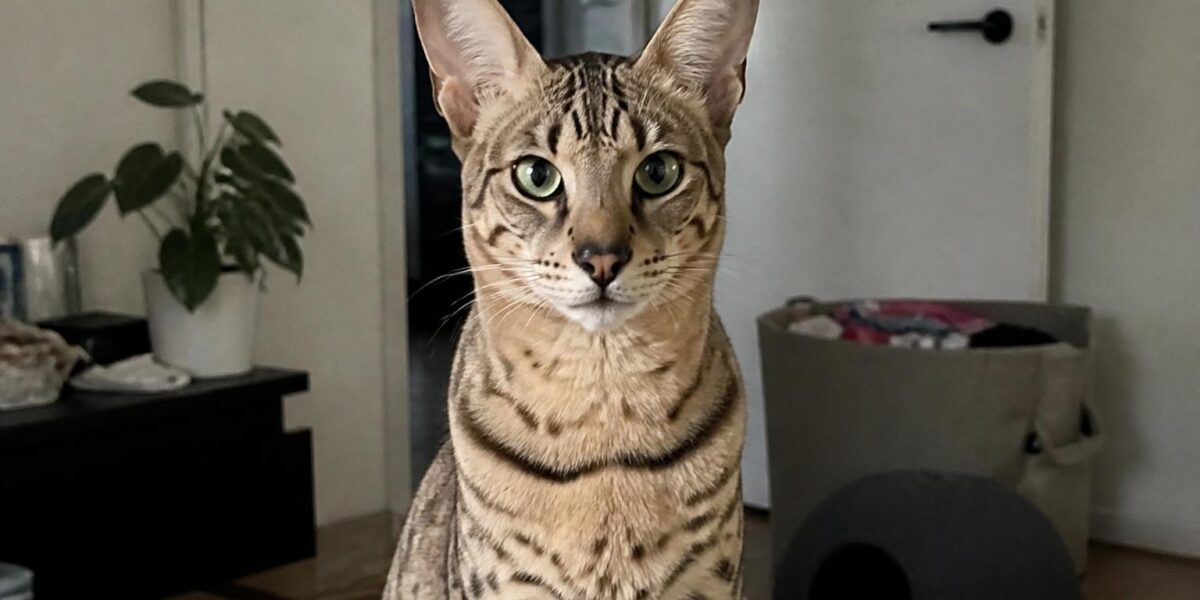
The coat is short to medium in length with a slightly coarse texture. The most common and desirable pattern is brown spotted tabby, featuring bold, dark spots on a warm golden to tawny background. The spots should be solid and bold, reflecting the Serval’s pattern. Other accepted colors include silver spotted tabby, black, and black smoke, though brown spotted tabby is most strongly associated with the breed.
Distinctive facial markings include dark tear marks running from the inner corners of the eyes down the sides of the nose, a trait inherited from the Serval that gives the Savannah an intensely focused expression. The ears are large, tall, and set high on the head, sometimes with ocelli, the light-colored markings on the back of the ears that are found on many wild cat species. The eyes are medium-sized and can be any color, though gold, green, and brown are most common.
The Savannah shares its exotic heritage with the Bengal cat, though the two breeds have different wild ancestors and distinct appearances. Another hybrid breed worth exploring is the Chausie, which descends from the Jungle Cat.
Temperament and Personality
The Savannah’s temperament is one of its most fascinating and complex aspects, and it varies considerably depending on the filial generation. Understanding these differences is crucial for choosing the right Savannah for your experience level and lifestyle.
F1 and F2 Savannahs are closest to their wild ancestor and tend to be the most challenging to own. These cats can be wary of strangers, selective about who they bond with, and prone to unpredictable behaviors that reflect their wild heritage. They are typically bonded to one or two people and may be aloof or avoidant with everyone else. F1 and F2 Savannahs require experienced owners who understand wild cat behavior and can provide the specialized environment these cats need.
Later-generation Savannahs (F3 and beyond) are progressively more domestic in temperament. F4 and later generations are typically social, confident, and affectionate with their families, though they retain the energy, intelligence, and curiosity that make the breed so captivating. These cats are often described as dog-like in their loyalty, following their owners from room to room, greeting them at the door, and sometimes playing fetch or walking on a leash.
Across all generations, Savannahs are extraordinarily athletic and curious. They are legendary jumpers, capable of clearing heights of six to eight feet from a standing position. They love water, often splashing in sinks, bathtubs, and even joining their owners in the shower. Their intelligence is exceptional, and they can learn to open doors, cabinets, and faucets, which means cat-proofing your home is not optional but essential.
Savannahs can get along with dogs, especially large, active dogs that can match their energy level. They are less predictable with small pets, as their strong prey drive can make them a risk to birds, rodents, and fish. With other cats, compatibility depends on the individual personalities involved and the generation of the Savannah.
Exercise, Enrichment, and Living Requirements
The Savannah is one of the most demanding domestic cat breeds in terms of exercise and enrichment needs. These are not cats that will be content with a scratching post and a bowl of kibble. Savannahs need extensive environmental enrichment, regular interactive play, and ideally, outdoor access in a safe, enclosed space.
A large, securely enclosed outdoor space, or catio, is highly recommended for Savannah owners. These enclosures allow the cat to experience the sights, sounds, and smells of the outdoors without the risks of free roaming. Indoor environments should include tall cat trees, climbing shelves, tunnels, and a variety of interactive toys. Cat wheels are popular among Savannah owners and provide an excellent outlet for the breed’s considerable energy.
Interactive play sessions are essential and should be provided multiple times daily. Feather wands, laser pointers used responsibly, and retrieval games engage the Savannah’s hunting instincts and provide physical and mental stimulation. Many Savannahs enjoy water play, and providing a shallow basin or fountain can be a source of entertainment.
Leash training is highly recommended for Savannahs, as it provides a safe way to explore the outdoors. Many Savannahs take to a harness and leash readily, especially when training begins during kittenhood. Regular walks and outings provide mental stimulation that indoor living alone cannot replicate.
Cat-proofing your home is critical with a Savannah. Their ability to jump to extreme heights, open doors and cabinets, and manipulate latches means that fragile items should be secured, cabinets should have child-proof locks, and windows and doors should be escape-proof. A bored or under-stimulated Savannah will find its own entertainment, which often involves creative destruction. For enrichment ideas, visit our guide to cat enrichment activities.
Health and Lifespan
The Savannah is generally a healthy breed with a lifespan of 12 to 20 years, with later generations tending toward the longer end of that range. The hybrid vigor that comes from crossing two genetically distinct animals can contribute to overall health and resilience, particularly in early generations.
Hypertrophic cardiomyopathy is a concern in Savannahs, as it is in many cat breeds. Regular cardiac screening, including echocardiograms, is recommended for breeding cats and advisable for pet cats as well. Responsible breeders screen their cats and work to minimize the incidence of heart disease in their lines.
One important health consideration unique to hybrid breeds is sensitivity to certain medications and anesthetics. Some early-generation Savannahs may react differently to ketamine and other drugs commonly used in veterinary practice. It is essential to work with a veterinarian who is experienced with hybrid breeds and to discuss any medication sensitivities before procedures.
Other potential health concerns include progressive retinal atrophy, pyruvate kinase deficiency, and the general health considerations that apply to all domestic cats, such as dental disease, obesity, and urinary tract issues. A high-quality, high-protein diet is important for maintaining the Savannah’s lean muscle mass and overall health. Many Savannah owners feed raw or minimally processed diets, though any dietary approach should be discussed with a veterinarian.
Regular veterinary care, including annual wellness exams, dental cleanings, vaccinations, and parasite prevention, supports long-term health. Maintaining a healthy weight is particularly important for Savannahs, as excess weight puts additional stress on their long, lean frames and can contribute to joint problems.
Grooming Needs
The Savannah’s short to medium-length coat is relatively easy to maintain. Weekly brushing with a rubber grooming mitt or soft bristle brush removes loose hair, stimulates circulation, and keeps the coat looking its best. The coat has a slightly coarse texture that is naturally resistant to matting, making it lower-maintenance than the coats of many domestic breeds.
Savannahs shed moderately, with slightly increased shedding during seasonal transitions. Regular brushing during these periods helps manage loose hair around the house. Bathing is rarely necessary, as the coat stays naturally clean, but Savannahs that enjoy water play may benefit from occasional bathing to remove any residue.
Ear care is important for the Savannah, as the large, prominent ears can accumulate wax and debris. Weekly ear checks and gentle cleaning with a veterinarian-approved ear cleaner help prevent infections. The large ear surface area also makes Savannahs more susceptible to sunburn on the ear tips, so limiting direct sun exposure is advisable.
Nail trimming every two to three weeks is recommended, along with regular dental care. Given the Savannah’s intelligence and sensitivity, establishing grooming routines early in life and making the experience positive through treats and praise helps ensure cooperation throughout adulthood.
Legal Considerations
Before purchasing or adopting a Savannah cat, it is absolutely essential to research the laws and regulations in your area. Because the Savannah has wild Serval ancestry, it is subject to restrictions that vary widely by country, state, province, and municipality.
In the United States, Savannah ownership laws vary by state. Some states, including Georgia, Hawaii, and Nebraska, prohibit Savannah ownership entirely. Others, such as New York and Massachusetts, restrict early-generation Savannahs but may allow later generations. Many states allow Savannahs of all generations without restriction. Local city and county ordinances may impose additional restrictions beyond state law.
In other countries, regulations vary even more widely. Australia prohibits the import and ownership of Savannah cats entirely. The United Kingdom and much of Europe have varying regulations depending on the generation. Canada generally permits later-generation Savannahs but may restrict early generations in some provinces.
Prospective owners should verify the laws at every level of government, including federal, state or provincial, and local, before committing to a Savannah. Reputable breeders can often provide guidance on the legal landscape, but the ultimate responsibility for compliance rests with the owner.
Who Is the Savannah Cat Best For?
The Savannah cat is best suited to experienced, dedicated owners who have thoroughly researched the breed and are prepared for the significant commitment it requires. Ideal Savannah owners have ample living space, the time and energy for daily interactive play and enrichment, and the financial resources for high-quality food, veterinary care, and environmental modifications.
Later-generation Savannahs (F4 and beyond) are more accessible for a broader range of owners, including experienced cat enthusiasts who want an active, engaging, and strikingly beautiful companion. These cats retain enough wild-looking appearance and energetic personality to be captivating while being fully domestic in temperament.
Early-generation Savannahs (F1 through F3) are only recommended for very experienced owners, ideally those who have previously owned hybrid cats or other demanding exotic breeds. These cats require a level of understanding, patience, and environmental management that goes beyond what most pet owners are accustomed to.
The Savannah is not recommended for first-time cat owners, owners who travel frequently or work long hours, or households where the cat would be left alone for extended periods without enrichment. It is also not suitable for homes with small children who may be too rough, or with small pets like hamsters, rabbits, or birds, due to the Savannah’s strong prey drive.
Frequently Asked Questions About the Savannah Cat
How high can a Savannah cat jump?
Savannah cats are exceptional jumpers, capable of leaping six to eight feet or more from a standing position. This extraordinary jumping ability is inherited from the Serval, which uses vertical leaps to catch birds and other prey in the African grasslands. Savannah owners need to secure high shelves, keep fragile items out of reach, and ensure that windows and high openings are escape-proof, as these cats can easily reach heights that would be impossible for most domestic breeds.
Are Savannah cats legal to own?
Savannah cat legality varies significantly by location. Some states, countries, and municipalities ban them entirely, while others restrict only early generations and permit later generations. Some areas allow all generations without restriction. It is essential to check federal, state or provincial, and local laws before purchasing or adopting a Savannah. Penalties for owning a restricted animal can include fines, confiscation of the cat, and in some cases, criminal charges.
Do Savannah cats get along with dogs?
Many Savannahs get along well with dogs, especially large, active dogs that can match their energy level and play style. The Savannah’s dog-like personality, which includes playing fetch and walking on a leash, can make it a compatible companion for canine housemates. However, introductions should be made gradually, and the individual temperaments of both the cat and the dog should be considered. Small dogs may trigger the Savannah’s prey drive, so caution is warranted.
What do Savannah cats eat?
Savannah cats thrive on a high-quality, high-protein diet. Many owners and breeders recommend raw or minimally processed diets that closely mimic the nutritional profile of a wild cat’s diet. However, any raw feeding program should be developed in consultation with a veterinarian to ensure it is nutritionally complete and safe. High-quality commercial cat foods with meat as the primary ingredient are also appropriate, particularly for later-generation Savannahs. Avoid diets high in fillers, grains, and artificial ingredients.
Looking to adopt a Savannah Cat Breed Profile?
Browse Savannah Cat Breed Profile cats and mixes available for adoption from shelters and rescues near you.
Find Savannah Cat Breed Profile Cats for Adoption