Last updated: May 4, 2026
In this article
- What an F3 Savannah Cat Actually Is
- Size, Build, and Appearance
- Legal Status
- Cost — Acquisition and Ongoing
- Behavior and Personality
- Daily Routine, Diet, and Enrichment
- Health and Lifespan Expectations
- Life Stages: Kitten Through Senior
- Comparison With Other Generations
- Adoption, Rescue, and Whether an F3 Is Right for You
- Frequently Asked Questions
What an F3 Savannah Cat Actually Is
An F3 Savannah cat is the third filial generation from the original African Serval × domestic cat foundation cross. Three generations back, a full Serval enters the pedigree; the kitten itself carries roughly 12% to 20% Serval genetics depending on which Savannah males have been used at each step. F3s are produced when an F2 female is bred to a Savannah or compatible male.
F3 Savannahs are often considered the sweet spot for prospective Savannah owners who want substantial wild-cat presence without the most extreme legal, behavioral, and cost realities of F1 or F2 generations. They are still large, athletic, vocal, and demanding by domestic-cat standards, but they fit into more normal homes and life situations than earlier generations.
This profile gives you the realistic picture so you can decide whether F3 fits your life — and whether you fit the cat’s needs in return.
Size, Build, and Appearance
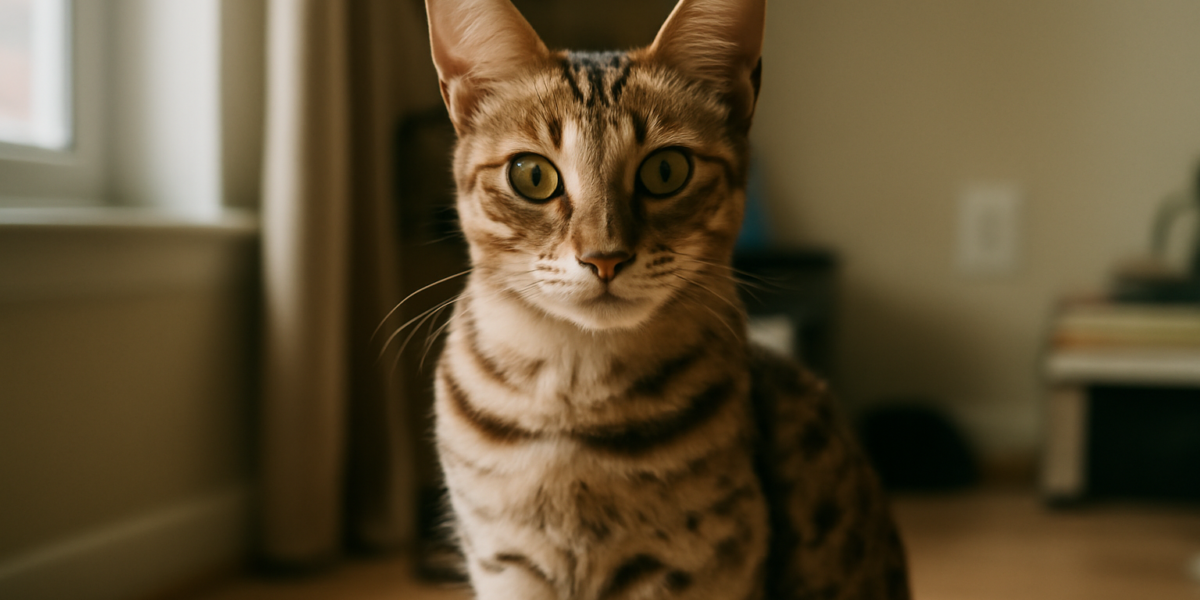
Adult F3 Savannah males commonly weigh 17 to 22 pounds, with some reaching 25+ pounds. Females are smaller, typically 13 to 17 pounds. The body remains tall, lean, and athletic, with long legs, a long neck, and the trademark large upright ears. Coats in the standard color are golden or tawny with crisp black spots flowing horizontally along the body.
Compared to F1 and F2 generations, F3s show somewhat less extreme leg length and ear size, though they still look unmistakably wild-influenced. To an inexperienced observer, an F3 still appears to be a “wild cat” rather than a typical pedigree domestic. Breeders and judges identify generation-specific traits readily; pet owners often cannot.
F3s jump well — vertical leaps of six to eight feet are within range — and they are powerful runners and climbers. Plan home setup accordingly.
Legal Status
F3 Savannahs face fewer legal restrictions than F1 and F2 generations. Many US states that ban earlier generations permit F3+ ownership without permits, though some maintain restrictions through F4 or beyond. International rules vary widely.
Verify legality at the state, county, and city level before pursuing. Get answers in writing. Even where F3s are legal at the state level, municipal ordinances or HOA rules can override. Our hybrid cat legality by state overview lays out the categories and considerations to research.
Insurance complications are typically less severe at F3 than at F1/F2, but many standard carriers still exclude or limit hybrid-cat coverage. See our hybrid cat pet insurance challenges guide for workarounds.
Cost — Acquisition and Ongoing
F3 Savannah kitten prices commonly range from $3,000 to $7,000 in legal jurisdictions, with significant variation by line, breeder, and individual cat. Pet-quality F3 males often sit at the lower end, while breeder-quality females and exceptional pet-quality individuals can exceed $7,000. Verify with current breeders — these figures shift year to year.
Ongoing costs are notably less than F1/F2 but still elevated compared to standard domestic cats:
- Specialized vet care (exotic-experienced ideally, though some general practitioners can handle F3s with consultation)
- High-quality diet, often partial raw or fresh-prepared
- Substantial enrichment infrastructure
- Possible permit fees in restrictive jurisdictions
- Insurance with carriers that cover hybrids
Behavior and Personality
F3 Savannahs are intelligent, active, vocal, and intensely bonded to their primary humans. They form deep attachments — many people describe their Savannah as more dog-like than cat-like in its preference for following the household around and engaging directly. Many learn to walk on harness, retrieve toys, respond to verbal cues, and learn complex routines.
F3s are generally somewhat more domestic in temperament than F2s — slightly less reserved with strangers, slightly more tolerant of handling variations, and somewhat more flexible about routine changes. They are still demanding compared to typical pedigree breeds, and they are still capable of remarkable behavior problems if their needs are unmet.
Reproductive note: F3 males are usually fertile, although some lines still show occasional male sterility. Most F3+ cats reproduce normally within the breed.
Daily Routine, Diet, and Enrichment
F3 Savannahs need substantial daily engagement. Plan for two structured interactive play sessions (45-60 minutes total), at least one training or puzzle-feeder session, continuous access to vertical climbing space, and rotating toys and challenges. F3s without enrichment redirect their energy onto your home, your sleep schedule, and your sanity. Many F3 owners describe their cat as “always on” — even sleeping cats wake instantly to investigate household sounds, and downtime needs to be scheduled into the day rather than expected as a default state.
Recommended baseline infrastructure includes:
- An outdoor catio or secure enclosed yard access
- Indoor climbing structures reaching at least six to eight feet
- Multiple scratching posts and surfaces
- Puzzle feeders and food-dispensing toys rotated weekly
- Access to safe water enrichment (fountain, bath, supervised pond)
- Daily structured interactive play time
- Training sessions using clicker work or target sticks
Our hybrid cat enrichment requirements and indoor cat exercise guides give practical setup ideas for various home sizes. Many F3 owners report that adding outdoor catio access transforms behavior dramatically — the combination of fresh air, novel sights, and bird-watching engagement provides hours of enrichment that no indoor toy rotation can match.
Grooming itself is straightforward. Savannah coats are short and dense; weekly brushing with a soft slicker or grooming mitt removes loose hair. Trim claws every two to three weeks, brush teeth several times weekly with feline toothpaste, and check ears monthly. Most F3s tolerate handling well if introduced patiently from kittenhood.
F3 Savannahs do best on high-protein, species-appropriate diets. Many breeders and owners feed partial or full raw, supplemented with high-quality wet food. Kibble can be part of a mixed diet but should not be the primary food. Caloric needs are higher than for domestic cats because of size and activity level — expect to feed roughly 25-40% more by volume than you would feed a similarly aged domestic cat, depending on activity and metabolism.
Use body condition scoring rather than pet-food-bag default portions to track caloric intake. Our hybrid cat raw diet feeding guide covers food safety, balance, supplementation, and the realistic learning curve. Whatever feeding model you choose, transition gradually, monitor stool quality, and consult a vet familiar with hybrid nutrition for taurine and essential nutrient supplementation.
Health and Lifespan Expectations
Responsible F3 breeders cardiac-screen parent cats annually for hypertrophic cardiomyopathy (HCM), the most significant Savannah breed concern. The hypertrophic cardiomyopathy in cats overview explains the condition, screening cadence, and warning signs you should know.
Vaccination protocols and anesthesia approaches still differ somewhat from domestic-cat norms at F3, though less dramatically than at F1/F2. Establishing care with an exotic-experienced veterinarian is still the safer default. Our hybrid cat vet special considerations overview covers anesthesia, vaccines, and drug-metabolism issues across hybrid generations.
Other concerns to monitor: dental disease (active dental care helps significantly), kidney function in middle adulthood and beyond, and joint health in larger individuals. Annual wellness exams from kittenhood are non-negotiable. The adult cat wellness checklist outlines screening cadence.
Life Stages: Kitten Through Senior
Kittenhood (0-12 months)
F3 kittens grow rapidly and need extensive socialization. Establish carrier and harness training early; many F3s leash-walk well with patient introduction. Vet visits should happen with an exotic-experienced practitioner where possible. Feed several small meals daily and transition gradually to adult diet structure.
Adolescent and adult (1-10 years)
Daily structured play, climbing access, and consistent enrichment routines. Annual cardiac screening, weight monitoring, and dental care from middle adulthood onward. Spay or neuter per your vet’s timeline.
Senior (10+ years)
Many F3 Savannahs remain athletic into their teens. Increase wellness exam frequency and monitor for kidney disease, arthritis, and cardiac changes. The senior cat care checklist covers what to track.
Comparison With Other Generations
F3 Savannahs are larger and more wild-influenced than F4 and F5 generations but smaller and less intense than F1 and F2. They are often the most accessible early-generation Savannah for prospective owners who want substantial wild presence without the legal, fertility, and behavioral complications of F1/F2.
If you want to compare directly: the F2 Savannah cat breed profile shows the next generation up, the F4 Savannah cat SBT profile shows the first show-eligible generation, and the full Savannah cat breed profile gives the breed overview. The African Serval and domestic pairing overview covers foundation cross history.
Adoption, Rescue, and Whether an F3 Is Right for You
F3 Savannahs sometimes appear in rescue, often because owners underestimated activity needs or moved to less permissive jurisdictions. Adopting a rescue F3 can be deeply rewarding for experienced cat owners with appropriate setup — these cats are often surprisingly well-socialized despite their backstories, and they bond rapidly with new humans who provide structure and engagement. Our adopting a rescue Savannah cat guide covers realistic intake assessment.
If buying from a breeder, work with established Savannah specialists who provide health guarantees, screen prospective buyers, and stay in touch long term. Walk away from any breeder who lets kittens go before twelve weeks, refuses to share parent health screening, or markets F3s as low-maintenance. None of that is accurate. Reputable breeders welcome detailed questions about parent health, generation history, kitten development timelines, and their support practices for adoptive families.
An F3 Savannah suits cat owners with experience handling active, intelligent breeds, an appropriate home environment with vertical climbing space, an exotic-cat-friendly vet relationship, verified legal status, a reasonable budget, and the schedule to provide significant daily engagement. They work in many more home situations than F1/F2 but still are not appropriate for first-time owners, frequent travelers, or households with small children or small prey-style pets.
If your situation is solid for F3 ownership, you will find one of the most rewarding companion relationships available in the cat world — strikingly beautiful, intensely bonded, and individually expressive. Consult your vet, your state’s wildlife department, and a hybrid-cat-experienced behaviorist before pursuing. The honest assessment up front protects both you and the cat. The full Savannah cat care guide covers practical daily living that applies across F3 and later generations.
Frequently Asked Questions
How big does an F3 Savannah get?
Males commonly 17-22 pounds, females 13-17 pounds. Some males reach 25+ pounds, but most fall within the typical range.
Is an F3 Savannah legal everywhere F1s are not?
Often yes, but not always. Some jurisdictions restrict all hybrid generations equally; others differentiate by generation. Verify locally before pursuing.
How much does an F3 Savannah cost?
Commonly $3,000-$7,000 for a well-bred kitten in legal jurisdictions. Verify with current breeders; figures shift year to year.
Are F3 Savannah males fertile?
Usually yes. Some lines still show occasional sterility, but most F3+ males reproduce normally.
Is an F3 Savannah a good first cat?
Generally not. F3s are more accessible than F1/F2 but still demanding. First-time cat owners should consider lower generations or non-hybrid breeds.
Looking to adopt a F3 Savannah Cat Breed Profile?
Browse F3 Savannah Cat Breed Profile cats and mixes available for adoption from shelters and rescues near you.
Find F3 Savannah Cat Breed Profile Cats for Adoption