
Last updated: April 27, 2026
In this article
Giant Schnauzer Dog Breed Profile
The Giant Schnauzer is a breed that commands attention the moment it walks into a room. Powerful, intelligent, and fiercely loyal, the Giant Schnauzer is the largest of the three Schnauzer varieties — and by far the most demanding. Originally developed in Bavaria as a versatile working dog capable of driving cattle and guarding estates, this breed has since distinguished itself in police work, military service, and competitive dog sports. Its striking appearance — a large, squarely built frame topped with the trademark wiry coat, bushy eyebrows, and full beard — makes it one of the most visually imposing dogs in the working group. But looks are only the beginning. The giant schnauzer is a dog of exceptional character that thrives when given a purpose, a consistent leader, and an outlet for its considerable energy and drive. This is not a breed for casual dog owners, but in the right hands, it is an extraordinary companion.
Quick Facts
| Characteristic | Details |
|---|---|
| Breed Group | Working Group (AKC) |
| Size | Large |
| Weight | 55–85 lbs (25–39 kg) |
| Height | 23.5–27.5 inches at the shoulder |
| Lifespan | 12–15 years |
| Coat | Dense, harsh, wiry double coat |
| Colors | Salt-and-pepper, solid black |
| Energy Level | Very High |
| Shedding | Low |
| Good With Kids | Best with older children; experienced owners recommended |
| Good With Other Pets | Can be challenging; early socialization essential |
| Trainability | High, but requires firm, consistent leadership |
| Hypoallergenic | Often considered low-allergen |
| Origin | Bavaria, Germany |
Personality and Temperament
The giant schnauzer is bold, loyal, and commanding — a dog that takes its role as family guardian seriously from day one. This is a breed with an unmistakable working drive that never fully switches off. Giant schnauzers are alert, watchful, and deeply attuned to their environment. They will notice changes in the household before you do, and they will act on their instincts if they perceive a threat. This natural protectiveness, when properly channeled, makes them outstanding guard dogs and personal protection companions.
Despite their serious demeanor in the field, giant schnauzers are affectionate and even playful within the family circle. They bond deeply with the people they live with and can be remarkably gentle with those they trust. However, this breed does not extend that warmth automatically to strangers. Giant schnauzers tend to be reserved with unfamiliar people until trust has been established, and they are not the kind of dog that greets every guest with enthusiasm.
What sets the giant schnauzer apart from many large breeds is the sheer intensity of its personality. This is not a passive dog that is content to lounge around waiting for attention. It needs purpose, engagement, and leadership. Without those things, it will find its own outlets — and those outlets are rarely convenient for the owner. For experienced dog handlers who can match the breed’s energy and intelligence, the giant schnauzer is a fiercely devoted, deeply satisfying partner.
Appearance
The giant schnauzer is the largest member of the Schnauzer family and carries that distinction in every line of its body. Built for strength and endurance, the giant schnauzer has a square, powerful frame — the body length roughly equals the height at the withers — giving it an impression of solidity and balance. Males typically stand 25.5 to 27.5 inches at the shoulder and weigh between 60 and 85 pounds, while females are slightly smaller.
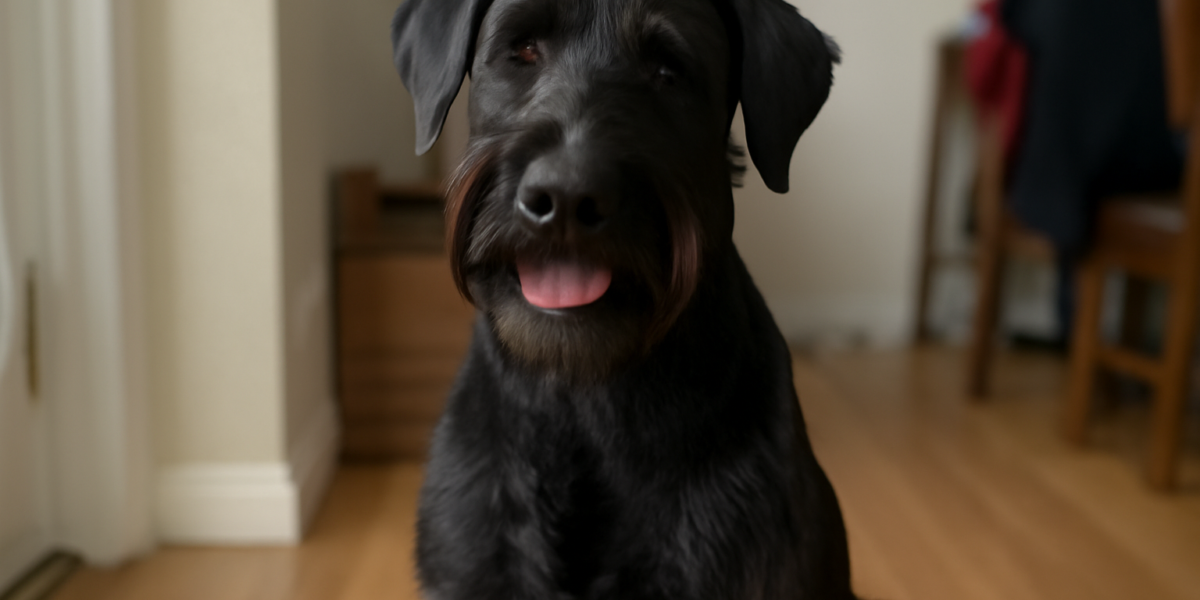
The coat is the breed’s most iconic feature: a dense, harsh, wiry outer coat over a soft undercoat. Accepted colors are salt-and-pepper — in which individual hairs are banded black and white to create a grizzled effect — and solid black. The hallmark beard and bushy eyebrows are present and prominent, just as they are on the Miniature and Standard Schnauzers, but on this larger frame they appear even more striking. The muzzle is strong and rectangular, with a blunt end. The overall expression is one of keenness and intelligence. The build is distinctly athletic: deep chest, well-sprung ribs, and a firm topline that conveys readiness for work at all times.
Exercise Needs
The giant schnauzer has very high exercise needs that must be taken seriously before bringing one into your home. This is a working breed developed for endurance and stamina, and a short daily walk will not come close to meeting its physical requirements. Plan for a minimum of 90 minutes to two hours of vigorous exercise every day — ideally split across multiple sessions. Running, hiking, cycling alongside an owner, fetch in a large fenced yard, and structured play all work well for this breed.
Beyond physical exercise, the giant schnauzer needs a job. Without a defined purpose or structured activity, this breed becomes frustrated and destructive. Dog sports are an excellent solution: giant schnauzers excel at Schutzhund (IGP), obedience trials, agility, tracking, and search and rescue work. These activities engage both the body and the mind, providing the deep satisfaction this breed craves.
A securely fenced yard is strongly recommended. Giant schnauzers should never be off-leash in unenclosed areas due to their strong prey drive and tendency to act independently when a stimulus catches their attention. Owners who cannot commit to providing substantial daily exercise and mental engagement should consider a different breed.
Grooming Needs
Grooming a giant schnauzer correctly requires time and knowledge, but the end result is a striking, well-maintained dog with a coat that performs exactly as it was designed to. The traditional grooming method for this breed is hand stripping — a technique in which the dead outer coat is manually pulled out rather than clipped. Hand stripping preserves the coat’s correct harsh texture and natural color pattern. Clipping is a common shortcut, but over time it softens the coat and can dull the color, resulting in a dog that no longer looks quite like the breed standard intends.
The beard and leg furnishings require brushing several times per week to prevent tangles and matting. The beard in particular needs daily attention — it traps food, water, and debris and can develop odor if not kept clean. Wiping the beard after meals and checking it regularly is part of the daily routine for any giant schnauzer owner.
Ears should be checked and cleaned weekly to prevent moisture buildup and infection. Nails require trimming every three to four weeks. Teeth should be brushed regularly. Professional grooming appointments every six to eight weeks are advisable for owners who do not hand strip at home. For more dog care guidance, visit our dog care blog.
Health and Common Issues
The giant schnauzer is a generally robust breed, but like all large working dogs, it has specific health conditions that prospective owners and adopters should understand.
Hip dysplasia is one of the most common concerns in the breed. This inherited condition causes improper development of the hip joint and can lead to pain and reduced mobility over time. Responsible breeders screen breeding stock with OFA or PennHIP evaluations. Maintaining a lean body weight and providing appropriate exercise from puppyhood reduces joint stress significantly. Osteochondrosis dissecans (OCD), a joint condition affecting the cartilage of the shoulder, elbow, or other joints, has also been reported in giant schnauzers and is worth monitoring in growing puppies. Autoimmune thyroiditis, an immune-mediated condition affecting thyroid function, occurs with some frequency in the breed and can cause weight gain, lethargy, and coat changes. Annual thyroid panels are recommended. Bloat (gastric dilatation-volvulus), a life-threatening condition in which the stomach fills with gas and twists, is a risk for all deep-chested large breeds including the giant schnauzer. Feeding multiple smaller meals, avoiding exercise immediately after eating, and knowing the warning signs of bloat can be life-saving. Regular veterinary check-ups and sourcing from health-tested lines remain the best overall approach.
Are Giant Schnauzers Good With Kids and Other Pets?
The giant schnauzer can be a devoted family dog, but this breed is best suited to households with older children and owners who have prior experience managing large, assertive dogs. Giant schnauzers are protective by nature and form strong bonds with the children they are raised with. However, their size, strength, and intensity mean they can accidentally overwhelm or knock over small children, even without aggressive intent. Supervision during interactions between young children and giant schnauzers is non-negotiable.
First-time dog owners often find the giant schnauzer’s combination of size, drive, and dominant personality more than they bargained for. The breed needs an owner who can set firm, consistent boundaries and follow through every time. Without that structure, the dog may begin testing limits in ways that become difficult to manage.
With other dogs, early and ongoing socialization is critical. Giant schnauzers can be assertive and dominant with unfamiliar dogs, particularly those of the same sex. They often do best as the only dog in the household or with a well-matched companion introduced carefully from a young age. Small animals — cats, rabbits, birds — present a challenge due to the breed’s pronounced prey drive, and cohabitation should be approached with great caution and careful, gradual introductions.
Training Tips
Training a giant schnauzer is one of the most rewarding experiences in dog ownership — and one of the most demanding. This breed is highly intelligent and picks up new concepts quickly, but it is also dominant by nature and will test its owner’s resolve on a daily basis. The giant schnauzer needs firm, fair, and consistent leadership from day one. Wishy-washy rules or inconsistent enforcement will be exploited immediately.
Positive reinforcement methods work well, but they must be delivered with clear expectations and confidence. Food rewards, praise, and structured play sessions are effective motivators. Harsh or punitive training methods damage trust and can provoke defensiveness in a breed this strong. Patience and persistence are non-negotiable — this is not a dog that responds to shortcuts.
Early puppy socialization and obedience training are essential. Giant schnauzer puppies should be exposed to a wide variety of people, environments, sounds, animals, and situations during the critical early socialization window. Enrollment in a puppy class followed by formal obedience training is strongly recommended. Giant schnauzers thrive in structured dog sports such as IGP (Schutzhund), agility, and advanced obedience, which channel their drive constructively. A well-trained giant schnauzer is a genuinely magnificent companion; an untrained one is a significant problem.
History and Origin
The giant schnauzer originated in the Bavarian Alps of southern Germany, where it was developed in the 17th and 18th centuries as a large, versatile working dog. Bavarian cattlemen needed a dog capable of driving livestock to market — an animal with the size and endurance to manage large herds over long distances, and the intelligence and strength to guard property overnight. The giant schnauzer was likely developed by crossing the Standard Schnauzer with larger breeds such as the Great Dane, Bouvier des Flandres, and rough-coated shepherd dogs native to the region. The result was a dog with the Schnauzer’s characteristic look and temperament scaled up to a formidable working size.
As the era of cattle driving faded, the giant schnauzer found new purpose as a guard dog for breweries, butcher shops, and farms throughout Germany. By the early 20th century, the breed had attracted the attention of police and military trainers, who recognized its intelligence, courage, and trainability. German police departments began formally training giant schnauzers during World War I, and the breed served in both World Wars. Today, the giant schnauzer continues to serve in police and military roles in Germany and elsewhere, while also competing at the highest levels of dog sport and serving as a guardian companion for dedicated owners worldwide.
Frequently Asked Questions
Is the giant schnauzer a good family dog?
The giant schnauzer can be a devoted family dog for the right household. It is best suited to active families with older children, experience handling large working breeds, and the time to commit to training, socialization, and daily exercise. It is not the ideal choice for first-time dog owners or families with very young children.
How much exercise does a giant schnauzer need?
Giant schnauzers require at least 90 minutes to two hours of vigorous exercise daily, along with significant mental stimulation. They are bred for endurance work and need a physical and mental outlet every single day. Dog sports such as IGP, agility, and tracking are excellent ways to meet this need in a structured and rewarding way.
Are giant schnauzers aggressive?
The giant schnauzer is protective and dominant, not inherently aggressive. A well-socialized and properly trained giant schnauzer is confident and controlled, not reactive or unpredictable. However, without proper socialization, training, and leadership, any dog of this size and drive can develop problematic behaviors. This is why experienced ownership and early training are so critical for this breed.
How is the giant schnauzer different from the standard schnauzer and Miniature Schnauzer?
All three Schnauzer varieties share the same characteristic look — wiry coat, beard, and bushy eyebrows — but they differ significantly in size and temperament. The Standard Schnauzer is the original breed. The Miniature Schnauzer was developed as a smaller ratter. The giant schnauzer was developed as a large working and herding dog and is the most physically powerful and dominant of the three. It also has the highest exercise and training demands of the three varieties.
Adopt a Giant Schnauzer
If you have the experience, time, and commitment that the giant schnauzer demands, adoption is a deeply rewarding path to bringing one into your life. Rescue giant schnauzers come in a range of ages — from young dogs needing structure and guidance to calmer adults that are already house-trained and ready to settle into family life. Many rescued giant schnauzers are loving, loyal dogs that simply ended up in a home that was not equipped to meet their needs.
Walk Me Home Rescue is dedicated to matching the right dogs with the right families. Our adoption team takes the time to understand both the dog’s history and your lifestyle to ensure a successful long-term match. If you are ready to open your home to a giant schnauzer or another deserving dog, we would love to help you find your match.


