
What IVDD Means
Intervertebral disc disease, abbreviated IVDD, is a condition in which the cushioning discs between the vertebrae of the spine fail and put pressure on the spinal cord. The discs sit between each pair of vertebrae and act as shock absorbers, allowing the spine to flex while protecting the delicate spinal cord that runs through the bony canal above. When a disc bulges or ruptures, the spinal cord is compressed, and the consequences range from mild back pain to complete paralysis.
In this article
IVDD dogs come in two main flavors. Hansen Type I disc disease is the classic problem of chondrodystrophic breeds (Dachshunds, Beagles, French Bulldogs, Shih Tzus, Pekingese) where discs degenerate early and rupture suddenly, often in young to middle-aged dogs. Hansen Type II disc disease is a slower, age-related process more commonly seen in larger breeds, where discs gradually bulge and produce progressive signs.
The condition is one of the most common neurological problems in dogs and one of the most stressful for owners. The good news is that with prompt evaluation and appropriate treatment, the majority of affected dogs recover, often dramatically. The key is recognizing the signs quickly and acting on them.
Why Some Breeds Are At Higher Risk
Chondrodystrophic breeds have a genetic mutation that causes early calcification of their intervertebral discs. The discs lose their elasticity and become brittle, making them prone to sudden rupture even from mild activities like jumping off a couch. Dachshunds are the poster breed, with veterinary studies suggesting a substantial proportion of Dachshunds will develop some form of disc disease in their lifetime.
Other commonly affected breeds include the Beagle, Cocker Spaniel, French Bulldog, Pekingese, Shih Tzu, Lhasa Apso, and Welsh Corgi. Mixed breeds with chondrodystrophic ancestry can also be affected. The genetic basis means that these breeds need extra attention to back protection throughout their lives.
Larger non-chondrodystrophic breeds (German Shepherds, Labradors, Doberman Pinschers) typically develop the slower Type II form later in life. Both types involve compression of the spinal cord but differ in how quickly signs appear and how treatment is approached.
Recognizing the Signs
The earliest signs are often subtle pain, expressed as reluctance to jump, hesitation to climb stairs, a hunched back, trembling, or a yelp when picked up. Some dogs hold their head or neck stiffly, refuse to look up at food, or seem to have a “low” carriage. Pain alone may be the only sign in the mildest cases.
As compression worsens, weakness in one or both back legs develops. Your dog may stumble, drag a paw, or knuckle over (resting on the top of the foot rather than the pad). The legs may cross under the body, and your dog may struggle to rise after lying down. This is the wobbly, clumsy phase that often prompts the urgent vet visit.
In severe cases, the back legs become completely paralyzed. The dog cannot stand or walk and may not even feel pinching of the toes. Loss of bladder and bowel control follows. Cervical (neck) IVDD can affect all four legs and produce neck pain, weakness, or even respiratory difficulty in extreme cases. Any sudden weakness or paralysis is an emergency.
Stages of Disc Disease
Veterinarians often grade IVDD on a five-point neurological scale to communicate severity and guide treatment. Grade 1 is back pain only with no neurological deficits. Grade 2 is mild weakness, with the dog still able to walk but ataxic. Grade 3 is more significant weakness with the dog unable to walk but still able to make voluntary leg movements.
Grade 4 is paralysis with intact deep pain sensation, meaning the dog cannot walk but still feels and reacts to firm pinching of the toes. Grade 5 is paralysis with loss of deep pain, the most severe stage. The grade strongly influences both treatment recommendations and prognosis.
Early grades often respond well to conservative management or surgery. Grade 5 is more challenging, and the chance of meaningful recovery declines significantly if surgery is delayed beyond about 24 to 48 hours after loss of deep pain. This is why prompt evaluation is so important.
Diagnosis
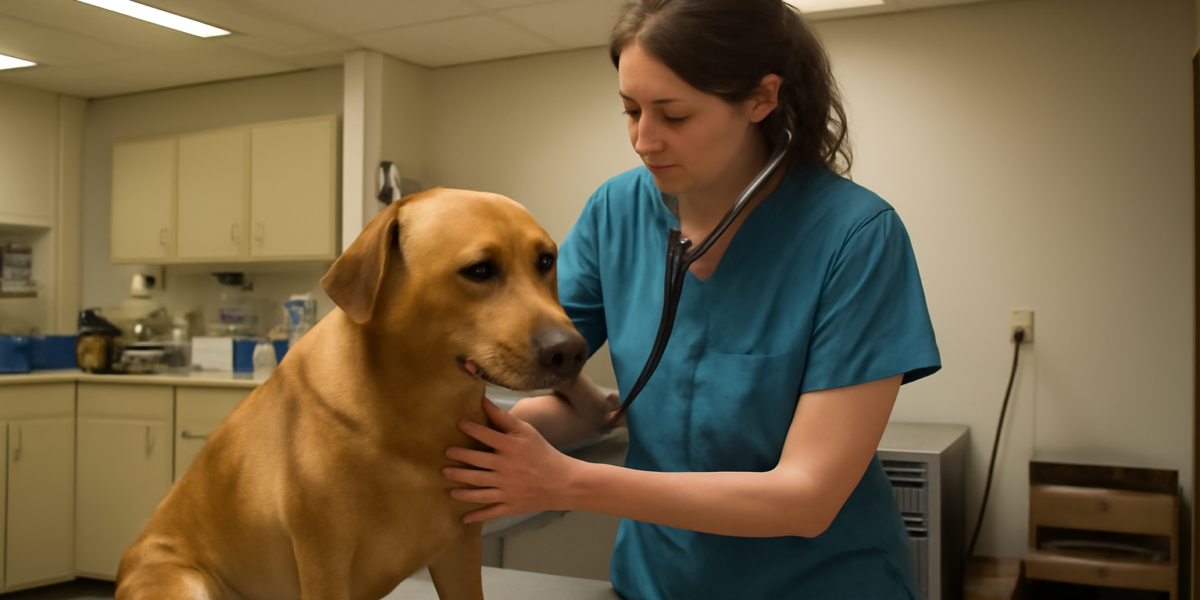
Your veterinarian will start with a neurological exam, assessing your dog’s posture, gait, reflexes, and pain sensation. The exam helps localize the problem to a region of the spine (cervical, thoracolumbar, or lumbosacral) and assigns a grade. Plain radiographs may show some changes such as calcified disc material or vertebral changes but cannot definitively diagnose disc compression.
Advanced imaging is the gold standard. MRI is the preferred study because it shows soft tissue, including the disc material and the spinal cord, in clear detail. CT myelography (CT after injection of contrast around the spinal cord) is an alternative that is widely available. Either modality is needed to plan surgery and confirm the location of disc material.
Imaging is typically done at a referral center where surgery can be performed if needed. For dogs with significant neurological signs, do not delay; the time from diagnosis to surgery often makes a real difference in outcome.
Conservative Management
For dogs with mild signs (Grade 1 or some Grade 2), conservative management is often the first choice. This means strict cage rest for four to six weeks, pain control, anti-inflammatory medication, and very limited activity. The goal is to let the disc material settle and reduce inflammation around the spinal cord while the dog avoids further injury.
Strict cage rest is genuinely strict. Your dog should be confined to a crate or small pen except for brief leash walks for elimination. No couches, no stairs, no jumping, no running, no rough play. Even short bursts of activity can re-injure the spine and undo the benefit of rest. Most owners are surprised by how restrictive this is.
Pain medication, muscle relaxants, and steroids or NSAIDs (your vet will choose, never both) are commonly prescribed. After the initial confinement, gradual return to activity over additional weeks is guided by your veterinarian’s recheck. Many dogs with mild disease recover completely with conservative care, but compliance with rest is essential.
Surgery for IVDD
Surgery is generally recommended for dogs with significant weakness or paralysis (Grade 3 and above), or for dogs that fail to improve with conservative management. The most common procedure is a hemilaminectomy or ventral slot, in which the surgeon removes a small piece of vertebral bone to access the spinal canal and remove the offending disc material.
Outcomes are generally very good, especially when surgery is performed promptly. Dogs with intact deep pain sensation (Grades 3 and 4) often recover the ability to walk within weeks to a few months. Recovery is more variable for dogs that have lost deep pain (Grade 5), and time to surgery becomes critical, with better odds when surgery happens within the first 24 to 48 hours of loss of deep pain.
Surgery is typically performed by a board-certified neurologist or surgeon at a specialty center. Costs are significant, but most owners find the investment worthwhile when their dog walks again. After surgery, dogs require strict confinement and rehabilitation for several weeks.
Recovery and Rehabilitation
Whether your dog had surgery or conservative management, recovery requires patience and commitment. The first weeks are about strict rest, pain control, and incision care if applicable. Bladder management may be needed for dogs that cannot empty their own bladder, and your veterinary team will teach you how to express the bladder if necessary.
Physical rehabilitation accelerates recovery and improves long-term outcomes. Underwater treadmill therapy is particularly valuable for dogs regaining the ability to walk. Other modalities include therapeutic exercise, balance and proprioception work, and massage. A certified rehabilitation veterinarian or therapist can build a program tailored to your dog’s stage of recovery.
Most dogs with successful surgery walk again within weeks. Some have residual weakness or proprioceptive deficits long term but live good-quality lives. Even dogs that do not regain full motor function can do well in carts and adaptive equipment, and many become beloved community ambassadors for spinal cord recovery.
Long-Term Care and Recurrence
Dogs that recover from one IVDD episode are at risk of future episodes, especially in chondrodystrophic breeds. Lifestyle modifications reduce the risk: avoid jumping on and off furniture, use ramps, keep the back well supported during play, and maintain a lean body weight. Strong core muscles from low-impact exercise help support the spine.
Some dogs benefit from preventive measures, including supplements, ongoing rehabilitation, and avoiding high-impact activities. Discuss long-term plans with your veterinarian, especially if your dog has had one episode and is at risk of another.
For Dachshunds in particular, our Dachshund-specific IVDD prevention guide covers breed-specific considerations. The dog care blog has more articles on senior wellness and orthopedic health.
Emergency Signs to Recognize
Certain signs warrant immediate emergency veterinary care. Sudden inability to use the back legs, sudden severe back or neck pain, complete paralysis, or loss of bladder and bowel control are all emergencies. Time to treatment is one of the strongest predictors of recovery, so do not wait to see if it improves.
For owners of at-risk breeds, knowing where the nearest 24-hour veterinary specialty hospital is located can save valuable time. Many emergency hospitals can stabilize a dog with IVDD before transferring to a surgical facility, but the path is faster if you go directly to a specialty center when one is available.
If you cannot reach a specialty center, call your regular veterinarian or any emergency clinic immediately. Initial pain control and stabilization can be provided while imaging and surgical referral are arranged.
Considering Adoption of an IVDD Survivor
Many dogs who have recovered from IVDD episodes end up looking for homes through rescues, sometimes because their original owners could not manage the recovery. These dogs often make wonderful companions and adapt beautifully to homes with appropriate care. The adopt a dog hub covers what to ask shelters about a dog’s medical history.
If you are adopting a dog with a known IVDD history, ask about the affected disc, what treatment was performed, and what current limitations exist. Many of these dogs do beautifully in homes with ramps, no stairs, and gentle exercise. Some need long-term medication, and some have permanent neurological deficits that can be supported with adaptive equipment.
Frequently Asked Questions
Can my dog walk again after IVDD?
Most dogs with intact deep pain sensation walk again with appropriate treatment, often dramatically. Recovery is more variable for dogs that have lost deep pain, and time to surgery is critical. Even dogs with permanent deficits often live good-quality lives with adaptive support.
How long is the recovery from IVDD surgery?
Most dogs are walking by two to six weeks after surgery, though full recovery often takes two to three months. Strict confinement during the early weeks and ongoing rehabilitation are essential to a good outcome.
Can IVDD be prevented?
The structural disc problem in chondrodystrophic breeds is largely genetic, but you can reduce risk through lean body weight, ramps instead of jumping, limited high-impact activity, and supportive harnesses. Strong core muscles from gentle, regular exercise support the spine.
Will my dog have another episode?
Recurrence is possible, particularly in chondrodystrophic breeds. Lifestyle modifications and ongoing veterinary care reduce the risk. Some dogs have a single episode and never another, while others have recurrent disease that may require additional treatment over the years.
Is IVDD painful?
Yes, IVDD is genuinely painful, especially in the early stages. Many dogs cry out, refuse to move, or guard the affected area. Good pain control is a central part of treatment. Loss of pain sensation in advanced disease is itself a sign of severe spinal cord injury, not absence of pain.
When should I call my veterinarian?
Call immediately for any sudden back or neck pain, weakness, paralysis, or loss of bladder control. These are emergencies. Earlier evaluation almost always means better outcomes.


