
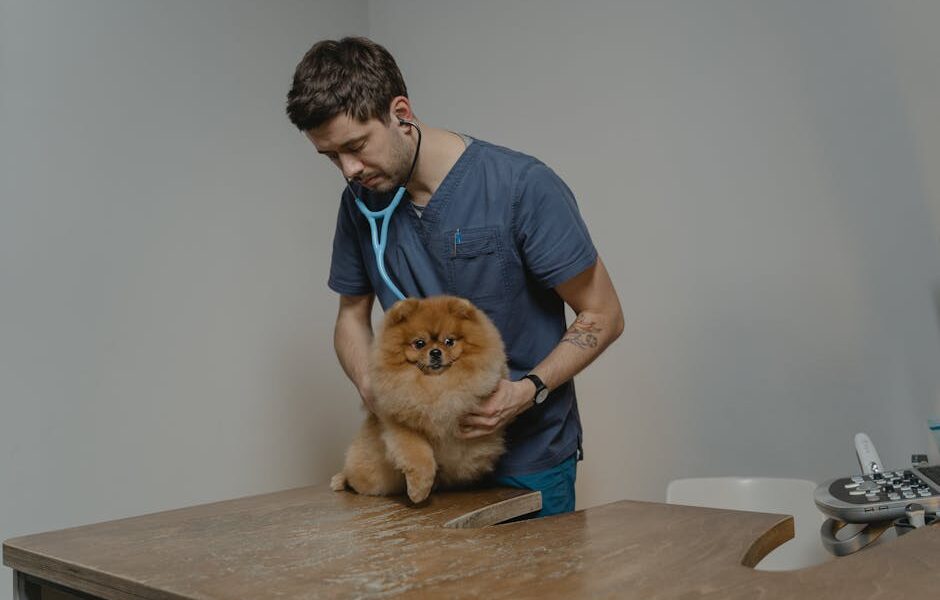
A cough can mean almost anything from mild airway irritation to congestive heart failure to a collapsed trachea or pneumonia. The pet coughing triage approach starts with identifying the cough pattern: when it happens, what it sounds like, and what other symptoms accompany it. This guide walks you through the common cough patterns in dogs and cats, when home monitoring is fine, when you need a vet visit this week, and the red-flag patterns — particularly involving difficulty breathing — that mean immediate ER.
In this article
- Step 1: Identify the Cough Pattern
- Step 2: Kennel Cough — Common and Usually Mild
- Step 3: Collapsing Trachea — Small-Breed Honking Cough
- Step 4: Cardiac Cough — The Nighttime Pattern
- Step 5: Cat Coughing — Often Asthma, Always Worth a Vet Visit
- Red-Flag Coughing Patterns — Always ER
- What to Bring to the Vet Visit
- Frequently Asked Questions
Step 1: Identify the Cough Pattern
Vets categorize coughs by sound, timing, and trigger. Try to describe (or video) your pet’s cough so you can match it to the right urgency level.
Soft, intermittent cough with no other symptoms in an otherwise normal pet — often allergies, mild irritation, or early chronic bronchitis. Monitor; schedule a primary vet visit within 1–2 weeks if it persists.
Hacking, gagging cough that sometimes ends with a small amount of foam or saliva — classic kennel cough (infectious tracheobronchitis) pattern, often after recent boarding, grooming, or dog park exposure. Highly contagious among dogs. Call the vet within 2–5 days; usually self-limiting in 1–3 weeks with supportive care.
Honking, goose-like cough — collapsing trachea, common in small and toy breeds (Yorkies, Pomeranians, Chihuahuas, Toy Poodles). Worsens with excitement, pressure on the throat from a collar, or hot/humid weather. Call the vet within a week for diagnosis and management plan.
Nighttime or position-related cough (worse lying down, better sitting up) — concerning for cardiac disease causing pulmonary edema or pleural effusion. Call the vet urgently — within 1–3 days.
Wet, productive cough with frothy white or pink-tinged fluid — possible pulmonary edema. If accompanied by rapid or labored breathing, ER immediately.
Coughing up blood — ER, regardless of other symptoms.
Step 2: Kennel Cough — Common and Usually Mild
Kennel cough is a complex of infectious agents (Bordetella, parainfluenza, mycoplasma, occasionally influenza) that causes the characteristic hacking-gagging cough in dogs. It typically appears 3–14 days after exposure at a boarding facility, dog park, grooming salon, or other dog-dense environment.
Most healthy adult dogs recover in 1–3 weeks with supportive care alone — humidified air, harness instead of collar (to reduce tracheal pressure), avoiding exercise that triggers coughing fits. Antibiotics are sometimes prescribed if a bacterial component is suspected or if symptoms are severe. Cough suppressants may be prescribed for comfort.
Quarantine the affected dog from other dogs for at least a week after symptoms resolve. Bordetella vaccines (intranasal or injectable) reduce risk but don’t eliminate it — the disease is similar to human common cold in that there are many causative agents.
For deeper detail on home management and timeline, see our dog kennel cough overview and the kennel cough home treatment walkthrough for supportive care steps.
Step 3: Collapsing Trachea — Small-Breed Honking Cough
Small and toy breeds with a distinctive goose-honk cough — especially during excitement, pulling on the leash, or in hot weather — likely have tracheal collapse. The trachea’s cartilage rings weaken and flatten during breathing, producing the characteristic noise.
Management focuses on weight loss (even modest excess weight worsens symptoms), switching from collar to harness, avoiding heat and humidity, and medical therapy with cough suppressants, anti-inflammatories, or bronchodilators. Severe cases sometimes require surgical stenting or external rings — referral to an internist or surgeon.
Our collapsed trachea in dogs guide covers diagnosis and the staged management approach typical for these patients.
Step 4: Cardiac Cough — The Nighttime Pattern
Cough that worsens at night, when the pet lies down, or after exercise, especially in middle-aged to older small-breed dogs (Cavaliers, Dachshunds, Maltese, Poodles) is concerning for mitral valve disease causing left-sided heart enlargement. The enlarged heart presses on the left mainstem bronchus, triggering cough; pulmonary edema then adds wet productive cough and respiratory distress.
This pattern needs prompt vet evaluation — chest X-rays, possibly cardiac ultrasound (echocardiogram), and an NT-proBNP blood test help confirm. Treatment with diuretics, ACE inhibitors, and pimobendan typically improves both quality and length of life significantly when started early.
If your pet shows nighttime cough plus rapid breathing (over 40 breaths per minute at rest while sleeping), pale or blue gums, exercise intolerance, or fainting, treat that as an ER visit — pulmonary edema can be life-threatening.
Step 5: Cat Coughing — Often Asthma, Always Worth a Vet Visit
Cats cough far less commonly than dogs, and when they do, the most common cause is feline asthma (also called feline lower airway disease). The pattern is often mistaken for hairball production — the cat crouches with elbows out, neck extended, and produces dry hacking without bringing anything up.
Any cat cough deserves a vet visit. Asthma is diagnosed with chest X-rays and managed with inhaled corticosteroids (typically via an Aerokat chamber and metered-dose inhaler) and bronchodilators. Untreated asthma can progress to acute respiratory crisis.
Less commonly cat cough signals heartworm disease, fungal infection, foreign body, or in older cats a lung mass. The cat coughing overview walks through the differential and what to expect at the vet visit.
Red-Flag Coughing Patterns — Always ER
Some cough presentations are emergencies regardless of context. Go to the ER immediately if you see:
- Coughing with difficulty breathing — labored, rapid, or noisy breathing accompanies the cough.
- Blue, grey, or pale gums — cyanosis means inadequate oxygen.
- Open-mouth breathing in a cat — cats are obligate nose breathers; open-mouth breathing is critical.
- Coughing up blood — fresh red or pink-frothy.
- Respiratory rate over 40 breaths per minute at rest in either species (normal: 15–30 dog, 20–40 cat at rest).
- Collapse, fainting, or sudden weakness with the cough.
- Severe lethargy and refusal to eat alongside cough.
- Choking-like cough with inability to clear the airway — possible foreign body in the airway.
For more detail on the canine cough differential and what your vet investigates see our dog coughing causes overview, which steps through the most common workup paths.
Cough severity is also worth scoring before the visit. A useful informal scale: mild (a few coughs per day, no impact on activity); moderate (multiple coughing episodes per day, fits last a minute or two, dog still eats and plays); severe (frequent coughing, productive of fluid, exercise intolerance, sleep disruption). Moderate or severe ratings warrant urgent attention even without one of the bright-line ER triggers above.
Also note environmental triggers: outdoor air pollutants, household smoke (cigarette, wood stove, fireplace), aerosol cleaners, scented candles, and dusty bedding can all worsen chronic cough. Eliminating the most likely irritants for two weeks while you wait for the vet appointment can sometimes resolve mild allergic cough on its own and tells you whether environment was the driver.
What to Bring to the Vet Visit
The single most useful thing you can bring is a video of the cough. Vets routinely diagnose cough patterns from a 20-second clip — the sound, timing, and accompanying posture often point straight to the cause. Film at home where the pet is comfortable.
Bring a timeline: when did the cough start, what triggers it (exercise, excitement, lying down, eating), how often, has it gotten worse or stayed the same, recent boarding or new pet exposure, current medications, and vaccine history. The more specific you can be, the faster the vet narrows the differential.
If your dog has been exposed to other dogs recently (dog park, boarding, grooming, daycare), mention it — kennel cough is so common that it’s near the top of the list for any acute hacking cough.
Frequently Asked Questions
Can I give my dog over-the-counter cough medicine like Robitussin?
Only with vet approval. Plain dextromethorphan (Robitussin DM) is sometimes used in dogs at vet-directed doses, but multi-symptom formulations contain acetaminophen, decongestants, or other ingredients toxic to pets. Never give cough medicine to cats without explicit vet direction.
How can I tell kennel cough from heart cough?
Kennel cough is hacking and gagging, usually in a dog otherwise acting normally, often with recent dog-dense exposure. Heart cough is softer, worse at night or lying down, in middle-aged to older small-breed dogs often with exercise intolerance. When in doubt, the vet’s chest exam and X-ray quickly distinguish them.
My dog has been coughing for three weeks — is that normal for kennel cough?
Kennel cough usually clears in 1–3 weeks. Cough persisting longer, especially with worsening symptoms, suggests something else (pneumonia, heart disease, chronic bronchitis, fungal infection) or a kennel cough complication. Schedule a vet visit.
Is reverse sneezing the same as coughing?
No. Reverse sneezing is a rapid forceful inhalation through the nose, usually in episodes of 5–30 seconds, and is benign. Cough is an expiratory event from the lungs and trachea. Video both — vets distinguish them easily on video.
Should I be worried about kennel cough spreading to my cat?
Most kennel cough pathogens are dog-specific and don’t infect cats. Some agents (mycoplasma, occasionally bordetella) can cross species, but it’s uncommon. Keep an eye on the cat and call the vet if any respiratory symptoms develop.


