Last updated: May 4, 2026
In this article
Overview
This spanish Mastiff breed profile is for the reader considering one of the largest and most ancient livestock guardian breeds in Europe. The Spanish Mastiff (Mastín Español) has been documented on the Iberian peninsula since Roman times and was used for centuries to guard transhumant sheep flocks across Spain — protecting them from wolves, bears, and rustlers as the flocks moved between summer pastures and winter grazing on the Cañadas Reales, Spain’s network of historic livestock routes.
Spanish Mastiffs are massive, loose-skinned, deep-jowled mastiff-type dogs with a working temperament that has changed surprisingly little across centuries. They are calm and patient at home, deliberate with strangers, and willing to escalate decisively when they decide the situation calls for it. They are also rare in North America, slow-maturing, expensive to feed and house, and entirely unsuited to most pet homes. The few that end up in rescue typically have a backstory worth understanding before adoption.
Quick facts: Group: livestock guardian (working mastiff). Origin: Spain. Size: giant, typically 28–35+ inches and 140–220+ pounds. Coat: medium-length double coat in a wide range of colors. Energy: low to moderate. Lifespan: giant-breed range, generally shorter than smaller dogs. Grooming: weekly brushing, drool-aware household, seasonal shed. Best for: working farms with livestock, large rural properties, experienced giant-mastiff owners.
History and Origin
The Spanish Mastiff descends from ancient mastiff-type dogs that arrived on the Iberian peninsula with Phoenician and later Roman traders. The breed was central to the Mesta — the medieval Castilian guild of sheep owners — which oversaw the transhumance routes across Spain. Spanish Mastiffs traveled with these flocks, protecting them across hundreds of miles of seasonal migration, and the breed was selected for endurance, calm temperament under stress, and the willingness to confront wolves when necessary.
Modern Spanish Mastiffs descend from working populations that survived the decline of large-scale transhumance in the twentieth century. The breed remains a working livestock guardian in parts of Spain today, where resurging wolf populations have kept the demand alive. The Real Sociedad Canina de España maintains the breed standard. Spanish Mastiffs are recognized internationally but remain uncommon outside Spain.
Temperament and Personality
Calm, dignified, watchful, and deeply attached to family. Spanish Mastiffs at home are typically slow-moving, patient, and tolerant — the breed is not anxious or busy, and adult dogs spend much of the day at rest, observing the household. With family children, well-socialized Spanish Mastiffs tend to be patient, although the size alone means supervision is required.
With strangers, the breed is reserved on first meeting and assesses each interaction. The Spanish Mastiff is not the most reactive of LGDs and is slower to escalate than some, but the dog is very willing to escalate if it decides escalation is required, and the size makes that escalation consequential. Force-free training works; harsh handling is counterproductive and damages the trust relationship that the breed runs on.
Same-sex dog aggression is moderate to significant in adults. Spanish Mastiffs raised with livestock and other pets generally accept them. Unfamiliar dogs entering the property is a serious territorial event.
Size and Appearance
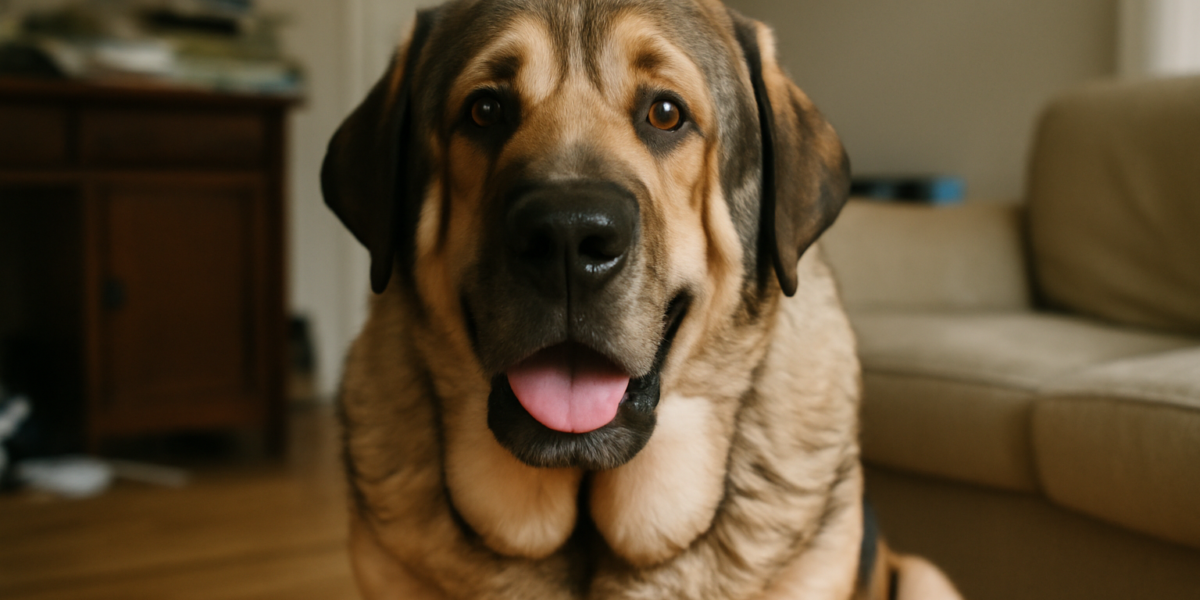
The Spanish Mastiff is one of the largest dog breeds in the world. Males stand 30–35+ inches at the shoulder and frequently weigh 180–220+ pounds; females run 28–32 inches and 140–180+ pounds. Some show-line and large working-line dogs exceed even these figures. The build is heavy mastiff — broad chest, deep jowls, loose skin, abundant dewlap, and a tail that is typically thick at the base and tapered.
The coat is medium-length, dense, and double, in a wide range of colors — fawn, brindle, red, black, wolf gray, and various combinations including white markings. The head is massive with a deep muzzle. Drool is part of the package.
Exercise and Activity Needs
Spanish Mastiffs are low- to moderate-energy by adult standards. A working dog on a Spanish farm meets activity needs through patrolling and slow movement; pet-line dogs need daily walks, access to a securely fenced large yard or acreage, and patience for a breed that is not built for high-intensity exercise.
Avoid heavy exercise in puppies and adolescents. The breed is genuinely slow to mature — physical growth often continues to age three — and the joints of a 200-pound giant cannot tolerate the same loading as a smaller dog. Off-leash work in unfenced areas is generally a poor idea, both because of territorial instincts and because the breed’s recall is unreliable in adults.
Grooming and Care
The double coat sheds year-round and blows heavily twice a year. Weekly brushing in normal seasons, daily during coat blow. The coat is generally self-cleaning when maintained, and bathing more than a few times a year is unnecessary unless the dog has gotten into something. Drool management is real — keep towels accessible, particularly after meals and water.
Never shave the coat. It insulates in both directions, and shaving disrupts that system. Standard ear, nail, and dental care otherwise. Diet should be a quality giant-breed formula, with deliberate slow growth in puppies. Joint supplementation is reasonable in adult dogs as recommended by your veterinarian.
Health and Lifespan
Hip and elbow dysplasia are common in giant breeds and worth screening. Bloat is a serious emergency risk in any deep-chested mastiff and every owner should learn the symptoms before adoption. Cardiac issues, entropion and ectropion (eyelid problems), heat sensitivity, and skin issues in the heavy folds are all worth monitoring.
Giant breeds typically live shorter lives than smaller dogs, and the Spanish Mastiff sits at the larger end of the giant range. Osteosarcoma, the bone cancer that disproportionately affects giant breeds, is a real risk. Plan financially before adoption — surgery, anesthesia, medication doses, food, crates, and bedding all run giant-scale.
Living With a Spanish Mastiff
The functional home is rural, fenced, with sufficient space for a giant dog and a household built around the dog’s calm rhythm. Suburban half-acre lots are typically too small and too stimulating. Apartment life is incompatible with the breed.
Children in the family are typically safe with well-socialized Spanish Mastiffs, but the size alone makes supervision non-negotiable — a 200-pound dog moving casually can hurt a child without any aggressive intent. Visiting children should be calm, supervised, and not allowed to invade the dog’s space. Other dogs entering the territory is a serious event for an adult Spanish Mastiff and should be managed carefully or avoided.
Training and Socialization
Start socialization the day the puppy comes home and continue through the first three years. Spanish Mastiffs mature slowly mentally as well as physically, and adolescence often extends through 30 months. Consistent, force-free handling through this period builds the trust relationship that the rest of training depends on. Heavy-handed correction damages trust and is counterproductive — a Spanish Mastiff that has lost trust in its handler is genuinely difficult to recover.
Realistic obedience expectations: solid sit, down, stay, leave-it, recall under low distraction, and good leash manners. Trial-level obedience is not the breed’s strength. Reading dog body language well matters more than any heel-and-finish drill, because the breed signals before it escalates and missing those signals is how avoidable incidents happen.
Is the Spanish Mastiff Right for You?
For most pet households, no. Spanish Mastiffs are working livestock guardian giants with a temperament shaped by centuries of transhumance work. The size, the cost, the slow maturation, the grooming load, and the protective instincts all combine to make the breed a serious commitment for a narrow set of homes. If you have rural acreage, livestock or a meaningful job, and experience with giant or guardian breeds, the Spanish Mastiff can be a remarkable companion. If you want a giant family dog without the heavy guarding drive, the Saint Bernard is closer to a pet temperament.
If the home is right and you are committed, breed-specific rescue is the responsible path, and Spanish Mastiff rescue networks are genuinely small in North America. Read about adopting an adult dog before starting — adult Spanish Mastiffs come to rescue because their adult size and temperament caught new owners off guard. Start at the adopt a dog hub.
Frequently Asked Questions
How big do Spanish Mastiffs get?
Adult males commonly weigh 180–220+ pounds; females 140–180+ pounds. Some individuals exceed these ranges. The Spanish Mastiff is among the largest dog breeds in the world.
Is the Spanish Mastiff the same as the Pyrenean Mastiff?
No. Both are Spanish livestock guardians and both are giant, but they are separate breeds. The Spanish Mastiff is heavier, more loose-skinned, and from the broader Iberian transhumance tradition; the Pyrenean Mastiff is specific to the Aragonese Pyrenees and has more white in the coat.
Are Spanish Mastiffs good family dogs?
For families with rural acreage and giant-breed experience, well-socialized Spanish Mastiffs tend to be calm, patient, and deeply bonded. For typical suburban pet families, the breed is generally a poor fit.
Do Spanish Mastiffs drool?
Yes, often significantly. The deep jowls and loose lips that come with mastiff structure produce drool, particularly after eating and drinking.
How long do Spanish Mastiffs live?
Giant breeds generally live shorter lives than smaller dogs, and Spanish Mastiffs sit firmly in the giant-breed range. Plan for a relationship measured in years rather than decades, and budget for giant-scale veterinary care throughout life.
Looking to adopt a Spanish Mastiff Breed Profile?
Browse Spanish Mastiff Breed Profile dogs and mixes available for adoption from shelters and rescues near you.
Find Spanish Mastiff Breed Profile Dogs for Adoption