
Last updated: April 25, 2026
In this article
Standard Poodle Dog Breed Profile
The standard poodle is one of the most misunderstood breeds in the canine world. Often reduced to a caricature of flamboyant show clips and aristocratic posturing, this dog is in reality a powerfully built, extraordinarily intelligent, and deeply athletic working breed that has spent centuries retrieving waterfowl, performing complex tasks, and forming inseparable bonds with the people fortunate enough to share their lives with one.
The standard poodle is the largest of the three poodle varieties and the one closest in form to the breed’s working origins. These dogs can keep pace with a distance runner, clear agility obstacles with breathtaking efficiency, and then settle in for an evening of calm companionship on the sofa. Their versatility is genuinely remarkable, and their low-shedding, curly coat makes them accessible to many households that would otherwise struggle with pet dander.
Whether you are an experienced dog owner looking for a capable, trainable partner or a family searching for a gentle, engaging companion that adapts to an active lifestyle, this guide will walk you through everything you need to know about the standard poodle.
Quick Facts
| Breed Group | Non-Sporting (AKC) |
|---|---|
| Height | Over 15 inches at the shoulder (typically 18 to 24 inches) |
| Weight | 40 to 70 pounds |
| Lifespan | 12 to 15 years |
| Coat Type | Dense, curly, continuously growing, low-shedding |
| Energy Level | High |
| Good With Kids | Excellent |
| Good With Other Pets | Generally yes |
| Trainability | Exceptionally high |
| Hypoallergenic | Considered low-allergen |
| Shedding | Minimal |
| Barking Tendency | Moderate |
Personality and Temperament
The standard poodle possesses one of the most compelling combinations of traits in the dog world: razor-sharp intelligence paired with genuine warmth, physical athleticism paired with dignified composure, and playful enthusiasm paired with emotional sensitivity. These dogs are not simply clever — they are perceptive, reading the moods and intentions of their people with uncanny accuracy and adjusting their behavior accordingly.
At home, standard poodles tend to carry themselves with a certain understated elegance. They are confident without being arrogant, alert without being anxious, and affectionate without being overwhelming. They bond deeply with their families and thrive in households where they are treated as full participants in daily life rather than kept apart or ignored.
Their playful side emerges freely during exercise, games, and training sessions, where they will approach challenges with visible enthusiasm and a clear desire to succeed. Standard poodles can be initially reserved with strangers, but they warm quickly once introduced and rarely exhibit aggression without cause. They do not tolerate extended isolation well and are happiest in homes where company is frequent and engagement is consistent. This is a breed that gives generously and asks for the same in return.
Appearance
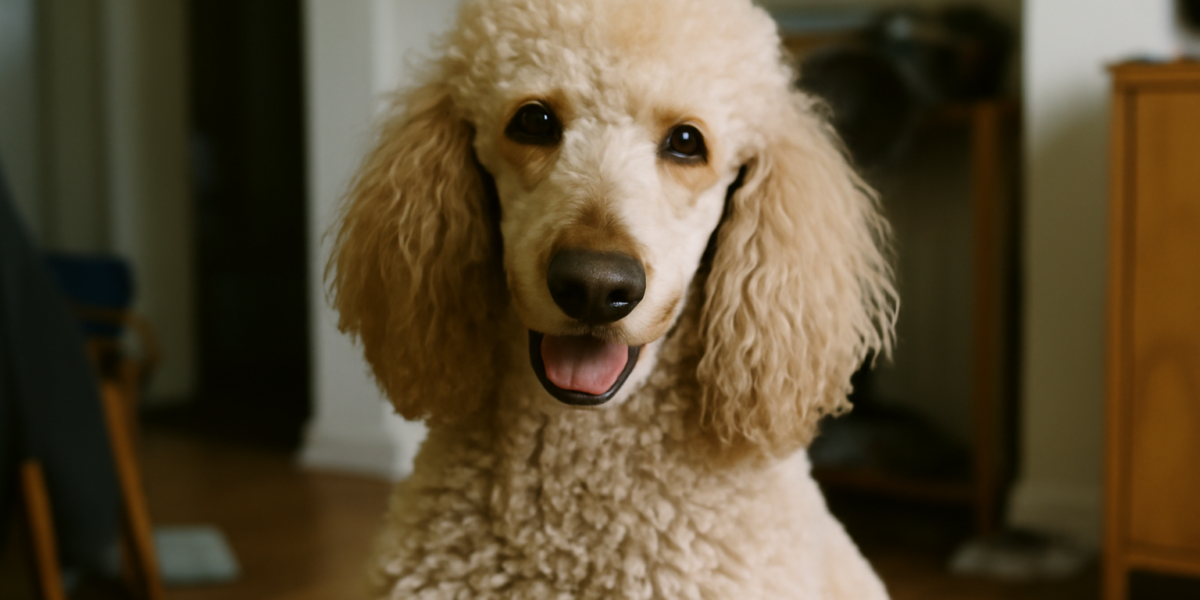
The standard poodle presents a square, well-proportioned silhouette — long-legged, deep-chested, and muscular beneath the coat. Their expression is alert and intelligent, with dark, oval eyes and long, flat ears that hang close to the face. Despite the elaborate clips associated with the breed in show competition, the underlying dog is athletic and solidly built.
The coat is the standard poodle’s most recognizable feature: dense, curly, and continuously growing in a single layer with minimal shedding. It comes in a wide range of solid colors including black, white, apricot, silver, blue, brown, cream, red, and cafe-au-lait. Parti-colored and phantom markings appear in some lines outside the show ring. Coat texture ranges from tight, uniform curls to broader, looser waves depending on the individual dog.
The various clip styles — from the elaborate continental and English saddle clips seen in conformation to the practical sporting clip preferred by working owners and pet families — all stem from the breed’s original function as a water retriever, where trimming was done for practicality, not decoration.
Exercise Needs
The standard poodle is a high-energy breed that requires substantial daily exercise to remain physically healthy and mentally balanced. A minimum of 60 minutes of vigorous activity per day is recommended, ideally divided across two or more sessions. Without adequate exercise, standard poodles can become restless, vocal, and prone to developing destructive habits born of boredom and pent-up energy.
As descendants of working water retrievers, standard poodles are naturally strong swimmers with an affinity for water. Swimming is an excellent form of low-impact, high-intensity exercise that most standard poodles embrace enthusiastically. Beyond swimming, this breed excels at agility, obedience trials, dock diving, rally, flyball, and even tracking and hunt tests — a breadth of athletic capability that reflects their versatile working heritage.
Mental exercise is equally important for a breed of this intelligence. Training sessions, puzzle feeders, scent work, and interactive games all contribute meaningfully to the standard poodle’s overall well-being. A dog that receives both physical and cognitive stimulation consistently is a calm, contented, and deeply rewarding companion to live with.
Grooming Needs
The standard poodle’s coat is a significant grooming commitment that should be factored carefully into any ownership decision. Because the coat grows continuously without the seasonal shedding cycles of most breeds, it requires regular maintenance to prevent painful matting and skin complications. Brushing several times per week — and ideally daily in longer coat styles — is necessary to keep the coat tangle-free.
Professional grooming appointments every four to eight weeks are standard for most standard poodle owners. A skilled groomer will execute your chosen clip, trim the nails, clean the ears, and identify any coat or skin concerns that need attention. Ear care deserves special diligence: the standard poodle’s drop ears and the hair that grows inside the ear canal create conditions favorable for moisture retention and infection if not kept clean and dry.
Some owners choose to allow their standard poodle’s coat to form natural cords — long, rope-like structures that develop when the curly coat is managed in a specific way over time. Corded poodles are striking in appearance but require a highly specialized grooming approach. For most pet owners, the sporting clip or puppy clip offers the most practical balance of style and ease of maintenance.
Health and Common Issues
The standard poodle is generally a healthy, long-lived breed, but like all purebreds, they carry certain inherited health predispositions that prospective owners should understand before committing.
Addison’s disease (hypoadrenocorticism) is one of the more commonly reported conditions in the standard poodle, involving insufficient production of adrenal hormones. It can be managed effectively with medication, but it requires lifelong treatment and regular veterinary monitoring.
Bloat, or gastric dilatation-volvulus (GDV), is a life-threatening emergency that affects large, deep-chested breeds including the standard poodle. Feeding smaller meals, using slow-feed bowls, and avoiding vigorous exercise immediately after eating are recommended precautions. Many owners of large poodles elect to have a prophylactic gastropexy performed during a routine surgical procedure.
Hip dysplasia is present in the breed and can range from mild to severe. Responsible breeders screen breeding stock through OFA or PennHIP evaluations. Progressive retinal atrophy (PRA) is an inherited eye condition causing gradual vision loss; DNA testing is available for carriers. Sebaceous adenitis, an inflammatory skin disease affecting the sebaceous glands, is also seen in standard poodles and can cause significant coat and skin changes if untreated. Routine wellness care and health testing through reputable breeders or thorough rescue evaluations remain the best foundation for a long, healthy life.
Are Standard Poodles Good With Kids and Other Pets?
Standard poodles are widely recognized as one of the best breeds for families with children, and for good reason. Their size gives them the physical resilience to engage with active, boisterous kids without being easily injured, while their gentle, patient nature means they are unlikely to react with snapping or aggression when play becomes exuberant. They tend to be genuinely fond of children and often seek them out as preferred play partners.
Because standard poodles are emotionally sensitive and highly attuned to the people around them, they generally thrive in households where children are taught to interact with dogs respectfully. Teaching children how to approach, pet, and play with a dog appropriately protects both the child and the dog, and ensures the relationship develops positively from the start.
With other pets, standard poodles tend to be adaptable and sociable. They typically coexist peacefully with other dogs of varying sizes and can form genuine friendships with cats when introductions are managed thoughtfully. Their retrieving instinct may occasionally surface around very small animals, so supervision around tiny pets is always advisable. Early socialization significantly expands the standard poodle’s comfort and flexibility in multi-pet households.
Training Tips
The standard poodle is consistently ranked among the top two or three most intelligent dog breeds in the world — a distinction that translates directly into one of the most rewarding training experiences available to any dog owner. These dogs learn new commands and behaviors with astonishing speed, often requiring only a few repetitions before a skill is reliably understood. Their intelligence, combined with a strong desire to engage with and please their handlers, makes them exceptional students at every level of training.
Positive reinforcement methods — rewarding desired behavior with treats, praise, toys, or play — are both the most effective and the most humane approach for this breed. Standard poodles are sensitive dogs, and harsh or punitive methods can erode the trust and enthusiasm that make them such willing partners. Consistency, clarity, and a positive tone go a long way with this breed.
Basic obedience training should begin as early as possible, and standard poodles are fully capable of progressing rapidly through advanced obedience, canine sports, therapy dog certification, and service dog work. Keeping training sessions varied and intellectually engaging is important — a standard poodle that becomes bored with repetitive drills may begin inventing their own entertainment, which is rarely convenient. Challenge them regularly, and they will reward you with performances that routinely astonish.
History and Origin
Despite their enduring association with France, where they are celebrated as the national dog, the standard poodle is believed to have originated in Germany. The breed’s name derives from the German word “pudeln,” meaning to splash in water, an apt description of the dog’s original function as a skilled waterfowl retriever used by hunters working lakes and marshes across northern Europe.
The distinctive poodle clips so often associated with show rings today were, in their original form, entirely practical. Hunters shaved portions of the dog’s body to reduce water resistance and improve swimming efficiency while leaving puffs of hair over the joints and chest to protect these areas from cold water exposure. The working standard poodle was therefore a highly functional athlete, not a decorative companion.
From Germany, the breed traveled to France, where its combination of intelligence, trainability, and striking appearance made it enormously popular with the French aristocracy and the broader public alike. Standard poodles became celebrated circus performers across Europe, demonstrating complex tricks and routines that showcased their exceptional cognitive abilities. The American Kennel Club recognized the poodle in the late nineteenth century, placing the standard variety in the Non-Sporting Group — a classification that many breed enthusiasts consider an imperfect fit for such an athletic, working-oriented dog, but one that has endured nonetheless.
Frequently Asked Questions
How big does a standard poodle get?
A standard poodle stands over 15 inches at the shoulder by AKC definition, with most adults measuring between 18 and 24 inches and weighing between 40 and 70 pounds. Males tend to be larger than females. Their size places them firmly in the medium-to-large category, giving them the physical presence of a working dog without the extreme bulk of giant breeds.
Are standard poodles really hypoallergenic?
No dog is truly hypoallergenic, but the standard poodle is widely considered one of the most allergy-friendly breeds available. Their low-shedding, continuously growing coat releases far less dander into the environment than double-coated or heavy-shedding breeds. Many people with mild to moderate dog allergies find they tolerate standard poodles well, though individual reactions vary. Spending time with the breed before committing to ownership is always recommended for allergy-sensitive households.
Do standard poodles make good apartment dogs?
Standard poodles can adapt to apartment living, but they are high-energy dogs that require substantial daily exercise. An apartment-dwelling standard poodle will need consistent, vigorous outdoor activity — long walks, runs, swims, or dog park visits — every single day. Without adequate exercise and mental stimulation, they are likely to become restless and difficult. For households that can commit to meeting those exercise needs, a standard poodle can be content in a smaller home.
What is the difference between a standard poodle and a doodle breed?
A standard poodle is a purebred dog with a documented lineage and predictable characteristics in terms of coat, temperament, size, and health. Doodle breeds, such as goldendoodles and labradoodles, are crosses between a standard poodle and another breed. While doodles often inherit some of the poodle’s low-shedding coat and intelligence, their traits can vary considerably from dog to dog. The standard poodle offers greater predictability and the full expression of the breed’s exceptional working and companion qualities.
Adopt a Standard Poodle
If you are ready to welcome a standard poodle into your life, adoption is one of the most meaningful ways to do it. Standard poodles and poodle mixes enter rescue for many reasons — owner life changes, surrenders, and strays — and many of these dogs are loving, healthy, and fully capable of thriving in the right home. Adopted dogs through WalkMeHome Rescue are health-screened, vaccinated, spayed or neutered, and evaluated for temperament before placement. Our team is committed to making lasting, thoughtful matches between dogs and families.
Browse our available dogs and begin your adoption journey today.


