Last updated: May 4, 2026
In this article
Standard Poodle vs Goldendoodle Overview
The standard poodle vs goldendoodle question is one many families ask without realizing it: when you want a Goldendoodle, what you often actually want is a Standard Poodle. Standard Poodles are a centuries-old purebred with predictable size, temperament, coat, and health. Goldendoodles are a designer cross (Golden Retriever x Standard or Mini Poodle) marketed heavily for “the best of both breeds.” The reality is more complicated, and the Standard Poodle often delivers what the Goldendoodle is sold to deliver — minus the marketing markup.
This comparison strips away the hype. Both can be wonderful family dogs. The differences are real and worth understanding before you spend $3,000 on a puppy.
For deeper context, see the Standard Poodle profile, the Goldendoodle profile, and our honest look at doodle marketing.
History and Origin
The Standard Poodle is one of the oldest dog breeds, with origins traced to Germany and France as a water retriever (“pudel” means to splash in German). The elaborate show clip evolved from working clips designed to insulate joints while retrieving in cold water. The Standard Poodle is the original; Miniature and Toy Poodles came later. AKC-recognized since 1887.
The Goldendoodle is a 1990s designer cross, less than 35 years old. There is no breed standard, no closed studbook, and no breed club with consistent recognition. Each Goldendoodle is essentially a new draw from the genetic deck, especially in F1 generations.
Size and Appearance
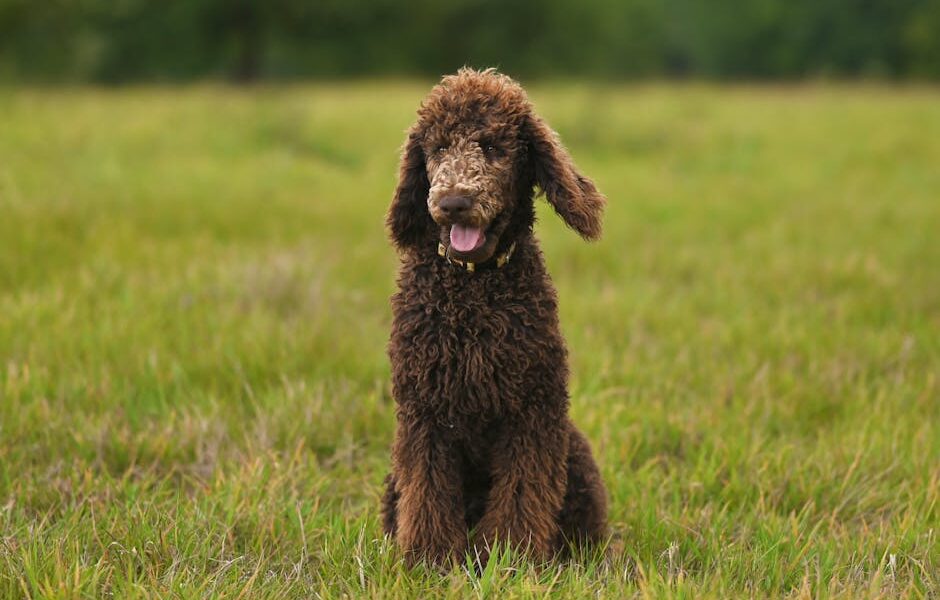
Standard Poodles weigh 40 to 70 pounds and stand over 15 inches. The build is square, athletic, and elegant. Coat is single-layered, curly, and continuously growing — they shed almost nothing but require regular trimming. Colors include black, white, apricot, red, brown, silver, blue, and parti.
Standard Goldendoodles weigh 50 to 90 pounds and stand 20 to 24 inches. Coats vary from flat (Golden-side) to wavy to curly (Poodle-side). Colors are typically cream, gold, red, apricot, or parti. The crucial difference is predictability — a Standard Poodle puppy will look like a Standard Poodle. A Goldendoodle puppy may look quite different from littermates by maturity.
Temperament
Standard Poodles are intelligent, sensitive, and dignified. They bond strongly with their people, are usually polite with strangers, and have a sense of humor. The “stuck up” reputation is undeserved — most Standards are playful and affectionate. They can be reserved without being unfriendly.
Goldendoodles tilt friendlier and more exuberant on the Golden side, more independent on the Poodle side. Variability is the operative word. A Goldendoodle could be calm and aloof or clingy and bouncy depending on which traits dominate. Both breeds are sensitive and do poorly with harsh handling.
Watchdog ability differs subtly. Standard Poodles often bark at unfamiliar visitors and may be initially reserved before warming up — a useful “soft alarm.” Goldendoodles typically greet everyone as friends, with little watchdog instinct. Neither is a guarding breed.
Trainability
Standard Poodles rank in the top three smartest dog breeds (along with Border Collies and German Shepherds). They learn fast, retain commands well, and excel at obedience, agility, scent work, and service work. Their sensitivity means positive reinforcement is critical.
Goldendoodles are also intelligent but more variable. Some inherit the full Poodle smarts; others are more food-driven and Golden-easy. Both train well with consistency. The Standard Poodle’s training ceiling is higher; the Goldendoodle’s average is more comfortable for casual owners.
Exercise Needs
Standard Poodles need 60 to 90 minutes of daily exercise. They love water, fetch, and learning tasks. They are athletic and can hike, swim, and run for hours when conditioned.
Goldendoodles need similar amounts and similar variety. Both breeds become destructive when underexercised. Standard Poodles often have a slight edge in stamina and athleticism for serious dog sports.
Both breeds excel at structured activities like agility, scent work, dock diving, and rally obedience. These activities also serve as enrichment that reduces destructive behaviors. Even one weekly class makes a noticeable difference for high-energy adolescent dogs.
Grooming: The Surprise
People often choose a Goldendoodle assuming the grooming is lighter than a Standard Poodle’s. It is not. Both need professional grooming every six to eight weeks at similar cost ($80 to $150) and similar at-home brushing (two to three times a week).
The actual difference: Standard Poodle coats are more predictable to maintain because the coat type is consistent. Goldendoodle coats vary, and a wavier coat that mats easily can be harder to manage than a Poodle’s curly but uniform coat. Many Goldendoodle owners are surprised by how much grooming their “low-maintenance doodle” needs. Grooming a Poodle and grooming a Goldendoodle compare the routines side by side.
Both shed minimally if the Poodle coat dominates. Neither is reliably hypoallergenic — allergens are in saliva and dander.
Health and Lifespan
Standard Poodles live 12 to 15 years and have known predispositions: hip dysplasia, Addison’s disease, sebaceous adenitis, eye conditions, and bloat. Reputable breeders test extensively, and the gene pool, while smaller than ideal, is well-studied.
Goldendoodles live 10 to 15 years and inherit risks from BOTH parent breeds, not just the “healthier” half. That includes Golden-side cancer (lymphoma and hemangiosarcoma), hip and elbow dysplasia from both, eye conditions, Addison’s, bloat, and ear infections. The “hybrid vigor” claim is overstated for designer crosses — see the hybrid vigor reality. A Goldendoodle is not automatically healthier than a Standard Poodle.
Cost and Rescue Availability
Standard Poodle puppies from reputable breeders run $1,500 to $3,500. Goldendoodle puppies often run higher at $2,500 to $5,000 because of doodle-pricing inflation. The Standard Poodle is often the better value if you want what doodles claim to offer. First-year costs run $1,800 to $3,500 for either, with annual ongoing costs of $2,000 to $3,500 driven heavily by grooming for both.
Both appear in rescue. Standard Poodle rescues exist nationally, and Poodle mixes are common in shelters. Goldendoodles increasingly appear in rescue too. Adopting a rescue Poodle covers what to expect; doodle rescues covers the doodle side. Adoption fees run $300 to $700.
Adopting an adult of either breed simplifies the decision. An adult Standard Poodle’s temperament is on display. An adult Goldendoodle’s coat type, size, and energy are settled, removing the F1-puppy lottery. Foster-based rescues describe each dog’s actual behavior with kids, cats, and other dogs — see adopting from a foster.
Living With Each Breed
A Standard Poodle’s day looks unsurprising once you know the breed: alert greeting, walk, breakfast, nap during work hours with occasional check-ins, evening exercise, family time. They are dignified about household disruption but engaged when invited.
A Goldendoodle’s day depends on which parent dominates. A Golden-leaning Goldendoodle wants more constant social contact, more bouncy play, and more involvement in activity. A Poodle-leaning Goldendoodle behaves much like a Standard Poodle.
Both breeds bond intensely with family and dislike being left for full workdays. Both excel as therapy dogs because of their sensitivity, intelligence, and social orientation. Both need socialization through puppyhood and adolescence to prevent shyness or reactivity — the sensitivity that makes them great companions also makes them vulnerable to anxiety in under-socialized dogs. Group classes through age two help.
Climate-wise, Standard Poodles tolerate cold and heat better than people expect because the curly coat insulates well in both. Goldendoodles vary; Golden-coat dogs handle heat worse than Poodle-coat dogs. Adjust exercise timing in summer for either.
Which Is Right for You
Choose a Standard Poodle if you want predictable size, predictable coat, predictable temperament, and one of the most intelligent dogs available. They cost less than Goldendoodles, train as well or better, and avoid the “what did I actually buy” surprise of doodle variability.
Choose a Goldendoodle if you specifically want the Golden Retriever sociability and you accept that the coat, size, and temperament will be a partial gamble. Adult rescue Goldendoodles offer more predictability than puppies because what you see is what you get.
For most families looking for “a smart, low-shed, family-friendly dog,” the Standard Poodle delivers more reliably than the Goldendoodle.
Adolescence and What Owners Wish They Knew
Both breeds hit a difficult adolescence from roughly 8 to 24 months. Standard Poodles in particular can develop fearfulness if not properly socialized through this window — they are sensitive dogs and adolescent fear periods can leave lasting impact. Goldendoodles can become bouncy and unfocused. Group classes through age two pay off enormously. Use force-free, reward-based trainers; punishment-based methods damage the sensitive temperament both breeds share.
Standard Poodle owners often wish they had known how social and people-bonded the breed is. Many also wish they had budgeted accurately for grooming — the curly coat requires the same regular professional grooming as a doodle. Goldendoodle owners often wish they had understood the coat lottery and grooming reality. The marketing has set unrealistic expectations.
For Goldendoodles, generation matters. F1 (50/50) puppies vary most in coat. F1B (75% Poodle) tends curlier and lower-shedding. F2 varies widely. The doodle generations guide explains why this matters when buying or adopting. Adult adoption removes the coat lottery entirely — you see what you get.
If you have decided on a doodle, comparison-shop with a Standard Poodle first. Many Goldendoodle buyers, after meeting an adult Standard Poodle, change their plans. The Standard Poodle delivers what the Goldendoodle marketing promises, with better predictability and often lower cost. Read our rescue Poodle guide for what to expect.
Frequently Asked Questions
Are Standard Poodles really friendlier than people think?
Yes. The “snobby” reputation is wrong. Most Standards are playful, affectionate, and silly with their people, just sometimes more reserved with strangers.
Do Standard Poodles need the fancy show clip?
No. Most pet Poodles wear a simple “lamb” or “sporting” clip — short, uniform, easy to maintain. The show clip is for show dogs only.
Which sheds less?
Standard Poodles shed less consistently because the coat is predictably curly and single-layer. Goldendoodles vary; F1B with more Poodle generally sheds least.
Which is healthier?
Neither has a clear advantage. Goldendoodles can inherit risks from both parents. Standard Poodles have known risks but a more researched health profile.
Can I find a Standard Poodle in rescue?
Yes. Standard Poodle rescues exist nationally, and Poodle mixes appear regularly in all-breed shelters. Filter for “Poodle” or “doodle” to surface both purebred Standards and crosses.
Do Standard Poodles need haircuts as often as Goldendoodles?
Yes — both need professional grooming every six to eight weeks. The myth that Goldendoodles need less grooming than Poodles is one of the most persistent and least accurate doodle marketing claims.
Looking to adopt a Standard Poodle vs Goldendoodle Comparison?
Browse Standard Poodle vs Goldendoodle Comparison dogs and mixes available for adoption from shelters and rescues near you.
Find Standard Poodle vs Goldendoodle Comparison Dogs for Adoption