Last updated: May 6, 2026
In this article
Turkish Angora Cat Breed Profile: The Graceful, Spirited Treasure
The Turkish Angora is one of the oldest and most naturally occurring cat breeds in the world. Hailing from the Ankara region of Turkey, where it is considered a national treasure, this elegant cat combines breathtaking beauty with a lively, intelligent personality that keeps its owners constantly entertained. With its silky, flowing coat, plumed tail, and alert, expressive eyes, the Turkish Angora is a vision of feline grace.
But do not let the refined appearance fool you. Behind that elegant exterior is a spirited, playful cat with a strong will and a mischievous streak. The Turkish Angora is athletic, curious, and remarkably intelligent — a breed that demands engagement and rewards it with fierce devotion. In this complete profile, we will explore the Turkish Angora’s fascinating history, striking appearance, dynamic personality, health considerations, grooming needs, and the type of home where it flourishes.
History and Origin of the Turkish Angora
The Turkish Angora has one of the longest and most storied histories of any domestic cat breed. Longhaired cats have been documented in the Ankara region of Turkey (formerly known as Angora) for centuries. These cats are believed to have developed their long, silky coats as an adaptation to the harsh winters of the mountainous Turkish interior.
Turkish Angoras were among the first longhaired cats to arrive in Europe, brought by travelers and traders as early as the 16th century. They quickly became prized possessions of European aristocracy and royalty. French and British nobles were particularly fond of these elegant cats, and they played a significant role in the early development of what would eventually become the Persian breed.
Ironically, the Turkish Angora’s contribution to the Persian nearly led to its downfall. As the Persian became increasingly popular in the West, the Turkish Angora was often crossed with Persians or overshadowed by them entirely. By the early 20th century, purebred Turkish Angoras had become extremely rare outside of Turkey.
Recognizing the breed’s cultural importance, the Ankara Zoo established a breeding program in the 1900s specifically to preserve the Turkish Angora, with particular emphasis on white cats with blue or odd-colored eyes. This program became the primary source for Turkish Angoras imported to the United States starting in the 1960s. American breeders Walter and Liesa Grant were among the first to bring Turkish Angoras from the Ankara Zoo to the U.S. and establish a breeding program.
The CFA granted the Turkish Angora championship status in 1973, initially only for white cats. Colored Turkish Angoras were accepted beginning in 1978. Today, the breed is recognized by all major cat registries and continues to be celebrated both as a beloved companion and as a living piece of Turkish cultural heritage.
Appearance and Physical Characteristics
The Turkish Angora is a medium-sized cat with a long, elegant body that is finely boned yet surprisingly muscular. Males typically weigh 7 to 12 pounds, while females range from 5 to 9 pounds. Despite their delicate appearance, Turkish Angoras are athletic and agile cats capable of remarkable physical feats.
The body is long, graceful, and lithe, with a fine bone structure that gives the cat an almost dancer-like quality of movement. The hind legs are slightly longer than the front legs, giving the Turkish Angora its characteristic upward-sloping back and elegant, flowing gait. The tail is long, plumed, and carried high and proudly, often described as looking like a fox’s tail or a feathered plume.
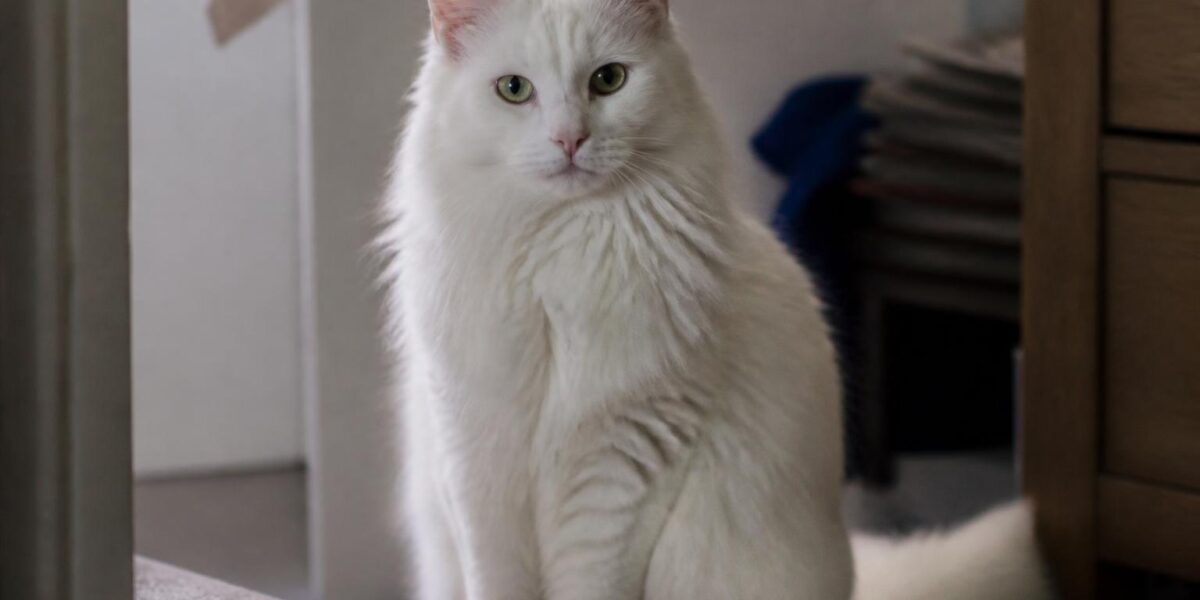
The head is a small to medium wedge shape with a gently rounded profile. The ears are large, pointed, and set high on the head, often with tufted tips. The eyes are large and almond-shaped, with a slight upward slant that gives the face an alert, intelligent expression. Eye color ranges widely and includes blue, green, gold, amber, and odd-eyed (one blue and one amber or green), particularly in white cats.
While white is the color most traditionally associated with the Turkish Angora, the breed actually comes in a wide array of colors and patterns, including black, blue, red, cream, tabby, tortoiseshell, Calico, bicolor, and smoke. The coat is single-layered (no undercoat), medium-long, and has a silky, flowing texture that shimmers as the cat moves. The fur is finest on the body and longer on the ruff, tail, and britches. This single-layer coat is easier to maintain than the dense double coat of breeds like the Persian. For general coat care tips, see our cat grooming guide.
Temperament and Personality
The Turkish Angora is a cat with a big personality packed into an elegant frame. These cats are intelligent, curious, playful, and determined. They have a strong will and a natural desire to be in charge of their household — many Turkish Angora owners joke that they do not own their cat; their cat owns them.
Playfulness is a defining trait of the Turkish Angora, and it persists well into adulthood and even old age. These cats love interactive toys, games of chase, and anything that challenges their agile minds and bodies. They are excellent jumpers and climbers, and they will find the highest point in any room. Many Turkish Angoras enjoy playing in water, batting at dripping faucets, or even joining their owners near a running bath.
Despite their spirited nature, Turkish Angoras are also deeply affectionate cats that form strong bonds with their families. They tend to choose a primary person and devote much of their attention to that individual, though they are generally friendly with all household members. They enjoy being held, carried, and cuddled — on their own terms, of course.
Turkish Angoras are moderately vocal. They communicate with a range of soft chirps, trills, and meows, often seeming to carry on genuine conversations with their owners. Their voice is pleasant and expressive rather than loud or demanding. They are excellent cats for families, including those with well-behaved children, and you can learn more about family-friendly felines in our guide to the best cats for kids.
One important consideration is that the Turkish Angora can be possessive and may not always appreciate sharing attention with other cats. While many Turkish Angoras coexist peacefully with other pets, some individuals prefer to be the center of attention and may become jealous or assertive if they feel another animal is competing for their human’s affection. Slow, careful introductions and ensuring each pet has individual attention can help manage this dynamic.
Health Issues and Lifespan
The Turkish Angora is generally a healthy breed with a lifespan of 12 to 18 years. As a naturally occurring breed with a relatively diverse genetic pool, it tends to be robust and vigorous. However, there are some health considerations specific to the breed.
The most well-known health concern in Turkish Angoras is hereditary deafness, which is associated with the white coat and blue eye color. White Turkish Angoras with two blue eyes have the highest incidence of deafness, while odd-eyed white cats may be deaf in the ear on the blue-eyed side. Not all white, blue-eyed Turkish Angoras are deaf, and the condition does not affect cats of other colors. Reputable breeders test for deafness and breed responsibly to minimize the incidence of this condition. Deaf cats can live full, happy lives with some environmental modifications.
Hypertrophic cardiomyopathy (HCM) has been reported in the Turkish Angora breed. Regular cardiac screenings, particularly for breeding cats, can help detect this condition early. HCM is manageable with medication when caught in its early stages.
Ataxia, a hereditary neurological condition that affects coordination and balance, has been identified in some Turkish Angora lines. Kittens affected by ataxia typically show symptoms by a few weeks of age. Responsible breeders screen for this condition and do not breed affected animals.
General health maintenance is important for all Turkish Angoras. Keep them well hydrated, as some cats can be prone to urinary issues. Watch for signs of cat dehydration and always provide fresh, clean water. Regular veterinary checkups, vaccinations, dental care, and parasite prevention form the foundation of a healthy life for your Turkish Angora.
Grooming and Care
Despite the Turkish Angora’s flowing coat, grooming is surprisingly manageable thanks to the breed’s single-layer coat, which lacks the dense undercoat that causes matting in many other longhaired breeds. A thorough brushing two to three times per week is usually sufficient to keep the coat smooth, tangle-free, and looking its best. During spring shedding season, daily brushing may be needed as the cat loses its winter coat.
A quality metal comb and a soft slicker brush are the best grooming tools for the Turkish Angora. Work through the coat gently, paying special attention to areas that are prone to tangling, such as the ruff, the britches (the fur on the hind legs), and the armpits. The silky texture of the Turkish Angora’s fur means that tangles are less common than with coarser-coated breeds, but regular grooming prevents any minor knots from developing into mats.
Bathing is rarely needed but can be done occasionally to keep the coat looking its most lustrous. When bathing, use a gentle cat-safe shampoo and rinse thoroughly. The single-layer coat dries relatively quickly compared to double-coated breeds.
Standard grooming care applies: trim nails every two to three weeks, check and clean ears weekly as needed, and maintain a dental hygiene routine. Turkish Angoras are generally cooperative with grooming, especially when introduced to it as kittens.
Environmental enrichment is essential for the Turkish Angora. These active, intelligent cats need climbing structures, interactive toys, puzzle feeders, and plenty of play sessions to keep their sharp minds engaged. A bored Turkish Angora will find creative (and often unwelcome) ways to entertain itself, so providing appropriate outlets for its energy and intelligence is important.
Who Is the Turkish Angora Best For?
The Turkish Angora is best suited for experienced cat owners who appreciate an active, intelligent, and sometimes demanding feline companion. This is not a passive, decorative cat — the Turkish Angora requires engagement, interaction, and mental stimulation. Owners who enjoy playing with their cats, training them, and being actively involved in their daily lives will find the Turkish Angora immensely rewarding.
Families with older children who can interact respectfully with cats are a good match. The Turkish Angora’s playful nature makes it an entertaining companion for kids, and its sturdy build means it can handle active play without being overwhelmed. Very young children may need supervision, as the Turkish Angora can be assertive if handled roughly.
The Turkish Angora can adapt to multi-pet households, but introductions should be handled carefully, particularly if the Angora has a dominant personality. Pairing a Turkish Angora with a more laid-back breed often works well, as it allows the Angora to assume a leadership role without conflict.
People who work from home or have flexible schedules are ideal Turkish Angora owners. These cats enjoy company and do best in homes where someone is present for much of the day. If you are away frequently, providing a compatible feline companion can help keep your Turkish Angora happy and stimulated.
If you are drawn to a cat that is beautiful, brilliant, spirited, and endlessly engaging, the Turkish Angora is a breed that will never bore you and will reward your attention with deep, unwavering devotion.
Frequently Asked Questions About the Turkish Angora Cat
Are all Turkish Angora cats white?
No, although white is the most famous and traditional color, Turkish Angoras come in a wide variety of colors and patterns, including black, blue, red, cream, tabby, tortoiseshell, calico, bicolor, and smoke. The white Turkish Angora remains the most iconic, particularly in Turkey, but colored Angoras are equally beautiful and are fully recognized by all major cat registries.
Are white Turkish Angoras always deaf?
Not always, but there is a higher incidence of deafness among white Turkish Angoras, particularly those with two blue eyes. Odd-eyed white cats may be deaf in one ear (typically on the blue-eyed side). White cats with amber or green eyes have a lower risk of deafness. Reputable breeders test for hearing and breed responsibly to reduce the occurrence of this condition.
Do Turkish Angora cats like water?
Many Turkish Angoras are known for their fascination with water. They may play with dripping faucets, splash in water dishes, or even attempt to join their owners in the bath or shower. While not all individuals share this trait, a love of water is more common in the Turkish Angora than in most other cat breeds.
How active are Turkish Angora cats?
Turkish Angoras are highly active and playful cats that retain their kitten-like energy well into adulthood. They need daily interactive play sessions, climbing opportunities, and mental stimulation to stay happy and healthy. They are excellent jumpers and climbers, and they enjoy games that challenge both their bodies and minds. A sedentary lifestyle does not suit this breed.
Looking to adopt a Turkish Angora Cat Breed Profile?
Browse Turkish Angora Cat Breed Profile cats and mixes available for adoption from shelters and rescues near you.
Find Turkish Angora Cat Breed Profile Cats for Adoption