Last updated: May 4, 2026
In this article
Overview
This afghan Hound breed profile is for the person who saw one of these dogs glide past at a dog show or in a movie and asked the obvious question: is the personality as remarkable as the look? The honest answer is that the personality is remarkable, but probably not in the way you expect. The Afghan Hound is an ancient sighthound from the mountainous regions of what is now Afghanistan, bred for centuries to course hare and gazelle across rough terrain alongside human hunters who relied on the dog’s eyesight, speed, and independent judgment. The result is one of the most physically striking dogs alive — and one of the least biddable.
Afghans are aloof, dignified, and famously selective in their affections. They are not the dog who wants to please you. They are the dog who decides whether you are worth their attention today. That trait, paired with a hard-wired prey drive and a coat that demands serious upkeep, makes Afghans a niche breed even among sighthound enthusiasts. The dogs who land in rescue often arrive because someone fell in love with the look and underestimated everything else.
Quick facts: Group: hound (sighthound). Origin: Afghanistan. Size: 25–27 inches at the shoulder, 50–60 pounds. Coat: long, fine, silky single coat. Energy: high in bursts, calm at rest. Lifespan: typically 12–14 years. Grooming: high — multiple hours of brushing per week. Best for: experienced sighthound owners with secure fencing, time for grooming, and tolerance for an independent thinker.
History and Origin
The Afghan Hound’s ancestors are among the oldest documented dog types, with sighthound depictions in Central Asian art going back thousands of years. The breed as it exists today was refined in the mountains and deserts of Afghanistan, where the long coat insulated against cold high-altitude air and the long, lean build allowed the dog to run down quarry across rocks and uneven ground. British officers brought Afghans west in the late 1800s and early 1900s, and the breed reached the United States and gained AKC recognition in the 1920s.
That working history matters because it shaped the temperament you live with. Sighthounds make split-second hunting decisions without consulting a handler. The Afghan in particular was bred to operate at distance, locking onto a fleeing animal and committing the entire body to chase. You cannot train that out. You can only manage around it.
Temperament and Personality
Afghans are quiet, dignified, and emotionally subtle inside the home. They are not demonstrative the way a Labrador is. Affection from an Afghan looks like the dog choosing to lie near you, leaning against your leg, or making sustained eye contact — not jumping, licking, or following you room to room. Many Afghan owners describe the breed as cat-like, and the comparison is fair.
They are deeply sensitive and read household tension well. Harsh corrections, raised voices, or chaotic environments shut them down quickly. Force-free training is not a stylistic preference with this breed — it is the only approach that works. An Afghan who feels pressured will simply disengage. Recovering that trust takes weeks, not minutes.
With strangers, expect cool reserve. Afghans are not aggressive, but they are not friendly to people they do not know, and they have no interest in being passed around at a party. With other dogs they tend to do well, particularly with other sighthounds. With cats, rabbits, and small animals — including small dogs running in a park — the prey drive is a serious risk and must be managed every single day.
Size and Appearance
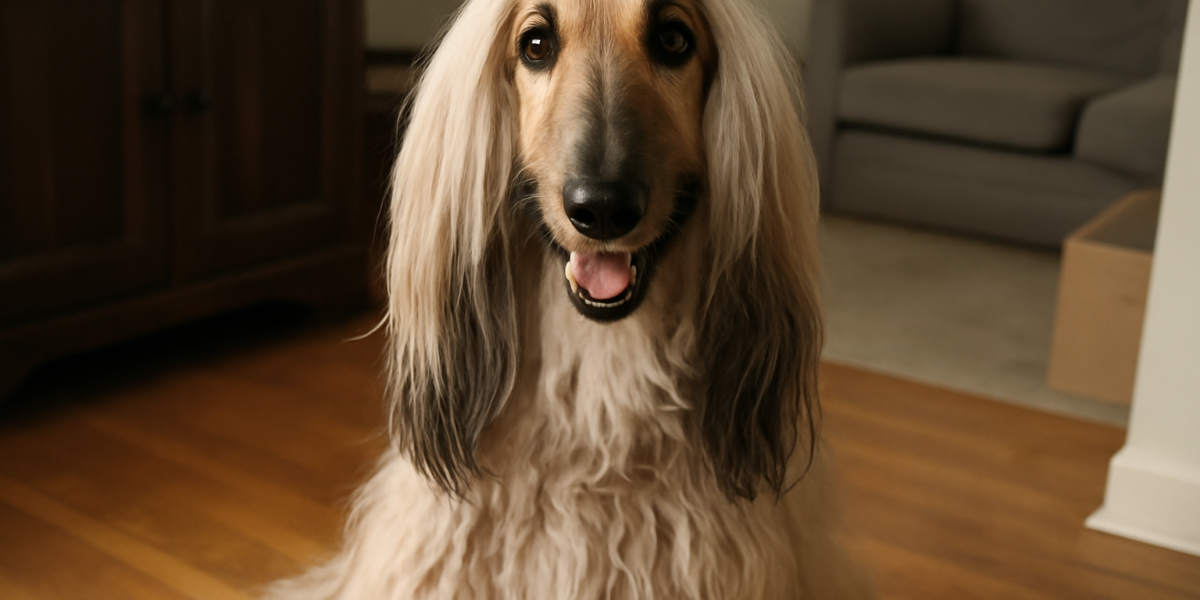
Adult Afghans stand around 25–27 inches at the shoulder and weigh 50–60 pounds, with males larger than females. The build is unmistakable: long head, prominent hipbones, a topknot of fine hair, long flowing coat over the body and legs, and a curled or ringed tail. The coat colors include cream, red, black, blue, brindle, and various combinations.
Beneath the coat is a lean, athletic dog. Like other sighthounds, Afghans have very low body fat, thin skin over a large surface area, and a metabolism that responds differently to drugs than typical dogs. Tell every veterinarian you work with that your dog is a sighthound — anesthesia and sedation protocols need adjustment.
Exercise and Activity Needs
Afghans are bursty athletes. They are calm and almost stately inside the home, but they need real high-speed exercise on a regular basis. A daily leash walk is not enough on its own. Afghans need access to a fully fenced area where they can sprint at full speed several times a week, ideally in sessions of fifteen to thirty minutes. Lure coursing, where the dog chases an artificial lure on a course, is one of the best exercise outlets ever invented for the breed.
Off-leash work outside an enclosed safe area is genuinely dangerous. Afghans can hit speeds well over thirty miles per hour and lock onto distant moving targets that you cannot even see. A loose Afghan that has spotted prey is gone, and recall does not bring it back. Six-foot solid fencing is the minimum standard, and reliable off-leash freedom should be limited to fenced parks, fenced yards, or formal coursing venues. Long-line walks are a reasonable compromise on trails.
Grooming and Care
The coat is the headline. Adult Afghan coats are long, fine, and prone to matting if neglected. Plan on a thorough brushing session two to three times per week, using a pin brush and a wide-tooth comb to work through the coat in sections from the skin out. Mats form quickly behind the ears, in the armpits, and on the legs, and once a mat is established it cannot be brushed out — it has to be cut out, which damages the coat line.
Most pet Afghans are bathed every one to two weeks. The coat should be fully blown out and brushed during drying or it will mat as it dries. Many owners use professional groomers regularly; others develop their own routines. The puppy coat is shorter and easier to manage. Around a year of age, the adult coat comes in and grooming demand jumps significantly. Going into adoption thinking you will skip grooming is not realistic with this breed.
Standard care otherwise: keep nails trimmed, check ears weekly for moisture and debris, brush teeth regularly, and watch for the thin-skin issues sighthounds get from sleeping on hard surfaces. Provide padded bedding.
Health and Lifespan
Afghans are generally healthy but carry several breed-relevant concerns. Sighthound anesthesia sensitivity is the most important — make sure every vet who works on your dog knows. Hip dysplasia, while less common than in larger breeds, does occur. Cataracts and other eye issues turn up in some lines, and hypothyroidism is reported. Cardiac screening is reasonable in adult dogs.
Afghans are also prone to bloat (gastric dilatation-volvulus), the deep-chested-dog emergency that can kill an unhealthy dog within hours. Learn the signs — distended abdomen, unproductive retching, restlessness, drooling — and know your nearest emergency vet. Lifespan is generally in the 12–14 year range, longer than many large breeds. Plan for a relationship measured in well over a decade.
Living With an Afghan Hound
The functional setup is a quiet, structured household with secure fencing, time for grooming, and at least one adult who genuinely enjoys the breed’s independent personality. Afghans do not thrive in chaotic homes with constant visitors, loud children, and rotating dog walkers. They do thrive with people who appreciate subtle affection and who can leave the dog to be a dog rather than forcing constant interaction.
Apartments can work if exercise is consistent and the household is calm, but most pet Afghans do better with at least a small fenced yard. With kids, the breed is generally tolerant of older children who handle dogs gently and a poor match for toddlers and high-energy young children. With other resident pets, expect to manage prey drive — a cat raised with the dog from puppyhood may be fine, a new cat brought into an adult Afghan’s home is a risk that has to be evaluated honestly.
Training and Socialization
Start socialization early and keep it positive. Expose your Afghan to a wide range of people, environments, sounds, and surfaces during puppyhood. Force-free methods, short sessions, and high-value treats are the formula. Long, repetitive drill-style obedience sessions backfire — the dog disengages, and you lose ground.
Realistic training expectations are solid sit, down, stay, leave-it, and a leash-walking habit that lets you live with the dog. Recall is the hardest skill in the breed and should not be trusted off-leash in unsecured areas regardless of how reliable it looks at home. Read dog body language carefully so you can spot when the Afghan is overwhelmed; the breed often goes still rather than reactive when stressed, and the signals are easy to miss. The 3-3-3 rule applies in full to Afghans coming out of rescue — give them three full weeks before expecting to see the real personality.
Is the Afghan Hound Right for You?
If you have the setup — secure fencing, time for grooming, tolerance for an aloof and independent dog, and an honest understanding of sighthound prey drive — an Afghan can be a remarkable companion. The bond is quiet but real, and the experience of living with a dog this old, this athletic, and this elegant is genuinely something else. If you wanted a velcro dog, a sport-prospect, or a low-maintenance pet, look elsewhere.
Adoption of adult Afghans through breed-specific rescue is the right path for most prospective owners. Adults already have the adult coat, the adult temperament, and a known history. Compare with related breeds like the Saluki, the Azawakh, or the Greyhound if you are sighthound-curious but not sure Afghans are the fit. Visit the adopt a dog hub to start a search, and read about decompression for rescue dogs before bringing one home.
Frequently Asked Questions
Are Afghan Hounds hypoallergenic?
No dog is truly hypoallergenic, but Afghans shed less than many breeds because the long coat traps loose hair until it is brushed out. People with mild dog allergies sometimes tolerate Afghans better than heavy-shedding breeds, but you should always spend significant time with the breed before adopting if allergies are a concern.
Are Afghan Hounds good with children?
With older, calm children who handle dogs respectfully, generally yes. With toddlers and chaotic young children, the breed is not a great fit — Afghans dislike being grabbed, climbed on, or pursued, and they will withdraw or escalate if cornered.
How much grooming does an Afghan Hound really need?
Real talk: several hours a week. Plan on two to three full brushing sessions plus baths every one to two weeks, plus blow-drying. Pet clips that shorten the coat reduce the workload considerably and are common among adopters who do not show.
Can Afghan Hounds be off-leash?
Only inside a fully fenced safe area. Outside one, the prey drive overrides recall, and a loose Afghan in chase mode is gone. This is not a training problem to solve — it is a sighthound reality to manage.
Do Afghan Hounds bark a lot?
Generally no. They are quiet dogs in the home. A bored or under-exercised Afghan may vocalize more, but sustained barking is not characteristic of the breed.
Looking to adopt a Afghan Hound Breed Profile?
Browse Afghan Hound Breed Profile dogs and mixes available for adoption from shelters and rescues near you.
Find Afghan Hound Breed Profile Dogs for Adoption