
Last updated: April 9, 2026
In this article
Quick Answer: YES — sago palms are extremely toxic to cats, and exposure is a life-threatening emergency. Every part of the sago palm is poisonous, but the seeds are the most dangerous. Ingestion of even a single seed can cause acute liver failure and death. If your cat has chewed, eaten, or had any contact with a sago palm, stop reading and contact a veterinarian or emergency animal clinic right now. Do not wait for symptoms to appear.
If you have searched “are sago palms toxic to cats,” you need an immediate, honest answer: yes, sago palms are toxic to cats at a level that places them among the deadliest plants in the world for felines. Sago palms are widely sold at garden centres, used as landscaping plants in warm climates, and kept as ornamental houseplants — yet many cat owners have no idea how serious the danger is. This is not a plant that will cause mild stomach upset. Sago palms toxic to cats trigger catastrophic liver failure, and the mortality rate remains close to 50 percent even when a cat receives aggressive emergency treatment. Understanding the danger, recognising the symptoms, and knowing how to act could be the difference between life and death for your cat.
Why Are Sago Palms So Dangerous?
Despite the name, the sago palm (Cycas revoluta) is not a true palm — it is a cycad, an ancient plant species that has survived largely unchanged for hundreds of millions of years. What makes sago palms toxic to cats at such a catastrophic level is a group of compounds called cycasins, particularly methylazoxymethanol (MAM). Cycasins are hepatotoxic, meaning they directly attack and destroy liver cells. When a cat ingests any part of the sago palm, cycasins are metabolised in the gut and released into the bloodstream, where they begin causing irreversible liver damage within hours.
Every part of the plant carries these toxins — the seeds, fronds, roots, and trunk — but the seeds contain the highest concentration and are therefore the most immediately lethal. A cat that ingests a single sago palm seed is at serious risk of fatal liver failure. There is no antidote. The only chance of survival is rapid emergency veterinary care that supports the liver while the body attempts to clear the toxins. Even then, the prognosis is guarded at best.
Symptoms of Sago Palm Poisoning in Cats
Sago palm poisoning in cats progresses in distinct stages, and the earliest signs can be deceptively non-specific. Many cat owners initially mistake the first symptoms for a routine stomach upset — a delay that dramatically reduces survival odds. If you know your cat has been near a sago palm, do not wait for symptoms at all. Seek emergency veterinary care immediately.
Within 15 minutes to 3 hours: Vomiting is almost always the first sign and can begin very rapidly after ingestion. Diarrhoea, drooling, weakness, and lethargy typically follow. The cat may refuse food and appear generally unwell.
12 to 24 hours: As liver damage accelerates, the cat becomes increasingly lethargic and may appear disoriented or uncoordinated. Abdominal pain may be evident. Some cats develop neurological signs including tremors or seizures as toxins accumulate.
24 to 72 hours: Overt liver failure sets in. Jaundice — a yellowing of the skin, eyes, and gums — may become visible. The cat may stop urinating, develop severe internal bleeding due to impaired clotting factors, or lose consciousness. Without veterinary treatment, death occurs at this stage or shortly after. Even with treatment, liver damage sustained by this point may be irreversible.
What to Do If Your Cat Ate Sago Palm
This is a veterinary emergency. There is no at-home treatment. Every minute between ingestion and the start of professional medical care reduces your cat’s chance of survival. Follow these steps immediately.
Call your veterinarian or emergency animal clinic right now. Do not wait to see whether symptoms develop. If your regular veterinarian is not available, go directly to the nearest 24-hour emergency animal hospital. You can also call the ASPCA Animal Poison Control Center at (888) 426-4435 (available 24 hours, a consultation fee may apply) or the Pet Poison Helpline at (855) 764-7661 while you are on your way.
Do not induce vomiting at home unless a poison control professional or veterinarian explicitly instructs you to do so. Improper induction of vomiting in a cat can cause additional injury and delay proper care.
Bring a sample or photo of the plant. If you can do so quickly and safely, take a photo or a clipping of the plant to help the veterinary team confirm the species and assess the likely dose.
Tell the team everything. Inform the vet exactly when the exposure occurred, which part of the plant was involved if known, and how much your cat may have ingested. This information shapes the treatment approach and timeline.
Treatment for Sago Palm Poisoning
There is no antidote for sago palm toxicity. Veterinary treatment focuses on aggressive decontamination and intensive liver support to give the body time to clear the cycasins before liver damage becomes complete.
If your cat arrives within a few hours of ingestion, the veterinarian may induce vomiting and administer activated charcoal to reduce further absorption of the toxin. Intravenous fluid therapy will be started immediately to support circulation and kidney and liver perfusion. Blood panels to assess liver enzyme levels, clotting ability, and organ function will be run repeatedly throughout hospitalisation — which typically lasts a minimum of 48 to 72 hours. Medications to protect and support liver function may be administered. In severe cases with impaired clotting, blood plasma transfusions may be necessary. The cat must be monitored closely for neurological deterioration and haemorrhage. Recovery, when it occurs, is slow and requires follow-up monitoring of liver function for weeks.
Sago Palm Survival Rate in Cats
The statistics are sobering, and cat owners deserve to understand them clearly. The survival rate for sago palm poisoning in cats is approximately 50 percent — even with prompt, aggressive veterinary care. Cats that do not receive treatment have a survival rate close to zero. Among cats that survive, some sustain permanent liver damage that affects their long-term health and quality of life.
Outcome depends heavily on how quickly treatment begins, how much of the plant was ingested, and which parts were consumed. Seed ingestion carries the worst prognosis. Cats treated within one to two hours of known exposure have better outcomes than those presenting after symptoms have progressed to liver failure. This is why sago palms toxic to cats represent one of the most urgent plant poisoning scenarios in veterinary medicine — there is almost no margin for delay, and even acting quickly is not a guarantee of survival.
How to Keep Cats Safe from Sago Palms
The only reliable way to protect a cat from sago palm poisoning is to ensure sago palms are not accessible. If you have a sago palm in your garden or home and your cat goes outdoors or has access to that area, the plant must be removed or the cat must be completely and permanently separated from it. “Probably won’t go near it” is not an acceptable risk when the consequence of being wrong is fatal liver failure.
When purchasing new plants, verify the botanical species name — not just the common name — against the ASPCA’s toxic plant database before bringing anything home. Sago palms are sometimes mislabelled or confused with safe palm varieties at garden centres. If you are building a cat-safe garden or indoor plant collection, choose from confirmed non-toxic species such as the areca palm, parlor palm, or bamboo palm. Speak to neighbours and family members who may have sago palms in spaces your cat can access.
For more guidance on building a safe environment for your cat, visit our cat care blog.
Frequently Asked Questions
Are all parts of the sago palm toxic to cats?
Yes. Every part of the sago palm is toxic to cats, including the seeds, fronds, roots, and the fibrous trunk. The seeds contain the highest concentration of cycasins and are the most immediately dangerous — ingestion of a single seed can be fatal. There is no safe part of this plant. Even handling the plant and then allowing a cat to groom your hands represents a theoretical risk. If a sago palm is in your home or garden, your cat must not have any access to it under any circumstances.
How quickly do symptoms of sago palm poisoning appear in cats?
Vomiting can begin within 15 minutes of ingestion. Other early symptoms — lethargy, diarrhoea, drooling, loss of appetite — typically appear within the first few hours. Liver failure develops over the following 24 to 72 hours. Because the early symptoms can look like ordinary stomach upset, some owners do not seek emergency care quickly enough. If you have any reason to believe your cat has been in contact with a sago palm, contact a veterinarian immediately — do not wait for symptoms to confirm your suspicion. With sago palms toxic to cats, acting before symptoms appear gives your cat the best possible chance.
Can a cat survive sago palm poisoning?
Yes, but survival is far from guaranteed. The survival rate is approximately 50 percent even with prompt, aggressive emergency treatment. Cats that receive veterinary care within one to two hours of ingestion have better odds than those who arrive after liver damage has progressed. Some survivors sustain permanent liver damage. The plants extreme toxicity and the low survival rate — even under treatment — make sago palm one of the most dangerous plants a cat can encounter. Prevention is the only truly reliable strategy.
What does a sago palm look like, and how do I identify one?
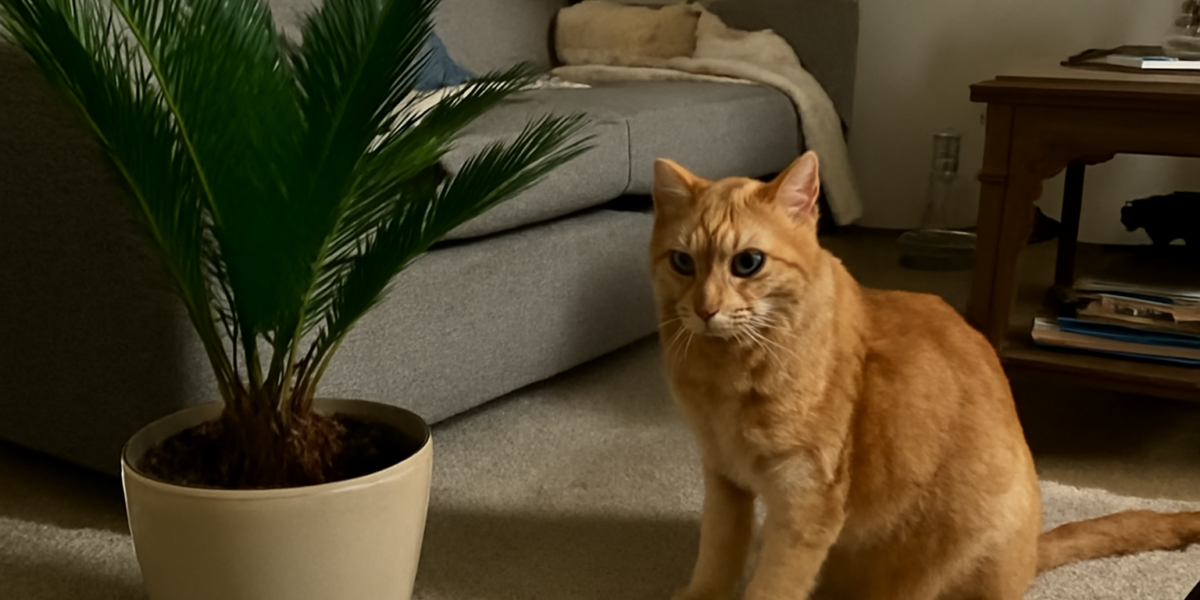
Sago palms have a thick, rough, pineapple-like trunk and stiff, feathery fronds that radiate outward in a circular pattern, giving the plant a symmetrical, crown-like appearance. They grow slowly and are often used as a centrepiece ornamental plant in gardens or large pots in warmer climates. Unlike true palms, their trunk is covered with the bases of old frond stems, giving it a distinctive textured look. Seeds, when present, are large, bright red or orange, and clustered in the centre of the plant — they are particularly attractive to animals. If you find a plant in a garden or nursery that you cannot positively identify as safe, photograph it and check the botanical name against the ASPCA Animal Poison Control database before allowing your cat near it.


