Last updated: April 27, 2026
In this article
Balinese vs Siamese Cat: Complete Breed Comparison
The Balinese cat is essentially a long-haired Siamese, and that single genetic difference creates a surprisingly distinct experience for owners of each breed. Both share the Siamese’s striking colorpoint pattern, sapphire blue eyes, elegant body type, and famously vocal personality. Yet the Balinese’s flowing coat, slightly mellower temperament, and different grooming requirements make it more than just a Siamese in a fancier outfit. For anyone drawn to the Siamese look and personality but wondering whether the Balinese might be a better fit, this comparison covers every meaningful difference between these two closely related breeds.
Both the Balinese and the Siamese are breeds that demand engagement. These are not cats that will sit decoratively on a shelf and ask nothing of you. They want conversation, interaction, play, and attention in quantities that surprise people accustomed to more independent feline companions. If you are looking for a low-maintenance, quiet cat, neither of these breeds belongs on your shortlist. But if you want a cat with the personality and social engagement of a dog, read on. For a broader look at cat breeds, our Ragdoll cat breed profile offers another perspective on affectionate, people-oriented cats.
Breed Origins and History
The Siamese is one of the oldest and most recognizable cat breeds in the world. Originating in Thailand, formerly known as Siam, the breed appears in manuscripts dating back to the 14th century. Siamese cats were treasured by Thai royalty and were believed to inherit the souls of deceased family members, a spiritual role that elevated them to a status few other animals have enjoyed. The breed first arrived in the West in the 1880s, when the British consul-general in Bangkok brought a breeding pair to England. The Siamese quickly captivated European and American cat fanciers with its striking appearance and extraordinary personality, and it has remained one of the most popular breeds worldwide ever since.
The Balinese emerged as a natural mutation within the Siamese breed. Occasionally, Siamese litters would produce kittens with longer, silkier coats, a result of a recessive long-hair gene carried by some Siamese bloodlines. For years, these long-haired kittens were quietly placed as pets rather than shown or bred. In the 1950s and 1960s, American breeders began selectively breeding these long-haired Siamese variants, eventually establishing them as a separate breed. The name Balinese was chosen not because the cats have any connection to Bali, but because breeders felt the cats’ graceful movement resembled Balinese dancers. The breed was recognized by the Cat Fanciers’ Association in 1970.
Genetically, the Balinese and the Siamese are nearly identical. The only difference is a single gene that controls coat length. This close genetic relationship means that the breeds share virtually the same health profile, body structure, and baseline temperament. The behavioral and personality differences that do exist between the two breeds are subtle and tend to be matters of degree rather than kind.
Size and Physical Appearance
Both breeds share the same elegant, svelte body type that cat fanciers describe as Oriental. The Siamese and the Balinese are medium-sized cats with long, tubular bodies, fine bones, and lean musculature. Males of both breeds typically weigh between 8 and 12 pounds, while females weigh between 6 and 10 pounds. Both breeds have long, tapered tails, long legs with small oval paws, and a distinctive wedge-shaped head with large, pointed ears and vivid blue almond-shaped eyes.
The primary physical distinction is the coat. The Siamese has a short, fine, close-lying coat that feels smooth and satiny to the touch. It requires minimal grooming and sheds moderately throughout the year. The Balinese has a medium-length to long single coat, meaning it lacks the dense undercoat found in most long-haired breeds. The Balinese coat is silky, lies relatively flat against the body, and forms a graceful plume on the tail. Despite being longer than the Siamese coat, the Balinese coat is surprisingly low-maintenance because the absence of an undercoat means it rarely mats.
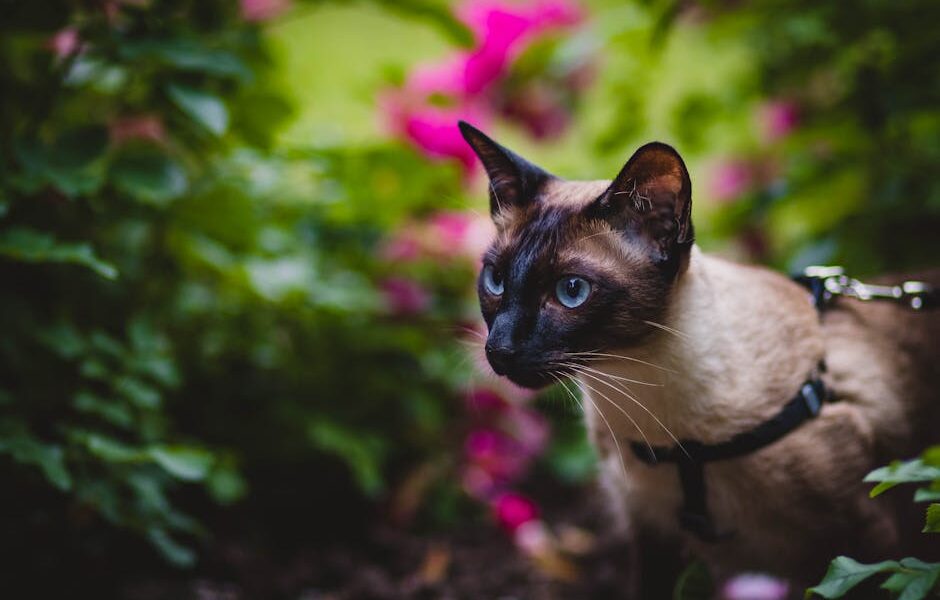
Both breeds display the colorpoint pattern, where the body is a pale cream or white and the extremities, known as points, display darker coloring on the face, ears, legs, and tail. Traditional colors include seal point, chocolate point, blue point, and lilac point, though the Balinese is sometimes recognized in additional colors depending on the cat registry. The colorpoint pattern is temperature-sensitive, meaning the cooler extremities develop darker pigmentation, and the pattern deepens with age and in cooler environments.
Temperament and Personality
Both the Siamese and the Balinese are among the most social, interactive, and vocal cat breeds in existence. They form intense bonds with their owners, demand participation in household activities, and are rarely content to be left out of anything. Both breeds will follow you from room to room, supervise your cooking, inspect your work, and voice their opinions on everything you do. If you close a door between yourself and one of these cats, you will hear about it immediately and at considerable volume.
The Siamese is the more intense of the two. Its personality has been described as demanding, relentless, and endlessly entertaining. Siamese cats are extraordinarily vocal, producing a loud, low-pitched, sometimes raspy voice that they deploy constantly throughout the day. They meow to greet you, to request food, to express displeasure, to narrate their activities, and seemingly just for the pleasure of hearing themselves talk. Siamese cats are also among the most energetic and mischievous of all cat breeds, capable of opening cabinets, turning on faucets, and finding ways into places their owners assumed were inaccessible.
The Balinese shares all of these traits but typically expresses them at a slightly lower intensity. Balinese cats are vocal, but their voices tend to be softer and less insistent than the Siamese. They are playful and curious, but slightly less manic in their exploration and mischief-making. Many Balinese owners describe their cats as having the Siamese personality with the volume turned down one or two notches. This slight mellowing makes the Balinese a better choice for people who love the Siamese personality but find the full-intensity version overwhelming.
Both breeds are highly intelligent and need mental stimulation to prevent boredom. Puzzle feeders, interactive toys, clicker training, and even agility courses designed for cats can help keep these brilliant minds engaged. Both breeds can learn tricks, walk on a leash, and play fetch, behaviors that reinforce their reputation as the most dog-like of all cat breeds. A bored Siamese or Balinese is a destructive Siamese or Balinese, so providing adequate enrichment is not optional.
Grooming and Coat Care
Grooming requirements are where the practical difference between these breeds is most apparent, though the difference is smaller than most people expect. The Siamese’s short coat is genuinely low-maintenance, requiring only weekly brushing with a rubber grooming mitt or soft brush to remove loose hair and distribute skin oils. Siamese cats shed moderately year-round, with slightly heavier shedding during seasonal changes, but the short hair is less noticeable on furniture and clothing than the hair of longer-coated breeds.
The Balinese’s longer coat requires slightly more attention, with two to three brushing sessions per week recommended. The good news is that the Balinese lacks an undercoat, which is the layer responsible for the worst matting and shedding in most long-haired cats. This means the Balinese coat tangles far less than breeds like Persians or Maine Coons and sheds less than you would expect given its length. A stainless steel comb and a slicker brush are the only tools needed to keep a Balinese coat in beautiful condition. The flowing tail plume may occasionally need attention to prevent tangling, particularly if the cat spends time outdoors or in dusty environments.
Both breeds require regular nail trimming every two to three weeks, weekly ear checks and cleaning as needed, and dental care throughout their lives. Both the Siamese and the Balinese are prone to dental issues, so regular brushing or the use of dental treats is recommended to prevent periodontal disease. Neither breed requires professional grooming unless the owner simply prefers to have it done.
Health and Lifespan
The Siamese and the Balinese share an almost identical health profile, which makes sense given their near-identical genetics. Both are generally healthy breeds with longer-than-average lifespans. The Siamese typically lives 12 to 20 years, with many reaching the upper end of that range. The Balinese has a similar lifespan of 12 to 20 years. Both breeds benefit from the genetic diversity maintained by responsible breeders and the overall hardiness of the Siamese lineage.
The most common health concern in both breeds is progressive retinal atrophy, a degenerative eye disease that causes gradual vision loss and can lead to blindness. Responsible breeders screen for this condition, but it cannot be entirely eliminated. Amyloidosis, a condition in which abnormal protein deposits accumulate in organs, particularly the liver, is another concern specific to the Siamese family of breeds. This condition can cause organ failure and is often fatal, though it is relatively uncommon.
Both breeds are prone to respiratory issues, particularly upper respiratory infections, and some Siamese and Balinese cats develop asthma. Their lean body type means they are less prone to obesity than many other breeds, but maintaining a healthy weight through appropriate diet and exercise is still important. Both breeds can also develop dental disease at higher rates than some other breeds, making regular dental care an important part of their health maintenance.
Cross-eyed appearance and kinked tails, once common in both breeds, have been largely bred out of modern bloodlines, though they occasionally still appear. These traits are cosmetic rather than health-related and do not affect the cat’s quality of life.
Living with a Vocal Breed
The single most important consideration for anyone choosing between the Siamese and the Balinese is noise tolerance. Both breeds are vocal in ways that many people find surprising, even shocking, if they have not previously lived with an Oriental-type cat. The Siamese’s voice in particular has been compared to a baby crying, and the volume and persistence of a Siamese demanding attention at three in the morning is something that no amount of reading can fully prepare you for.
If you live in an apartment with thin walls and close neighbors, the Balinese’s somewhat softer voice may be the wiser choice. If you work from home and need quiet during video calls, neither breed is ideal, though the Balinese is again the slightly more manageable option. If you live in a detached house and genuinely enjoy having a chatty companion who provides running commentary on your life, either breed will deliver that experience in abundance.
It is worth noting that both breeds vocalize more when they are bored, lonely, or understimulated. A Siamese or Balinese that receives adequate attention, play, and companionship is quieter, though never silent, than one that is left alone with nothing to do. Providing a companion cat, preferably another Oriental breed that will appreciate the constant conversation, can also reduce attention-seeking vocalizations directed at the owner. Our Birman cat breed profile covers a quieter alternative for those drawn to blue-eyed colorpoint cats.
Allergy Considerations
The Balinese is frequently cited as a more hypoallergenic option compared to many cat breeds, including the Siamese. Some research suggests that Balinese cats produce lower levels of the Fel d 1 protein, the primary allergen responsible for cat allergies in humans. However, the evidence is not conclusive, and individual variation within the breed is significant. No cat breed is truly hypoallergenic, and allergy sufferers should spend extended time with any cat they are considering before making a commitment.
The Siamese produces typical levels of Fel d 1 and is not considered a lower-allergen breed. If allergies are a factor in your decision, the Balinese may offer a marginal advantage, but managing expectations is important. Air purifiers, regular grooming to reduce dander, and allergy medications may still be necessary regardless of which breed you choose.
Frequently Asked Questions
Is a Balinese just a long-haired Siamese?
Genetically, yes. The Balinese differs from the Siamese by a single recessive gene that produces a longer coat. However, decades of separate breeding have produced some subtle temperamental differences, with the Balinese generally being slightly calmer and softer-voiced than the Siamese. The physical difference in coat length also creates different grooming requirements and a different aesthetic. Many breed enthusiasts consider the Balinese a distinct breed in its own right rather than simply a coat-length variant of the Siamese.
Which breed is better for first-time cat owners?
The Balinese is slightly more forgiving for first-time cat owners due to its marginally calmer disposition and less insistent vocalizations. The full-intensity Siamese personality can overwhelm inexperienced owners who are not prepared for the level of interaction these cats demand. However, neither breed is a typical beginner cat. Both require significant time, attention, and engagement from their owners. First-time owners should research both breeds thoroughly and ideally spend time with each before deciding.
Can Siamese and Balinese cats be left alone during the workday?
Both breeds struggle with being left alone for extended periods. They are highly social cats that can develop separation anxiety, depression, and destructive behaviors when isolated for too long. If you work outside the home full-time, providing a companion cat is strongly recommended. Two cats of the same or similar breed will keep each other company, engage in social grooming, and play together, significantly reducing the stress of being alone. If a second cat is not possible, interactive toys, puzzle feeders, and a cat-sitter or enrichment visit can help.
Do Balinese cats shed as much as other long-haired breeds?
No. The Balinese sheds significantly less than most long-haired breeds because it lacks a dense undercoat. The single-layer silky coat lies close to the body and produces far less loose fur than double-coated breeds like Persians, Maine Coons, or Norwegian Forest Cats. The Balinese does shed, but the amount is closer to what you would expect from a short-haired cat than a long-haired one. Regular brushing two to three times per week keeps shedding well under control.
Which breed is more affectionate?
Both breeds are extremely affectionate, ranking among the most people-oriented cat breeds in existence. The Siamese tends to express affection more intensely and persistently, following its owner everywhere, demanding lap time, and vocalizing constantly for attention. The Balinese is equally affectionate but may be slightly less insistent about it, occasionally allowing you a few moments of personal space before resuming its campaign for your attention. The difference is subtle, and individual personality varies as much as breed tendencies.
Looking to adopt a Balinese vs Siamese Cat?
Browse Balinese vs Siamese Cat cats and mixes available for adoption from shelters and rescues near you.
Find Balinese vs Siamese Cat Cats for Adoption