Last updated: May 6, 2026
In this article
- A Mythical History: From Viking Ships to Modern Homes
- Physical Characteristics: Built for the Wild
- Temperament: Gentle Giants with Independent Spirits
- Health and Lifespan
- Grooming the Norwegian Forest Cat’s Magnificent Coat
- Living with a Norwegian Forest Cat: Practical Considerations
- Frequently Asked Questions
Norwegian Forest Cat Breed Profile: The Majestic Viking Cat
There are few cat breeds that carry the weight of myth and legend quite like the Norwegian Forest Cat. Known in its homeland as the “Norsk Skogkatt,” this magnificent feline is said to have traveled with Viking explorers, protected Norwegian farmsteads from rodents for centuries, and even pulled the chariot of the Norse goddess Freya. Whether or not those ancient stories are entirely true, one thing is certain — the Norwegian Forest Cat is a breathtaking breed that combines wild beauty with a surprisingly gentle, family-friendly temperament.
With their thick, water-resistant double coats, tufted ears, and bushy tails, Norwegian Forest Cats look like they stepped straight out of a Scandinavian fairy tale. But beneath that rugged exterior lies a sweet, patient soul that makes this breed a wonderful companion for families, singles, and multi-pet households alike. In this comprehensive guide, we explore everything you need to know about this Viking cat.
A Mythical History: From Viking Ships to Modern Homes
The Norwegian Forest Cat’s history is intertwined with the history of Norway itself. These cats are believed to have arrived in Scandinavia thousands of years ago, likely brought by traders and Vikings who valued them as skilled mousers aboard their longships. Over centuries of natural selection in Norway’s harsh climate, these cats developed their distinctive thick, waterproof double coats and sturdy, muscular builds.
In Norse mythology, the Norwegian Forest Cat holds a special place. The goddess Freya, associated with love, beauty, and fertility, was said to have her chariot pulled by two large cats that many scholars believe were inspired by the Skogkatt. The breed also appears in Norwegian folk tales as the “fairy cat” — a magical, large feline that could climb sheer rock faces that no other cat could manage.
Despite their long history, the Norwegian Forest Cat was not formally recognized as a breed until the 1930s, when cat enthusiasts in Norway began a focused effort to preserve the breed. World War II nearly devastated the breeding program, but dedicated breeders revived it in the 1970s. King Olav V of Norway designated the Norwegian Forest Cat as the country’s official national cat breed. The breed arrived in North America in 1979 and was granted full championship status by the Cat Fanciers’ Association in 1993.
Today, the Norwegian Forest Cat is popular worldwide, though it remains most beloved in Scandinavia. Those who have compared this breed to the Maine Coon will notice some similarities — both are large, long-haired, and gentle. For a detailed comparison, see our article on the Maine Coon vs. Norwegian Forest Cat.
Physical Characteristics: Built for the Wild
The Norwegian Forest Cat is a large, powerful breed that impresses with both size and beauty. Males can weigh between 12 and 16 pounds, with some reaching 18 pounds or more. Females are smaller, typically ranging from 8 to 12 pounds. Despite their size, these cats are well-proportioned and athletic rather than stocky, with strong legs and large, tufted paws that act like natural snowshoes.
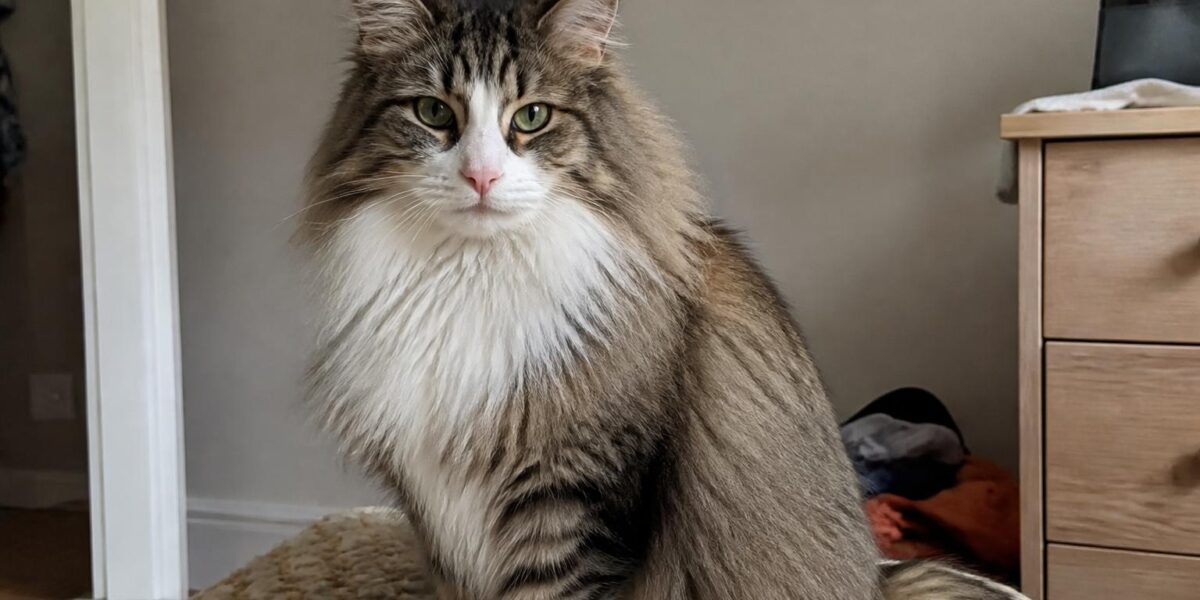
The coat is the breed’s most striking feature. It consists of a dense, woolly undercoat covered by long, glossy guard hairs that are water-resistant. The coat is longest around the neck, forming a magnificent ruff, and on the hind legs, where it creates distinctive “britches.” The tail is long and bushy — when the cat wraps it around itself, it provides extra insulation against cold winds. Ear tufts and toe tufts complete the wild, mountain-cat appearance.
Norwegian Forest Cats come in virtually every color and pattern, including tabby, solid, bicolor, tortoiseshell, and Calico. The only colors not accepted in breed standards are those indicating hybridization, such as chocolate, lavender, and the pointed (Siamese-type) pattern. Eye color varies with coat color and can be green, gold, copper, or odd-eyed in white cats.
The head is an equilateral triangle shape with a long, straight profile — no break at the nose. This is one of the key differences from the Maine Coon, which has a more squared-off muzzle. The Norwegian Forest Cat’s almond-shaped eyes, set at a slight angle, give the face an alert and intelligent expression that perfectly matches the breed’s personality.
These cats mature slowly, often not reaching their full size until they are four to five years old. Watching a Norwegian Forest Cat kitten grow into its full, majestic adult form is one of the great pleasures of owning the breed.
Temperament: Gentle Giants with Independent Spirits
For all their wild appearance, Norwegian Forest Cats are remarkably gentle, patient, and good-natured. They are affectionate without being demanding, enjoying time with their humans but also perfectly content to entertain themselves when you are busy. This balanced temperament makes them one of the best cats for families.
Norwegian Forest Cats are moderately active. They enjoy climbing — not surprising given their history of scaling Norway’s rocky terrain — and a tall, sturdy cat tree is practically a requirement for this breed. They are also skilled hunters who will enthusiastically chase toys, feather wands, and the occasional wayward insect. Interactive play sessions are important for keeping them mentally stimulated and physically fit.
Intelligence is a strong suit for the Wegie, as fans affectionately call them. They are observant and curious, often figuring out how to open doors, cabinets, and other things their humans might prefer stayed closed. Puzzle feeders and interactive toys are excellent ways to channel this intelligence productively.
Socially, Norwegian Forest Cats are friendly but not overbearing. They enjoy meeting new people but typically do so on their own terms, approaching when they are ready rather than rushing up to every visitor. With family members, they are warm and loving, often choosing to sit near their humans rather than on them. They are not typically lap cats in the way smaller, more clingy breeds might be, but they do appreciate physical contact and will often lean against you or rest a paw on your arm.
Their voice is quiet and musical. Norwegian Forest Cats are not excessive talkers, but they do communicate through soft chirps, trills, and the occasional meow. They are particularly likely to vocalize at mealtimes or when something has captured their interest.
In multi-pet households, Norwegian Forest Cats generally do well. Their calm, confident nature means they are rarely aggressive with other cats or cat-friendly dogs. They are patient enough to tolerate the antics of other pets and children, though they will remove themselves from a situation if things get too rowdy.
Health and Lifespan
Norwegian Forest Cats are a robust breed with a typical lifespan of 14 to 16 years. Their history as a natural breed that evolved through survival in harsh conditions has given them a generally solid constitution. However, there are certain health conditions that are more prevalent in the breed, and responsible owners should be aware of them.
Hypertrophic cardiomyopathy is the most common form of heart disease in cats and occurs in Norwegian Forest Cats as it does in many breeds. Regular veterinary checkups that include cardiac auscultation can help detect this condition early. Some breeders screen their cats with echocardiograms before breeding.
Glycogen storage disease type IV is a rare but serious inherited metabolic disorder that can occur in Norwegian Forest Cats. Affected kittens typically show symptoms before six months of age. Genetic testing is available, and responsible breeders screen for this condition. Always ask a breeder for test results if you are acquiring a kitten.
Hip dysplasia, while more commonly associated with dogs, can occur in large cat breeds including the Norwegian Forest Cat. Maintaining a healthy weight throughout your cat’s life is one of the best ways to minimize the impact of this condition on your cat’s quality of life.
Kidney and urinary tract issues can occur in the breed. Ensuring adequate hydration through access to fresh water, water fountains, and wet food can help support urinary health. Regular veterinary monitoring of kidney function is particularly important as your Norwegian Forest Cat enters its senior years.
Dental health should not be overlooked. Periodontal disease is common across all cat breeds, and regular dental care — both professional cleanings and at-home maintenance — is an important part of your cat’s overall health routine.
Grooming the Norwegian Forest Cat’s Magnificent Coat
That stunning double coat does require regular attention, but it is less work than you might expect. The texture of the Norwegian Forest Cat’s coat is designed by nature to resist matting, thanks to the glossy, slightly oily guard hairs that cover the dense undercoat. However, regular grooming is still important to keep the coat healthy and to reduce the amount of loose fur around your home.
During most of the year, two to three brushing sessions per week are sufficient. Use a wide-toothed comb or a slicker brush to work through the coat gently, paying special attention to the areas most prone to tangles — behind the ears, under the legs, and around the collar ruff. During the spring and fall shedding seasons, when the coat “blows out” its undercoat, daily brushing is recommended to manage the dramatic increase in loose fur.
Bathing is generally unnecessary, as the coat’s natural water resistance keeps it clean. If a bath does become necessary, you may find it takes some work to fully wet the coat through that water-resistant outer layer. Use a degreasing shampoo first, followed by a cat-appropriate conditioner, and allow plenty of time for thorough drying.
Nail trimming every two to three weeks, regular ear checks, and dental care round out the grooming routine. Starting these habits when your Norwegian Forest Cat is a kitten will make the process easy and enjoyable for both of you throughout their life.
Living with a Norwegian Forest Cat: Practical Considerations
Before bringing a Norwegian Forest Cat into your home, there are some practical matters to consider. Their size means they need more space than a smaller breed. While they can adapt to apartment living, they do best in homes where they have room to climb and explore. Invest in a sturdy, tall cat tree — standard cat furniture may not support their weight. Wall-mounted shelves and climbing systems are also excellent options for giving your Wegie the vertical territory they crave.
Feeding a large breed requires attention to portion sizes and nutritional quality. High-quality, protein-rich food formulated for large or active breeds is ideal. Because of their slow maturation, Norwegian Forest Cat kittens may need kitten food for longer than average — consult your veterinarian about the best time to transition to adult food. Monitor weight carefully, as their thick coat can mask gradual weight gain.
Norwegian Forest Cats are generally indoor cats, though some owners provide supervised outdoor access through catios or enclosed gardens. Their strong hunting instincts mean they can pose a risk to local wildlife if allowed to roam freely, and their friendly nature makes them vulnerable to theft or other dangers outside.
If you are considering adoption, Norwegian Forest Cats do appear in rescue organizations, though less frequently than more common breeds. Breed-specific rescue groups are the best resource. Adult rescues can be wonderful companions, as the breed’s gentle nature makes them adaptable to new homes even later in life.
The Norwegian Forest Cat is a breed that rewards its owners with years of loyal companionship, stunning beauty, and a connection to one of the oldest feline lineages in the world. Their combination of wild appearance and gentle spirit makes them truly unforgettable.
Frequently Asked Questions
What is the difference between a Norwegian Forest Cat and a Maine Coon?
While both are large, long-haired breeds, there are several important differences. The Norwegian Forest Cat has a triangular head with a straight nose profile, while the Maine Coon has a more squared-off muzzle with a gentle concave curve to the nose. Norwegian Forest Cats tend to have a more elegant, athletic build, while Maine Coons are often broader and more heavily boned. The Norwegian Forest Cat’s coat is glossy and water-resistant, whereas the Maine Coon’s coat is shaggier and more uneven in length. Temperamentally, Norwegian Forest Cats are slightly more independent, while Maine Coons tend to be more consistently social and outgoing.
Can Norwegian Forest Cats live in warm climates?
Yes, Norwegian Forest Cats can adapt to warmer climates, though they are naturally built for cold weather. In warm environments, they will shed much of their dense undercoat and develop a lighter summer coat. It is essential to keep them in air-conditioned spaces during extreme heat, ensure they always have access to fresh water, and watch for signs of overheating. Many Norwegian Forest Cats in warmer regions live perfectly happy, healthy lives with appropriate indoor climate control and care.
Are Norwegian Forest Cats hypoallergenic?
No, Norwegian Forest Cats are not hypoallergenic. In fact, their thick double coat means they produce a significant amount of dander, which is the primary allergen for most people with cat allergies. The allergen is actually a protein found in cat saliva, skin, and urine — not the fur itself — but more fur means more surface area for allergens to accumulate. If you have cat allergies, spending time with a Norwegian Forest Cat before committing to adoption is strongly recommended to gauge your reaction. Regular grooming and air purification can help reduce allergens in the home but will not eliminate them entirely.
How much exercise does a Norwegian Forest Cat need?
Norwegian Forest Cats are moderately active and benefit from two to three dedicated play sessions per day, each lasting 10 to 20 minutes. They are natural climbers and will use vertical space like cat trees and wall shelves enthusiastically. Interactive toys such as feather wands, fishing pole toys, and laser pointers are great for structured play, while puzzle feeders can provide mental stimulation between sessions. While they are not as hyperactive as some breeds, they do need regular activity to maintain a healthy weight and prevent boredom-related behavioral issues, especially given their large size.
Looking to adopt a Norwegian Forest Cat Breed Profile?
Browse Norwegian Forest Cat Breed Profile cats and mixes available for adoption from shelters and rescues near you.
Find Norwegian Forest Cat Breed Profile Cats for Adoption