Last updated: May 4, 2026
In this article
If you are looking for a dog that combines the heart of a devoted companion with the working ability of a seasoned professional, the beauceron is a breed that deserves your full attention. Developed in the plains of northern France as both a herder and a guardian, this is a dog with centuries of purposeful work behind it — and that heritage is written into every part of how it thinks, moves, and bonds with the people it loves. The Beauceron is not a casual choice. It is a serious dog for owners who are ready to meet it with equal seriousness, and for those who do, the reward is one of the most loyal and capable canine partners imaginable.
| Origin | France (La Beauce region) |
|---|---|
| Size | Large |
| Weight | 70–110 lbs |
| Lifespan | 10–12 years |
| Coat | Short, dense double coat; black and tan (harlequin pattern also recognized) |
| Temperament | Confident, loyal, protective, intelligent, energetic |
| Good With | Experienced dog owners, active families, older children; needs early socialization with other pets |
Personality & Temperament
The beauceron carries itself with a quiet, unhurried confidence that tells you immediately this is not a dog that is easily rattled. Bred to manage large flocks of sheep across open farmland — sometimes driving herds of several hundred animals with minimal human direction — the beauceron developed a mind that is independent, decisive, and always alert. That combination of self-assurance and intelligence makes this a dog that is genuinely impressive to watch in action, and genuinely challenging to live with if you are not prepared for it.
With family, the beauceron is devoted and deeply loyal. It forms strong bonds and takes its role as protector seriously without becoming aggressive or anxious. There is a calm steadiness to the breed that experienced owners find immensely reassuring — this dog does not bark at nothing, does not fuss, and does not seek unnecessary conflict. When something genuinely warrants attention, though, the beauceron will make itself known with complete conviction.
This is not a breed for first-time owners or for households that cannot commit to consistent engagement and leadership. The beauceron needs to understand its place in the family structure, and it needs an owner who can establish that clearly, fairly, and without hesitation. Get that foundation right, and you will have a companion of remarkable steadiness and warmth.
Appearance
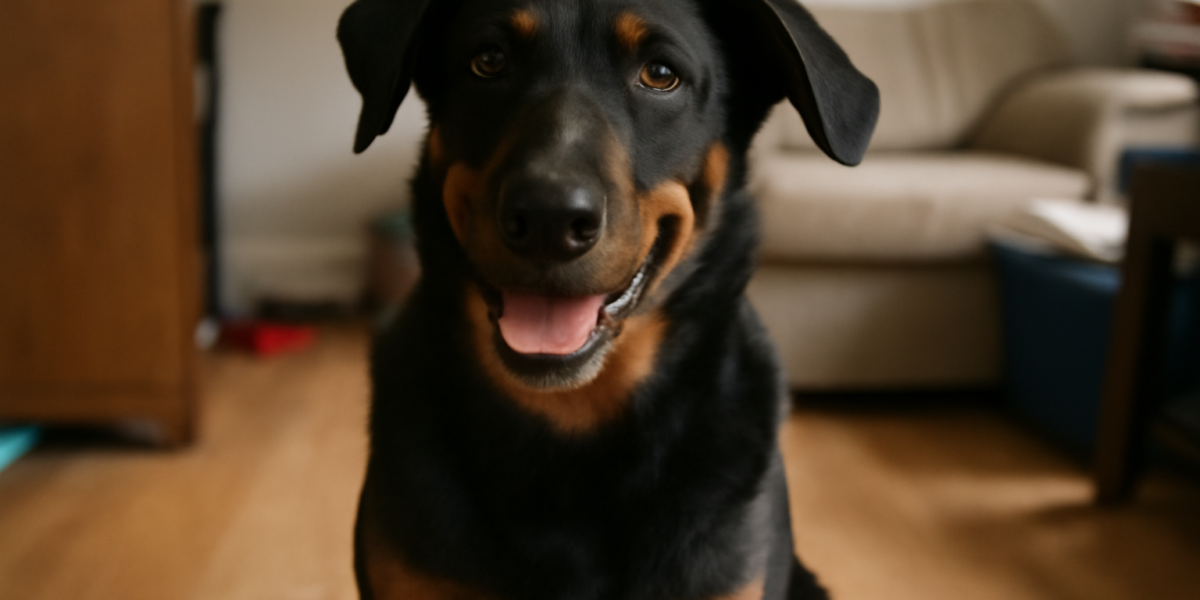
The beauceron is a striking dog — large, muscular, and well-balanced without appearing heavy or cumbersome. Standing 24 to 27.5 inches at the shoulder, it has the build of an athlete: a deep chest, powerful hindquarters, and a straight, strong back that suggests both endurance and speed. The head is proportionate and noble-looking, with a flat skull, a strong muzzle, and dark, oval eyes that project calm intelligence.
The coat is the classic black and tan — a rich, dense black across most of the body with tan markings above each eye, on the cheeks, throat, chest, legs, and beneath the tail. A harlequin pattern, in which patches of grey are mingled into the black, is also recognized by the breed standard. The double coat is short and close-lying, with a wooly undercoat that provides insulation in colder weather.
One of the most distinctive physical features of the beauceron is its double dewclaws on each rear leg. These are not an anomaly — they are a requirement of the breed standard and have historically been associated with the breed’s sure-footedness across uneven terrain. Any beauceron without them would be disqualified from conformation showing.
Exercise Needs
The beauceron was bred to spend entire days on the move across open countryside, and its exercise requirements reflect that heritage directly. This is not a breed that will be satisfied with a short walk around the block and an hour on the couch. A well-exercised beauceron needs at least 90 minutes of meaningful physical activity every day — and that activity should include more than just walking.
Running, hiking, cycling alongside you, retrieving, swimming, and dog sports such as Schutzhund, agility, tracking, or herding trials are all excellent outlets for this breed’s energy and working drive. Mental exercise matters just as much as physical. A beauceron that is physically tired but mentally under-stimulated will find its own outlets, and those outlets rarely align with what you would choose for it.
A securely fenced yard is a significant asset, though it should never be treated as a substitute for genuine exercise and human interaction. This is a dog that works best when it is working with you, not running laps on its own. If your lifestyle includes regular outdoor activity and you are looking for a dog to bring along, the beauceron will match your pace and then some.
Grooming Needs
Relative to its size and the volume of dog you are dealing with, the beauceron is a fairly low-maintenance breed when it comes to grooming. The short, dense double coat does shed — particularly during the twice-yearly seasonal blows in spring and autumn — but does not mat or tangle, and does not carry the same upkeep demands of a long-coated herding breed.
Weekly brushing with a firm bristle brush or a rubber grooming mitt is sufficient for most of the year to remove loose hair and keep the coat looking clean and healthy. During heavy shedding periods, daily brushing will help manage the volume and reduce the amount of hair migrating onto your furniture and clothing. Bathing is needed only occasionally, perhaps every six to eight weeks or when the dog is genuinely dirty.
Beyond coat care, the routine is straightforward. Check and clean the ears weekly to prevent moisture and debris buildup. Trim nails every three to four weeks, or more frequently if the dog does not naturally wear them down on hard surfaces. Dental hygiene should not be neglected — brushing teeth several times a week, or daily if possible, significantly reduces the risk of periodontal disease as the dog ages. For more general guidance, visit our dog care blog.
Health & Common Issues
The beauceron is generally a healthy and hardy breed, having been shaped by centuries of practical working life rather than show-ring selection alone. That said, as with all large breeds, there are health conditions prospective owners and adopters should understand going in.
Bloat (gastric dilatation-volvulus) is the most urgent health risk for deep-chested large breeds, and the beauceron fits that profile. Bloat occurs when the stomach fills with gas and rotates on itself, cutting off blood supply — it is life-threatening and requires emergency veterinary intervention. Feeding smaller meals, avoiding vigorous exercise immediately after eating, and knowing the warning signs are essential habits for any beauceron owner.
Hip dysplasia is a concern in large and active breeds, and the beauceron is no exception. Responsible breeders screen for it, but it can develop even in dogs from health-tested lines. Maintaining a healthy weight and providing appropriate exercise throughout puppyhood reduces the long-term risk.
Dilated cardiomyopathy, a condition in which the heart muscle weakens and enlarges, has been reported in the breed with enough frequency to warrant regular cardiac screening as part of annual wellness care. Catching changes early gives the best opportunity for management and a good quality of life.
Are Beaucerons Good With Kids and Other Pets?
The beauceron can be a wonderful family dog, but the fit depends heavily on the household and the effort put into early socialization and training. With older children who understand boundaries and can engage with a large, energetic dog respectfully, the beauceron is typically patient and gentle. Its protective instincts make it naturally attentive to children in its family, and many beaucerons form particularly close bonds with the younger members of their households.
Very young children require more careful management. The beauceron’s size and energy alone can be overwhelming for toddlers, and the breed’s herding instinct may lead it to attempt to “gather” small, fast-moving children — nipping at heels is a behavior that must be addressed early and consistently. Supervision during interactions is always a sensible practice regardless of age.
With other dogs, a well-socialized beauceron raised alongside them generally does well, though same-sex aggression can occur and early introductions should be managed carefully. The breed’s herding and guarding background means smaller animals — cats, rabbits, and the like — should be introduced slowly and under close supervision, particularly in the early months. Patience during the introduction period pays off considerably over time.
Training Tips
Training a beauceron is one of the most rewarding challenges in the dog world — provided you come into it with the right approach. This is a breed of exceptional intelligence and a strong desire to work, which means it is entirely capable of learning complex tasks and responding to nuanced commands. It also means that inconsistency, weakness, or unclear expectations will be noticed and tested.
The most effective training for a beauceron is firm, fair, and consistent. Harsh corrections or punishment-based methods will backfire — this breed has too much self-possession to respond well to domination and may shut down or become resentful. Positive reinforcement paired with clear structure and high expectations is the winning formula. Keep sessions purposeful and varied; a bored beauceron will disengage quickly.
Early socialization is non-negotiable. Expose puppies to a wide range of people, environments, sounds, and other animals from the earliest age possible. Puppy classes are an excellent starting point, and formal obedience training should continue well into adolescence. Many beauceron owners go further into dog sports — tracking, protection work, agility, or herding — and find that the structure and challenge those sports provide transforms the dog’s overall behavior at home as well. An experienced dog owner will get the most out of this breed.
History & Origin
The beauceron’s story begins in the flat agricultural plains of northern France, in a region known as La Beauce — the breadbasket of France, stretching southwest of Paris. References to large French herding dogs matching the beauceron’s description appear in manuscripts dating to the late 1500s, making this one of the oldest working breeds on the continent. For centuries these dogs managed vast flocks of sheep, driving them across the open plains with a combination of physical authority and sharp intelligence.
The breed was formally distinguished from its cousin, the Briard, in 1893, when the Société Centrale Canine recognized the two as separate breeds. The beauceron’s first official breed club was established in 1922, formalizing the standard that has changed relatively little since.
The beauceron proved its value far beyond the farm during the World Wars. Both the French Army and the German military used these dogs extensively in World War I and World War II for messenger work, search and rescue, detecting mines, and moving supplies under fire. Their intelligence, courage, and ability to work independently in chaotic conditions made them invaluable. That wartime legacy is part of why the breed commands such respect among working dog enthusiasts today. The American Kennel Club recognized the beauceron in 2007, bringing broader attention to a breed that had long been celebrated in Europe but remained relatively rare in North America.
Frequently Asked Questions
Is the beauceron a good dog for first-time owners?
Honestly, the beauceron is best suited to owners who have experience handling large, intelligent, and strong-willed working dogs. This is not because the breed is dangerous or unmanageable — it is because it requires a level of confident, consistent leadership that takes experience to develop. A first-time owner who is willing to invest heavily in training classes, work with a professional trainer, and commit to the breed’s exercise and mental stimulation needs can succeed, but it will take real dedication. The beauceron will reward that effort generously.
How much exercise does a beauceron need each day?
At a minimum, plan for 90 minutes of genuine physical activity daily, broken across two or more sessions. Walking alone is not enough for most beaucerons. Running, hiking, retrieving, or participation in dog sports such as agility, Schutzhund, or herding trials will provide the kind of exercise this breed needs to stay balanced and content. Mental stimulation — through training, puzzle feeders, and interactive games — should accompany physical exercise. A beauceron that is consistently under-exercised will express its frustration through destructive behavior.
What is the double dewclaw on a beauceron?
The double dewclaw — two functional dewclaws side by side on each rear leg — is a hallmark of the beauceron and required by the breed standard. Unlike the single dewclaws found on the front legs of most dogs, which are sometimes removed for safety reasons, the beauceron’s rear double dewclaws are deeply connected to bone and tissue, and removing them is considered a serious fault. They are believed to have historically aided the breed’s traction and balance across varied terrain, and they remain one of the most recognizable and defining characteristics of the breed.
Are beaucerons rare in the United States?
Compared to more widely recognized herding breeds, yes — the beauceron remains relatively uncommon in the United States. The American Kennel Club only recognized the breed in 2007, and registration numbers are still modest compared to German Shepherds or Belgian Malinois. That means finding a beauceron from a reputable breeder may take time and research, and finding one in a rescue or shelter requires patience. However, beaucerons do appear in rescue from time to time — often surrendered by owners who were not prepared for the breed’s demands — and adoption is always worth exploring first.
Adopt a Beauceron
If the beauceron has captured your attention — its intelligence, its loyalty, its striking appearance, and its deep working heritage — we encourage you to start your search with adoption. Beaucerons do appear in shelters and rescues, often because their previous owners underestimated the commitment this breed genuinely requires. Giving one of those dogs a knowledgeable, prepared home is one of the most meaningful things a dog lover can do.
Browse our current listings on the Walk Me Home dog adoption page to see dogs available near you, including herding breeds and working dogs that may be waiting for exactly the right family. You can also explore our dog care blog for guidance on welcoming a large breed into your home, building a training foundation, and setting both you and your new dog up for a long and rewarding life together. The right dog is out there — and they are ready to meet you.
Looking to adopt a Beauceron Dog Breed Profile?
Browse Beauceron Dog Breed Profile dogs and mixes available for adoption from shelters and rescues near you.
Find Beauceron Dog Breed Profile Dogs for Adoption