Last updated: May 4, 2026
In this article
Quick Comparison
The F4 Savannah vs F5 Savannah comparison helps prospective owners distinguish between the first show-eligible generation and the next step closer to fully domestic temperament. Both F4 SBT and F5 SBT Savannahs are TICA championship-eligible. By pedigree, F4 SBT Savannahs are approximately 6.25% Serval and F5 SBT Savannahs are approximately 3.125%, though actual genetic contribution varies because of how genes segregate during reproduction.
Adult F4 Savannahs typically weigh 10 to 16 pounds, with males larger than females, and retain more Serval-like elegance and height. F5 Savannahs typically weigh 10 to 15 pounds, trending toward fully domestic build. Both sexes are typically fertile in both generations, which makes the breeding pool large enough for established breeder networks. Cost reflects the difference in wild presence: F4 SBT pet-quality typically $1,500 to $4,000; F5 SBT $1,000 to $2,500.
Care complexity follows the same gradient. Both generations are energetic and require enrichment, but F5 is generally more “first-time-Savannah-owner appropriate” while F4 better suits buyers who specifically want the more dramatic Serval-like presence. Neither is a low-key apartment cat; both need vertical space, daily engagement, and committed owners.
Generation and Wild Ancestry
Generation labels in Savannah pedigrees follow the F-number system. F1 means filial-1, the direct cross between a Serval (Leptailurus serval) and a domestic cat. F2 is the offspring of an F1 bred back to a domestic-line Savannah. The progression continues to F3, F4, and F5, with each generation moving further from the wild ancestor and closer to fully domestic temperament. F4 SBT (Stud Book Tradition) is the first generation considered fully domestic by TICA standards and the first show-eligible generation. F5 SBT is the second show-eligible generation.
The wild-ancestor percentage by pedigree is approximate, with F4 around 6.25% and F5 around 3.125%. SBT designation requires three generations of Savannah-to-Savannah breeding without outcrossing, which is why “F4 SBT” and “F5 SBT” are the formal labels and why the SBT marker matters. An F4 cat without the SBT designation may still have non-Savannah outcrosses in recent pedigree, which affects show eligibility.
Fertility is consistent across F4 and F5: both sexes are typically fertile in both generations. Earlier generations (F1, F2, F3) had male fertility issues similar to other wild hybrids, but by F4 the genetic distance has stabilized enough that breeding programs operate normally. Read more in our wild cat hybrid generations explained overview.
Origin and History
The Savannah breed was developed starting in the 1980s through deliberate crosses between the African Serval and domestic cats. Early generations were experimental, with breeders working through F1 through F3 stages to establish a stable population. TICA accepted the Savannah for championship status in the early 2010s, with F4 SBT and later generations show-eligible.
F4 and F5 SBT cats are produced by established Savannah breeders and form the bulk of the modern pet and show population. Earlier-generation cats (F1 through F3) are still produced by specialized foundation breeders, primarily as breeding stock and for buyers seeking close-to-wild presence with the higher complexity that entails.
The Serval itself is a medium-sized African wild cat. We do not recommend keeping the wild parent species as a pet; Servals are unsuitable for typical home environments, require specialized exotic-pet permits where legal, and are unfair to keep outside dedicated wildlife facilities. The Savannah breed exists because of past breeding programs that produced domesticated descendants, and ethical Savannah ownership focuses on those descendants rather than the wild progenitor.
Appearance and Build
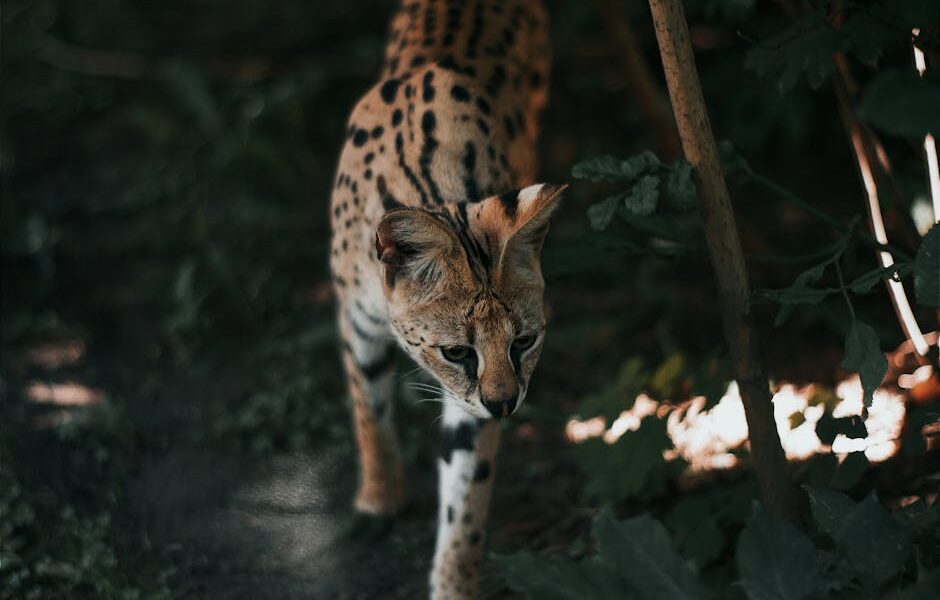
F4 SBT Savannahs retain more Serval-like features than F5. Adults are tall and leggy, with long necks, prominent rounded-tip ears placed high on the head, and a long body that gives them a striking, elegant outline. Adult weights typically fall between 10 and 16 pounds, with males larger than females. Coat is short and dense with a tawny gold base and discrete black spots, plus the breed-distinctive bold tear-mark facial pattern.
F5 SBT Savannahs trend toward a more domestic build. Adults are still leggy and tall by domestic-cat standards, but proportions move closer to a large active domestic cat than to a small Serval. Adult weights typically fall between 10 and 15 pounds. The coat pattern remains the same Savannah look: tawny gold spotted, with the tear-mark facial pattern and the breed’s signature ear placement.
Side by side, an F4 Savannah generally has more dramatic Serval-like elegance, longer ears in proportion to head, and a more pronounced wild-cat presence in motion. F5 Savannahs look like remarkably striking domestic cats with long legs and bold spotting. For full breed context see our Savannah cat breed profile.
Temperament and Personality
Both F4 and F5 SBT Savannahs are highly active, intelligent, and engaged. They form strong bonds with their families, often described as dog-like in their attachment and trainability. Many Savannahs walk on harness, learn tricks, fetch toys, and follow their owners from room to room. Vocalization is moderate and includes the breed’s signature chirps, trills, and occasional dramatic vocalizations inherited from Serval ancestry.
F4 Savannahs typically have slightly more intense energy and prey drive than F5, with a stronger tendency toward jumping, climbing, and exploring beyond what most homes provide for. They are also more likely to require committed handler time and structured enrichment to stay balanced. F5 Savannahs generally settle into household routines more readily, though they remain active and demanding by domestic cat standards.
Both generations do well with respectful older children, friendly dogs, and other social cats. Small caged pets like birds and hamsters are a poor match because of prey drive. Multi-pet households with another active cat often suit Savannahs well by giving them a play partner. Read our hybrid cat enrichment requirements guide for what daily life looks like.
Care, Grooming, Activity, and Generation Implications
Grooming is straightforward across F4 and F5 generations. The short, dense Savannah coat needs only weekly combing to manage shedding. Bathing is rarely needed. Nail trims, ear checks, and dental care follow normal pedigreed cat schedules.
Activity needs are demanding for both. Both F4 and F5 Savannahs require daily structured play (multiple sessions totaling at least 45 minutes is a starting point), extensive vertical climbing space, puzzle feeders, and ideally a companion animal to share their energy. F4 Savannahs in particular often benefit from secure outdoor enclosures or catio access; F5 can usually be managed indoors with a well-designed setup.
Diet considerations align with broader Savannah practices. Some breeders and owners feed raw or species-appropriate diets; others use high-quality commercial cat food. Our hybrid cat raw diet feeding overview discusses considerations. The Savannah cat care guide covers practical setup that scales to both F4 and F5 generations.
Health and Lifespan
Both F4 and F5 SBT Savannahs share Savannah breed health considerations. Hypertrophic cardiomyopathy is the most relevant cardiac concern across pedigreed cats including Savannahs and should be screened with cardiac ultrasound. Pyruvate kinase deficiency is genetically testable and present in some Savannah lines. Reputable breeders screen for both. Our HCM in cats overview is the most relevant cardiac resource.
Veterinary considerations for hybrid cats can include attention to anesthetic protocols, dosing baselines, and routine bloodwork interpretation. Choosing a veterinarian familiar with hybrid or exotic-adjacent species is recommended, particularly for F4 cats. Our hybrid cat vet special considerations guide outlines what to ask.
Pet insurance for Savannahs is more accessible than for earlier-generation Bengal hybrids, but some carriers still exclude or restrict hybrid cat coverage. F5 SBT cats may have better marketplace options than F4 SBT depending on the carrier. Our hybrid cat pet insurance challenges article covers the marketplace.
Living Situation Fit
F4 Savannahs suit households with prior experience with active or hybrid cats, ample vertical space, and ideally outdoor enclosure access. They do well with active families, work-from-home owners, and homes with another social cat or friendly dog. They are not first-Savannah-owner appropriate for owners coming from very low-energy cat experiences.
F5 Savannahs suit a broader range of active households. First-time-Savannah owners with experience caring for active or vocal cats can usually manage F5 successfully. Apartments work if vertical space, daily engagement, and structured enrichment are provided; otherwise a house with secure outdoor access is preferable.
Legality is an important consideration. Savannah F4 and F5 SBT cats are legal in most U.S. states, but some states restrict or ban hybrid cats regardless of generation. Verify local and state laws before committing. Our hybrid cat legality by state guide is the starting point.
Cost and Availability
F4 SBT Savannahs are produced by established TICA breeders specializing in the breed. Pet-quality F4 SBT kittens typically fall in the $1,500 to $4,000 range, with show-quality cats higher. Waitlists are typically a few months for desired color and sex.
F5 SBT Savannahs are more widely available through the same breeder networks. Pet-quality F5 SBT kittens typically fall in the $1,000 to $2,500 range. Both generations are TICA championship-eligible, so show-quality buyers across F4 and F5 have multiple breeder options.
For sibling B107 articles in this batch, see our F4 Savannah cat SBT profile and F5 Savannah cat show standard. Related resources include our largest hybrid cat breeds roundup and highest energy cat breeds overview. Rescue is also worth considering; see adopting a rescue Savannah cat.
Decision Framework: When to Choose Each
Choose an F4 SBT Savannah if you specifically want the more dramatic Serval-like presence (taller, longer-eared, more elegant outline), you have prior experience with active or hybrid cats, and you can provide ample vertical space and enrichment. F4 SBT is the first show-eligible generation, so you also have championship show options. Verify breeder cardiac screening and PK deficiency testing.
Choose an F5 SBT Savannah if you want a Savannah that fits more readily into an active household, you are a first-time Savannah owner with experience caring for active cats, and you prefer slightly lower cost and easier insurance options. F5 SBT is also championship-eligible, so show eligibility is the same as F4 within TICA classes.
Skip both if you cannot provide daily structured engagement, vertical space, and committed enrichment. A bored Savannah of any generation produces destructive behavior and litter box issues. Consider a calmer breed from our calmest cat breeds list instead, or compare with broader hybrid options in our hybrid cat breeds overview.
Frequently Asked Questions
How much Serval is in F4 vs F5 Savannahs?
By pedigree, F4 SBT Savannahs are approximately 6.25% Serval and F5 SBT Savannahs are approximately 3.125%. Actual genetic contribution varies because of gene segregation during reproduction, but the pedigree percentage is the standard reference for breeding and registration.
Are both F4 and F5 Savannahs show-eligible?
Yes. TICA accepts F4 SBT and later Savannah generations for championship status. The SBT (Stud Book Tradition) designation requires three generations of Savannah-to-Savannah breeding without outcrossing. Cats without the SBT marker may not be show-eligible.
Which generation is better for a first-time Savannah owner?
F5 SBT generally suits first-time Savannah owners better because the temperament is more manageable and the cost and insurance picture is friendlier. F4 SBT is appropriate for experienced active-cat owners who specifically want the more Serval-like presence.
Are Savannahs legal in all states?
No. Savannah cats are legal in most U.S. states, but some states restrict or ban hybrid cats regardless of generation. Verify your state’s wildlife and exotic-pet rules and local municipal ordinances before committing.
Can I adopt a Savannah?
Yes. Savannahs do appear in shelters and breed-specific rescues, often as adolescents whose energy outpaced their previous owner’s expectations. Browse the adopt cats hub for current listings and check our cat-only rescues overview for additional options.
Looking to adopt a F4 Savannah vs F5 Savannah?
Browse F4 Savannah vs F5 Savannah cats and mixes available for adoption from shelters and rescues near you.
Find F4 Savannah vs F5 Savannah Cats for Adoption