
Last updated: April 25, 2026
In this article
Flat-Coated Retriever Dog Breed Profile
The flat coated retriever is one of the most distinctive and underappreciated sporting dogs in the world. Sleek, glossy, and animated by an enthusiasm that rarely dims with age, this breed has captured the loyalty of devoted admirers for well over a century — and yet it remains far less familiar to the general public than its close cousins, the Labrador Retriever and the Golden Retriever. That relative obscurity is, in many ways, a surprise. The flat coated retriever is an outstanding hunter, an endlessly affectionate family companion, and a dog whose sheer joy for life is almost impossible to resist. Often called the “Peter Pan of retrievers,” the flat coat seems constitutionally incapable of growing up, carrying a puppy-bright spirit into its senior years. This profile covers everything prospective owners need to know — from daily care and health considerations to the breed’s fascinating history — so you can determine whether the flat coated retriever is the right dog for your home and lifestyle.
Quick Facts
| Attribute | Details |
|---|---|
| Breed Group | Sporting |
| Size | Large |
| Weight | 55 – 70 lbs |
| Height | 22 – 24.5 inches at the shoulder |
| Life Expectancy | 8 – 10 years |
| Coat | Dense, flat-lying single coat; glossy black or liver, with feathering on legs, chest, and tail |
| Shedding | Moderate year-round, with seasonal increases |
| Exercise Needs | High — 1.5 to 2 hours of vigorous activity per day |
| Trainability | High, though independent-minded |
| Good With Kids | Excellent |
| Good With Other Pets | Very Good |
| Apartment Friendly | Not recommended without exceptional daily exercise |
Personality and Temperament
Ask anyone who has shared their life with a flat coated retriever and the description is almost always the same: relentlessly happy, incurably playful, and somehow forever young. This breed has earned its nickname — the Peter Pan of retrievers — through decades of demonstrating that maturity is optional. While other large dogs settle into a calmer adult rhythm by age two or three, the flat coat tends to retain its boisterous, puppyish energy for the entirety of its life. That exuberance is one of the breed’s most endearing qualities, though prospective owners should enter with their eyes open to what it actually means day to day.
The flat coated retriever is an optimist by nature. It greets strangers with tail-wagging enthusiasm, approaches new situations with curiosity rather than caution, and seems genuinely convinced that every person, dog, and experience is a potential source of delight. This sunny disposition makes the breed a wonderful companion for active families and individuals who want a dog that is fully engaged in life alongside them.
Flat coats are also deeply affectionate and people-oriented. They do not thrive when left alone for long periods and can develop anxiety or destructive habits if their need for companionship goes unmet. For owners who are home frequently and want a dog that is fully present in daily life, the flat coated retriever offers an unmatched combination of warmth, playfulness, and loyalty.
Appearance
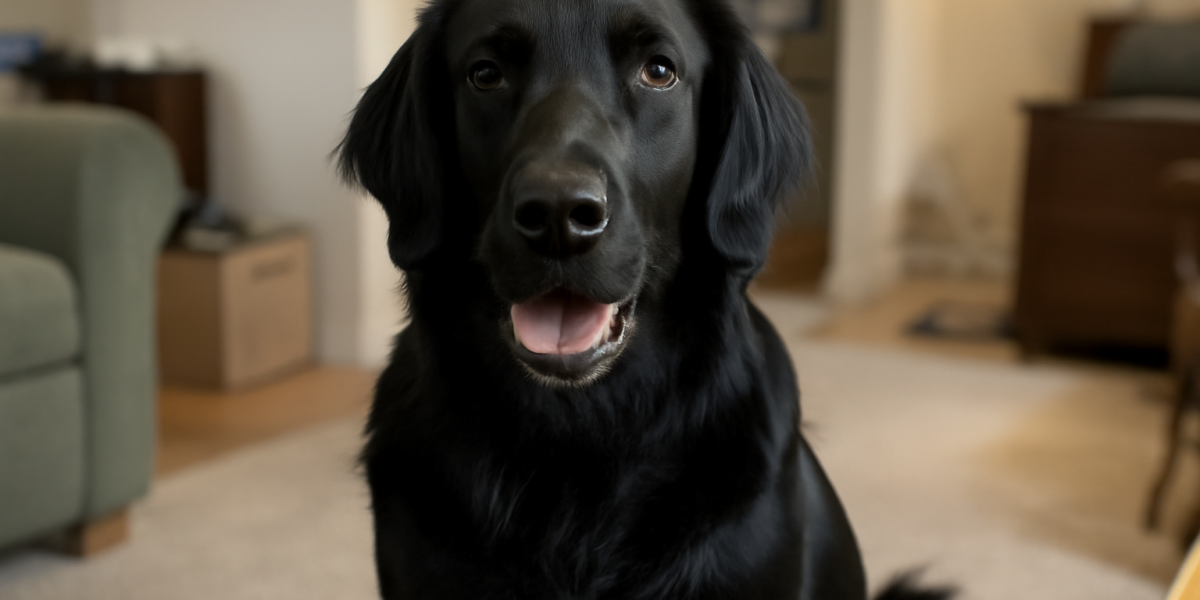
The flat coated retriever is an elegant, well-balanced dog that conveys both athleticism and refinement. The most immediately striking feature is the coat itself: dense, lustrous, and lying flat against the body — hence the breed’s name. Unlike the double coat of a Golden or Labrador, the flat coat’s coat is a single layer, giving it a sleek, almost polished appearance. Color is limited to solid black or solid liver (a rich chocolate-brown), with no other shades recognized by breed standards.
The coat is adorned with fine feathering — longer, silkier hair — on the chest, the backs of the legs, and the tail, which adds to the breed’s graceful silhouette. The head is distinctive: long and elegantly molded, with a minimal stop between skull and muzzle, giving the dog an almost Hound-like refinement that sets it apart from blockier retriever breeds. The eyes are dark brown or hazel, almond-shaped, and carry an expression that is alert, kind, and faintly mischievous — a fitting window into the breed’s character. The tail is carried level with the back and seems to wag as a default state, rarely still.
Exercise Needs
The flat coated retriever is a high-drive sporting dog originally bred to work all day in the field alongside hunters. That heritage translates directly into exercise requirements that are not negotiable if you want a settled, well-mannered companion at home. Plan on providing a minimum of 90 minutes to two hours of vigorous physical activity every single day. Casual walks will not satisfy this breed; the flat coat needs to run, retrieve, swim, or otherwise work its body and mind at genuine intensity.
Off-leash exercise in a safely fenced area is ideal. Flat coats are outstanding retrievers and will play fetch with a tirelessness that can outlast almost any human willing to throw the ball. They are also natural, enthusiastic swimmers and take to water with the same wholehearted joy they bring to everything else. Trail hiking, running, dock diving, and agility are all excellent outlets for a flat coat’s energy.
Mental stimulation is equally important. Training sessions, nose work, hunting activities, and interactive puzzle feeders all help burn the mental energy that physical exercise alone cannot fully address. A flat coated retriever that receives adequate daily activity is a calm, manageable, and deeply rewarding companion. One that is consistently under-exercised becomes restless, vocal, and prone to inventing its own destructive entertainment indoors. This is a breed best suited to owners who genuinely enjoy an active, outdoors-oriented lifestyle.
Grooming Needs
One of the practical advantages of the flat coated retriever over other retrievers is a coat that is relatively straightforward to maintain. The single-layer, flat-lying coat does not mat as readily as the dense double coat of a Golden Retriever, and the overall grooming workload is manageable for most owners willing to commit to a consistent routine.
Brushing two to three times per week with a slicker brush keeps the coat clean, removes loose hair, and prevents any tangles from developing in the feathered areas on the legs, chest, and tail. During seasonal shedding periods — typically spring and autumn — more frequent brushing will help manage the increased hair fall. Bathing every four to six weeks, or after muddy outings, keeps the coat looking its characteristic glossy best.
Beyond the coat, standard maintenance applies: nails should be trimmed every three to four weeks to prevent overgrowth and discomfort, ears should be checked weekly and gently cleaned to prevent moisture buildup and infection, and teeth should be brushed regularly to support long-term dental health. Starting all grooming routines from an early age makes the process easier for both dog and owner and keeps the flat coat looking its elegant best throughout its life. For more guidance on dog coat care, visit our dog care blog.
Health and Common Issues
The flat coated retriever is an athletic, vigorous breed in many respects, but it carries one of the most serious health burdens of any purebred dog, and every prospective owner must understand this before bringing one home.
Cancer is the dominant health concern for the breed. Studies estimate that a significant majority of flat coated retrievers will develop cancer during their lifetime — at rates that substantially exceed the already elevated rates seen in Golden Retrievers. Histiocytic sarcoma is a particular concern and occurs in flat coats at far higher frequency than in virtually any other breed. Fibrosarcoma, osteosarcoma, and lymphoma are also diagnosed more commonly than in the general dog population. This cancer burden directly influences the breed’s relatively short average lifespan of 8 to 10 years, and it is something owners must approach with regular veterinary monitoring and a commitment to catching any changes early.
Hip dysplasia is the second major health concern, involving abnormal development of the hip joint that can lead to pain and arthritis as the dog ages. Bloat — gastric dilatation and volvulus — is a life-threatening emergency that can affect deep-chested breeds like the flat coat, requiring immediate veterinary intervention. Responsible breeders screen for hip dysplasia and maintain health records; adopters should request all available health history. Routine annual examinations, maintaining a healthy weight, and close attention to any changes in behavior or movement all support the best possible quality of life for a flat coated retriever.
Are Flat-Coated Retrievers Good With Kids and Other Pets?
The flat coated retriever’s natural enthusiasm and affectionate temperament make it an excellent companion for children, with one important caveat. Because the breed retains such a pronounced puppy energy throughout its life — and can be genuinely boisterous — very young or small children can inadvertently be knocked over during exuberant play. This is not an aggression issue; it is simply a reflection of the breed’s size and unbridled excitement. With older children who can match the flat coat’s energy and enthusiasm, the pairing is outstanding. Flat coats love to run, play, and roughhouse, and they are patient and good-natured in a way that holds up even in the chaos of busy family life. As with any breed, supervision is essential when dogs and young children share space.
With other dogs, the flat coated retriever is typically friendly, social, and easygoing. Their non-territorial nature and genuine love of companionship mean they often get along exceptionally well in multi-dog households. With cats and other small animals, early socialization is important, as the breed’s retrieving instincts and high energy can occasionally make smaller pets feel overwhelmed. Most flat coats introduced carefully to cats in puppyhood live harmoniously alongside them.
Training Tips
The flat coated retriever is an intelligent dog with a genuine desire to engage — but it is also a breed with its own ideas, and those ideas tend to involve play, exploration, and whatever smells most interesting in the immediate vicinity. Training a flat coat requires patience, consistency, and a sense of humor. Owners who approach sessions with positive energy and an understanding that the breed’s independent streak is simply part of its character will get the best results.
Positive reinforcement methods work extremely well with this breed. High-value food rewards, enthusiastic praise, and short training sessions of 10 to 15 minutes keep a flat coat engaged and eager. Long, repetitive drills cause the breed to lose interest quickly. Variety, playfulness, and a light touch are far more effective than rigid, regimented sessions.
Begin foundational commands — sit, stay, come, down, and leash manners — as early as possible. Because flat coats remain puppy-like in their exuberance for years, establishing solid recall and leash manners early is particularly important. The breed excels in field work, agility, dock diving, and nose work, all of which provide an excellent outlet for both physical energy and mental drive. Enrolling in a structured puppy or obedience class gives the flat coated retriever socialization opportunities it genuinely thrives on and provides the owner with tools to channel the breed’s energy constructively.
History and Origin
The flat coated retriever is one of England’s oldest retriever breeds, developed in the mid-nineteenth century to meet the demands of British gamekeepers and wildfowlers who needed a versatile, hard-working dog capable of retrieving both upland game and waterfowl in the challenging conditions of the English countryside. The breed’s development is often attributed in part to S.E. Shirley, the founder of The Kennel Club, who played a significant role in standardizing its type.
The breed’s foundation stock likely included St. John’s Water Dogs imported from Newfoundland — the same dogs that contributed to the development of the Labrador Retriever — along with Collie blood for trainability and Setter for elegance. By the late 1800s, the flat coated retriever was the most popular retriever in England, prized by gamekeepers as the working retriever of choice. It was often referred to simply as the “gamekeeper’s dog.”
That dominance was not to last. The early twentieth century saw the rapid rise of the Labrador Retriever and, later, the Golden Retriever, and the flat coat’s popularity declined sharply. The two World Wars pushed the breed close to extinction, and the recovery was slow. Today, the flat coated retriever remains a relatively rare breed compared to its retriever cousins, though it has passionate devotees who prize its unique combination of elegance, athleticism, and irrepressible spirit. Its relative obscurity means the breed is sometimes overlooked in rescue — which makes finding a flat coat in need of a home a genuinely special opportunity.
Frequently Asked Questions
How long do flat coated retrievers typically live?
The average lifespan of a flat coated retriever is 8 to 10 years — somewhat shorter than other retriever breeds, largely due to the breed’s elevated cancer rates. Some individuals live beyond this range with attentive veterinary care, a healthy diet, regular exercise, and proactive health monitoring. Understanding and accepting this aspect of the breed is an important part of making an informed decision about ownership.
Is the flat coated retriever a good choice for first-time dog owners?
The flat coated retriever can be a good match for a first-time owner who is genuinely active, home frequently, committed to daily training, and prepared for a dog that retains high puppy energy for many years. For owners who prefer a calmer, more rapidly maturing dog, or who have limited time for exercise and enrichment, the flat coat is likely not the right fit. Honest self-assessment about lifestyle is essential before choosing this breed.
Do flat coated retrievers do well in apartments or small homes?
The flat coated retriever is not an ideal choice for apartment living. The breed’s high energy and need for substantial daily exercise make a home with a securely fenced yard a much better fit. That said, a committed owner in a smaller space who provides 90 minutes or more of vigorous daily exercise and ample mental stimulation can make it work — but it requires genuine dedication and should never be attempted casually.
How does the flat coated retriever differ from the Golden Retriever?
While both breeds share retriever heritage and a friendly temperament, there are meaningful differences. The flat coated retriever is sleeker in build, comes only in black or liver (never gold), and tends to mature more slowly — retaining its puppy energy longer than the Golden. The flat coat is also considerably rarer and carries a significantly higher cancer risk. The Golden Retriever is generally a slightly calmer, more predictable choice for first-time owners, while the flat coat appeals to experienced owners who want something a little more spirited and uncommon.
Adopt a Flat-coated Retriever
If the flat coated retriever’s combination of elegance, joy, and boundless enthusiasm sounds like a perfect match for your lifestyle, adoption is a wonderful place to begin. Rescue flat coats are available in a range of ages and temperaments — from young dogs bursting with energy to calmer adult dogs ready to settle into a loving home. Older flat coated retrievers in rescue can be particularly rewarding; they often arrive with solid basic manners and a depth of gratitude for a second chance that is genuinely moving.
At WalkMeHome Rescue, we take care to match each dog with a family where they can truly thrive. If you are ready to open your home to one of the most spirited and joyful dogs in the sporting group, browse our available dogs and start the process today at our adopt a dog page.


