Last updated: May 4, 2026
In this article
- Great Dane vs Saint Bernard at a Glance
- History and Origin
- Size and Appearance
- Temperament and Personality
- Trainability and Intelligence
- Exercise and Activity Needs
- Grooming and Care
- Health and Lifespan
- Cost and Availability in Rescue
- Living Situation and Real-World Costs
- Which Is Right for You?
- Frequently Asked Questions
Great Dane vs Saint Bernard at a Glance
The Great Dane vs saint bernard question pits two of the most famous giant breeds against each other — the elegant German “Apollo of Dogs” against the iconic Swiss alpine rescuer. Both are huge, both are family-oriented, and both come with the giant-breed realities of shorter lifespan, hefty food bills, and a household built to accommodate a small horse. They look very different, behave differently in pace and texture, and suit different homes. Pick well and you have one of the most rewarding companion dogs in the world.
In broad strokes, the Great Dane is taller, leaner, sleeker, and faster — the breed is built like a deer-sized Greyhound. The Saint Bernard is shorter (relatively — still huge), stockier, heavier, and slower-moving — built for plowing through snow, not chasing prey. Both are gentle giants in temperament, but the daily texture of life with each breed differs in important ways. Both deserve experienced owners or first-time owners who have done thorough homework.
History and Origin
The Great Dane was developed in Germany (despite the name) as a boar-hunting dog and estate guardian for nobility. Crossing Mastiff-type dogs with sighthounds produced a tall, fast, powerful hunter that could pull down wild boar and stand watch over castles. By the 19th century, the breed had become more companion than hunter, and Germany formally adopted it as a national breed. The AKC recognized the Great Dane in 1887. Today’s Dane is firmly a family dog with watchful tendencies.
The Saint Bernard descends from large Alpine working dogs kept by monks at the Saint Bernard Hospice in the Swiss Alps from at least the 17th century. The breed was used to find and rescue lost travelers in mountain snow. The breed split into shorthair and longhair varieties in the 19th century, with longhairs developed via a Newfoundland cross that the monks ultimately did not keep at high altitude because the coat froze. AKC recognition came in 1885. The Saint has been a companion-and-rescue breed throughout its modern history.
Size and Appearance
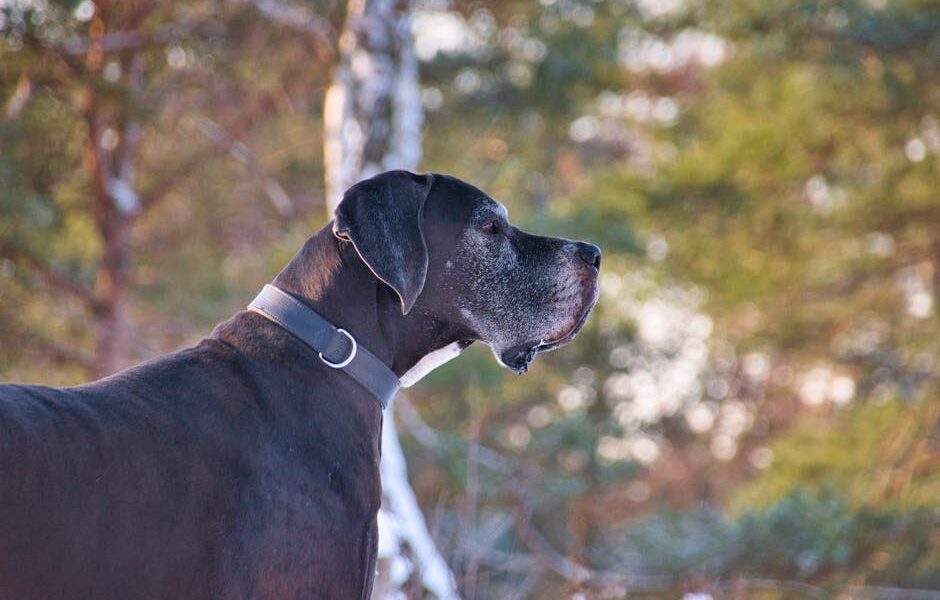
The Great Dane is the taller breed. Adult males stand 30 to 34 inches at the shoulder and most weigh 140 to 175 pounds; females are 28 to 32 inches and 110 to 140. The build is athletic, deep-chested, and lean — closer to a “huge greyhound” than a “huge mastiff.” Coat is short and easy-care in fawn, brindle, blue, black, harlequin, mantle, or merle.
The Saint Bernard is shorter and heavier. Adults stand 26 to 30 inches and most weigh 120 to 180 pounds, with males larger. The build is broad, muscular, and substantial. Coat is red and white in shorthair (smooth) or longhair (rough) varieties. The Saint Bernard reads as “huge fluffy mountain”; the Great Dane reads as “huge sleek nobleman.” Furniture, vehicles, and crate sizes are equally challenging for both. The Great Dane fits in a tall narrow space; the Saint Bernard fits in a wide deep space.
Temperament and Personality
Both breeds are friendly, family-oriented gentle giants. Neither is a default guard dog despite the size. Both bond intensely with their families, and both can be wonderful with children when raised with them and supervised.
The Great Dane is famously the “lap dog who thinks he is a lap dog” — affectionate, leaning, and highly attached to family members. Danes are typically friendly with strangers once introduced and may be slightly more anxious or sensitive than the Saint Bernard, particularly without thorough early socialization. The Saint Bernard is the calmer, slower-moving breed — more reserved with strangers and slightly more guardian-leaning, but still gentle. Both breeds suffer when left for long stretches alone. Both have a strong velcro tendency. Read the canine body language guide to read these stoic breeds accurately.
Trainability and Intelligence
Both breeds are intelligent and respond well to force-free training. Both are large enough that even mild leash pulling, jumping, or counter-surfing becomes a serious management problem in adulthood, so early training matters more than with smaller breeds.
The Great Dane is reasonably food-motivated and tends to learn quickly with patient handling. The Saint Bernard is slower to learn but rock-solid once a behavior is in place. Neither is a competitive obedience star, but both can earn good house manners, reliable recall, and solid leash work. Group puppy class through adolescence is essential for both. Adolescent giants are hilarious and dangerous — a 110-pound puppy with no impulse control is a wrecking ball. Plan training as a multi-year commitment, not a 6-week class.
Exercise and Activity Needs
Both breeds need moderate, not high, exercise — but the Great Dane needs slightly more. Plan on 60 to 90 minutes of daily activity for the Dane and 45 to 60 minutes for the Saint. Both should avoid hard exercise on growing joints until skeletal maturity at 18 to 24 months, and both overheat easily.
The Great Dane has more sprint capability and benefits from short bursts of running in safe spaces, structured games, and longer walks. The breed has a higher general energy level than the Saint Bernard but is still not an endurance breed. The Saint Bernard prefers cool-weather walks, snow work, and easy yard time. Mental enrichment matters as much as physical exercise for both — chew toys, food puzzles, training sessions. Neither breed is suited to a hot climate without serious management.
Grooming and Care
The Great Dane has a short, easy-care coat that sheds moderately year-round. Weekly brushing handles it. Bathe every six to eight weeks. Drool is moderate — Danes drool, but less than Saints. Skin folds are minimal.
The Saint Bernard sheds dramatically — both varieties — and longhairs need three to four weekly brushings, with line-brushing through the chest and trousers. Drool is heavy thanks to loose lip flews. Keep face towels in every room. Both breeds need monthly ear cleaning, weekly tooth brushing, and three-to-four-week nail trims. Saints need attention to skin folds around the eyes and muzzle. Both breeds need beds, crates, and vehicles built for giants — a regular dog bed will not work.
Health and Lifespan
Both are giant breeds with shorter lifespans than smaller dogs. Great Danes typically live 7 to 10 years; Saint Bernards typically live 8 to 10. Both are at significant risk for bloat (GDV) — the Great Dane is among the highest-risk breeds in the world for GDV, and many owners pursue prophylactic gastropexy at spay/neuter. Both are predisposed to hip and elbow dysplasia.
Dilated cardiomyopathy is well-documented in Great Danes; cardiac screening is essential. Both breeds see osteosarcoma in middle age, and the Great Dane is among the highest-risk breeds. Lymphoma appears in both. Saints see cherry eye and ectropion. Reputable breeders screen for hips, elbows, eyes, hearts, and thyroid. Lean body condition extends life with both breeds. Pet insurance signed up early pays for itself.
Cost and Availability in Rescue
Both breeds appear in rescue regularly, often when owners underestimate adult size, food costs, vet bills, or the heartbreak of shorter giant-breed lifespans. Adoption fees typically run $300 to $700 with full vetting. Breed-specific rescues exist for both — see our Great Dane rescue adoption guide and Saint Bernard rescue adoption guide.
Many giant-breed rescues require a fenced yard, large-breed experience, and an honest plan for ongoing veterinary and grooming costs. Foster-based rescues have the deepest knowledge of individual dogs. Adopting an adult dog is especially worth considering — many wonderful Dane and Saint seniors are in foster care with years of love left to give. The Adopt a Dog hub shows current listings.
Living Situation and Real-World Costs
Both breeds need substantial living space and budgets. A 150-plus-pound dog needs a large bed, a vehicle that accommodates the dog comfortably, and an emergency veterinary plan with a clinic able to handle giant breeds. Food costs scale with size — feeding either breed is meaningfully more than feeding a medium breed. Weight-based medications, anesthesia protocols, and parasite prevention all cost more, and giant-breed-specific dosing matters for safe care.
Climate matters for both breeds. The Saint Bernard struggles dramatically in heat thanks to the dense coat; the Great Dane is somewhat more heat-tolerant but still vulnerable to summer extremes. Both need air conditioning in most US summer climates. Both also need a securely fenced yard for safe outdoor time, and many rescues require fenced yards as a baseline. Honest research about housing, food, and vet costs before adopting prevents painful returns.
Which Is Right for You?
Pick a Great Dane if you want the elegant, athletic giant — slightly higher energy, slightly leaner, less shedding, and less drool. Danes are famously affectionate and “leaning” with their people and tend to be more universally social with strangers. Be honest about the elevated GDV and DCM risk and budget for cardiac monitoring.
Pick a Saint Bernard if you live in a cooler climate, you want the iconic alpine rescue look, you can manage heavier shedding and significantly more drool, and you appreciate a calmer, slower-moving giant. Saints are slightly more guardian-leaning and slightly more reserved with strangers, which suits some homes well. Both breeds reward experienced owners with extraordinary devotion. Both are inappropriate for low-income or low-space households purely because of cost.
Frequently Asked Questions
Which is bigger, a Great Dane or a Saint Bernard?
Great Danes are typically taller; Saint Bernards are typically heavier. Saints look bigger because of the dense build and thick coat; Danes look bigger when standing thanks to their height.
Which breed sheds and drools more?
The Saint Bernard sheds more (especially the longhair) and drools more. The Great Dane is the lower-grooming and lower-drool option of the two.
Which is calmer at home?
The Saint Bernard has a slightly lower indoor energy level. Great Danes can also be calm at home but need slightly more daily exercise to settle.
Which lives longer?
Saint Bernards typically live slightly longer on average, though both have shorter giant-breed lifespans than smaller dogs.
Are these breeds good with kids?
Both can be wonderful with their family’s children when raised with them. Both still need supervision because of size — a casual bump can knock over a small child. Neither is ideal for households with frequent young visitors.
Looking to adopt a Great Dane vs Saint Bernard?
Browse Great Dane vs Saint Bernard dogs and mixes available for adoption from shelters and rescues near you.
Find Great Dane vs Saint Bernard Dogs for Adoption