
Last updated: May 23, 2026
In this article
- Why These Categories Are Not the Same
- Street Dogs: Born and Raised Free-Roaming
- Stray Dogs: Formerly Owned, Now Loose
- Community Dogs: Informal Ownership Without Households
- Free-Roaming vs Feral: A Critical Distinction
- CNVR: The Modern Population Management Approach
- Rescue Imports: What Adopters Should Know
- Transport Syndrome and Behavioral Acclimation
- Middle Eastern, Eastern European, and Asian Rescues
- What to Expect in the First Year
- Frequently Asked Questions
Why These Categories Are Not the Same
The street dog community dog distinction has become important as international rescue imports have grown and adopters increasingly find themselves bringing home dogs whose backgrounds defy the standard US shelter narrative. The terms “street dog,” “stray dog,” “community dog,” “free-roaming dog,” and “feral dog” are often used interchangeably in casual conversation, but they describe meaningfully different populations with different histories, behaviors, and rescue implications.
Understanding the categories helps adopters set realistic expectations for what their new dog will need. A formerly owned stray who was loved by a family before getting lost approaches household integration very differently from a third-generation free-roaming village dog who has never been inside a home. Both are valid adoption candidates; the work involved is not the same.
This guide walks through the practical distinctions, the global context, the major rescue and population-management approaches, and what each background means for the adoption process. For the cat-side parallel, our feral vs community vs stray cat distinction covers similar territory in cats, including the important difference that feral cats often cannot be socialized to indoor pet life while feral dogs sometimes can.
Street Dogs: Born and Raised Free-Roaming
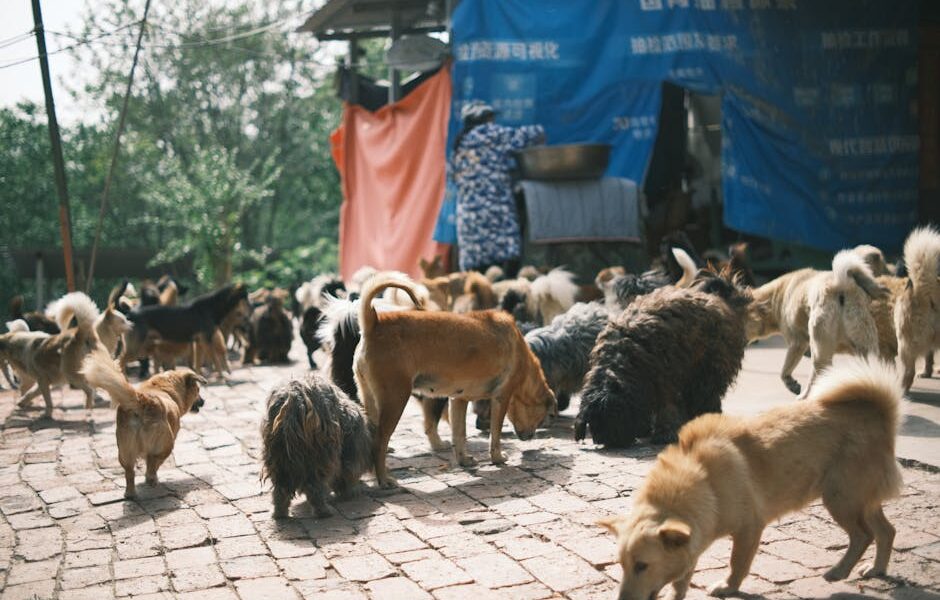
Street dogs are dogs born outside of formal human ownership, raised in public spaces, and operating in a population that has been free-roaming for generations. The defining feature is intergenerational free-ranging — these dogs are not lost pets; they are descendants of dogs who have lived this way for years or centuries.
Global street dog populations are concentrated in countries with weak or absent spay-neuter infrastructure and cultural tolerance for free-roaming dogs. Estimates vary, but India is widely cited at thirty to sixty million street dogs, Mexico at roughly ten million, Romania at around two million, and similar populations exist across Southeast Asia, the Middle East, the Balkans, parts of Africa, and Latin America. The total global street-dog population is in the hundreds of millions.
Street dogs often have established territories, group structure, and feeding routines built around human waste streams and informal community feeding. Many are friendly enough with humans to accept food but wary of being touched or confined. Behavior varies enormously between regions and individuals — some street dogs become house pets within weeks of adoption; others require months of patient decompression and may never tolerate indoor life fully.
Stray Dogs: Formerly Owned, Now Loose
Stray dogs are the population most US shelters were built to handle. A stray dog is a dog that was previously owned and is now loose — lost, abandoned, escaped, or surrendered. Strays in the US context typically end up in municipal shelters within days to weeks of going loose, are scanned for microchips, and either reunited with owners, transferred to rescues, or placed for adoption.
Behaviorally, strays are usually closer to typical pet dogs than street dogs are. They have lived indoors, know house manners (or knew them before going loose), and respond predictably to leashes, food bowls, and human handling. Their challenges are usually shorter-term — adjustment to a new home rather than fundamental reorientation to indoor life.
The line between stray and street dog blurs in countries with weak shelter infrastructure. A dog abandoned in rural Mexico may live as a stray for a few weeks, then integrate into a local free-roaming group and become effectively a street dog. Adopters importing dogs from those countries should ask the rescue about the dog’s specific history, not just the country of origin.
Community Dogs: Informal Ownership Without Households
Community dogs occupy a middle ground that often surprises Western adopters: dogs informally cared for by a neighborhood, fed by multiple people, sometimes given names by residents, but not owned by any single household. Community dogs are common across India, Southeast Asia, parts of Latin America, the Middle East, and some Mediterranean countries.
A community dog is not the same as a street dog because community dogs have human relationships and care networks. They may sleep on specific porches, accept handling from specific people, and have established relationships with shopkeepers, restaurant owners, or apartment residents who feed them. They are also not the same as owned pets because no single person makes decisions about their veterinary care, sterilization, or movement.
Many international rescues pull from community dog populations because these dogs are friendlier with humans than true street dogs. They often have some basic socialization (acceptance of handling, recognition of food bowls, comfort around human noise) that street dogs lack. They may also have lower medical risks because community feeding tends to be more reliable than scavenging.
Free-Roaming vs Feral: A Critical Distinction
Free-roaming and feral are not synonymous. A free-roaming dog is any dog living outside of formal household confinement — could be a street dog, stray, or community dog. A feral dog is a free-roaming dog that has become non-socialized to humans and avoids human contact.
True feral dogs are uncommon. Most “feral” populations are actually free-roaming with varying degrees of human socialization. A dog can be free-roaming and friendly with humans (street dogs in many Indian cities), free-roaming and indifferent (stable village dog populations), or free-roaming and avoidant (true feral). The third category is the smallest and the hardest to adopt.
For comparison, the cat side is different — feral cat populations are far more common because cats can sustain themselves on rodents and prey without human dependence. Dogs are mostly commensal with humans even when free-roaming. The cat distinction guide covers why feral status differs across species.
CNVR: The Modern Population Management Approach
Catch-Neuter-Vaccinate-Return (CNVR) programs are the leading evidence-based approach to managing free-roaming dog populations globally. The protocol catches free-roaming dogs, sterilizes them, vaccinates against rabies and core diseases, and returns them to their original territory. The dogs continue their lives in place but no longer reproduce.
CNVR works because removing or killing free-roaming dogs creates territory vacancies that other dogs quickly fill — the “vacuum effect.” Sterilized dogs continue to occupy territory, exclude new arrivals, and the population gradually declines as natural mortality reduces it. The approach has been formally endorsed by the World Health Organization, World Animal Protection, and the Humane Society International.
Culling-based approaches (mass roundups and euthanasia) have been repeatedly shown to fail. They are also widely condemned on welfare grounds. Countries that have shifted from culling to CNVR — including Bhutan, India in several states, and parts of Thailand — have seen meaningful reductions in both free-roaming populations and rabies incidence over five to ten year programs.
Rescue Imports: What Adopters Should Know
International rescue imports have become common in the US, particularly from Mexico, Puerto Rico, Romania, Bosnia, Turkey, Thailand, China, and Korea. The dogs come through a variety of channels: large established rescues with sophisticated medical screening, small grassroots organizations with variable practices, and informal “flight nanny” arrangements through individuals.
Medical risks for imported dogs include parvovirus and distemper (particularly in puppies who may not have completed vaccination before travel), heartworm (significantly more prevalent in many source countries than in the US), tick-borne diseases (ehrlichiosis, babesiosis, anaplasmosis from many source regions), parasites (whipworm, giardia, hookworm), and rabies (most countries require rabies vaccination certificates for import, but mistakes happen).
Quarantine of new arrivals from international transport is essential. Plan for two to four weeks of isolation from resident dogs, with vet visits early in the quarantine period to test for the regional disease panel. Many veterinarians familiar with imports recommend running a heartworm test, full fecal panel, and tick-borne disease panel on arrival regardless of pre-shipment paperwork.
Transport Syndrome and Behavioral Acclimation
Transport syndrome is the cluster of stress-related issues that often emerge in dogs who have traveled long distances. Symptoms include diarrhea, decreased appetite, withdrawal, hyper-vigilance, and sometimes severe shutdown for the first few days to weeks. The combination of multiple environment changes (origin shelter, transport vehicle, layover, foster, final home) compounds the stress.
The 3-3-3 rule is a useful framework: three days to decompress (the dog hides, eats little, may not interact), three weeks to settle into a routine (basic preferences emerge, the dog learns the household pattern), three months to feel fully at home (the dog’s personality fully appears, training takes hold). Imported dogs often need longer than the standard 3-3-3 — a 6-6-6 or 9-9-9 timeline is more realistic for severely under-socialized arrivals.
During the decompression phase, minimize stimulus. Quiet rooms, limited household traffic, no dog parks or vet visits beyond essential medical care, and patient waiting. Many imported dogs do best initially in a small space (a single room or pen) where they can decompress without making large decisions. The principles in our dog anxiety when moving home guide are especially applicable.
Middle Eastern, Eastern European, and Asian Rescues
Different regional source populations bring different typical backgrounds. Middle Eastern rescue dogs (Saudi Arabia, UAE, Lebanon, Israel, Egypt) often come from urban free-roaming populations or from informal shelters that may have limited resources. Many have had positive human contact through feeders and informal caretakers. Our adopting a street dog from the Middle East guide covers this population in depth.
Eastern European rescues (Romania, Bulgaria, Serbia, Bosnia) often come from large municipal shelters where conditions vary widely, or from CNVR programs where dogs were temporarily housed before transport rather than returning to territory. Many Eastern European street dogs are larger and more dog-social than dogs from other regions because they evolved in pack-friendly free-roaming populations.
Asian rescues (Thailand, Indonesia, China, Korea) often include dogs saved from the meat trade, which carries its own behavioral profile — these dogs may have spent time in extreme confinement and high-stress conditions and may need extended decompression. Korean Jindo, Sapsali, and various Southeast Asian village dogs are common in this group.
What to Expect in the First Year
Adopting an international rescue or domestically rescued street-type dog is a longer commitment than adopting a typical US shelter dog. Expect medical workup costs in the first three months (often $300-800 beyond what was covered by the rescue), expect slower training progress (the dog may need to learn that indoor life is safe before they can learn sit and down), and expect behavioral surprises as the dog decompresses.
Most imported street and community dogs become beloved household members within six to twelve months. Some take longer. A small percentage remain semi-feral or fearful long-term and benefit from continuing professional behavior support. Going in with realistic expectations and a willingness to extend the timeline produces the best outcomes.
If you are considering this kind of adoption, work with a rescue that provides honest assessment, post-adoption support, and access to behavior consultants. Reputable international rescues will tell you about specific behavioral challenges they observed in the source country and during transport, not gloss over them. Beware rescues that promise “all dogs are house-trained and great with kids” — that level of certainty is impossible for dogs from genuinely free-roaming backgrounds.
Frequently Asked Questions
Can a street dog ever fully adjust to house life?
Most can, given enough time. The adjustment varies from weeks (for community dogs with prior positive human contact) to a year or more (for genuinely under-socialized arrivals). Some dogs prefer outdoor sleeping spaces, more independent routines, and lower physical contact even after full adjustment, and that is okay.
How do I know if my imported rescue dog is dealing with transport syndrome or a deeper behavioral issue?
Transport syndrome usually resolves substantially within two to four weeks with patient management. If at four to six weeks the dog is still severely shut down, not eating, or showing escalating fear behaviors, work with a vet and behavior consultant. Some dogs need anti-anxiety medication during the initial integration — see our dog depression management guide for the medical workup framework.
Are street dogs safe to adopt with children?
Depends on the individual dog and their history. Some street and community dogs are excellent with children; others have never met children and are fearful. Ask the rescue specifically about the dog’s exposure to children and observe direct interactions before final placement.
What vaccines does an imported dog need beyond what’s standard?
Imported dogs should be tested for heartworm and tick-borne diseases on arrival, even if paperwork shows they were treated. The vaccination schedule is then individualized based on what they have already received. Bordetella, leptospirosis, and influenza vaccines are reasonable additions given the high-density transport environment they came through. Our puppy vaccination deep dive covers the general framework.
Should I support CNVR programs over rescue imports?
Both are valuable in different ways. CNVR addresses the population at the source and helps far more dogs per dollar than international transport. Rescue imports save individual dogs from situations where return to street life is not safe. Many donors support both — CNVR for systemic change and rescue imports for specific adoptable dogs.


