Last updated: April 27, 2026
In this article
Overview
The Thai cat, often called the Traditional Siamese or Old-Style Siamese, represents the original body type of the Siamese breed before modern show breeding created the ultra-sleek, angular Siamese we see today. This Thai cat breed profile introduces a breed that combines the classic pointed coat and brilliant blue eyes of the Siamese with a more moderate, rounded body that many cat lovers find irresistible.
Thai cats have been documented in Thailand (formerly Siam) for centuries, appearing in the ancient manuscript “Tamra Maew” (The Cat-Book Poems) dating back to the 14th century. While the modern show Siamese was selectively bred toward an increasingly extreme body type from the mid-20th century onward, the Thai cat preserves the look of the original cats that first captivated Western cat fanciers in the late 1800s. TICA recognized the Thai as a distinct breed in 2009.
Quick Facts
- Breed Group: Natural / traditional
- Size: Medium, 8-15 pounds
- Lifespan: 12-16 years
- Energy Level: High
- Grooming Needs: Low
- Coat: Short, close-lying pointed coat with blue eyes
Temperament and Personality
If you have ever heard that Siamese cats are vocal, opinionated, and deeply bonded to their people, multiply that reputation and you have the Thai cat. These are cats with enormous personalities packed into medium-sized bodies. They are affectionate to the point of being demanding, and they will make sure you know when they want attention, food, or just a good conversation.
Thai cats are famous for their voices. They have a wide vocal range and use it liberally, meowing, chirping, trilling, and sometimes delivering what can only be described as full monologues. They seem to genuinely enjoy communicating with their humans and will respond when spoken to, creating back-and-forth exchanges that are endlessly entertaining.
Beneath the chattiness is a profoundly loyal companion. Thai cats often choose one person as their primary human and will shadow that person throughout the day. They are lap cats, shoulder cats, and under-the-covers cats. If you are looking for a feline that will give you space and independence, look elsewhere — the Thai wants to be wherever you are.
They are playful and intelligent, excelling at interactive games and capable of learning tricks and commands. Thai cats retain their kitten-like playfulness well into their senior years. They are also emotionally perceptive, often responding to their owner’s mood with comforting proximity or playful antics when spirits need lifting.
Size and Appearance
The Thai cat has a moderate, well-balanced body type that distinguishes it from the modern show Siamese. Where the modern Siamese is extremely slender with an elongated, tubular body and a narrow, wedge-shaped head, the Thai is rounder, sturdier, and more muscular.
Adults typically weigh between 8 and 15 pounds, with males being significantly larger than females. The body is medium-length with moderate bone structure and visible muscle tone. They are athletic without being extreme, with a slightly rounded belly and a balanced overall silhouette.
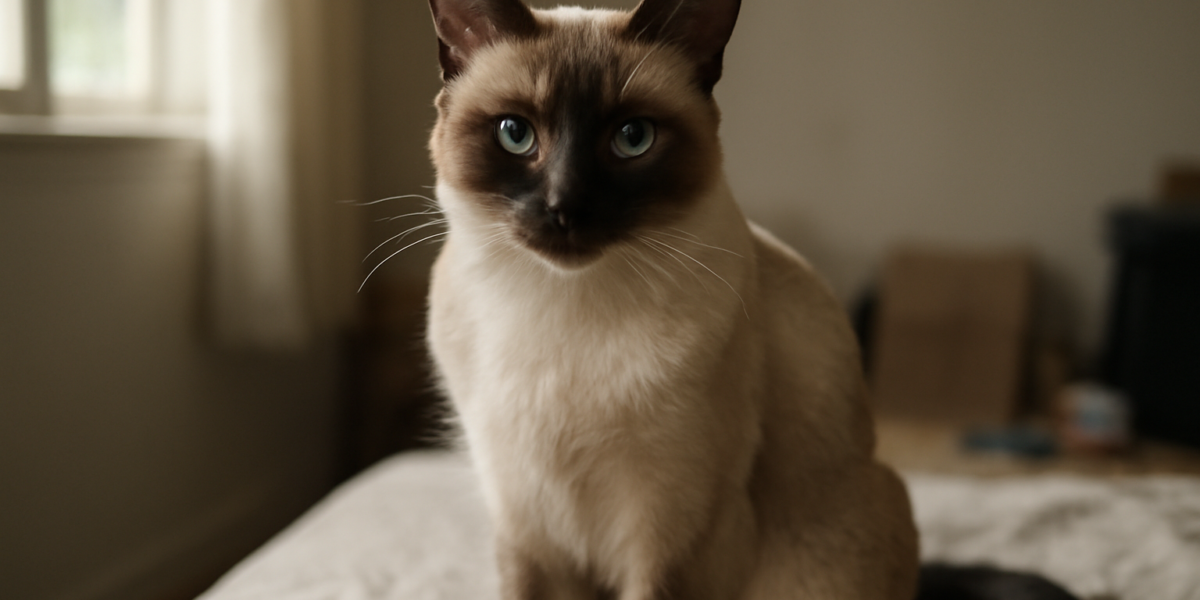
The head is a modified wedge shape — broader than the modern Siamese but not as round as a British Shorthair. They have a flat forehead, a medium-length nose with a gentle curve in profile, and rounded cheeks. The ears are medium to large, wide at the base, and set wide apart. The eyes are large, brilliant blue, and slightly rounded with an intelligent, expressive gaze.
Thai cats always have the pointed coat pattern, meaning their body is lighter in color while the face (mask), ears, legs, and tail are darker. Point colors include seal, blue, chocolate, lilac, red, cream, and various tabby and tortie point combinations. The short, close-lying coat has a silky texture and minimal undercoat.
Exercise and Activity Needs
Thai cats are energetic and need regular physical and mental stimulation. They are not the type to lounge on a cushion all day — they want to play, explore, and interact with their environment and their people.
Interactive play is the best way to channel your Thai’s energy. Wand toys, feather teasers, and small balls that they can chase and bat around are all popular choices. Many Thai cats enjoy playing fetch and will bring toys back to you repeatedly. Plan for at least two vigorous play sessions of 15 to 20 minutes each day.
Cat trees, climbing shelves, and window perches are important for giving your Thai vertical territory to explore. They enjoy surveying their home from high vantage points and will use every level of a multi-tiered cat tree. Place a cat tree near a window for the ultimate entertainment station — Thai cats love watching birds and outdoor activity.
Mental enrichment is equally important. Puzzle feeders, treat-dispensing toys, and training sessions keep the Thai’s busy mind engaged. Without adequate stimulation, Thai cats can become bored, vocal, and potentially destructive. Some owners find that clicker training provides an excellent outlet for their Thai’s intelligence and desire to interact.
Grooming and Care
The Thai cat’s short, close-lying coat is remarkably low-maintenance. A weekly brushing with a soft bristle brush or rubber grooming mitt is usually sufficient to remove loose hair and keep the coat sleek and glossy. Thai cats shed minimally compared to many other breeds, making them a relatively tidy housemate.
Bath time is rarely necessary unless your cat gets into something messy. The Thai’s short coat does a good job of staying clean on its own. If you do bathe your Thai, use a gentle cat-specific shampoo and dry them thoroughly afterward.
Dental care deserves regular attention. Brush your Thai’s teeth several times a week with cat-safe toothpaste to prevent dental disease, which is common in many cat breeds. Trim nails every two to three weeks and check ears weekly for wax buildup or signs of infection.
Feed a high-quality cat food appropriate for your Thai’s life stage. These active cats generally maintain a healthy weight as long as they receive adequate exercise, but monitor their food intake and adjust portions if you notice weight gain. Fresh water should always be available, and a cat water fountain can encourage better hydration.
Health and Lifespan
Thai cats are generally healthy with a lifespan of 12 to 16 years, and many live well beyond that with proper care. Their moderate body type, which avoids the extremes of the modern Siamese, contributes to their overall robustness.
Some health conditions to be aware of include amyloidosis (a liver condition that can affect Siamese-related breeds), hypertrophic cardiomyopathy, and progressive retinal atrophy. Responsible breeders screen for these conditions, and early detection through regular veterinary checkups greatly improves outcomes.
Crossed eyes (strabismus) and kinked tails, once common in traditional Siamese lines, have been largely bred out of the Thai. These conditions are considered cosmetic faults in show standards but do not affect the cat’s health or quality of life.
Thai cats can be prone to dental issues, making preventive dental care particularly important. Upper respiratory infections are also something to watch for, especially in multi-cat households. Keep vaccinations current and maintain a clean living environment. Regular vet visits, a nutritious diet, and an active lifestyle are the best foundations for a long, healthy life with your Thai cat.
Is the Thai Cat Right for You?
The Thai cat is perfect for owners who want a deeply engaged, communicative companion and do not mind a vocal housemate. If you enjoy talking to your cat, having a constant shadow, and being the center of a feline’s universe, the Thai will make you very happy.
This breed is not ideal for people who want a quiet, independent cat. Thai cats require significant attention and interaction, and they will vocally express their displeasure if they feel neglected. They do not do well being left alone for long periods and can develop separation anxiety. If your household is typically empty during the day, consider getting two Thai cats or pairing your Thai with another social breed.
Thai cats are wonderful with families, including homes with respectful children and cat-friendly dogs. Their social, outgoing nature helps them adapt to busy household environments. They are less suited to very quiet, calm households where their energy and vocalization might feel overwhelming.
If you are interested in pointed cats with blue eyes, compare the Thai with the Colorpoint Shorthair, which adds an even broader range of point colors. You can also browse our cat adoption hub to find cats looking for loving homes, or visit our cat care blog for more breed comparisons and care guides.
Frequently Asked Questions
What is the difference between a Thai cat and a Siamese cat?
The Thai and modern Siamese share the same ancestral roots but have diverged in body type. The modern Siamese has an extremely elongated, slender body with a narrow, angular head and very large ears. The Thai has a more moderate, rounded body type that reflects what Siamese cats looked like before mid-20th-century show breeding trends. Temperament-wise, both are vocal, affectionate, and intelligent, though some owners report Thais as slightly calmer.
Are Thai cats loud?
Yes, Thai cats are among the most vocal cat breeds. They meow, chirp, trill, and carry on extended vocal exchanges with their owners. Their voices tend to be slightly softer and less strident than the modern Siamese, but they are still decidedly chatty cats. If you live in an apartment with thin walls, this is worth considering.
Do Thai cats get along with dogs?
Thai cats generally get along well with cat-friendly dogs. Their confident, social personality helps them hold their own in a multi-pet household. Proper introductions are important, and the initial meeting should be supervised and gradual. Most Thais will establish a comfortable relationship with a resident dog within a few weeks.
How rare are Thai cats?
Thai cats are less common than the modern show Siamese, but they are more readily available than extremely rare breeds. Dedicated Thai cat breeders exist in North America, Europe, and Asia. Expect a waiting list with most reputable breeders. Since Thais are sometimes confused with traditional Siamese by shelters, you may occasionally find Thai-type cats in rescue organizations as well.
Looking to adopt a Thai Cat Breed Profile?
Browse Thai Cat Breed Profile cats and mixes available for adoption from shelters and rescues near you.
Find Thai Cat Breed Profile Cats for Adoption