
Last updated: May 16, 2026
In this article
- The Short Answer: Death Cap Mushrooms Are SEVERE-Tier Toxic to Pets
- What Makes the Death Cap So Dangerous
- The Deceptive 24 to 48 Hour False Recovery
- How Pets Encounter Death Caps
- Symptoms to Watch For
- What to Do in the First Hour
- Veterinary Treatment for Amatoxin Poisoning
- Other Wild Mushrooms That Look Confusingly Similar
- Preventing Mushroom Ingestion in the First Place
- Other Severe-Tier Mushrooms in the Same Family
- Frequently Asked Questions
The Short Answer: Death Cap Mushrooms Are SEVERE-Tier Toxic to Pets
Yes, death cap mushrooms (Amanita phalloides) are severely toxic to dogs, cats, and people. Among all the wild mushrooms that grow in North America and Europe, the death cap is responsible for the vast majority of fatal mushroom poisonings in mammals. There is no safe nibble, no safe sniff-and-taste, and no safe dose for any pet of any size.
If you suspect your dog or cat has eaten a death cap, or any unidentified wild mushroom, treat it as a true emergency. Call your veterinarian, the ASPCA Animal Poison Control Center at 888-426-4435, or the Pet Poison Helpline at 855-764-7661 right away. Do not wait for symptoms to appear. By the time obvious illness shows up, the worst of the liver damage may already be underway.
This article walks through what makes the death cap so dangerous, the deceptive timeline of poisoning, what to do in the first hour, and how to keep your yard and walking routes mushroom-aware.
What Makes the Death Cap So Dangerous
The death cap belongs to the Amanita genus and contains a group of compounds called amatoxins, with alpha-amanitin being the principal toxin. Amatoxins are not destroyed by cooking, drying, freezing, or stomach acid. A piece of death cap that fell off a forager’s basket and sat on a hiking path for a day is just as toxic as a fresh one.
Alpha-amanitin works at the cellular level. It binds to RNA polymerase II inside cells and shuts down protein synthesis, particularly in the liver and kidneys, which filter and concentrate the toxin. Liver cells starved of new protein begin to die over the following 24 to 72 hours. The kidneys can follow.
The death cap is one of the most studied toxic mushrooms in veterinary medicine, and the consensus across the ASPCA Animal Poison Control Center, Pet Poison Helpline, and university veterinary schools is the same: any suspected ingestion is a true emergency, regardless of how your pet looks at the moment you find them.
The Deceptive 24 to 48 Hour False Recovery
This is the single most important thing for any pet owner to understand about death cap poisoning. Symptoms unfold in stages, and one of those stages is a temporary improvement that fools owners into thinking the danger has passed.
The classic pattern looks roughly like this:
- Hours 0 to 6: No symptoms. Your pet looks completely normal.
- Hours 6 to 24: Severe gastrointestinal phase. Profuse vomiting, watery or bloody diarrhea, abdominal pain, dehydration.
- Hours 24 to 48: The deceptive false recovery. Vomiting eases, your pet seems calmer, may drink and eat a little. This is NOT recovery. The amatoxin is silently destroying liver cells.
- Hours 48 to 72 and beyond: Liver failure phase. Jaundice, lethargy, low blood sugar, bleeding disorders, kidney failure, seizures, coma.
Owners who see the false recovery and decide to wait it out are the ones who lose their pets. The vet treatment window that gives a dog or cat the best chance is the first 24 hours after ingestion, before the liver damage takes hold. Do not be reassured by a quiet afternoon between the vomiting and the crash.
How Pets Encounter Death Caps
Death caps grow in association with the roots of certain hardwood trees, especially oaks. They appear in late summer and fall in cool, damp conditions. Although the species is European in origin, it has spread across North America with imported nursery trees and is now established along both coasts and in many inland states.
Common encounter scenarios for pets include:
- A dog grabbing a mushroom on a walk through an oak-lined park, sidewalk strip, or forest trail
- A puppy in a new yard exploring lawn fungi after a rainy week
- A cat with outdoor access investigating a flush of mushrooms under landscape trees
- A dog finding a mushroom that a forager dropped or discarded
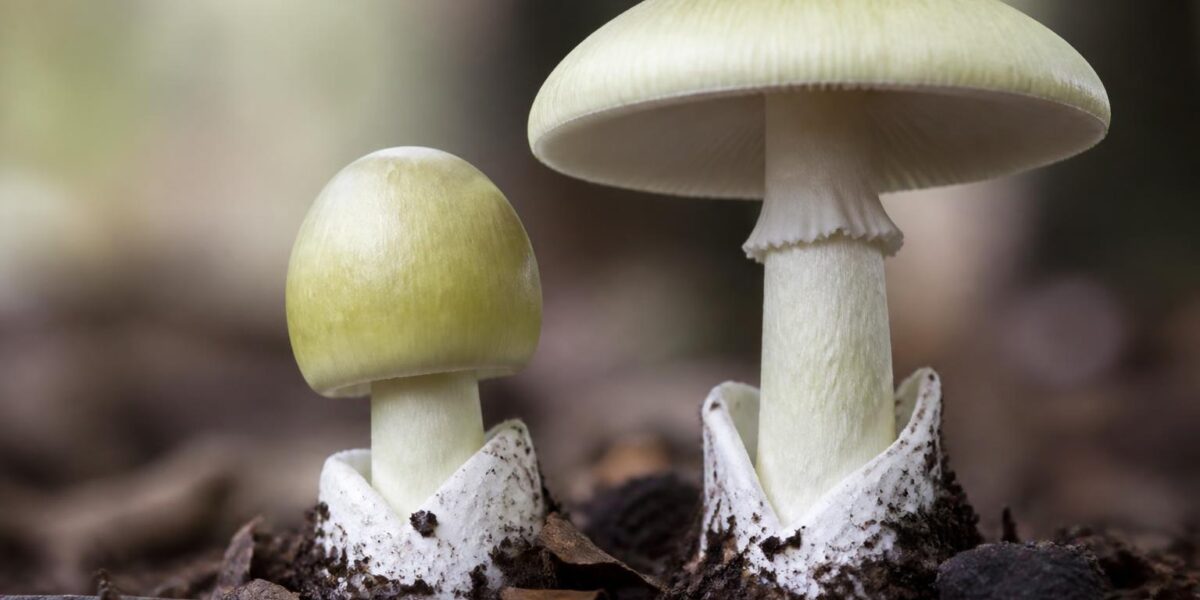
Death caps are not flashy. The cap is greenish, yellowish, or olive-tan, with a white stem, white gills, a skirt-like ring on the stem, and a cup-like sac (volva) buried at the base. To a curious dog, they smell faintly sweet and feel rubbery. None of this is reason to start identifying mushrooms in your yard. Identification is a job for trained mycologists and only matters in hindsight.
Symptoms to Watch For
Because the toxic dose for a dog or cat is small relative to body weight, symptoms can appear after even a single bite. Call your vet immediately if you see any of the following after a known or suspected mushroom encounter:
- Vomiting, especially repeated or projectile
- Profuse, watery, or bloody diarrhea
- Abdominal pain (a hunched posture, restlessness, whining when picked up)
- Excessive drooling or refusing food
- Weakness, wobbly gait, or collapse
- Yellow tint to gums, eyes, or inner ears (jaundice)
- Dark or tea-colored urine
- Seizures or unresponsiveness
If you witnessed the ingestion and your pet is currently asymptomatic, do not wait for symptoms. The treatment window that matters most is the asymptomatic window.
What to Do in the First Hour
The hour after ingestion is the highest-leverage time you have. Take these steps:
- Remove your pet from the area so they cannot eat any more.
- Photograph the mushroom in place from multiple angles, including the base and underside. Do not scrub off any soil.
- Collect a sample with a stick or gloved hand and place it in a paper bag (NOT plastic — plastic accelerates decomposition and ruins identification). A small amount of damp soil included is fine.
- Call your vet and the ASPCA APCC (888-426-4435) or Pet Poison Helpline (855-764-7661). Both have per-incident fees, and both can guide your vet through treatment.
- Do NOT induce vomiting at home unless a poison control specialist or vet specifically tells you to. Hydrogen peroxide given incorrectly can cause aspiration pneumonia or stomach ulcers.
- Bring the sample with you to the clinic. A vet or local mycology contact may be able to identify the species, which guides treatment.
If you are not 100 percent sure what your pet ate, treat it as a worst-case mushroom and head to the clinic. Better an unnecessary trip than a missed window.
Veterinary Treatment for Amatoxin Poisoning
There is no over-the-counter antidote for amatoxin. Veterinary treatment for suspected death cap ingestion is intensive and often requires a 24-hour or referral hospital. Components typically include:
- Decontamination — induced emesis if the ingestion was very recent, followed by repeated doses of activated charcoal to interrupt the enterohepatic recirculation of the toxin
- Aggressive intravenous fluid therapy to support the kidneys and replace GI losses
- Liver-protective medications (silymarin / milk thistle derivatives, N-acetylcysteine, S-adenosylmethionine) given by your vet’s protocol
- Frequent bloodwork to monitor liver enzymes, clotting factors, and kidney values
- Plasma transfusion in cases of severe coagulopathy
- Supportive nutrition, anti-nausea medication, and dextrose for low blood sugar
Outcomes depend heavily on how quickly treatment begins. Pets caught and treated before symptoms develop have a meaningfully better prognosis than those who arrive after the false-recovery window has closed and liver enzymes are climbing.
Other Wild Mushrooms That Look Confusingly Similar
Several edible-looking mushrooms can be mistaken for death caps by laypeople, which is exactly why we never recommend that pet owners try to identify wild fungi themselves before treatment. Even seasoned foragers occasionally make fatal errors. From a pet-safety standpoint, the only useful rule is: if your pet ate a wild mushroom you did not personally cultivate, treat it as toxic.
Pets do not benefit from waiting while you Google photo galleries. The amatoxin clock has already started. Pack the sample, go to the vet, and let identification happen on the side.
Preventing Mushroom Ingestion in the First Place
Mushroom prevention is mostly about awareness during the months when fungi flush. In most temperate climates that means late summer through fall, and again briefly after spring rains. Practical steps:
- Walk your yard before letting pets out, especially after rain. Wear a glove or use a poop-bag to remove and bag any mushrooms.
- Keep lawns aerated and avoid letting tree-leaf debris build up — decomposing organic matter is the substrate fungi need.
- On walks, leash dogs through wooded paths and oak-lined sidewalks during mushroom season and intervene with a firm “leave it” before they can investigate.
- Discourage scavenging behavior with training. A reliable “drop it” cue is one of the best safety investments you can make.
- For cats with outdoor access, consider a catio or supervised harness time during mushroom season.
For broader plant safety in the home, our guide on dog-safe houseplants covers indoor risks, and the umbrella articles on mushrooms and cats and mushrooms and dogs cover the broader category.
Other Severe-Tier Mushrooms in the Same Family
The death cap is not the only amatoxin-bearing mushroom you should know about. Several other species share its mechanism and severity:
- Destroying angel mushrooms (Amanita virosa / bisporigera) — pure white, same amatoxin profile, same SEVERE tier.
- Autumn galerina (Galerina marginata) — small brown “funeral bell” mushrooms that grow on rotting wood and pack the same liver-destroying toxin.
- Fly agaric (Amanita muscaria) — same genus, different toxins (ibotenic acid, muscimol), more neurological than hepatic.
- Panther cap (Amanita pantherina) — also ibotenic-acid-class, severe and emergency-tier.
If you live anywhere with deciduous trees and seasonal rain, assume your area has at least some of these.
Frequently Asked Questions
How much death cap does it take to kill a dog or cat?
Veterinary toxicology references describe even small ingestions as potentially fatal in pets, particularly small dogs and cats. We do not publish dose figures because the risk does not scale linearly with body weight, the toxin concentration varies between specimens, and citing a “low dose” can mislead owners into waiting. Treat any quantity as an emergency.
My dog ate a mushroom but seems fine. Should I still go to the vet?
Yes. The asymptomatic window for amatoxin poisoning is the most important treatment window you have. By the time symptoms develop, the chance of full recovery has already narrowed. Bring a sample of the mushroom in a paper bag if possible.
Will activated charcoal from my pantry help?
No. Pet treatment uses pharmaceutical-grade activated charcoal at vet-prescribed doses, often combined with a cathartic, and given multiple times to interrupt enterohepatic recirculation. Pantry charcoal is not the same product. Skip it and go directly to the vet.
Can I induce vomiting at home with hydrogen peroxide?
Only if a poison control specialist or your vet tells you to, and only with their dosing guidance. Hydrogen peroxide given incorrectly causes aspiration pneumonia, esophageal ulcers, or no vomiting at all. Cats should generally not be made to vomit with peroxide — the technique is unreliable and can be harmful.
How do I know if a mushroom in my yard is a death cap?
You probably cannot, and we do not recommend that pet owners try. The safer rule is: if a wild mushroom is in your yard, remove it with a gloved hand or a poop bag, place it in the trash, and walk the area daily during mushroom season. If your pet has already eaten one, photograph and bag a sample and head to the vet — identification is a clinical step, not a homeowner step.


