Last updated: May 16, 2026
In this article
- The Short Answer: Borage Is Toxic to Dogs and Cats
- Meet Borago Officinalis: The Starflower
- The Toxic Chemistry: Pyrrolizidine Alkaloids in Borage
- Why Borage Surprises Pet-Owner Gardeners
- Symptoms of Borage Toxicity in Dogs and Cats
- What to Do If Your Pet Ate Borage
- Edible Flowers and Garnishes: A Real-World Pet Risk
- Borage Seed Oil Supplements: A Special Case
- Borage and Comfrey: Same Family, Same Chemistry
- How Borage Compares with Other Herb-Garden Plants
- Growing or Removing Borage in a Pet Household
- Frequently Asked Questions
The Short Answer: Borage Is Toxic to Dogs and Cats
Borage (Borago officinalis), the cheerful blue-flowered pollinator-favorite herb that fills cottage gardens and edible-flower beds, is toxic to dogs and cats. The leaves, stems, flowers, and seeds all contain pyrrolizidine alkaloids — the same hepatotoxic chemistry that puts comfrey on the toxic-plant list. Severity is generally moderate per ASPCA framing for acute exposures, and the bigger long-term concern is cumulative liver damage from repeated low-dose exposure that may not produce clinical signs until the damage is advanced.
If you suspect your pet has ingested borage — chewed leaves in the herb bed, eaten flowers from a salad garnish, or consumed a borage-containing herbal product — call your veterinarian, the ASPCA Animal Poison Control Center at 888-426-4435 (per-call fee), or the Pet Poison Helpline at 855-764-7661. Borage is one of those garden plants whose pet-safety profile has surprised many gardeners; the rest of this guide explains why a familiar, deliberately planted edible-flower herb deserves the same caution as its more notorious cousin comfrey.
Meet Borago Officinalis: The Starflower
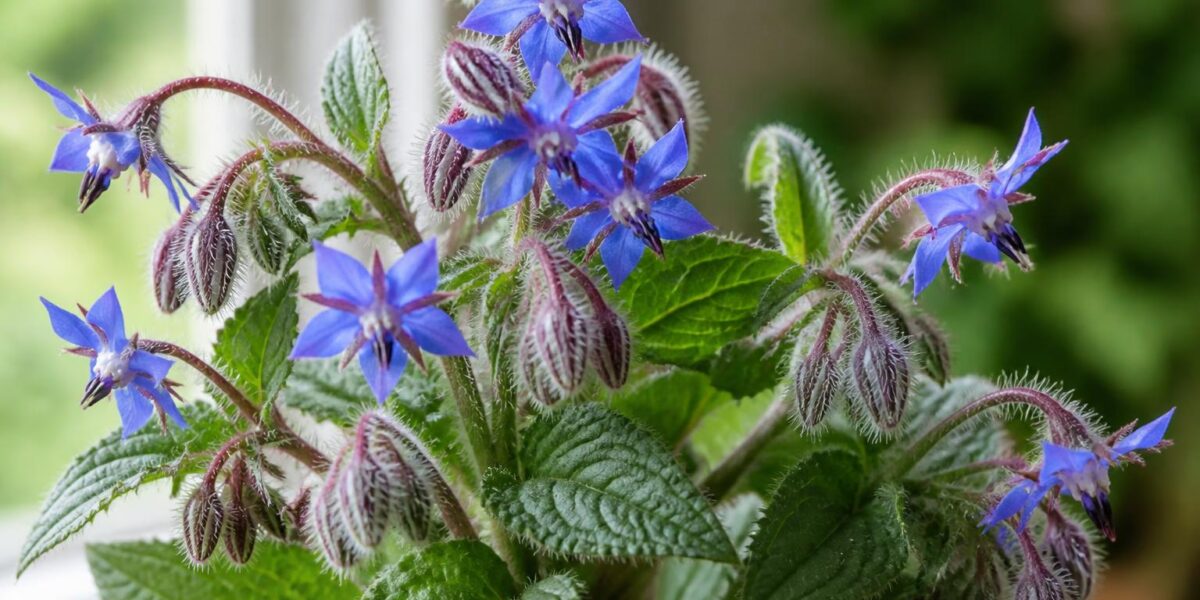
Borage is an annual herb in the borage family, Boraginaceae — the same family as comfrey, heliotrope, forget-me-nots, and Russian comfrey. Native to the Mediterranean, it has naturalized widely in temperate regions and is grown in cottage gardens, vegetable beds, and pollinator plantings around the world. The plant grows to about 2 to 3 feet tall, with large, hairy, gray-green leaves and clusters of distinctive bright blue (occasionally pink or white) star-shaped flowers that bloom over a long period through summer.
The flowers are the plant’s most famous feature. Their bright blue color, edible quality, and long bloom season have given borage a place in both ornamental gardens and edible-flower preparations. The flowers are scattered on salads, frozen into ice cubes, candied as garnishes, and floated in summer drinks. The leaves are sometimes used in soups, stews, and herbal teas in Mediterranean cooking traditions, with a flavor described as cucumber-like.
The plant is also valuable to bees and other pollinators, and is often deliberately included in companion-planting schemes for vegetable gardens, where it supposedly repels certain pests and attracts beneficial insects. None of this is wrong — borage is a useful garden plant. The pet-safety question is independent of its garden virtues.
The Toxic Chemistry: Pyrrolizidine Alkaloids in Borage
Like comfrey, borage produces pyrrolizidine alkaloids (PAs) — a family of hepatotoxic plant compounds that cause cumulative liver damage when ingested over time. The PA concentrations in borage are generally lower than in comfrey, which has sometimes led to borage being treated as the “safer” of the two in popular herbal-medicine literature. The current toxicological consensus has shifted: borage is now treated as hepatotoxic enough that internal use is cautioned against in human and veterinary contexts, and the same caution applies to pets.
The mechanism is identical to comfrey. The liver converts pyrrolizidine alkaloids into reactive pyrrole intermediates that damage hepatic cells and small hepatic veins. The end stage of significant cumulative exposure is veno-occlusive disease — progressive obstruction of the small veins that drain the liver, leading to portal hypertension, ascites, and eventually liver failure.
The PA load is highest in borage leaves and seeds, with smaller amounts in flowers and stems. Borage seed oil — sometimes sold as a dietary supplement for its gamma-linolenic acid content — is generally low-PA after refinement, but the unrefined plant material is not. Pet-safety-wise, every part of the live plant should be considered toxic at exposure-relevant doses.
Why Borage Surprises Pet-Owner Gardeners
This is the practical heart of the article. Borage is widely sold as a “beneficial herb” in seed catalogs, marketed in companion-planting guides as a vegetable-garden ally, and often included in edible-flower seed blends for salad gardens. Many pet-owning gardeners have a thriving borage patch by accident — a few seeds came in with a wildflower mix, a friend shared a cutting, a permaculture design recommended the plant for nutrient mining or pollinator support.
What is missing from much of this marketing is the pyrrolizidine-alkaloid story. The plant looks innocent: cheerful blue flowers, fuzzy gray-green leaves, no obvious “do not eat” cues. The flowers go on salads. The leaves go on tea. The plant self-seeds, multiplies, and shows up in unexpected corners of the garden. Pets that graze the herb bed are exposed without anyone realizing the plant is toxic.
If your garden has borage and you live with pets, the appropriate response is to recognize it as a hepatotoxic plant, restrict access, and skip the deliberate culinary use that increases plant material in pet-accessible areas. Borage fans can grow it in fenced beds and harvest selectively without exposing the pets to grazing volunteers.
Symptoms of Borage Toxicity in Dogs and Cats
The clinical picture mirrors comfrey toxicity. Acute high-dose exposures are uncommon but can produce vomiting, drooling, lethargy, and signs of acute liver injury within 24 to 72 hours. The more typical scenario is chronic low-dose exposure, where damage develops gradually over weeks to months. Watch for:
- Vomiting, sometimes intermittent over weeks
- Reduced appetite or progressive weight loss
- Yellowing of the gums, eyes, or skin (jaundice — a late sign)
- Dark urine
- Pale or clay-colored stool
- Distended abdomen (ascites — fluid accumulation as portal hypertension develops)
- Lethargy or reduced activity tolerance
- Bruising or abnormal bleeding (advanced liver dysfunction affects clotting)
- Confusion or behavior changes (hepatic encephalopathy in advanced cases)
As with comfrey, many of these signs are non-specific and can be missed for months. If your pet has had access to borage over time and presents with any pattern of unexplained GI signs, weight loss, or jaundice, mention the plant exposure history to your veterinarian — it changes the diagnostic priorities and may direct earlier liver-function testing.
What to Do If Your Pet Ate Borage
The right response depends on the exposure pattern:
- Move the pet away from the plant. Sweep visible plant material from the mouth if it is safe.
- Identify the exposure history. A single chewed leaf or stolen flower is different from “the dog has been grazing the borage patch all summer.” Both warrant a vet conversation, but they will be triaged differently.
- Bag a sample — leaf, flower, or stem — to bring to the vet. Borage is identifiable but not always familiar to every clinician on sight, especially without flowers present.
- Call your veterinarian. Mention pyrrolizidine alkaloids and Boraginaceae if the team is unfamiliar with borage toxicology — that is the relevant chemistry.
- If your vet is closed, call ASPCA APCC at 888-426-4435 or Pet Poison Helpline at 855-764-7661.
- Do not induce vomiting at home for chronic-exposure cases — there is no acute event to evacuate. For an acute large ingestion, follow vet guidance specifically.
Treatment is largely supportive: liver-protective therapy with S-adenosylmethionine (SAMe) or silybin (milk thistle extract), intravenous fluids, anti-nausea medication, and serial liver enzyme monitoring. Early intervention matters because veno-occlusive disease, once established, is difficult to reverse.
Edible Flowers and Garnishes: A Real-World Pet Risk
One of the more common borage-pet exposure scenarios is the edible-flower kitchen scenario. Borage flowers turn up in fine-dining salads, summer cocktail bars, frozen-flower ice cubes for entertaining, and home-grown edible-flower garden harvests. A pet that licks a salad plate, knocks over an ice tray, or eats a flower-garnished hors d’oeuvre is being exposed to borage tissue.
One stolen flower is unlikely to cause acute illness but is a real exposure event in the cumulative-PA sense. Repeated exposures from a household where borage flowers are used regularly add up. Pet-owner cooks who use borage as a garnish should think about kitchen layout — flowers prepped and stored where pets cannot reach, dropped petals swept up promptly, and no plate-licking access for dogs in households where the herb is in regular use.
Borage tea, used in some Mediterranean and herbal traditions, is a higher-dose exposure than a single garnish flower. A pet that lapped up borage tea from an unattended cup is being dosed at a meaningful level. Treat any liquid herbal preparation as a more concentrated exposure than the same plant in solid form.
Borage Seed Oil Supplements: A Special Case
Borage seed oil is sold as a human dietary supplement for its gamma-linolenic acid (GLA) content. Refined borage seed oil products are typically processed to remove most pyrrolizidine alkaloids, and reputable supplement manufacturers test for PA residual content. This refined oil has a different safety profile than the live plant tissue and is sometimes recommended for pets in veterinary nutrition contexts at low doses.
That said, the supplement market is not uniformly regulated, and PA testing varies. If your veterinarian recommends a borage seed oil product for your pet — for skin and coat support or other indications — use the specific brand they recommended at the dose they specified. Do not assume that human-grade borage seed supplements are appropriate for pets, and never improvise dosing. The supplement is a different product than the live plant, and the live plant is the one this article addresses.
Borage and Comfrey: Same Family, Same Chemistry
Borage and comfrey are the two most-grown Boraginaceae family members in pet-owner herb gardens, and they share the pyrrolizidine alkaloid chemistry that drives both species’ pet toxicity. For the dedicated comfrey overview, see comfrey for pets — the cumulative hepatotoxic mechanism is the same, the symptom picture is the same, and the management approach is the same.
Beyond the borage family, the same pyrrolizidine alkaloid family appears in boneset (Asteraceae), in some Senecio species, and in a handful of other plants across multiple botanical families. The cross-family chemistry is a useful reminder that PA toxicity is not just a borage-and-comfrey issue. If you are reading about hepatotoxic plant alkaloids and you encounter “pyrrolizidine alkaloids” in any plant description, treat that plant as a potential cumulative-toxin concern around pets.
How Borage Compares with Other Herb-Garden Plants
Within the herb-and-spice plant safety landscape, borage sits in the moderate-to-serious tier with chronic-exposure cumulative risk being the distinguishing feature. The other herb-garden plants worth knowing as comparison points include mustard (acute irritant from glycosinolates), tarragon (estragole), and marjoram (essential-oil load). Each is in a different family with different chemistry.
For broader pet-safe planting decisions, the cat-safe houseplants guide and dog-safe houseplants guide are the right starting points. Borage would not appear on a recommended pet-safe list, but it appears in many pollinator and edible-flower plantings, so the realistic strategy is restricted access and clear identification rather than complete removal in cases where the plant has other garden value.
Growing or Removing Borage in a Pet Household
Borage is an annual that self-seeds aggressively. A single mature plant can produce thousands of seeds, and volunteer seedlings appear in unexpected corners of the garden the following spring. If you are deciding to remove borage because of your pets, the practical project is a multi-season one: pull plants before they flower and set seed, watch for volunteer seedlings, and pull those promptly.
If you choose to keep borage for its pollinator value or edible-flower use, the practical pet-safety approach is physical separation. Plant borage in a fenced bed or contained area the dog cannot enter. Cut flowers and leaves before letting pets into the garden area. Pull spent plants before they shed seeds into pet-accessible areas. Sweep dropped leaves and flowers promptly. Compost trimmings in a closed bin pets cannot dig into. Skip the deliberate use of borage in pet-shared kitchen scenarios — the salad-garnish risk is real for households with food-stealing dogs.
Frequently Asked Questions
If I have always used borage in my garden without a problem, is it really risky?
Many gardeners report no observed problems with borage, partly because chronic-exposure liver damage develops silently. The current veterinary consensus is that the cumulative hepatotoxic risk is real and warrants restricted access for pets, even if no specific incident has occurred in your household yet. The plant’s familiar reputation predates much of the modern understanding of pyrrolizidine alkaloids.
Are borage flowers safe to use as edible garnishes around pets?
The flowers contain pyrrolizidine alkaloids at lower concentrations than leaves but are not pet-safe. Use them in human food prepared away from pets, store and serve where pets cannot reach, and skip the practice in households where pets routinely sample plates or steal food. One garnish flower is unlikely to cause acute illness; repeated exposures matter.
What if my dog ate one borage leaf?
A single leaf is unlikely to cause dramatic acute illness but is a real exposure. Call your vet, ASPCA APCC at 888-426-4435, or Pet Poison Helpline at 855-764-7661 with the exposure history. If this is an isolated event, monitoring and possibly a baseline liver-enzyme check may be all that is needed. If it is part of an ongoing access pattern, the discussion is different.
Is borage seed oil supplement safe for pets?
Refined borage seed oil products processed to remove pyrrolizidine alkaloids have a different safety profile than the live plant. Some veterinary nutrition recommendations include borage seed oil for skin and coat support at specific doses. Do not improvise dosing or substitute human supplements without veterinary guidance — the supplement and the live plant are different products with different safety considerations.
Is borage on the ASPCA toxic plant list?
Borage (Borago officinalis) is recognized in veterinary toxicology resources as a hepatotoxic plant due to pyrrolizidine alkaloid content, in the same family as comfrey and with the same general mechanism of toxicity. ASPCA APCC handles cases involving Boraginaceae plants and can provide species-specific guidance for your particular pet. Always confirm with your vet rather than relying on older general herbal references that may underestimate the risk.