
Last updated: May 16, 2026
In this article
- Reassurance First: Curry Leaf Plants Are Generally Safe Around Pets
- Meet the Curry Leaf Plant: Murraya Koenigii
- The Aromatic Chemistry of Curry Leaves
- Curry Leaf Plant Versus Curry Powder: The Critical Distinction
- Murraya Koenigii Versus Helichrysum Italicum (the “Curry Plant”)
- What “Generally Safe” Means in Practice
- Symptoms That Would Warrant a Vet Call
- Curry Leaves in the Kitchen: Cooking Around Pets
- Companion Pet-Safe Herb-Garden Plants
- Growing Curry Leaf Plants with Pets: Practical Tips
- Frequently Asked Questions
Reassurance First: Curry Leaf Plants Are Generally Safe Around Pets
If you grow a curry leaf plant (Murraya koenigii) in your kitchen herb garden — popular in households cooking South Indian, Sri Lankan, or Malaysian cuisine — the live plant itself is generally considered safe around dogs and cats per ASPCA framing. Murraya koenigii is not on ASPCA’s toxic-plant list, and the leaves are an everyday culinary ingredient in pet-owning households across South Asia and the South Asian diaspora. A pet that nibbled a leaflet from your kitchen-counter tree is unlikely to develop more than transient mild GI upset, if anything.
Two distinctions are worth naming up front. First, the curry leaf plant is not the same as curry powder, which is a spice blend that varies enormously by recipe and may contain ingredients (like garlic, onion, fenugreek, or others) that have their own pet considerations. Second, Murraya koenigii (the true curry leaf) is not the same as Helichrysum italicum (the so-called “curry plant,” a Mediterranean ornamental whose foliage smells like curry but is not used in cooking). Both points are addressed in detail below.
Meet the Curry Leaf Plant: Murraya Koenigii
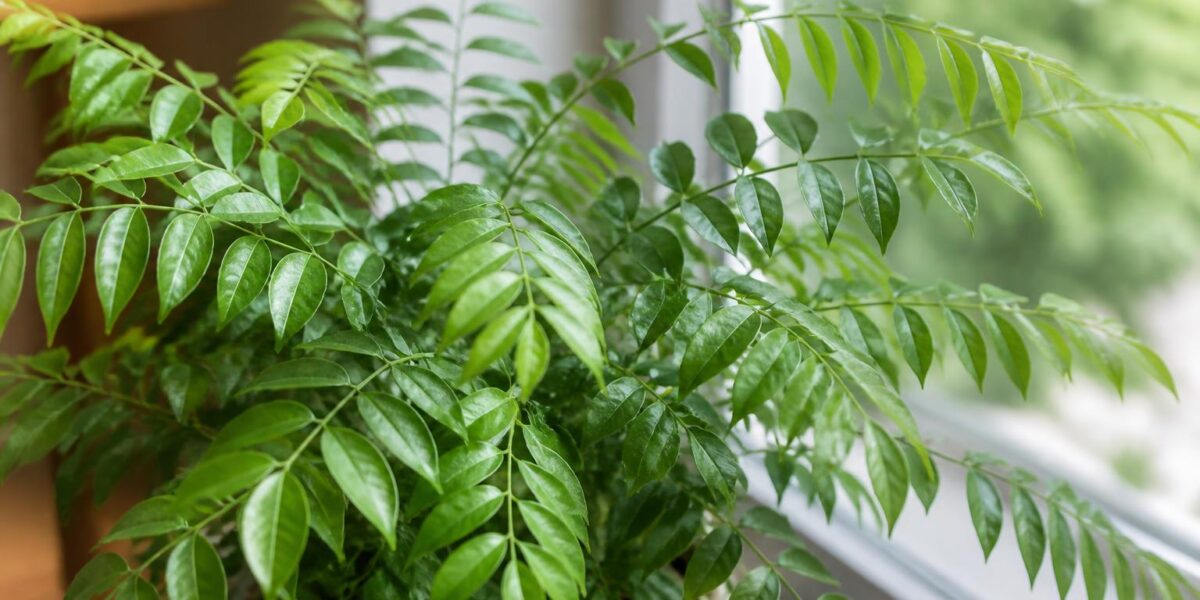
The true curry leaf plant is a small to medium tropical tree in the citrus family (Rutaceae), native to South Asia. It is closely related to oranges, lemons, and limes — and the family connection shows in the leaf chemistry, which contains aromatic compounds in the same general class as citrus oils. The plant grows to about 10 to 20 feet in tropical conditions, but in most North American homes it is kept as a 2 to 5-foot container plant, indoors over winter, on a sunny patio in summer.
The leaves are pinnate (feather-like), with 11 to 21 small leaflets arranged along a central stem. Crushed fresh, they release the distinctive complex aroma that defines South Indian and Sri Lankan curries — herbal, citrusy, slightly nutty, faintly sulfurous. Cooking with curry leaves is typically a “tempering” step: a small handful tossed into hot oil at the start of a dish, releasing the aroma into the oil before the rest of the ingredients go in. Most home cooks pluck leaves directly from a kitchen plant rather than buying dried (which loses much of the flavor).
The Aromatic Chemistry of Curry Leaves
Curry leaf essential oils contain a mix of aromatic compounds — caryophyllene, alpha-pinene, beta-pinene, sabinene, and various terpenes — along with smaller amounts of carbazole alkaloids that give the leaves their slightly bitter edge. The total essential-oil load in fresh leaves is modest, comparable to other small culinary herbs. A pet that chewed a few leaflets is being exposed to a very small amount of these compounds — well below thresholds that would be expected to cause harm in most household scenarios.
As with the broader family of aromatic kitchen herbs, the dose-and-form distinction matters. Fresh leaves in normal cooking quantities are unremarkable around pets. Concentrated curry leaf essential oil — which is sold in some specialty aromatherapy and Ayurvedic supplement lines — is a different exposure entirely and would be handled with the same caution as other phenolic and terpene-heavy oils, particularly around cats. Most kitchen herb gardeners will never encounter concentrated curry-leaf oil, and the practical risk picture stays low.
Curry Leaf Plant Versus Curry Powder: The Critical Distinction
This is the most important practical point in the article. The curry leaf plant and curry powder are not the same thing, and a pet ingestion of curry powder is a different situation than a pet sniff of the kitchen plant.
“Curry powder” is a spice blend that varies enormously by recipe and region. A typical North American supermarket curry powder might contain turmeric, coriander, cumin, fenugreek, mustard seed, ginger, black pepper, cinnamon, cardamom, cloves, and varying amounts of dried red chili — and many also contain garlic powder and/or onion powder, both of which are independently problematic for pets in larger amounts. South Indian curry powders may include curry leaves themselves, but always alongside many other ingredients.
If your pet ate a noticeable quantity of curry powder, the right action is to identify the brand and recipe and call your veterinarian, ASPCA APCC at 888-426-4435, or Pet Poison Helpline at 855-764-7661. The team will want to know specifically about onion, garlic, and chili content. The curry leaf plant itself is the lower-concern half of this picture; the powder is where the labels-matter scenarios appear.
Murraya Koenigii Versus Helichrysum Italicum (the “Curry Plant”)
The second important distinction is between the real curry leaf plant and the so-called “curry plant” sometimes sold at garden centers. Helichrysum italicum is a Mediterranean shrubby herb with silver-gray needle-like leaves whose crushed foliage smells remarkably like curry — but the plant has no culinary use in actual curries. It is grown ornamentally for its scent and silver foliage, and used in some essential-oil and skincare products.
The Helichrysum italicum plant is generally considered low-concern for pets in casual exposure (it is not on ASPCA’s toxic list), but its essential oil is concentrated and would be handled with the same caution as other Mediterranean-herb oils. Importantly, you cannot cook a real Indian curry with Helichrysum leaves, and you cannot expect Helichrysum leaves to behave like Murraya leaves in any culinary or chemical sense. Check the Latin name on the plant tag if you are buying a “curry plant” intending to use it in food — Murraya koenigii is the one you want.
What “Generally Safe” Means in Practice
Calling Murraya koenigii “generally safe” is not a license for unlimited pet consumption. The real-world caveats:
- Volume effects. A pet that chewed a few leaflets is fine. A pet that demolished half the plant could develop GI upset purely from volume.
- Mechanical irritation. Curry leaf stems are woody at the base; the leaflets themselves are tender. Whole stem fragments can be a mild swallowing concern in small pets.
- Citrus-family relationship. Some pets, particularly cats, find the citrus-family aroma unpleasant and avoid the plant on their own. A few are interested for the same reason cats sometimes investigate orange peels.
- Concentrated essential oil. The fresh leaves are mild; bottled essential oil is a different matter. Skip diffuser use of curry-leaf oil around cats.
None of these caveats turn the curry leaf plant into a hazard. They are the watch-for-this list for outlier scenarios.
Symptoms That Would Warrant a Vet Call
For most pets and most curry leaf plant interactions, no veterinary intervention is needed. Call your vet if you see:
- Repeated vomiting or persistent diarrhea over 12 to 24 hours after a large plant ingestion
- Apparent abdominal pain, hunched posture, or refusal to eat
- Lethargy or weakness
- Drooling that does not resolve within a few hours
- Skin redness or rubbing where curry leaf oil contacted fur (rare household scenario)
- Any ingestion of curry powder or a curry-spiced dish, where the question shifts to onion, garlic, and other co-ingredient concerns
For curry-powder ingestions specifically, do not wait for symptoms — call your vet, ASPCA APCC at 888-426-4435, or Pet Poison Helpline at 855-764-7661 with the spice mix label or recipe ready. The veterinary team will triage based on the most concerning ingredient.
Curry Leaves in the Kitchen: Cooking Around Pets
South Asian cooking with curry leaves is fragrant, oil-tempered, and often unfolds with a curious dog or cat watching the stove. A few practical kitchen notes for pet households:
- Curry leaves go into hot oil at the start of many recipes — a moment of dramatic crackling that can scare or attract pets. Keep pets out of the immediate stovetop zone during tempering.
- The oil itself becomes infused with curry-leaf aromatics during cooking. Counter spills of seasoned oil can be slip hazards and oily-fur-grooming concerns; wipe up spills promptly.
- Finished dishes typically contain onion, garlic, ginger, chili, and other ingredients beyond the curry leaves — these matter more than the curry leaves themselves for pet safety. A dog that licks a curry-stained plate is mostly being exposed to allium and capsaicin.
- Dried curry leaves keep poorly in flavor but are non-toxic. Pet ingestion of a dropped dried leaf is a non-event.
For pet households new to curry-leaf cooking, the takeaway is that the leaf is the easy part of the safety picture — it is the rest of the dish that warrants ingredient awareness.
Companion Pet-Safe Herb-Garden Plants
Curry leaf fits comfortably alongside other reassurance-tier kitchen herbs in a pet-safe garden. Within Walk Me Home Rescue’s library, the natural companions are basil, cilantro, dill, fennel, and parsley — each generally safe per ASPCA, each useful in many cuisines, each appropriate in a pot near where pets pass.
For South Asian and Southeast Asian kitchen pairings specifically, curry leaf is most often grown alongside lemongrass, holy basil, and cilantro. The first two have their own Walk Me Home Rescue overviews — lemongrass and holy basil — and both belong on a pet-safe South Asian herb-garden shortlist. For broader pet-safe planting decisions, the cat-safe houseplants guide and dog-safe houseplants guide are the right starting points.
Growing Curry Leaf Plants with Pets: Practical Tips
Curry leaf trees are not the easiest indoor plants to grow well in temperate climates. They want bright light, consistent warmth (above 65 degrees Fahrenheit), well-drained soil, and protection from drafts. They grow slowly, especially indoors, and can drop leaves in response to stress (overwatering, cold spells, sudden lighting changes). A healthy 3-foot specimen represents several years of attention.
For pet households, the layout is straightforward. Place the pot in a sunny window where dogs cannot knock it over, and where indoor cats are not tempted to climb. The plant has a slender central stem when young and is fragile if pulled — a heavy ceramic pot helps stability. If you summer the plant outdoors, put it in a fenced area away from where dogs roam. Skip systemic chemical pesticides on a plant whose leaves you cook with and whose air your pets share — neem oil and mild horticultural-soap sprays are the pet-safer alternatives for scale, mealybug, and aphid management.
Frequently Asked Questions
Are curry leaves safe in food I share with my dog?
The leaves themselves are generally low-concern. The bigger question is what else is in the dish. Most curries contain onion, garlic, chili, and other ingredients that are independently problematic for pets in noticeable amounts. Plain curry leaves cooked into rice with no allium would be the closest thing to a pet-friendly preparation, but talk to your vet before sharing meals routinely.
What if my cat chewed a leaflet off my curry leaf plant?
Almost certainly fine. Murraya koenigii is not on ASPCA’s toxic list, and a single leaflet is a tiny exposure. Watch for vomiting, gagging, or any change in behavior over the next 24 hours, and call your vet if anything unusual develops.
Is curry powder dangerous for dogs?
Possibly, depending on the recipe. Most commercial curry powders contain garlic and/or onion powder, both of which are problematic for pets in larger amounts. They may also contain chili that causes GI upset and other ingredients to scan for. If your dog ate a noticeable amount, identify the brand and call your vet, ASPCA APCC at 888-426-4435, or Pet Poison Helpline at 855-764-7661.
Is the “curry plant” sold at garden centers the same as the curry leaf plant?
No. The plant most often labeled “curry plant” at North American garden centers is Helichrysum italicum, a Mediterranean ornamental that smells like curry but is not used in cooking. The true culinary curry leaf is Murraya koenigii. Check the Latin name on the tag before buying for cooking use.
Can I grow curry leaf plants outdoors with dogs in the yard?
In hot climates (Zone 9 and warmer) the plant can grow outdoors year-round. Use a fenced bed if your dog is a chewer, but the plant itself is generally low-concern. In colder climates the tree must come indoors over winter, which limits outdoor exposure to summer months and tames the question.


