
Last updated: May 16, 2026
In this article
- Are Basil Plants Safe for Pets? The Quick Answer
- Meet Ocimum Basilicum and Its Cousins
- Why Basil Is Non-Toxic
- What to Expect From a Curious Pet
- The Large-Quantity Caveat
- Sweet Basil, Thai Basil, and Holy Basil
- Basil in the Kitchen Herb Garden
- Cats and the Mint Family Connection
- Dogs and Basil in the Garden
- Vet Routing and Final Reassurance
- Frequently Asked Questions
Are Basil Plants Safe for Pets? The Quick Answer
Yes, basil plants are safe for pets. The ASPCA does not list Ocimum basilicum, the common sweet basil, or its many cultivars and close cousins like Thai basil and holy basil, as toxic to cats, dogs, or horses. A foraging cat that nibbles a leaf, a curious dog that snatches a sprig out of a planter, or a kitten that gnaws on a stem will not be poisoned. Basil sits firmly on the kitchen-herb green-light list alongside cilantro, dill, and fennel.
The reassurance comes with the same generic caveat that applies to any leafy plant. Large quantities of basil leaves, like large quantities of lettuce or grass, can cause mild stomach upset because pets are not built to handle big volumes of fibrous plant matter at once. A small sniff-and-taste session in the herb planter is fine. A determined dog who chews through an entire established basil bush in one sitting may earn herself a bout of vomiting or a soft stool. This guide walks through the basil family, what to expect from a curious pet, and how basil compares with the few culinary herbs that are genuinely toxic.
Meet Ocimum Basilicum and Its Cousins
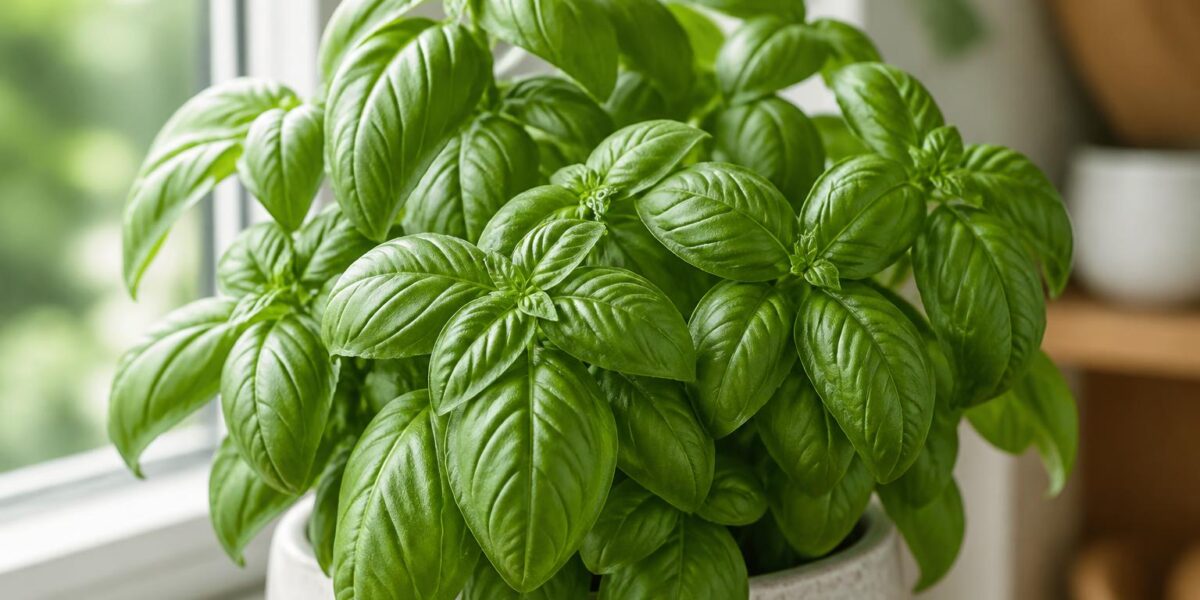
Sweet basil is a tender annual in the mint family (Lamiaceae), grown across the world for culinary use. The plant forms a soft-stemmed bush ten to twenty inches tall, with paired oval leaves that release the familiar warm sweet scent when crushed. Small white or pink flowers appear in spikes when the plant is allowed to bolt, and basil reseeds itself readily in warm climates. The genus Ocimum includes about fifty related species, of which a handful are widely cultivated.
Common cultivars and varieties include Genovese basil (the classic Italian cooking basil), Thai basil (Ocimum basilicum var. thyrsiflora, with anise notes and purple stems), holy basil or tulsi (Ocimum tenuiflorum, used in South Asian and Southeast Asian cooking and in herbal medicine), lemon basil, cinnamon basil, and African blue basil. All of these share the same non-toxic profile for cats and dogs and can be treated interchangeably for pet-safety purposes.
Why Basil Is Non-Toxic
The chemistry of a basil leaf is dominated by aromatic essential oils, especially eugenol, linalool, and methyl chavicol, which are responsible for the characteristic scent and flavor. Those oils are present at low concentrations in fresh leaves, well below thresholds that cause poisoning in small mammals. Basil contains no cardiac glycosides, no significant alkaloids, no cyanogenic compounds, and no calcium oxalate raphides.
The ASPCA listing reflects this benign chemistry, and basil is one of the few culinary herbs that is genuinely safe to grow on a windowsill or in a kitchen-garden bed without supervision concerns. Veterinary toxicology references treat sweet basil and its cultivars as low-risk plants. The contrast with mint and chamomile is worth noting: mint family relatives like peppermint and spearmint are listed as toxic to cats per ASPCA due to higher essential-oil load, while chamomile, often grouped with culinary herbs, is also on the toxic list.
What to Expect From a Curious Pet
Most pets that meet a basil plant will sniff, lick, occasionally chew a leaf, and move on. Cats sometimes show a mild interest in the aromatic foliage similar to but weaker than the catnip response, since basil shares some terpene chemistry with the broader mint family. Dogs may take a curious bite and either spit it out or chew it down, depending on personal taste. Neither response is dangerous; the leaves are safe.
If your pet swallows several leaves or a small handful of stems, the most likely outcome is no observable effect at all. The next most likely outcome is a mild stomach upset over the next twelve hours, with one or two episodes of vomiting or a soft stool, the same generic plant-matter response a dog might have after grazing on lawn clippings. Provide fresh water, wait it out, and resume normal feeding when your pet is interested.
The Large-Quantity Caveat
The honest caveat for any non-toxic plant is volume. A pet that consumes an entire established basil bush, perhaps twenty to thirty mature stems, has eaten a large bolus of fibrous plant matter, and the gut may need to process that load with extra effort. Persistent vomiting, ongoing diarrhea past a day, lethargy, refusal to eat, or any abdominal distress warrants a call to your veterinarian, the ASPCA Animal Poison Control Center at 888-426-4435, or the Pet Poison Helpline at 855-764-7661. The poison-control lines are staffed twenty-four hours a day and can confirm the non-toxic plant listing while screening for other causes.
This same caveat applies to lettuce, grass, parsley, dandelion greens, and any other leafy plant a pet might forage in volume. The plant is not the problem; the volume is. Realistically, most cats and dogs do not eat enough basil at one sitting to trigger a visible response, since the strong aromatic flavor is self-limiting for most animals.
Sweet Basil, Thai Basil, and Holy Basil
For pet-safety purposes the three commonly grown culinary basil types behave the same. Sweet basil and Thai basil are both Ocimum basilicum cultivars, with Thai basil distinguished by anise-flavored leaves, narrow pointed shape, and purple flower spikes. Holy basil or tulsi is Ocimum tenuiflorum, a closely related species with smaller serrated leaves and a clove-like aroma. None of the three are listed as toxic to pets.
If you grow holy basil for tea or for traditional household use, please keep concentrated tulsi essential oil away from cats and dogs. Concentrated essential oils of any aromatic herb can cause toxicity not because the underlying plant is dangerous but because the oil concentrates the aromatic compounds to many times the natural leaf level. Our essential oils toxic to cats guide covers the concentrated-oil concern in detail.
Basil in the Kitchen Herb Garden
Basil grows happily in a sunny windowsill pot, an outdoor container, or a kitchen-garden bed. It needs full sun, warm temperatures, regular water, and well-drained soil. The plant is annual in temperate climates, so in most of North America the basil bed will be replanted from seed or seedlings each spring after the last frost. Many home gardeners grow several basil cultivars side by side to harvest leaves for different recipes.
If your herb garden also includes some of the toxic Mediterranean herbs, you can plant the safe and toxic species together as long as you know which is which. Among the herbs you might grow together, basil, cilantro, dill, and fennel are non-toxic to pets, while rosemary, thyme, oregano, sage, and lavender have varying caveats depending on species. The species-by-species linked guides cover the specific concerns.
Cats and the Mint Family Connection
Basil and catnip are both mint-family plants, but their effects on cats are quite different. Catnip (Nepeta cataria) carries the compound nepetalactone, which triggers the famous catnip response in many adult cats. Basil contains different essential oils and produces a much weaker reaction at most, ranging from no interest at all to mild sniffing-and-rubbing in cats with sensitive noses. Basil is not a catnip substitute, and most cats find the plant uninteresting.
The bigger reason to mind cats around basil is simply foraging behavior. Cats with an oral exploration habit may strip a windowsill basil plant in repeated sessions, which is bad for the plant rather than the cat. A wand toy, a window perch, and a food puzzle ball typically redirect that energy. Our cat-safe houseplants guide covers the broader greenery picture, and the adopt-a-cat hub includes a plant-and-enrichment checklist for the early days at home.
Dogs and Basil in the Garden
Dogs that have access to an outdoor basil patch may nibble in passing on a sniff walk. The leaves are aromatic enough to put off most dogs after a single bite, although there are always exceptions for the determined plant-grazer. If your dog has a plant-grazing habit in general, address the habit rather than the individual plant. Long sniff walks, structured exercise, and food puzzles reduce boredom-driven foraging.
Outdoor basil plantings can also be raised on a small bed or in a tall planter to put the plants above muzzle height. Our pet-safe garden plants guide and the adopt-a-dog hub cover broader garden planning for dog households.
Vet Routing and Final Reassurance
Basil is one of the easiest culinary herbs to grow with cats and dogs in the household. The plant is non-toxic, foraging amounts are unproblematic, and only a very large ingestion would warrant the same generic vet routing applied to any plant matter. Keep your own veterinarian’s number, the ASPCA Animal Poison Control Center at 888-426-4435, and the Pet Poison Helpline at 855-764-7661 saved in your phone for general pet emergencies, but basil is not where the worry needs to sit.
If you are building a pet-friendly herb garden from scratch, start with the basil and dill safe-list, layer in cilantro, parsley, and fennel, and check each addition against the ASPCA database before bringing it home. For broader inspiration, the pet-safe garden plants guide extends well beyond herbs into vegetables, flowers, and ground covers.
Frequently Asked Questions
Can my dog eat basil leaves from my dinner plate?
A small amount of fresh basil from a meal is not dangerous, although seasoned cooked food often contains garlic, onion, or fats that are bigger concerns than the basil itself. Plain fresh basil leaves are safe in small quantities.
Is basil safe for cats?
Yes. The ASPCA does not list basil as toxic to cats, and most cats show only mild interest in the aromatic foliage. Watch for the same large-volume caveat that applies to any leafy plant, but normal sniffing or nibbling is not a concern.
What about basil essential oil?
Concentrated basil essential oil is a different category entirely. Like most essential oils, it carries a much higher dose of aromatic compounds than the fresh leaf and can be toxic to cats and dogs. Keep diffusers away from pet living areas and never apply essential oils directly to a pet.
Can my dog eat basil pesto?
Pesto usually contains garlic, onion, salt, and fats that are problematic for dogs even though the basil itself is fine. A tiny accidental lick is not an emergency, but pesto is not a dog snack.
Will basil help my pet’s digestion?
There are no proven veterinary benefits, and any home herbal use should be discussed with your veterinarian. Basil is safe to encounter and to ingest in small amounts; it is not a recommended treatment for any pet condition.


