
Last updated: May 4, 2026
In this article
- The Short Answer on Chamomile for Cats
- The Two Chamomiles: Why the Species Matters
- The Asteraceae Allergy Question
- How a Tasting Portion of Tea Works
- Traditional Uses: What’s the Evidence Like
- Topical Chamomile and Wound Care
- Chamomile Essential Oil Is Off-Limits
- Pregnant Cats: A Specific Caution
- Cats With Specific Health Conditions
- Comparing Chamomile to Other Cat-Curious Herbs
- What to Do If Your Cat Has a Reaction
- Frequently Asked Questions
The Short Answer on Chamomile for Cats
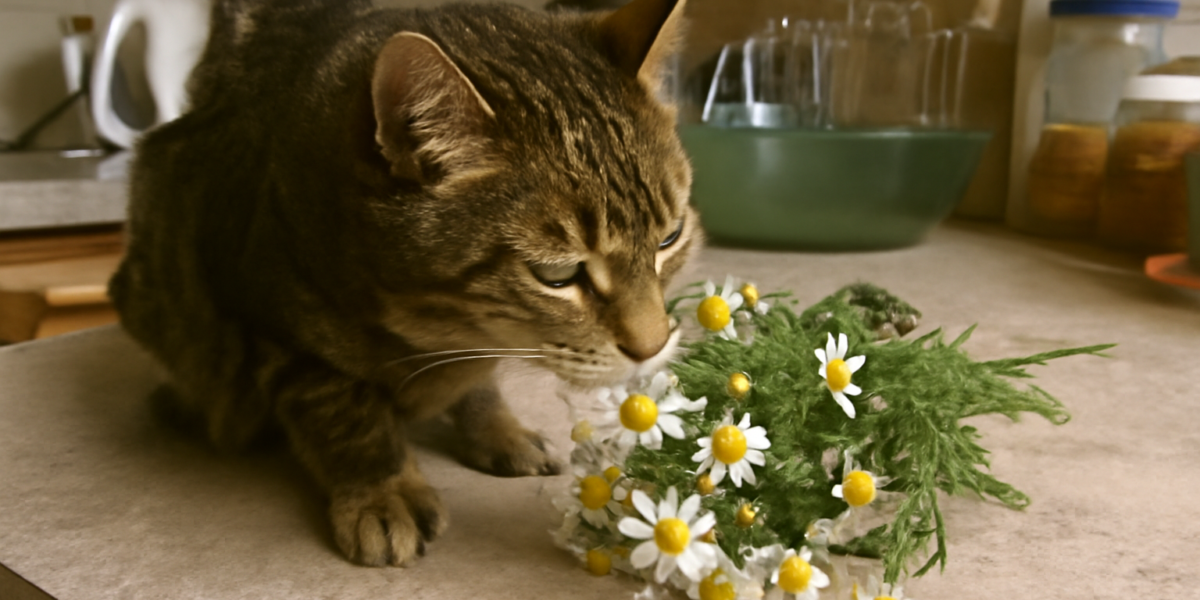
Can cats eat chamomile? With caution. Weak, cool, brewed German chamomile tea in very small amounts (about a teaspoon) is generally tolerable for healthy adult cats and has a long history in herbal pet care for digestion and mild anxiety. Roman chamomile carries a higher allergic potential and is not the variety to choose. Concentrated chamomile essential oil should never be given to or used on a cat. Some cats are allergic to chamomile through cross-reactivity with the broader Asteraceae plant family (which includes ragweed, daisies, and asters), and pregnant queens should avoid chamomile entirely based on traditional herbal cautions about uterine effects.
This is one of the more nuanced food-safety conversations because chamomile sits in a gray zone between “harmless herb” and “potential trigger.” It is not a feline staple, and it is not a clear toxin. Whether it belongs anywhere in your cat’s life depends on her health history and what you are trying to accomplish.
The Two Chamomiles: Why the Species Matters
Two distinct plants are sold as chamomile in human herbal markets. German chamomile (Matricaria chamomilla) is the most common and is the variety in most teas, sleep products, and dietary supplements. Roman chamomile (Chamaemelum nobile, sometimes called English chamomile) is grown more often as a ground-cover herb and appears in some traditional remedies and essential oils. The two share many compounds but in different proportions.
For cats, German chamomile is the safer choice if any chamomile is going to be considered. It contains lower levels of compounds that have been linked to allergic reactions in sensitive individuals. Roman chamomile has higher levels of certain sesquiterpene lactones and is more likely to cause contact dermatitis in humans and animals. If a cat product or pet remedy lists Roman chamomile, the caution level rises. If you brew tea at home, choose German chamomile and check the label.
The Asteraceae Allergy Question
Chamomile belongs to the Asteraceae family, the same group that includes ragweed, daisies, sunflowers, and chrysanthemums. Cats with environmental ragweed allergies have a measurable risk of cross-reactivity to chamomile because the proteins involved share structural similarities. If your cat has known seasonal allergies, sneezes during ragweed season, or has reacted to other Asteraceae plants, chamomile should be off the menu.
Cross-reactivity is not universal. Some cats with ragweed allergy show no chamomile reaction. But because there is no cheap way to predict which cats will react, the safer move is to avoid chamomile in any allergic cat unless your veterinarian has cleared it. An allergic reaction to chamomile in a cat can range from mild lip-licking and head-shaking to vomiting, diarrhea, hives, or in rare severe cases anaphylaxis.
How a Tasting Portion of Tea Works
If you are considering offering your healthy adult cat a tiny amount of chamomile tea, the procedure matters. Start with a single, fresh, organic German chamomile tea bag (or one teaspoon of loose dried German chamomile). Steep in a cup of just-off-the-boil water for two to three minutes — no longer. Remove the bag, let the tea cool completely to room temperature, and offer one teaspoon (about 5 mL) on a saucer. That is the entire portion.
Most cats will sniff and walk away. If your cat drinks the teaspoon and shows no vomiting, drooling, hives, swelling, breathing changes, or behavioral oddness over the next several hours, you can consider this an occasional offering rather than a regular daily routine. There is no veterinary justification for daily chamomile tea in healthy cats, and chronic exposure to herbal compounds can have unpredictable effects.
Traditional Uses: What’s the Evidence Like
Chamomile has a long history in human and folk-veterinary use for digestive complaints, mild anxiety, and gentle wound care. The compounds responsible — including apigenin, bisabolol, and chamazulene — have anti-inflammatory and mild sedative effects in laboratory studies. The translation to clinical use in cats is less rigorous. Most pet-care chamomile recommendations come from herbal tradition rather than controlled feline trials.
This does not mean chamomile is useless for cats; it means we should be honest about how thin the evidence is. If your cat has anxiety, talk to your veterinarian about validated approaches, including environmental modification, pheromone therapy, and prescription medications when warranted. If your cat has digestive symptoms, get a veterinary workup before trying herbs, because vomiting and diarrhea in cats can have many serious causes that do not respond to chamomile.
Topical Chamomile and Wound Care
Some traditional pet-care references describe using cooled chamomile tea as a gentle eye-area or skin rinse. The honest assessment is that this is rarely the right choice for cats. Better-studied and safer options exist for nearly every situation a chamomile rinse might address. For eye discharge or irritation, your veterinarian can prescribe a feline-appropriate ophthalmic product. For skin irritation, your veterinarian can recommend a medicated rinse or topical treatment.
If you have already used cooled chamomile tea on a small area of your cat’s skin and she is not licking it obsessively or developing redness, the application itself is unlikely to have caused harm. Going forward, default to veterinary-recommended products. Do not ever apply chamomile essential oil topically to a cat — concentrated oils are an entirely different and more dangerous category.
Chamomile Essential Oil Is Off-Limits
Like other concentrated essential oils, chamomile essential oil should not be applied to, ingested by, or diffused around your cat. Cats lack key liver enzymes that break down many of the terpenes in essential oils, which means small doses linger longer and reach higher tissue concentrations than they would in a human. This applies to both German and Roman chamomile oils.
If you use essential oils for personal aromatherapy, keep your cat out of the room while diffusing and ensure thorough ventilation afterward. Diffuser droplets settle on surfaces and fur, and cats ingest residues during grooming. The simplest cat-safe rule is to avoid essential oil diffusers in cat households entirely or to use only oils your veterinarian has confirmed are safe at the concentrations involved.
Pregnant Cats: A Specific Caution
Pregnant queens should not be offered chamomile tea or chamomile-containing products. Traditional herbal medicine includes warnings that chamomile can affect uterine tone in larger doses, and although the feline-specific evidence is limited, the conservative position during pregnancy is to avoid herbs that have any reproductive concern in animal or human studies. The same caution extends to nursing queens because herbal compounds can pass into milk.
This is a “skip it unless your veterinarian specifically says otherwise” situation. A pregnant cat has nothing to gain from chamomile and a small but real theoretical risk if exposed. Stick to a complete-and-balanced diet and consult your reproductive veterinarian for any concerns about her digestion or stress level.
Cats With Specific Health Conditions
Cats with liver disease should avoid chamomile because the compounds involved require hepatic clearance, and a compromised liver may handle them poorly. Cats with bleeding disorders or those on anticoagulant medications should also avoid chamomile because some chamomile compounds may have mild antiplatelet effects, although the clinical significance in cats is unclear.
Cats on multiple medications may experience drug interactions with chamomile through shared metabolic pathways. Cats with inflammatory bowel disease may react unpredictably to herbal additions to their diet and should stick to the prescription therapeutic foods their veterinarian has selected. When in doubt, ask before offering.
Comparing Chamomile to Other Cat-Curious Herbs
Among herbs cats may encounter, chamomile sits in the more cautious category. Catnip (Nepeta cataria) and silvervine are well-established cat-safe enrichment herbs with predictable behavioral responses. Cat grass provides safe chewing material. Peppermint is more concerning than chamomile because of menthol and pulegone — but both should be approached with care.
For digestive support specifically, the better answer is rarely an herb. It is a veterinary visit, an appropriate diet, and treatment of any underlying condition. Quick-fix herbal remedies for chronic feline GI issues often delay the real diagnosis, which costs more in the long run. Your cat’s diet is a better starting point for digestive issues than chamomile tea.
What to Do If Your Cat Has a Reaction
Allergic and adverse reactions to chamomile in cats can include vomiting, diarrhea, hives, facial swelling, lethargy, drooling, or breathing changes. Mild reactions may resolve on their own with fresh water and rest. More severe signs — facial swelling, weakness, breathing difficulty, or significant vomiting — warrant an urgent veterinary call.
If your cat ingested a large amount of chamomile (a whole tea bag of dried herb, for example, or chamomile essential oil), call your veterinarian or the ASPCA Animal Poison Control Center immediately. Bring the product or packaging so the team knows the variety and dose. Most cats who get into chamomile recover well with supportive care, but the timing of veterinary contact matters.
Frequently Asked Questions
Can chamomile help my anxious cat?
The evidence for chamomile as a feline anxiolytic is weak, and many veterinary professionals would steer toward better-studied options. Pheromone diffusers, environmental enrichment with puzzle feeders and play, and prescription medications when needed all have stronger track records. Talk to your veterinarian.
Is chamomile in pet treats safe?
Some commercial pet treats include trace chamomile for marketing or mild calming claims. Products formulated for cats and tested at appropriate doses are generally fine. Homemade chamomile dosing for cats is harder to control and is not recommended without veterinary supervision.
Can I use chamomile tea bags as a compress for my cat’s eyes?
Better not. Eye conditions in cats need veterinary diagnosis. A chamomile compress could mask symptoms or cause additional irritation. Use only veterinarian-prescribed eye products for any eye complaint.
What if my cat ate dried chamomile flowers from my pantry?
Watch for vomiting, diarrhea, drooling, hives, or breathing changes over the next twelve hours. Most cats who eat a small amount of dried chamomile will be fine. If she ate a large amount or shows any allergic signs, call your veterinarian.
Are chamomile and catnip the same?
No. They are unrelated plants with different chemistry and different effects. Catnip (Nepeta cataria) is in the mint family and produces a well-known stimulating response in many cats through nepetalactone. Chamomile is in the Asteraceae family and does not have the same predictable behavioral effect.


