
Last updated: May 4, 2026
In this article
- The Short Answer on Fennel for Cats
- The Three Forms of Fennel: Bulb, Frond, and Seed
- Why Cats Usually Refuse Fennel
- Cooked Bulb: How to Offer a Tasting Portion
- Fronds in Food: A Tiny Aromatic Garnish
- Why Fennel Seed Is Not for Cats
- Pregnant Cats: Skip Fennel Entirely
- Cats With Specific Health Conditions
- Fennel Compared to Other Cat-Curious Vegetables
- What to Do If Your Cat Eats Too Much Fennel
- Frequently Asked Questions
The Short Answer on Fennel for Cats
Can cats eat fennel? Yes, in tiny amounts. The bulb (cooked) and the feathery green fronds (raw or cooked) are generally tolerable for healthy adult cats in very small portions, and fennel does not appear on standard feline toxic plant lists. That said, fennel has a strong licorice-anise aroma that most cats find off-putting, so the question of whether your cat can eat fennel often resolves itself when she sniffs it once and walks away. The more important caution is around fennel seed and fennel essential oil, which are concentrated forms that are not appropriate for cats.
Fennel comes up in pet conversations because it has a long history in human and herbal-veterinary use as a digestive aid. Some traditional herbalists have recommended weak fennel infusions for gassy or constipated pets. The evidence base for those uses in cats is thin, and modern veterinary medicine has better, better-studied tools for both problems. Treat fennel as a curiosity vegetable, not a remedy.
The Three Forms of Fennel: Bulb, Frond, and Seed
The fennel plant (Foeniculum vulgare) gives us three culinary forms. The bulb is the swollen white-and-green base, with a celery-like texture and a mild licorice flavor when cooked. The fronds are the feathery green tops, used like an herb in salads and on top of fish. The seeds are dried, dark, oblong, and intensely flavored — common in Italian sausage, Indian spice blends, and after-dinner mints.
For cats, the bulb and fronds are the parts that can be offered in tiny amounts. The seeds are not. The bulb cooked plain is the gentlest form, with the strongest flavors mellowed by heat. Fresh fronds chopped into food add a hint of aroma and a small amount of plant material. Fennel seed concentrates the same volatile oils that give fennel its smell, and at concentrations that are simply too potent for a small carnivore. The same principle applies to fennel essential oil, which should never come near your cat in any form.
Why Cats Usually Refuse Fennel
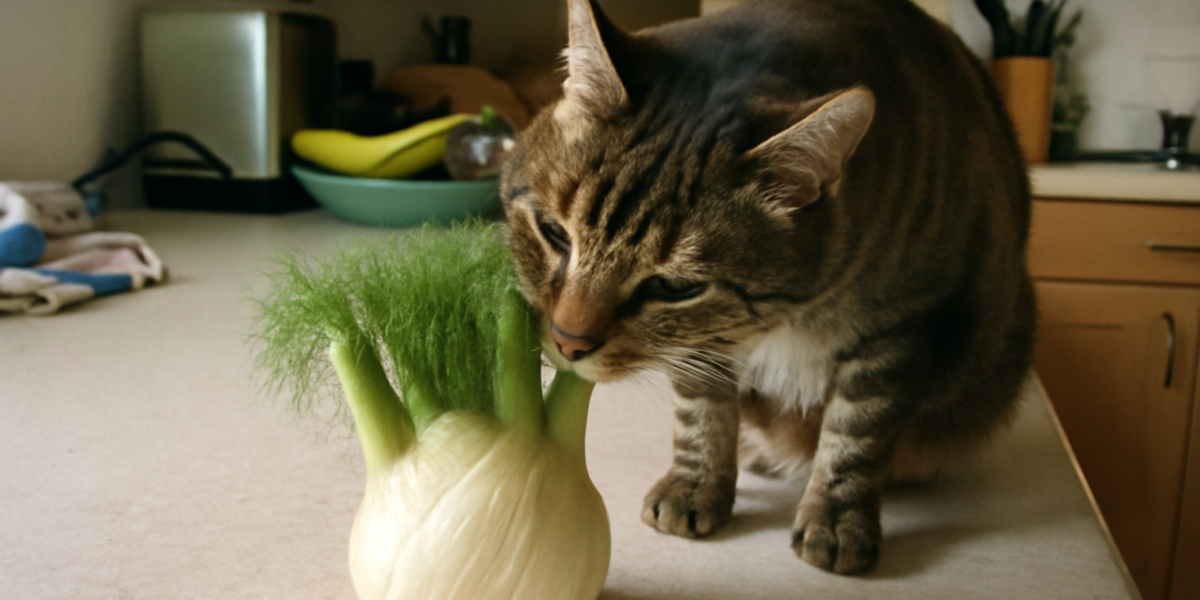
Cats lack the sweet taste receptor entirely, but they have a strong sense of smell, and the dominant aroma compound in fennel — anethole — registers as harsh and medicinal to many feline noses. The same molecule appears in star anise, licorice root, and tarragon, all foods cats typically reject. So when you offer your cat a tiny piece of cooked fennel bulb, the most likely reaction is a sniff, a dramatic head-back, and a confused look at you.
This is actually convenient. A cat who refuses fennel is one less risk to manage. If your cat is the unusual outlier who shows interest in the bulb or chews on a frond hanging out of a salad, you can let her have a tiny taste and observe. Some cats find the texture interesting even when the flavor is foreign. Either way, your cat is not losing anything nutritionally by skipping fennel.
Cooked Bulb: How to Offer a Tasting Portion
If your cat wants to try fennel, the safest version is plain cooked bulb. Slice off a thin wedge of fresh fennel bulb, simmer or steam it in plain water until soft, and let it cool fully. Chop a piece smaller than a pea and offer it on her plate or your finger. No salt, butter, oil, garlic, onion, or seasoning of any kind. The cooking softens the texture and mellows the licorice flavor, both of which make the experience easier on her stomach.
That pea-sized piece is the entire portion for a sampling moment, not a daily ingredient. Watch for any vomiting, diarrhea, drooling, or change in appetite over the next twenty-four hours. If she tolerates it and you want to repeat, no more often than once every couple of weeks, and never as a replacement for any portion of her balanced cat food. Fennel adds almost nothing nutritionally that her diet does not already provide.
Fronds in Food: A Tiny Aromatic Garnish
Fennel fronds are the gentlest form of fennel for a curious cat. Snip a few fronds with kitchen shears, mince them very fine, and stir a quarter teaspoon into her wet food once. If she eats it without complaint, you have a small, low-risk way to add a hint of greenery occasionally. If she picks around it or refuses the whole bowl, that is your answer.
Some cats like the chewing action of plant matter, the way they like nibbling cat grass. Fennel fronds are not a replacement for cat grass — they don’t fulfill the same enrichment role — but a tiny amount is unlikely to cause harm in most cats. As with any food experiment, keep portions small and infrequent.
Why Fennel Seed Is Not for Cats
Fennel seed is a concentrated source of anethole, fenchone, and other aromatic oils, all of which would be far below your cat’s radar in a fresh bulb but become potent in dried seed form. Whole seeds are also a small choking hazard, and ground seed releases its oils even more aggressively. Some traditional herbal recipes for “digestive water” or “windy stomach tea” call for steeping fennel seeds, but those preparations were designed for humans, often adults, and the dosing does not scale safely to a ten-pound cat.
Beyond concentration, fennel seed often appears in spice blends that contain other ingredients hostile to cats. Italian sausage seasoning typically combines fennel seed with garlic and onion powder. Indian panch phoron mixes fennel seed with cumin, fenugreek, mustard, and nigella. None of those mixes is appropriate for a cat. If your cat licks a single seed off the floor, you do not need to panic, but actively offering fennel seed is unwarranted.
Pregnant Cats: Skip Fennel Entirely
One specific caution: if your cat is pregnant, do not offer fennel in any form. Traditional herbal medicine has long warned that fennel can affect uterine tone, and some animal research in non-feline species suggests anethole and related compounds have hormonal activity. The studies in cats are essentially absent, and the prudent move during pregnancy is to avoid foods that have any plausible reproductive concern, especially when the food itself offers no nutritional value.
This caution is rooted in tradition more than rigorous trial data, but during a pregnancy, the burden of proof should run the other way: avoid unless clearly needed. Stick to a high-quality, complete-and-balanced diet recommended by your veterinarian, and save the curiosity foods for after the kittens are weaned.
Cats With Specific Health Conditions
Cats with sensitive stomachs, inflammatory bowel disease, or chronic vomiting and diarrhea should not get fennel. The volatile oils, even in fresh form, can trigger gut motility changes in a system that is already easily upset. Diabetic cats, on the other hand, can have a tiny taste of plain cooked fennel without significant glycemic impact — fennel bulb is low in carbohydrate — but it remains an unnecessary food in those cats’ diets.
Cats with confirmed plant allergies, particularly to plants in the Apiaceae family (which includes fennel along with carrot, parsley, dill, and celery), should avoid fennel by default. If your cat has reacted to celery or carrots in the past, fennel is in the same family and may trigger a similar reaction.
Fennel Compared to Other Cat-Curious Vegetables
Among the vegetables your cat might encounter on a kitchen counter, fennel sits closer to the “she probably won’t want it” end. Vegetables that are easier for the average cat to tolerate include tiny pieces of cooked cauliflower, plain steamed broccoli, or a sliver of cabbage. None of these have fennel’s strong licorice profile, and none carry the pregnancy caution.
If you are looking for something gently aromatic that your cat may actually engage with, a tiny chopped piece of cooked asparagus or a strand of bok choy (or its leafy tops) tends to work better than fennel for cats with even mild greens curiosity. Fennel remains an interesting kitchen-counter encounter, not a vegetable to push.
What to Do If Your Cat Eats Too Much Fennel
If your cat gets into more fennel than a tasting portion — say, a piece of bulb the size of her paw, or a handful of fronds, or a fennel-seed-heavy meatball — watch her closely. Most cats will at most experience mild stomach upset, vomiting, or soft stool for a day. Offer fresh water, hold off on extra treats, and let her normal food settle her system. If vomiting continues past twenty-four hours, if she stops eating, or if you see lethargy, drooling, or unsteadiness, call your veterinarian.
If she gets into raw fennel that was part of a seasoned dish (Italian sausage, fennel-and-onion gratin, fennel pesto), the seasonings are usually a bigger concern than the fennel itself. Garlic, onion, and salt cause more trouble for cats than fennel does. Bring the recipe or product label to your veterinary call so the team can guide your monitoring.
Frequently Asked Questions
Is fennel tea safe for cats?
Weak fennel tea has been used in traditional herbalism for digestive issues, but the dosing has not been validated for cats. A single teaspoon of cooled, very weak brewed fennel tea is unlikely to harm a healthy adult cat, but it is not a recommended remedy. If your cat has digestive symptoms, see your veterinarian instead of self-treating.
Can cats have fennel essential oil for fleas or anxiety?
No. Concentrated essential oils, including fennel oil, are not safe for cats topically, internally, or in diffuser form in poorly ventilated spaces. Cats lack key liver enzymes that metabolize many of the compounds in essential oils. Use veterinarian-prescribed flea and anxiety treatments only.
What if my cat ate a fennel sausage or salami?
The fennel itself is not the main worry — the sausage almost certainly contains garlic, onion powder, and high salt. Watch for vomiting, diarrhea, weakness, or pale gums and call your veterinarian if she ate more than a tiny taste.
Will fennel help my gassy cat?
Probably not in any reliable way. Persistent gas in cats often points to dietary intolerance, gut motility issues, or underlying disease. A veterinary workup is more useful than a folk remedy. If your cat is regularly bloated or passing gas, schedule a visit.
Can kittens eat fennel?
Skip fennel for kittens. Their developing digestive systems do best on a complete-and-balanced kitten diet. Save curiosity foods for adulthood, and only as occasional tastes.


